
For most Calgary-area buyers weighing a CIBC vs TD mortgage offer, the smarter move is rarely picking one bank over the other. It’s shopping both against the broader market through a licensed mortgage broker, who can typically negotiate a rate 0.10% to 0.30% better than what a branch first proposes. First-time buyers, self-employed applicants, and anyone approaching renewal stand to gain the most. Call Guriqbal Chahal, MBA, PMP, at Dreamhouse Mortgage for a free rate comparison before you sign anything.
TL;DR:
- Negotiated rates from banks often vary by only 0.10% to 0.30%, but a broker working with multiple lenders can secure more competitive terms.
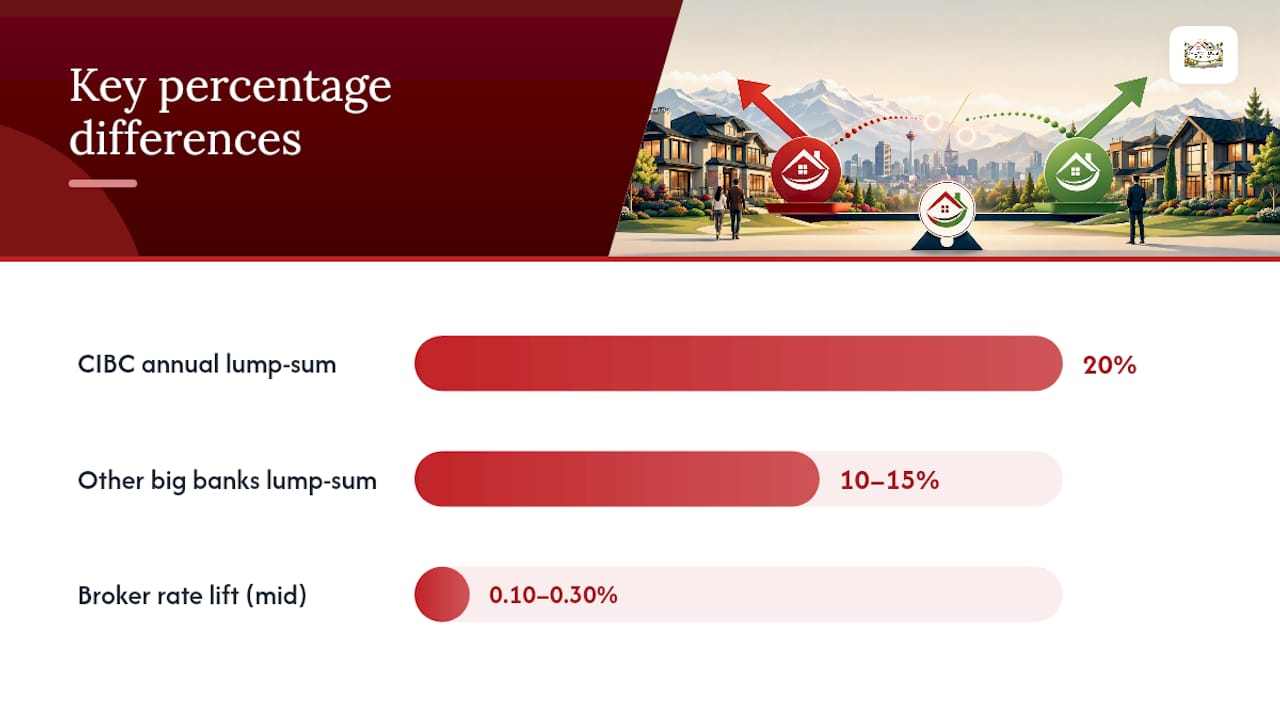
- Prepayment privileges differ significantly, with CIBC generally allowing up to 20% lump-sum payments annually, compared to 10-15% at many big banks.
- Flexibility features like portability, blend-and-extend, and product variety can impact costs and should be carefully compared before signing.
- Rate holds typically last 90 to 120 days, and early break penalties can reach thousands of dollars, especially on fixed-rate mortgages using interest-rate-differential calculations.
- Consulting a licensed broker who can access dozens of lenders may save thousands over the long term, especially for complex files or strategic renewals.
Table of Contents
- CIBC vs TD Mortgage: Key Differences At A Glance
- How Do You Compare Rates, Penalties, And Prepayment Rules?
- A Decision Checklist For Comparing Two Bank Offers
- Why A Licensed Alberta Broker Can Improve Your Outcome
- What Fees And Timelines Should You Expect At Closing And Renewal?
- How Much Interest Will You Actually Pay Over The Full Term?
- Does Customer Service Differ Between CIBC And TD?
- What Credit Score And Income Rules Apply To Each Bank?
- How Do CIBC And TD Compare On Mobile Banking For Mortgages?
- What Happens If You Break Your Mortgage Early?
- The Real Question Isn’t CIBC Or TD
- Call Dreamhouse Mortgage Before You Sign
- Sources
- FAQ
CIBC vs TD Mortgage: Key Differences At A Glance
When you put a CIBC offer and a TD offer side by side, the headline rate is only one variable. Calgary buyers who focus only on the number in bold print often miss the terms that end up costing (or saving) thousands over a five-year term.
Both banks post competitive advertised rates, but posted rates are rarely what anyone actually pays. A mortgage specialist at a branch has some room to negotiate, but that room is limited by the bank’s own discount authority. A broker working the same file across 30 to 50 or more lenders has a much wider net to fish from, and that gap is where the 0.10% to 0.30% lift usually comes from.
Prepayment privileges differ more than most buyers expect. CIBC’s variable-rate products often allow lump-sum prepayments up to 20% annually on some products, while comparable big-bank offers frequently sit in the 10% to 15% range depending on whether the mortgage is fixed or variable. If you plan to make extra payments toward principal, that difference changes how fast you actually build equity.
Convertibility and portability also vary by product line. TD, for example, offers combined term-and-revolving structures that pair a fixed-payment term portion with a HELOC-style revolving portion, useful if you’re planning renovations down the road. CIBC lists its own proprietary product bundles that may include cash-back options or bundled banking perks.
Here’s what actually moves the needle when you compare two big-bank quotes side by side:
- Negotiated rate vs posted rate. Ask each bank for their best discretionary rate in writing, not the number on their website.
- Prepayment allowance. Confirm the exact annual lump-sum percentage, whether payment increases are allowed, and if “double-up” payments are permitted.
- Portability and blend-and-extend terms. Find out if you can carry the mortgage to a new property without breaking the term, and at what cost.
- Product variety. Check whether the offer includes a HELOC wrapper, cash-back option, or only a standard closed term.
- Rate hold length. Verify how many days the quoted rate is guaranteed while you shop or close.
For first-time buyers with a straightforward income and a strong credit score, either bank’s standard closed mortgage can work fine. For investors, self-employed applicants, or anyone who expects to renovate or sell within the term, the fine print on portability and prepayment usually matters more than a fractional rate difference.
How Do You Compare Rates, Penalties, And Prepayment Rules?
Comparing two bank quotes properly means looking past the interest rate to the total cost of flexibility. A slightly higher rate with generous prepayment terms can beat a lower rate with rigid conditions, depending on your plans.
Here’s a practical sequence for evaluating any mortgage offer, whether it comes from CIBC, TD, or a broker’s shortlist:
- Get the negotiated rate in writing, along with the rate hold period. Most banks hold a quoted rate for 90 to 120 days, which matters if your closing date might shift.
- Ask for the exact prepayment privilege wording. A “15% annual lump-sum” privilege on a $500,000 mortgage means you can pay down $75,000 extra in a calendar year without penalty. That’s a meaningful difference from a 10% allowance, which caps you at $50,000.
- Request a sample amortization schedule showing what happens if you use the full prepayment privilege every year. This turns an abstract percentage into real numbers you can compare.
- Confirm the penalty formula for breaking the mortgage early. Most closed mortgages use either three months’ interest or an interest-rate-differential (IRD) calculation, whichever is higher, and IRD penalties on fixed-rate mortgages can run into the thousands.
- Check convertibility rules. A convertible mortgage lets you lock a variable rate into a fixed term without breaking the contract, which matters if rates start climbing mid-term.
The portability and blend-and-extend features built into most Canadian mortgages let you carry your existing rate and term to a new property, or blend your current rate with a new one if you need more money partway through your term. This can save a household thousands in penalty costs if a job transfer or growing family forces a move before the term is up.
Open vs closed mortgages create the starkest trade-off. An open mortgage allows unlimited prepayment but carries a noticeably higher rate, sometimes a full percentage point above a comparable closed term. It rarely makes sense unless you know with certainty that you’ll pay off the mortgage, sell, or refinance within months. For most Calgary buyers, a closed mortgage with strong prepayment privileges delivers the better balance of cost and flexibility.
Pro Tip: Before accepting any bank’s “best rate,” ask them directly: “Is this your maximum discretionary discount, or can you do better?” Branch staff often have more room than the first number suggests, and a written broker quote in hand gives you leverage to test that room.
A Decision Checklist For Comparing Two Bank Offers
Calgary buyers juggling two mortgage offers, one from CIBC and one from TD, or comparing either against a broker’s market shortlist, need a structured way to decide rather than picking on gut feeling. Run through this checklist before signing anything.
Total cost comparison
- Calculate the total interest paid over the full term at each bank’s negotiated rate, not the posted rate.
- Factor in any cash-back incentives or fee waivers, since these offset closing costs but sometimes carry a claw-back if you break the mortgage early.
Flexibility needs
- Decide whether you’re likely to make lump-sum payments, increase your regular payment, or need to port the mortgage to a new home within the term.
- Match those plans against each offer’s specific prepayment and portability language.
Timeline and rate holds
- Confirm how long each rate hold lasts and whether it covers your expected closing date, including any possession delays common with new builds in growing areas like Airdrie and Cochrane.
Lender policy fit
- Self-employed applicants and investors should ask directly how each lender verifies income and whether stated-income programs or rental income offsets are available.
Renewal strategy
- Ask what happens at renewal. Some lenders auto-renew at a posted rate that’s higher than what a re-shopped market rate would offer.
Once you’ve gathered written quotes from both banks, request exact wording on prepayment and penalty clauses, then get a comparison quote from a mortgage broker. If either bank’s terms feel rigid, if your income situation is complex, or if the renewal terms look unfavorable, that’s your signal to bring in a broker rather than negotiate solo.
Any of these should prompt a call to a broker before you commit.
Why A Licensed Alberta Broker Can Improve Your Outcome
Dreamhouse Mortgage is led by Guriqbal Chahal, MBA, PMP, Broker of Record, who works with banks, credit unions, monoline lenders, and alternative lenders across Alberta rather than a single institution’s product shelf. That access matters because a broker isn’t limited to what one bank is willing to offer on a given day.
A 0.25% rate improvement on a $500,000 mortgage can save roughly $7,500 to $22,500 over a five-year term, depending on amortization length and how the savings compound.
That single statistic explains why getting a broker quote before signing a bank offer is worth the phone call, even if you end up choosing the bank in the end.
Local experience matters too. Calgary’s mortgage market has its own rhythm: new-build closings in communities like Airdrie and Cochrane often involve builder-driven timelines that don’t match a standard resale closing, and lenders vary in how comfortable they are financing acreage or rural properties around Rocky View County. A broker who works these files regularly knows which lenders move fast on new-build possession dates and which ones handle self-employed income documentation with less friction.
For first-time buyers specifically, brokers commonly provide underwritten pre-approvals and direct guidance on CMHC-insured mortgage options, which can simplify a process that feels overwhelming on a single bank’s website. And because standard A-lender deals typically pay the broker’s commission through the lender, most Calgary buyers pay nothing extra for that wider search and negotiation.
What Fees And Timelines Should You Expect At Closing And Renewal?
Closing costs run fairly consistently across CIBC, TD, and most Canadian lenders, though the exact figures depend on your property and lender. Expect an appraisal fee if the lender requires one, legal fees for your real estate lawyer to review and register the mortgage, and a deposit hold on your rate that typically lasts 90 to 120 days from approval.
Timelines from application to funding usually run two to four weeks for a straightforward file with clean income documentation, though new-build purchases in Airdrie or Cochrane often stretch longer due to builder possession schedules. Self-employed applicants or those with multiple income sources should budget extra time for income verification.
Renewal behavior deserves particular attention. When your term matures, your current lender will typically send a renewal letter with a new rate, often close to the posted rate rather than a negotiated one. Roughly 65% of Canadians accept that renewal offer without shopping around, which usually means paying more than necessary. Re-shopping your renewal four to six months before maturity, ideally through a broker comparison, routinely uncovers better terms than an auto-renewal.
How Much Interest Will You Actually Pay Over The Full Term?
The rate you sign matters less in isolation than what it does to your total interest paid across a standard 25-year amortization. A quarter-point difference sounds small until you multiply it across a mortgage balance for two and a half decades.
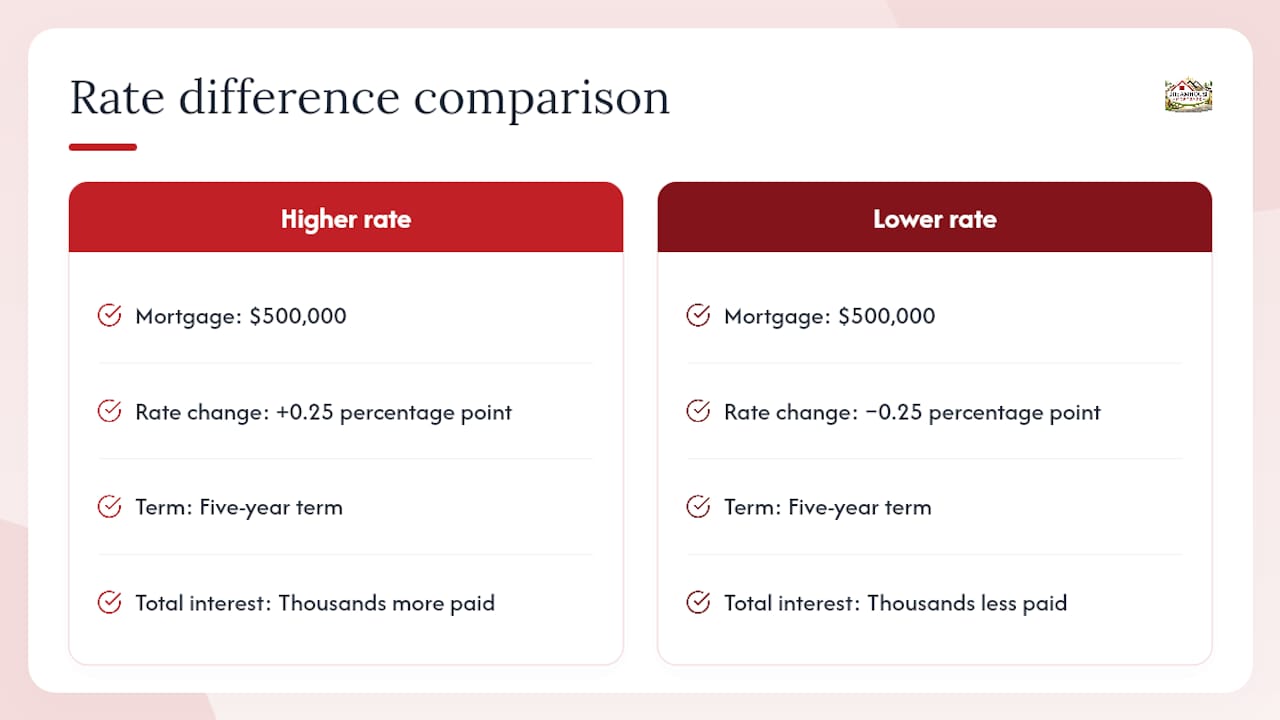
On a $500,000 mortgage, moving from a negotiated rate that’s 0.25% higher to one that’s 0.25% lower changes your total interest cost by thousands of dollars over a five-year term alone, before you even factor in what happens at renewal if the pattern repeats over multiple terms. Shorter amortization periods reduce total interest paid dramatically but raise your monthly payment, so the right choice depends on your cash flow as much as the posted rate.
Comparing CIBC and TD side by side on total cost means asking both banks for an amortization schedule at their best negotiated rate, not just the monthly payment figure. A lower monthly payment with a longer amortization can look attractive on a mortgage statement while costing far more in cumulative interest over the life of the loan. This is where a checklist for comparing home loan offers helps keep the comparison honest, since it forces you to look at total cost rather than the headline number.
Does Customer Service Differ Between CIBC And TD?
Both banks offer branch access, phone support, and dedicated mortgage specialists, and Calgary has no shortage of branch locations for either institution across the downtown core and surrounding communities. Service quality at the branch level tends to depend more on the individual specialist you’re assigned than on which bank’s name is on the door.
The bigger service distinction shows up in complexity handling. A straightforward, single-income, high-credit-score file tends to move smoothly through either bank’s standard process. Files with self-employment income, multiple properties, or newcomer status often need more back-and-forth, and a single bank’s specialist may have less flexibility to structure around those complications than a broker working across multiple lenders’ underwriting guidelines.
Response time during a competitive Calgary housing market matters too. When you’re up against multiple offers on a property in Chestermere or Okotoks, a lender who can turn around pre-approval documentation quickly gives you a real edge. This is one area where working through Dreamhouse Mortgage adds value, since coordinating document collection and lender selection through one point of contact tends to move faster than juggling two separate bank applications yourself.
What Credit Score And Income Rules Apply To Each Bank?
Both CIBC and TD generally look for a credit score in the mid-600s or higher for a conventional insured mortgage, though the exact threshold shifts based on your down payment size, debt load, and overall application strength. Buyers with scores below that range aren’t automatically excluded, but they may face a higher rate or need a larger down payment to qualify.
Income verification differs more by employment type than by bank. Salaried employees with T4 income typically move through underwriting the fastest at either institution. Self-employed applicants face more scrutiny industry-wide, since lenders want two years of tax returns, business financials, and sometimes a co-signer or larger down payment to offset the perceived risk. Newcomers to Canada without an established credit history here often need alternative documentation, like international credit references or larger down payments, and not every lender handles these files the same way.
This is precisely where lender variety matters. A broker who knows which lenders on their panel are more flexible with self-employed or newcomer files can steer your application toward a better fit rather than forcing a single bank’s rigid criteria to work for a situation it wasn’t really built for.
How Do CIBC And TD Compare On Mobile Banking For Mortgages?
Both banks offer mobile apps that let you view mortgage balances, track payment schedules, and in some cases make lump-sum prepayments directly through the app. These tools have improved significantly and make day-to-day mortgage management fairly convenient regardless of which bank holds your mortgage.
Where the apps matter less is at the decision-making stage. Neither bank’s app will tell you whether a competitor’s rate would save you money, nor will it flag whether your prepayment privilege usage is optimized against your actual financial goals. Mobile banking is a maintenance tool once your mortgage is in place, not a comparison tool for choosing the mortgage in the first place. Treat convenience features as a tiebreaker after you’ve already settled the rate, terms, and structure that actually determine your total cost.
What Happens If You Break Your Mortgage Early?
Breaking a closed mortgage before the term ends triggers a penalty at either bank, and the calculation method matters more than most buyers realize when they sign. Variable-rate mortgages typically charge three months’ interest as the penalty, a relatively predictable and modest cost.
Fixed-rate mortgages use an interest-rate-differential (IRD) calculation, comparing your contract rate against the current rate for a term matching your remaining time left, and charging you the difference. This can run into the thousands of dollars, particularly if rates have dropped since you signed, since the bank is compensating for the lost interest income. Always ask each lender for their exact penalty formula and, if possible, a sample calculation based on your specific mortgage balance and remaining term. The same caution applies whether you’re financing a primary residence or an investment property, where early break penalties can complicate a resale or refinance strategy.
The Real Question Isn’t CIBC Or TD
Most articles comparing CIBC and TD mortgages treat it like picking a sports team, when the more useful question is whether either single-bank offer beats what the broader market can deliver. The research bears this out: a broker’s access to 30 or more lenders and a documented 0.10% to 0.30% rate advantage isn’t a marginal benefit. It’s the difference between thousands saved or left on the table over a five-year term.
Conventional advice tends to stop at “compare rates,” which misses that prepayment flexibility, portability, and renewal behavior often matter more than a rate that differs by a few basis points. If you take one thing from this comparison, prioritize getting a written broker quote before you sign either bank’s offer. Not because either bank is a poor choice. Because you can’t know if it’s a good deal until you’ve seen what else is available.
— Guriqbal Chahal, MBA, PMP
Call Dreamhouse Mortgage Before You Sign
Dreamhouse Mortgage gives Calgary buyers something neither CIBC nor TD can offer on their own: a side-by-side market comparison across dozens of lenders before you commit to a single institution’s rate. Whether you’re a first-time buyer trying to make sense of a pre-approval, a self-employed applicant worried about income verification, or a homeowner staring down a renewal letter, Guriqbal Chahal and the Dreamhouse Mortgage team can pull a market quote and show you exactly where you stand.

A consultation typically takes 20 to 30 minutes and works best when you come prepared with your last two years of income documentation (or business financials if self-employed), a recent credit report, and any rate offers you’ve already received from a bank. From there, Dreamhouse Mortgage can usually turn around a comparative rate quote within a day or two, and a full pre-approval within about a week for straightforward files.
Whether you’re buying your first home in Airdrie, refinancing in Cochrane, or approaching renewal anywhere in Calgary, rate negotiation support from a licensed broker costs you nothing extra on a standard deal and can save thousands over your term. Call Guriqbal Chahal, MBA, PMP, Mortgage Broker, at 403-966-6072, or find Dreamhouse Mortgage on Google Business Profile to book your free consultation today.
Sources
The comparisons in this article draw on Canadian-specific mortgage industry analysis, including broker-versus-bank breakdowns and current CIBC and TD product overviews:
- Banks vs Mortgage Brokers Canada (2026) — Which Is Better?
- Mortgage Broker vs. Bank: Which Is Best? – NerdWallet Canada
- CIBC mortgage rates: See today’s rates, features and how they compare
Bank product terms, prepayment allowances, and rate holds change regularly. Always verify current terms directly with the lender or with your mortgage broker before signing.
This article is general information, not a substitute for advice from a qualified financial advisor. Consult a qualified financial professional about your own circumstances before acting on anything here.
FAQ
Which bank is better, TD or CIBC, for a mortgage?
Neither bank is universally better. TD and CIBC each offer competitive products with different prepayment allowances and proprietary features, so the right choice depends on your specific plans for paydown, portability, and renewal, not a blanket ranking.
Which Canadian bank is best for mortgages?
There’s no single best bank for every buyer, since eligibility, income type, and flexibility needs vary. A licensed mortgage broker can compare offers from CIBC, TD, and dozens of other Canadian lenders at once to find the best fit for your situation.
Is CIBC a good bank for mortgages?
CIBC offers competitive mortgage products, including variable-rate options with prepayment allowances up to 20% on some products, making it a solid option for buyers who value flexible paydown terms.
Who is offering the best mortgage rate in Canada?
The best rate depends on your credit profile, down payment, and property type, and it changes regularly across lenders. A mortgage broker shopping 30 to 50 or more lenders at once is typically the fastest way to find the strongest available rate for your specific file.
Do mortgage brokers cost more than going directly to a bank?
On a standard A-lender deal, most Canadian borrowers pay no broker fee, since the lender pays the broker’s commission directly. That means comparing offers through a broker typically costs nothing extra out of pocket.
Recommended
- Mortgage Broker vs. Bank Calgary Alberta: The Shocking Truth Nobody Tells You
- How Much Mortgage Can I Qualify For in Calgary? (Shocking 2026 Truth Revealed)
- Bank of Canada Rate Calgary Mortgage: How the Bank of Canada Rate Affects Your Calgary Mortgage | Critical Insights for Homebuyers
- Calgary Mortgage Calculators 2026: Avoid Costly Payment Mistakes & Estimate Your Monthly Mortgage Accurately