
You’ve done the responsible thing. You’ve been saving. You’ve cut back on spending, watched listings in Calgary, Airdrie, Chestermere, Cochrane, Red Deer, and Okotoks, and maybe even got yourself mentally ready for the mortgage payment. Then a major hurdle shows up. It isn’t always the monthly payment. It’s the cash you need before you even get the keys.
That’s where a lot of buyers get stuck. They’re mortgage-capable, but cash-short at the exact moment it matters most.
Down payment assistance programs can help, but they’re often misunderstood. A lot of people hear “assistance” and assume free money, no strings, no impact later. That’s not how most programs work in practice. The smarter way to think about them is as a financing tool that helps bridge a gap, provided the rest of your mortgage file still makes sense.
This guide looks at down payment assistance programs through an Alberta lens. If you’re buying in Calgary or the surrounding communities, the mechanics matter just as much as the idea.
Table of Contents
- The Down Payment Challenge in Alberta Today
- What Exactly Is Down Payment Assistance
- Comparing the Types of Assistance Programs
- Down Payment Assistance Options in Alberta
- Your Step-by-Step Application Guide
- Alternatives and Holistic Mortgage Planning
- Frequently Asked Questions
- Can I use down payment assistance if I’m not a first-time buyer
- Is down payment assistance usually a grant
- Will assistance affect my ability to refinance later
- Does my credit score matter
- Can assistance help with closing costs too
- Is this only relevant in Calgary
- What’s the biggest mistake buyers make
- How do I know whether assistance is actually right for me
The Down Payment Challenge in Alberta Today
A common Alberta buyer profile looks like this. You’ve got solid income, stable work, and enough discipline to save regularly. But every time you get closer, the target seems to move. A condo in Calgary feels possible until you add closing costs. A starter home in Airdrie or Chestermere looks manageable until you realise how much cash has to be in your account before possession day.

That stress is real, and it catches more buyers than is generally recognized. Especially first-time buyers. Especially newcomers. Especially buyers who can handle a monthly payment but don’t have a large pool of liquid cash.
In Alberta, that usually shows up in practical questions, not abstract ones. Can I buy sooner instead of waiting another year? Can I keep some cash back for moving costs, repairs, or an emergency fund? Can I still qualify if part of my down payment comes from a structured source instead of pure savings?
Practical rule: A down payment problem isn’t always an affordability problem. Often, it’s a timing and cash-flow problem.
That’s where down payment assistance programs enter the conversation. Not as magic. Not as a shortcut around lending rules. As a tool to help buyers bridge the upfront gap and get into a home with a structure they can carry.
For buyers trying to understand the baseline cash requirement first, it helps to review minimum down payment rules in Calgary before looking at assistance options. Once you know the minimum requirement, you can judge whether assistance fills a small shortfall or whether the purchase needs to be reworked altogether.
Why buyers feel squeezed
Some buyers in Cochrane or Okotoks are surprised by how many costs pile up before closing:
- The down payment itself: This is the obvious one, but it’s only part of the cash requirement.
- Closing costs: Legal fees, adjustments, and other purchase expenses still have to be planned for.
- Post-possession cash: Moving, utility set-up, and immediate repairs don’t wait.
- Lender expectations: Even with assistance, the overall mortgage file still has to meet policy.
What Exactly Is Down Payment Assistance
Think of down payment assistance as a financial co-pilot. It helps with the hardest stretch of the journey, which is getting enough money together to complete the purchase. It does not fly the whole plane for you. You still need income, credit, acceptable ratios, and a mortgage product that fits the property and your profile.
That distinction matters because buyers often confuse assistance with approval. They’re not the same thing. A person can qualify for the idea of assistance but still not qualify for the first mortgage that has to sit underneath it.
What down payment assistance is
Down payment assistance helps with upfront home-buying costs. Depending on the program, it may be used toward the down payment, closing costs, or both. National program guidance also notes that these programs often come with credit score and debt service requirements, and the design can vary widely between jurisdictions and providers, as explained in Rocket Mortgage’s overview of down payment assistance.
In practice, many programs are not simple grants. They may be a deferred loan, a forgivable loan, a second mortgage, or another structured form of support. That’s why the words on the brochure don’t tell the whole story.
What down payment assistance is not
It’s not a replacement for mortgage qualification.
It’s not automatic.
And it’s not always “free money”.
If a program helps you buy today, ask what happens when you sell, refinance, or renew. That’s where the real cost often shows up.
The question that matters most
Most buyers start with, “Do I qualify for assistance?”
A better question is, “How does this assistance fit into my mortgage structure?”
That changes everything. It forces you to look at:
- Repayment timing: Is it due monthly, later, or only on a trigger event?
- Lien position: Does the assistance sit behind the main mortgage?
- Product pairing: Can it be used with the mortgage type you qualify for?
- Exit flexibility: Will it complicate a refinance or future move?
That’s the practical lens. Assistance can be helpful. But only when it fits the full financing plan.
Comparing the Types of Assistance Programs
A Calgary buyer can look at two offers that both cover a down payment gap and assume they solve the same problem. They do not. One may disappear after a few years if you stay in the home. The other may sit on title as a second charge and come due when you sell or refinance.
Why structure matters more than the headline
In practice, the label matters less than the repayment terms, the timing, and how the assistance fits with your first mortgage. That is especially true in Alberta, where buyers in Calgary, Airdrie, Cochrane, and nearby communities are often piecing together a purchase in a market that feels more affordable than Toronto or Vancouver, but still stretches monthly budgets and cash-to-close.
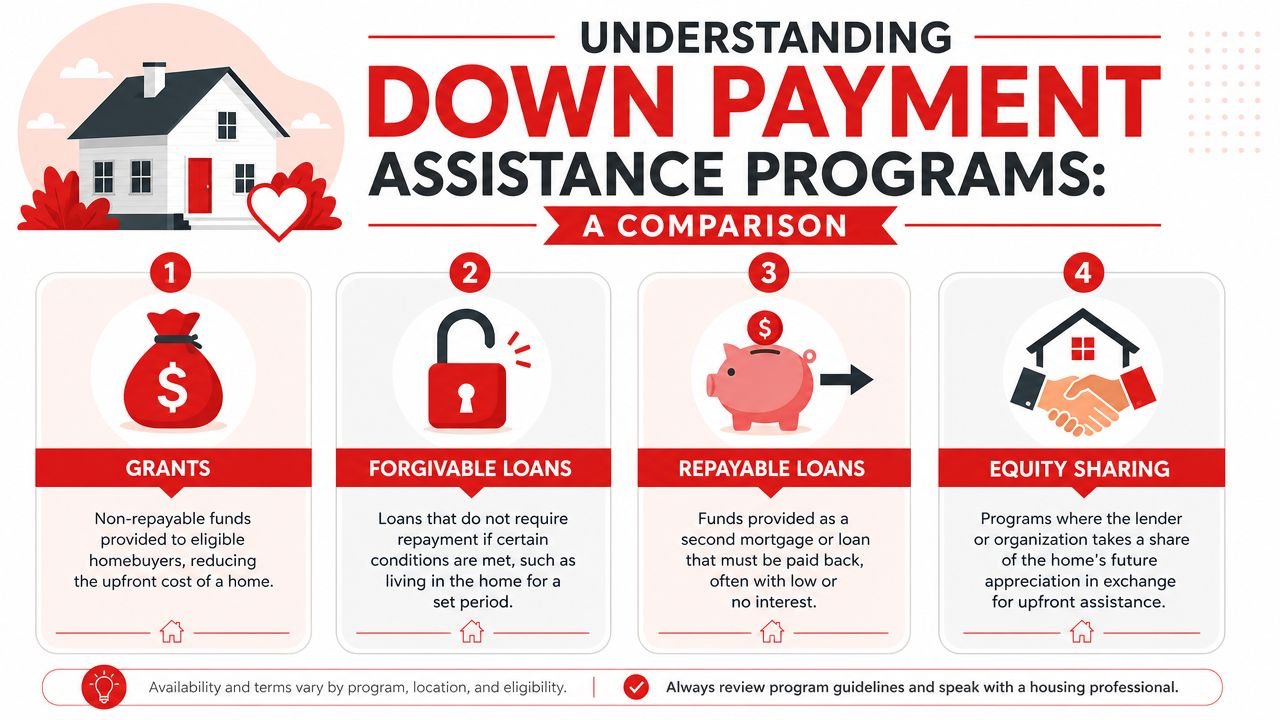
The main program types fall into four buckets: grants, forgivable loans, repayable second mortgages, and equity-sharing arrangements.
Grants are the simplest to use and the easiest to explain. If the terms say repayment is not required, the money reduces your upfront cash need without creating a later payoff event. The catch is availability. True grant programs are usually limited by income, location, funding windows, or buyer profile.
Forgivable loans start as debt but can be forgiven over time if you meet the rules. Usually that means living in the home for a set number of years and staying in good standing. This structure can work well for a buyer purchasing a starter home in Airdrie and planning to stay put for several years. It works poorly for someone who may relocate for work in two years.
Repayable second mortgages are the version that catches buyers off guard most often. They solve the immediate cash problem, but they also add another layer to the financing stack. In a Calgary file, that can matter if you want to refinance later, switch lenders at maturity, or pull equity for renovations once you have some appreciation.
Equity sharing changes the conversation again. Instead of straightforward repayment, the provider may claim part of the future value increase. That can help a buyer get into the market sooner, but it also means you may give up part of the upside if home values rise.
Down Payment Assistance Types at a Glance
| Assistance Type | How It Works | Repayment Requirement | Best For |
|---|---|---|---|
| Grant | Funds are provided to help with upfront costs | Usually no repayment if programme terms are met | Buyers who qualify for limited grant-based programmes |
| Forgivable loan | Starts as a loan and may be forgiven over time or after conditions are met | Repayment may be waived if occupancy and programme conditions are satisfied | Buyers planning to remain in the home for years |
| Repayable second mortgage | Assistance is added as a junior loan behind the first mortgage | Usually repaid on sale, refinance, maturity, or another trigger event | Buyers who need gap financing now and understand the later obligation |
| Equity sharing | Provider contributes funds in exchange for a future economic interest | Repayment can include a share of future value growth depending on terms | Buyers comfortable trading some upside for upfront help |
A simple filter helps here. Choose the type that still works if life changes.
Ask these questions before you commit:
- Will this need to be repaid if I sell earlier than planned?
- Does it sit behind my main mortgage on title?
- Could it limit my ability to refinance or switch lenders later?
- If I buy in Cochrane today and move to Calgary in three to five years, what does that exit look like?
- Does my mortgage insurer and lender allow this structure?
That last point matters more than many buyers expect. If you are buying with less than 20% down, read up on how CMHC insurance in Alberta works before combining any assistance product with your main mortgage. On tighter files, a small structuring issue can turn an approval into a decline.
The primary trade-off
Assistance can get you through the front door sooner. It can also reduce flexibility later.
A buyer stretching to purchase a condo in Calgary may be fine with that trade if the plan is to hold the property for a long time. A buyer who expects a job transfer, a growing family, or a quick move from condo to detached home needs to be more careful. The wrong structure can turn a short-term affordability fix into an expensive obstacle at renewal, refinance, or sale.
Good assistance helps the full mortgage plan hold together. Bad assistance only solves possession day.
Down Payment Assistance Options in Alberta
A Calgary buyer will often call after a weekend of Googling, convinced there must be a provincial grant they missed. By Monday, they are frustrated. They have found American articles, outdated forum threads, and a few half-explained programs that do not line up with how Alberta mortgages are underwritten.
That confusion is common because Alberta does not have one well-known, broad down payment assistance program that fits everyday buyers across Calgary, Airdrie, Cochrane, Chestermere, Okotoks, and nearby communities. The actual options are more practical than promotional. They depend on where the funds come from, how the lender views that source, and whether the rest of the file is strong enough to carry the purchase.
What Alberta buyers usually end up using
In this market, down payment help usually comes from a small set of workable sources rather than a single public grant.
Family gifts
This is often the cleanest option if parents or relatives can help. It still needs proper paperwork, a gift letter, and a paper trail showing the money has been transferred.Savings plus registered-plan withdrawals
Buyers who have some money saved but not enough in chequing often use RRSP funds where the rules allow, along with their own cash on hand.Approved borrowed funds
Some lenders will consider borrowed down payment structures. Some will not. The rate, debt ratios, and monthly payment tolerance all matter more once debt is part of the plan.Lender and insurer product matching
A workable file in Alberta often comes down to placing the deal with a lender whose policy fits the down payment source, property type, and borrower profile.
That last point trips people up.
A buyer in Airdrie with solid income and a gifted down payment may have several lender options. A self-employed buyer in Cochrane using a mix of savings and borrowed funds may have far fewer. On paper, both buyers have "down payment assistance." In practice, one file is straightforward and the other needs careful structuring before an offer goes in.
How this plays out in Calgary-area purchases
In Alberta, the question is usually not, “What program can I apply for?” The better question is, “What down payment setup will a lender accept for this purchase?”
That answer changes with the file. A condo in Calgary can bring different underwriting concerns than a detached home in Okotoks. A buyer with recent commission income is assessed differently than someone on salary. A purchase with less than 20% down also has to fit insurer rules, not just lender preference.
Here is what I tell first-time buyers. Start with the purchase plan, not the program search. Confirm your price range, monthly comfort, and source of funds first. Then check whether that source works with the lenders available for your credit, income, and property.
The Alberta reality
Broad internet advice often assumes a U.S.-style system with city agencies, state programs, and large public grant directories. Alberta usually works differently. Buyers here are more often piecing together an acceptable down payment from savings, gifts, registered funds, or an approved borrowing structure, then matching that setup to a lender that will sign off on it.
That can feel less exciting than finding a headline grant. It is also more useful.
A down payment plan that works cleanly with lender policy is what gets a Calgary-area deal from pre-approval to possession without last-minute surprises.
Your Step-by-Step Application Guide
The buyers who move through this process smoothly aren't always the ones with the biggest savings. They're the ones who get organised early and understand how the assistance fits the mortgage file.
Start with the full mortgage picture
Step one is not filling out a random programme form you found online. Step one is figuring out whether the purchase works at all, and under what structure.
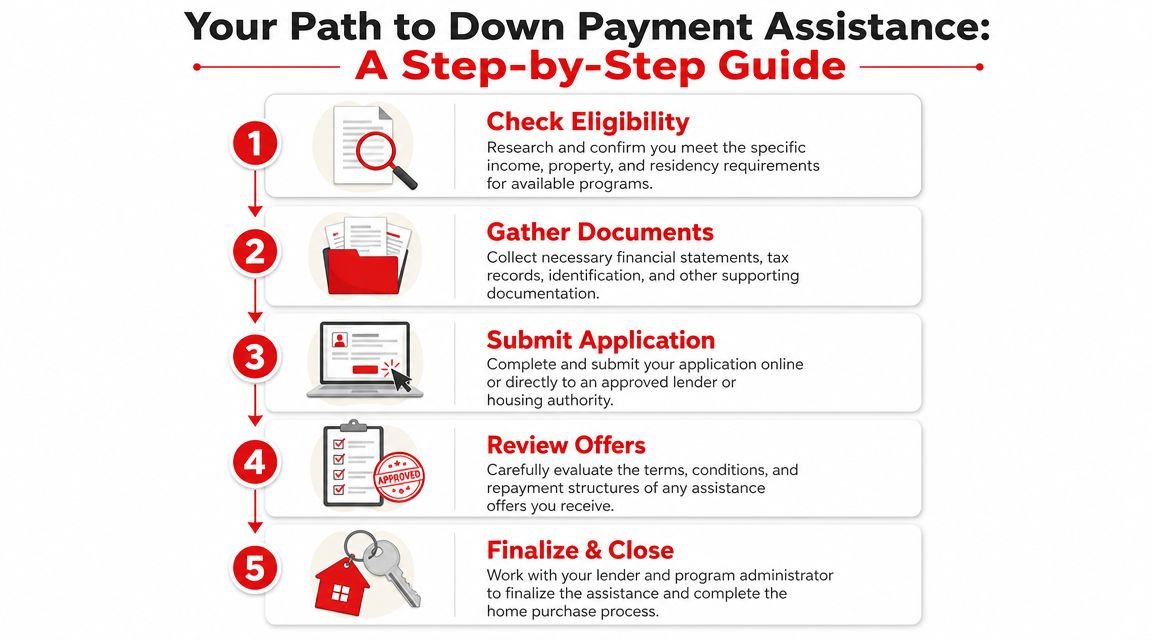
A practical workflow looks like this:
Confirm your buying range
Before discussing assistance, get realistic on purchase price, monthly comfort, and cash available. Don't shop at the top of what a lender may approve if your cash position is already tight.Identify acceptable down payment sources
Savings, gifts, registered funds, or approved borrowed sources each come with their own documentation trail. The source matters as much as the amount.Match the source to the lender
Some structures look fine to a buyer but don't fit a lender's policy. Consequently, deals can fall apart late if the planning was sloppy.Review the assistance terms in plain language
If repayment is deferred, ask exactly when it becomes due. If it's forgivable, ask what conditions could cancel that forgiveness. If it's secured, ask what happens on title.
Documents and timing make or break the process
Most delays happen because buyers underestimate paperwork. Assistance is rarely separate from the mortgage process. It usually runs alongside it.
Be ready to provide:
- Income proof: Pay stubs, employment letters, or alternative income documents if you're self-employed.
- Bank statements: These help verify the source and history of funds.
- Identification: Standard lender and legal requirements still apply.
- Gift letters or supporting declarations: If family funds are involved, documentation has to be clear and consistent.
- Explanations for credit issues: If your file has bruises, address them early rather than hoping no one notices.
A 2024 National Mortgage Professional report stated that the average DPA benefit across homebuyer assistance programmes was roughly $17,000, and that the number of national homebuyer assistance programmes had reached 2,444, up by 29 programs in the quarter reported. The same report also noted Urban Institute analysis showing 39.5% of DPA borrowers nationally received assistance, and it referenced Philadelphia Fed research finding no “statistical and substantive difference” in mortgage performance between borrowers who used DPA and those who did not, as covered in the National Mortgage Professional report on DPA programme count and usage.
That's useful context. But in an Alberta transaction, the file still succeeds or fails on execution.
Buyers should treat assistance paperwork with the same seriousness as the mortgage application itself. If one side is incomplete, the whole transaction can stall.
Common mistakes I'd tell any buyer to avoid:
- Applying too late: Assistance questions should come up before you write an offer, not after conditions are tight.
- Misreading “deferred”: Deferred doesn't mean erased.
- Moving money around casually: Large unexplained deposits create underwriting issues.
- Ignoring future plans: If you may refinance or move soon, ask how the assistance affects that exit.
Alternatives and Holistic Mortgage Planning
Some buyers need down payment assistance programs. Others don't need a formal programme at all. They need a better mix of tools.

The strongest plans usually combine tools
A good home-buying plan in Alberta often blends more than one source of funds. That might include personal savings, a family gift, and a registered-plan strategy. It might mean buying a slightly different property type to preserve emergency reserves instead of draining every account just to close.
For many buyers, the federal tools matter as much as any assistance conversation. If you're comparing ways to use your registered savings, this guide on FHSA vs Home Buyers' Plan in Calgary is worth reviewing before you decide where the down payment should come from.
Think beyond approval
Approval is not the finish line. Sustainable ownership is.
That means your down payment strategy should leave room for real life:
- Home repairs: Even well-kept homes come with surprises.
- Job changes: A move or income shift can happen faster than expected.
- Rate changes at renewal: Your payment today isn't the only payment that matters.
- Refinance flexibility: Some assistance structures are easier to unwind than others.
GSFA notes that many of its programmes do not require first-time-buyer status, and it also notes that perfect credit is not required, according to the GSFA overview of assistance programme flexibility. Again, that's not an Alberta programme, but the insight is useful. Buyers often focus too narrowly on “first-time buyer” labels when the better question is whether the first mortgage, property type, credit profile, and down payment source all work together.
The best down payment plan is the one that helps you buy without leaving you fragile the month after you move in.
Frequently Asked Questions
Can I use down payment assistance if I'm not a first-time buyer
Sometimes, yes. Some assistance models are limited to first-time buyers, but not all are. The key issue isn't the label. It's whether the lender or programme provider allows your borrower profile, property type, and mortgage structure.
Is down payment assistance usually a grant
Not usually. Many buyers assume it's free money, but a lot of assistance is structured as a second mortgage or deferred-payment loan. That means it may reduce your cash needed at closing while still creating a repayment obligation later.
Will assistance affect my ability to refinance later
It can. If the assistance is secured as a junior loan or subordinate lien, a refinance may trigger repayment or require the second-position lender's involvement. Ask this before you commit, especially if you expect to refinance to consolidate debt, remove a borrower, or access equity later.
Does my credit score matter
Yes. Even when a programme is flexible, the main mortgage still has to be approved. Weak credit doesn't always shut the door, but it changes which lenders and products are realistic.
Can assistance help with closing costs too
In some cases, yes. Some programmes or lender structures can be used toward both the down payment and closing costs. But you have to verify the exact permitted use of funds. Don't assume all upfront costs are covered.
Is this only relevant in Calgary
No. Buyers in Airdrie, Cochrane, Chestermere, Red Deer, and Okotoks run into the same core issue. They can often handle the mortgage payment, but the upfront cash requirement slows them down. The local housing market changes the numbers on the purchase, but the financing logic is similar.
What's the biggest mistake buyers make
They focus only on getting into the home and not on what happens after. If the assistance creates a future repayment event, affects title, or limits refinancing flexibility, that needs to be understood before the offer goes in.
How do I know whether assistance is actually right for me
Run the full scenario. Compare buying now with assistance against waiting and saving longer. Look at monthly affordability, cash reserves, future plans, and how stable your job and income are. The best answer isn't always the fastest path into the market.
If you're buying in Calgary, Cochrane, Red Deer, Chestermere, Airdrie, or Okotoks and want help sorting through your down payment options, speak with DreamHouse Mortgage. A proper review can help you understand what's workable, what's risky, and how to structure a mortgage plan that fits your real budget.
Contact Guriqbal Chahal, MBA, PMP
Mortgage Broker | Dreamhouse Mortgage
📞 403-966-6072
Written with the Outrank app