
Mortgage Broker Fiduciary Duty Explained
A mortgage broker fiduciary duty is the legal and ethical obligation to put your financial interests first when helping you secure a mortgage. This standard goes beyond simply finding you a loan. It requires your broker to disclose commissions, manage conflicts of interest, and document why a specific product suits your situation. For first-time homebuyers in Calgary, Airdrie, Cochrane, and Edmonton, understanding this duty is the clearest way to protect yourself in one of the largest financial decisions of your life. This article breaks down mortgage broker fiduciary duty explained in plain terms, covering what it means under Canadian mortgage law, how it applies in Alberta, and exactly how you can verify your broker is following it.
What fiduciary duties do mortgage brokers owe to borrowers in Alberta?
A mortgage broker fiduciary duty is defined by four core obligations: loyalty, disclosure, care, and conflict management. Each one shapes how your broker must behave from the first consultation through to funding.

Duty of loyalty
The duty of loyalty requires your broker to prioritize your interests above their own financial incentives and above any lender’s preferences. This means a broker cannot steer you toward a product simply because it pays a higher commission. If two mortgage products are equally suitable for your situation, the broker must recommend the one that costs you less or carries fewer restrictions, not the one that earns them more.
Duty of disclosure
Disclosure of commissions and conflicts of interest is not optional. Your broker must tell you which lenders they work with, how much they earn from each referral, and whether any relationship with a lender could influence their advice. Disclosure alone does not resolve a conflict. The broker must also document how they handled it and demonstrate that your interests came first.
Duty of care
Modern fiduciary standards require brokers to conduct a thorough needs analysis covering your income, risk tolerance, and long-term financial goals. A quick approval is not enough. Your broker must assess whether the loan is sustainable over its full term, not just whether you qualify today. This is especially relevant for self-employed borrowers in Calgary and newcomers to Canada whose income structures require more careful review.
Duty to manage conflicts of interest
The following situations represent common conflicts a broker must actively manage:
- Receiving higher commissions from one lender than another for the same loan type
- Having a referral arrangement with a real estate agent who also benefits from a fast close
- Recommending a product from a lender with whom the broker has a volume-based incentive agreement
- Failing to present alternative lenders who may offer better terms for your specific profile
Each of these situations requires the broker to document their reasoning and show that the recommendation served your interests, not theirs.
Consequences of a duty breach
A breach of fiduciary duty in Alberta can result in regulatory complaints to the Real Estate Council of Alberta (RECA), civil liability, and loss of the broker’s license. Borrowers who discover an undisclosed commission or a recommendation made against their interests have grounds to file a formal complaint. Understanding these protections gives you real leverage when choosing and working with a broker.
How does the Best Interests Duty apply to mortgage brokers in Alberta?
The Best Interests Duty (BID) is the formal regulatory framework that codifies fiduciary obligations for mortgage brokers. It transforms the general concept of acting in a client’s best interests into a specific, documented, and enforceable standard.
Conduct a client-specific needs assessment. Your broker must gather detailed information about your income, debts, credit profile, down payment, and long-term goals before recommending any product. A generic rate quote does not satisfy this requirement.
Compare multiple lenders and products. The Best Interests Duty framework requires brokers to consider a genuine range of options. In Alberta, this means reviewing products from banks, credit unions, monoline lenders, and alternative lenders where relevant to your situation.
Document the reasoning behind every recommendation. Regulators prioritize demonstrable, client-specific justification over subjective belief or outcomes alone. Your broker must be able to show, in writing, why the recommended product suits your circumstances better than the alternatives reviewed.
Disclose all commissions and conflicts in writing. A Credit Proposal Disclosure or equivalent document must detail the recommended loan, all commissions received, and product comparisons with explanations. This document is your record of the broker’s compliance.
Apply the conflict priority rule. When a conflict exists between your interests and the broker’s financial benefit, your interests must win. This rule is central to BID and is not satisfied by disclosure alone.
Regulatory oversight in Alberta
In Alberta, mortgage brokers are licensed and regulated by RECA under the Real Estate Act. RECA sets conduct standards that align with the BID framework, requiring brokers to act honestly, with integrity, and in the best interests of their clients. The federal Office of the Superintendent of Financial Institutions (OSFI) also sets guidelines that affect how federally regulated lenders interact with brokers, which indirectly shapes the advice borrowers receive.
Documentation is the proof
The key misconception borrowers hold is equating a broker’s good intentions with compliance. Compliance depends on what brokers can demonstrate with evidence and client-specific documentation, not on what they believe they did. If your broker cannot produce a written rationale for their recommendation, that is a compliance gap, not just a communication issue.
Pro Tip: Ask your broker to provide a written summary of the lenders and products they reviewed before making their recommendation. A broker who fulfills their fiduciary obligations will have this documentation ready without hesitation.
Fiduciary duty vs. standard mortgage broker responsibilities
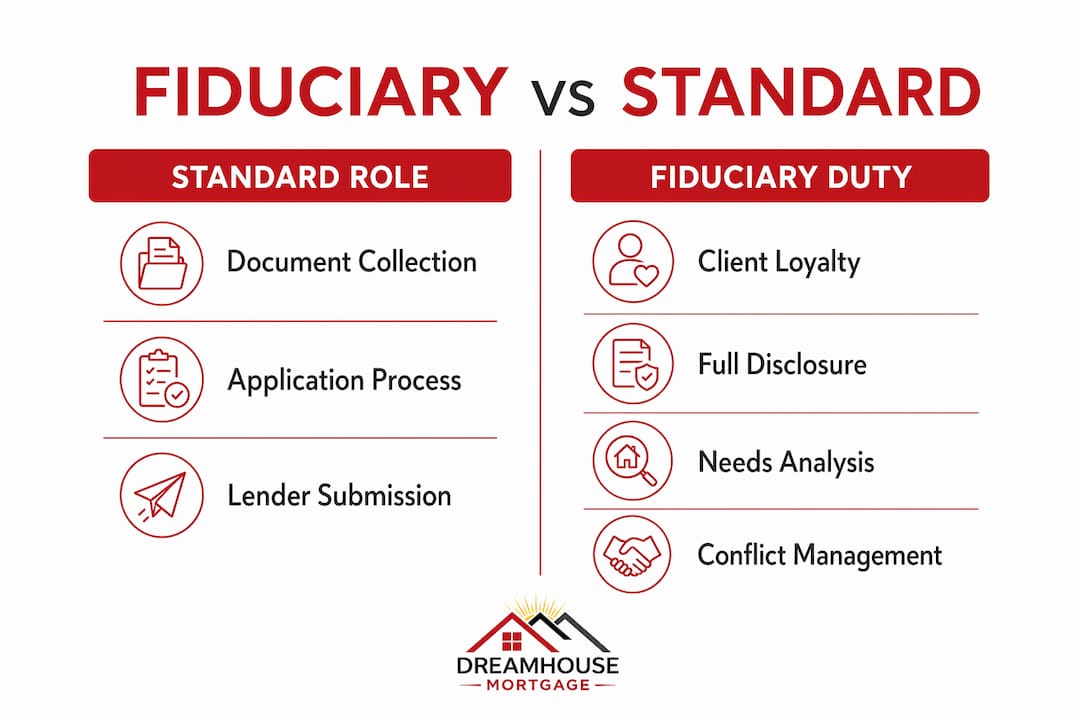
Not every broker action carries fiduciary weight. Understanding the difference helps you identify when a broker is simply doing their job and when they are going above and beyond to protect your interests.
| Responsibility | Standard broker role | Fiduciary obligation |
|---|---|---|
| Collecting your financial documents | Required for all mortgage applications | No additional duty; administrative task |
| Submitting your application to a lender | Standard service for all clients | Must submit to lenders most likely to approve on best terms for you |
| Presenting a mortgage rate | Providing a competitive rate from available lenders | Must demonstrate rate reflects your best available option across lenders reviewed |
| Disclosing commissions | May vary by brokerage practice | Mandatory; must be in writing with amounts and lender names |
| Recommending a specific product | Based on lender relationships and availability | Must be documented with client-specific reasoning and conflict management |
| Managing a conflict of interest | Not always addressed proactively | Must be disclosed, documented, and resolved in your favor |
The table shows a clear pattern. Standard broker responsibilities focus on process. Fiduciary obligations focus on outcomes and transparency. A broker can complete every administrative task correctly and still fail their fiduciary duty if they never disclose a commission or document why they chose one lender over another.
Fiduciary duties are not implied simply because a broker influences your decisions. They are enforced through specific conduct standards, disclosure requirements, and conflict priority rules. This distinction matters when you are comparing brokers in Calgary, Chestermere, or Okotoks. A broker who meets the fiduciary standard is not just processing your application. They are acting as your financial advocate.
The practical implication for borrowers is straightforward. When you choose a broker who operates under a clear fiduciary standard, you gain a documented record of their reasoning, full visibility into their compensation, and a legal basis for complaint if they fall short. That is a materially different level of protection than working with a broker who simply finds you a loan.
How can borrowers verify their mortgage broker is fulfilling fiduciary duties?
You do not need a legal background to verify whether your broker is meeting their fiduciary obligations. A few direct questions and a review of the documents they provide will tell you most of what you need to know.
Questions to ask your broker
- How many lenders did you review for my situation, and which ones did you rule out and why?
- What commission do you receive from the lender you are recommending, and how does that compare to alternatives?
- Can you provide a written explanation of why this product suits my long-term goals better than the other options you reviewed?
- Do you have any referral arrangements or volume agreements with this lender?
- What happens if I want to break this mortgage early, and did that factor into your recommendation?
Borrowers can test fiduciary adherence by asking brokers how many lenders were considered and requesting explanations for recommending a particular product over close alternatives. Absence of a clear answer is a warning sign, not just a gap in communication. You can find a full list of questions to ask your broker before signing anything.
How to read your disclosure documents
Your broker must provide written disclosure of their commissions before you sign any agreement. Review this document carefully. Check that it names the lender, states the commission amount or range, and explains any other financial benefit the broker receives. Transparency about commission nature and amounts keeps brokers aligned with legal and regulatory standards. If the document is vague or omits amounts, ask for a revised version before proceeding. Understanding broker commission structures in Alberta gives you the context to interpret what you receive.
Red flags that indicate a duty breach
- The broker cannot explain why they chose one lender over another
- Commission disclosure is verbal only, with no written record
- The broker discourages you from shopping around or comparing rates independently
- Recommendations change after you mention a competing offer, without a new needs assessment
- The broker rushes you to sign before you have reviewed all documents
Pro Tip: Request all disclosures and recommendation rationales in writing before your application is submitted. A broker who resists this request is signaling that their process may not meet the fiduciary standard.
Filing a complaint in Alberta
If you believe your broker has breached their fiduciary duty, RECA is the primary regulatory body for filing a formal complaint in Alberta. Borrowers should verify broker compliance by requesting documentation explaining loan recommendations and commission structures. Regulatory audits focus on records showing rationale favoring borrower best interests. If those records do not exist, the broker has a compliance problem. Keep copies of all documents your broker provides, including emails and written summaries, as these form the basis of any complaint or legal action.
Key Takeaways
A mortgage broker’s fiduciary duty is enforceable only when supported by written disclosure, documented reasoning, and a demonstrated conflict priority rule favoring the borrower.
| Point | Details |
|---|---|
| Fiduciary duty is legally enforceable | In Alberta, RECA regulates broker conduct and borrowers can file formal complaints for duty breaches. |
| Disclosure must be written and specific | Commission amounts, lender names, and conflict management must appear in writing before you sign. |
| Documentation proves compliance | A broker must produce a written rationale for every recommendation; good intentions are not enough. |
| Ask direct questions before signing | Request a list of lenders reviewed and written reasons for the recommended product. |
| Fiduciary duty exceeds standard service | Standard broker tasks focus on process; fiduciary obligations require client-first outcomes and transparency. |
Work with a fiduciary-minded mortgage broker in Calgary and Alberta

Dreamhouse Mortgage, led by Guriqbal Chahal, MBA, PMP, operates with full transparency on commissions, lender selection, and recommendation reasoning. The brokerage serves Calgary, Airdrie, Cochrane, Chestermere, Okotoks, Edmonton, Red Deer, and surrounding Alberta communities. Whether you are a first-time homebuyer, a self-employed professional, or an investor, Dreamhouse Mortgage reviews products from banks, credit unions, monoline lenders, and alternative lenders to find the option that fits your situation. The team documents its reasoning and discloses all compensation so you always know where your broker stands. Learn how rate negotiation works as part of the fiduciary process. Contact Guriqbal Chahal at 403-966-6072 or visit the Dreamhouse Mortgage Google Business Profile to book a consultation.
FAQ
What is a mortgage broker’s fiduciary duty in Canada?
A mortgage broker’s fiduciary duty is the legal obligation to act in the borrower’s best interests, disclosing all commissions and conflicts while documenting the reasoning behind every recommendation. In Alberta, this duty is enforced by RECA under the Real Estate Act.
Is a mortgage broker legally required to disclose their commission?
Yes. Under the Best Interests Duty framework, brokers must provide written disclosure of all commissions received from lenders before a borrower signs any agreement. Verbal disclosure alone does not satisfy this requirement.
How is fiduciary duty different from standard broker service?
Standard broker service covers administrative tasks like collecting documents and submitting applications. Fiduciary duty adds the obligation to prioritize your financial interests, document recommendation reasoning, and resolve all conflicts in your favor.
What should I do if my broker breached their fiduciary duty in Alberta?
File a formal complaint with RECA, the regulatory body for mortgage brokers in Alberta. Gather all written documents your broker provided, including commission disclosures and recommendation summaries, as these form the basis of your complaint.
How do I know if my broker reviewed enough lenders?
Ask your broker directly how many lenders they considered and why they ruled out alternatives. Demonstrable reasoning is a core requirement of the Best Interests Duty. A broker who cannot answer this question clearly may not have met their fiduciary obligations.