
Your credit bureau reports from Equifax Canada and TransUnion Canada directly determine whether you qualify for an A-lender mortgage, which rate tier you receive, and whether you must use alternative or insured pathways. Lenders use the contents of those reports, not just the score, to decide approval, pricing, and which lender category fits your file.
Three actions to take right now:
- Pull both your Equifax and TransUnion reports and compare them for errors or missing accounts.
- Pay down revolving balances before your next statement closing date to lower reported utilization.
- Avoid applying for any new credit for at least 90 days before a lender pulls your file.
Pro Tip: Ask your mortgage broker which bureau your target lender typically queries. Then time your card payments to land before that bureau’s next reporting cycle, not just before the payment due date.
Before applying, review the mortgage checklist for Calgary buyers to confirm your documents and credit position are ready.
Table of Contents
- What lenders actually look for on your Canadian credit report
- What Canadian credit score ranges mean for your mortgage options
- When lenders check your credit during the mortgage process
- Common credit-report red flags that can cause a mortgage denial
- How to prepare and repair your credit before applying
- What are your options if your credit score has problems?
- How Dreamhouse Mortgage handles credit challenges in Alberta: real scenarios
- How to get your free credit report in Canada before applying
- How joint credit and spousal credit affect your mortgage application
- How credit utilization ratio affects your credit score
- Key Takeaways
- Dreamhouse Mortgage helps Alberta buyers get approved
- Useful sources
- FAQ
What lenders actually look for on your Canadian credit report
The Financial Consumer Agency of Canada (FCAC) confirms that credit bureaus compile your report from lender-supplied data, covering cards, loans, mortgages, payment history, balances, and public records. Lenders read all of it, not just the three-digit score.
Key elements lenders examine:
- Payment history. This carries the most weight. A single 30-day late payment is a yellow flag; a 90-day late within the past 12 months can trigger an outright denial at most A-lenders. Multiple late payments across accounts signal a pattern underwriters treat as high risk.
- Balances and utilization. High revolving balances relative to your credit limits reduce your score and raise lender concern about cash-flow management. The widely cited guideline is to keep utilization below 30% on each card and in aggregate.
- Credit inquiries. Hard inquiries stay on your Equifax file for three years and on your TransUnion file for six years in Canada. Clustered inquiries can signal financial stress. Mortgage-specific rate shopping is treated more leniently: scoring models typically group multiple mortgage inquiries within a 14–45 day window and count them as a single inquiry.
- Public records and collections. Bankruptcies, consumer proposals, collections, and judgments appear in this section. Each carries a specific timeline for removal and a specific underwriting response.
- Account age and mix. Lenders prefer files with established accounts (five or more years) and a mix of revolving credit (cards, lines of credit) and installment credit (car loans, student loans). A thin file with only one account type is harder to underwrite.
Not all creditors report to both bureaus. Reporting is voluntary, so your Equifax score and TransUnion score can differ by 20 points or more. That gap matters when a lender pulls only one bureau.
Pro Tip: Mortgage brokers routinely pull both bureau reports to spot discrepancies before a lender does. A broker can steer your file to a lender that queries the bureau where your score is stronger.

What Canadian credit score ranges mean for your mortgage options
The score scale in Canada runs from 300 to 900. Where your score sits determines which lenders will consider your application and at what rate.
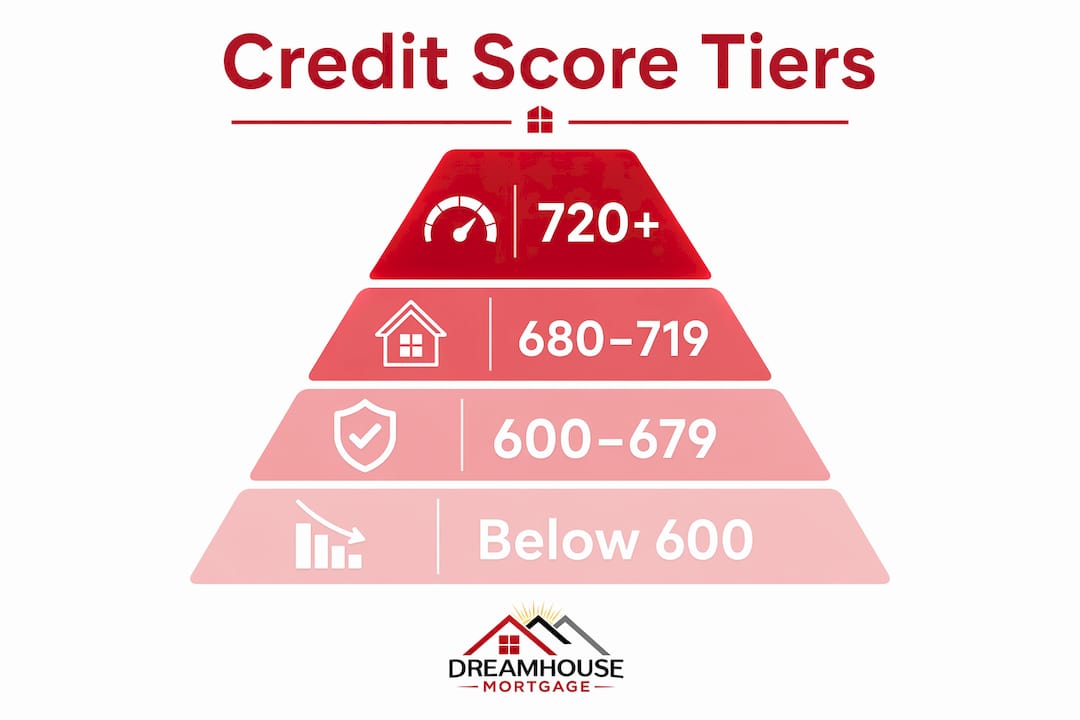
| Score Range | Lender Access | Typical Outcome |
|---|---|---|
| 720+ | All A-lenders, banks, credit unions | Best available rates; full product access |
| 680–719 | All A-lenders | Competitive rates; minor pricing difference from top tier |
| 680–718 | Most A-lenders | Standard rates; some lenders apply closer scrutiny |
| 660–679 | Some A-lenders, most B-lenders | Rate premium likely; manual review common |
| 600–658 | B-lenders, CMHC-insured path | Higher rates and fees; insured mortgage required below 680 at most banks |
| Below 600 | Private lenders, Mortgage Investment Corporations (MICs) | Highest rates; significant fees; short terms |
The 680 threshold is the single most important number in Canadian mortgage lending. Moving from 679 to 681 can shift a borrower from B-lender pricing to A-lender pricing. Over a five-year term, that difference can amount to roughly $15,000–$25,000 in interest costs on a typical Alberta mortgage.
CMHC will insure mortgages at scores as low as 600, but most A-lenders set their own internal floor at 680. That gap is where many first-time buyers in Calgary, Airdrie, and Cochrane get caught: they qualify for insurance but not for the lender’s rate tier they expected. See CMHC insured mortgage minimums for Alberta for the current thresholds.
Alberta credit unions and broker-channel lenders sometimes offer more flexibility near the 680 floor, particularly when compensating factors exist (stable employment, low debt ratios, larger down payment).
When lenders check your credit during the mortgage process
Credit checks happen at multiple points, and each one has different consequences for your file.

| Stage | Type of Check | What Lenders Verify |
|---|---|---|
| Pre-approval | Hard inquiry (broker may use soft view first) | Score, payment history, major derogatory items |
| Full application | Hard inquiry | Updated balances, new accounts, current utilization |
| Underwriting | In-depth review of full report | All items; compensating factors assessed |
| Pre-funding | Possible re-verification | Confirms no new debt or major changes since approval |
| Renewal | Hard or soft depending on lender | Score, payment history since original approval |
The mortgage pre-approval process in Alberta typically involves a hard pull. A single hard inquiry for a mortgage usually lowers your score by only a few points. The more significant risk is applying to multiple lenders outside a rate-shopping window, which can produce several independent hard inquiries.
Between pre-approval and closing, avoid applying for new credit cards, car loans, or lines of credit. Keep card balances low and document any large deposits into your bank account. Lenders may re-verify your credit file immediately before funding, and a new liability discovered at that stage can delay or cancel the approval.
Common credit-report red flags that can cause a mortgage denial
Lenders rank the following items from most to least severe when reviewing a file:
- Recent bankruptcy or consumer proposal. A bankruptcy discharged within the past two years will disqualify most A-lender applications. Most lenders require two years of re-established credit post-discharge before considering an application.
- Active collections or judgments. An unpaid collection account, especially one reported within the past 24 months, raises serious underwriting concerns. Paid collections are viewed more favorably but still require explanation.
- 90-day late payment within the past 12 months. A single 90-day delinquency on any account is often enough to trigger a denial at major banks, regardless of the overall score.
- Very high utilization. Cards consistently reported above 80% of their limit signal cash-flow stress, even when payments are on time.
- Multiple recent hard inquiries. Clustered inquiries can flag a borrower as high-risk. A pattern of five or more hard inquiries in six months often requires a 3–6 month stability period before a successful application.
- Identity-theft accounts. Fraudulent accounts on your report can suppress your score and confuse underwriters. Dispute these immediately with both bureaus.
- Inconsistent reporting between bureaus. When Equifax and TransUnion show materially different balances or payment histories for the same account, underwriters may downgrade the application or request manual verification.
A single 90-day late payment within the last year, or three or more hard inquiries in 60 days, are the two patterns Dreamhouse Mortgage most commonly sees triggering denials for first-time buyers in Calgary and the surrounding area.
How to prepare and repair your credit before applying
A structured, time-based approach produces the most reliable results.
Immediate steps (days to 30 days):
- Pull both your Equifax and TransUnion reports. In Canada, you can request a free copy of each report by mail or online through each bureau’s official website.
- Identify and dispute any errors. File disputes directly with Equifax Canada and TransUnion Canada. Include supporting documents (statements, letters from creditors). Bureaus typically resolve disputes within 30 business days.
- Pay down card balances before the statement closing date, not just the due date. Balances are reported at statement close, so a payment made after the statement generates but before the due date does not reduce the reported balance for that cycle.
- Stop applying for new credit immediately.
Short-term steps (1–3 months):
- Reduce utilization below 30% across all revolving accounts. If one card is at 90% and another is at 5%, pay the high one down first.
- Contact creditors about pay-for-delete arrangements on collection accounts where possible. Not all creditors agree, but some will remove a collection upon full payment.
- Gather supporting documents: recent pay stubs, T4s, CRA Notice of Assessment, bank statements, and proof of rent if applicable.
Medium-term steps (3–12 months):
- Maintain on-time payments across every account for at least six consecutive months. Payment history improvement takes time to register.
- If your credit file is thin, consider becoming an authorized user on a family member’s established account, or open a secured credit card and use it lightly.
- Confirm each issuer’s reporting schedule so you can time payments to maximize the score before a lender pull.
Pro Tip: Check which day of the month each of your card issuers reports to the bureaus. Pay balances down to under 10% of the limit two to three days before that date, not just before the payment due date. This single habit often produces a measurable score lift within one or two billing cycles.
What are your options if your credit score has problems?
Poor credit does not automatically mean no mortgage. Several routes exist, each with real tradeoffs.
- Wait and repair. For scores below 620 with recent derogatory items, a 6–12 month repair period often produces better long-term outcomes than rushing into a high-rate private mortgage. The math usually favors patience.
- Apply with a co-borrower or co-signer. A co-borrower with strong credit can offset a weaker primary applicant. Both parties’ incomes and debts are included in the qualification calculation. The co-borrower’s credit is also at risk if payments are missed.
- B-lender or alternative lender route. B-lenders accept lower scores (typically 600–679) and recent derogatory items, but charge a rate premium of 1%–3% above A-lender rates and often add lender fees. This can be a bridge strategy: get into the property, repair credit, then refinance to an A-lender at renewal.
- Private lenders and Mortgage Investment Corporations (MICs). These lenders focus on property equity rather than credit score. Rates are significantly higher and terms are short (typically one to two years). Useful for very specific situations, not as a long-term solution. See private mortgage options in Canada for how this route works.
- CMHC-insured mortgage with a larger down payment. If your score is 600 or above and your income qualifies, an insured mortgage remains accessible. A larger down payment (10%–20%) can sometimes compensate for a weaker credit profile when combined with other strong factors.
- Newcomers with no Canadian credit history. Specific programs exist for newcomers to Canada in Calgary, Edmonton, and Airdrie. See no credit history mortgage options in Alberta for details.
When the path forward is unclear, a licensed mortgage broker in Alberta can assess which route fits your specific file, income, and timeline.
How Dreamhouse Mortgage handles credit challenges in Alberta: real scenarios
Mortgage brokers pull both bureau reports to identify discrepancies and match borrowers to lenders that favor a particular bureau or that manually underwrite when compensating factors exist. This is a core part of how Dreamhouse Mortgage, led by Guriqbal Chahal, approaches files for buyers across Calgary, Airdrie, Cochrane, Chestermere, Red Deer, and Edmonton.
Three anonymized scenarios from the Dreamhouse Mortgage client base:
- Scenario A. A Calgary first-time buyer had a 665 TransUnion score and a 682 Equifax score. The lender Dreamhouse Mortgage selected pulled Equifax only. With three months of focused utilization reduction and one error corrected on the Equifax file, the buyer qualified at A-lender rates. The TransUnion score was irrelevant to that lender’s decision.
- Scenario B. An Airdrie buyer had a consumer proposal discharged 18 months prior and a score of 610. A-lender approval was not available. Dreamhouse Mortgage placed the file with a B-lender at a rate premium, with a documented plan to refinance at the two-year mark once the proposal seasoned past the standard waiting period.
- Scenario C. A Cochrane buyer had a score of 622 and a 10% down payment. CMHC insurance was available at that score. Dreamhouse Mortgage structured the file to meet CMHC guidelines and secured approval through an insured mortgage pathway, with a plan to build credit toward A-lender rates at renewal.
Common documents requested in Alberta mortgage files: T4 slips, CRA Notice of Assessment (two years for employed; two to three years for self-employed), recent pay stubs, bank statements (90 days), proof of down payment source, and proof of rent for applicants without a prior mortgage history.
How to get your free credit report in Canada before applying
Both Equifax Canada and TransUnion Canada are required to provide Canadians with a free copy of their credit report on request. The process differs slightly between bureaus.
Equifax Canada: You can request your free report online through the Equifax Canada website or by mail. The online option typically delivers the report immediately. The free report shows your full credit history but may not include your score unless you pay for a score product.
TransUnion Canada: TransUnion offers a free report online through its consumer portal. As with Equifax, the free report includes your full credit file. Score access may require a separate subscription or one-time purchase.
Pull both reports at least three to six months before you plan to apply. That window gives you time to dispute errors and see corrections reflected before a lender pulls your file. The FCAC provides guidance on credit report and score basics and your rights as a Canadian consumer.
When reviewing your report, check for: accounts you do not recognize, incorrect balances or payment statuses, accounts listed as open that you have closed, and public records that should have been removed based on provincial timelines.
How joint credit and spousal credit affect your mortgage application
When two people apply for a mortgage together, lenders review both credit files. The lender does not average the two scores. Most lenders use the lower of the two primary applicants’ scores to determine rate tier and qualification.
This means a spouse or co-borrower with a 620 score can pull a joint application out of A-lender territory even when the primary applicant has a 740. The stronger borrower’s score does not offset the weaker one for pricing purposes.
Joint credit history also means shared liability. Late payments on a joint account appear on both files. If one partner has a strong credit history and the other has a weak one, it may be worth considering whether applying solo (using only the stronger borrower’s income) produces a better outcome, provided that income alone qualifies for the required mortgage amount.
For first-time buyers in Calgary and Chestermere purchasing together, Dreamhouse Mortgage typically reviews both files before advising on whether a joint or solo application is the stronger path. Common first-time buyer mistakes in Alberta covers this scenario in more detail.
How credit utilization ratio affects your credit score
Credit utilization is the percentage of your available revolving credit that you are currently using. It is calculated per card and in aggregate across all revolving accounts.
A card with a $10,000 limit and a $4,500 balance is at 45% utilization. If you have three cards with a combined limit of $30,000 and combined balances of $12,000, your aggregate utilization is 40%. Both the per-card and aggregate figures influence your score.
Utilization below 30% is the standard guideline. Scores typically improve further when utilization drops below 10%. The relationship is not linear: going from 80% to 30% produces a larger score improvement than going from 30% to 10%, but both moves matter when you are near a key threshold like 680.
Utilization is recalculated every reporting cycle. Unlike a late payment, which stays on your file for years, high utilization can be corrected quickly. Paying down a card balance before the statement closing date produces a lower reported balance in the next cycle, which the bureau reflects immediately. This makes utilization the fastest lever most borrowers have to improve their score before a lender pull. Debt consolidation is one strategy some Alberta buyers use to reduce aggregate utilization before applying.
Key Takeaways
Your credit bureau reports and the score they generate are the primary filter lenders use to determine mortgage approval, lender tier, and rate pricing in Canada.
| Point | Details |
|---|---|
| Check both bureaus early | Pull Equifax and TransUnion reports 3–6 months before applying to find and fix errors in time. |
| The 680 threshold is critical | Moving from 679 to 681 can shift you from B-lender to A-lender pricing, saving roughly $15,000–$25,000 over five years. |
| Utilization is the fastest fix | Pay card balances below 30% before the statement closing date; improvements show in the next reporting cycle. |
| Avoid new credit before applying | New hard inquiries and new accounts within 90 days of a lender pull can reduce your score and raise underwriting flags. |
| Dreamhouse Mortgage | Guriqbal Chahal reviews both bureau files and matches Alberta buyers to the lender and bureau combination that fits their credit profile. |
Dreamhouse Mortgage helps Alberta buyers get approved

Dreamhouse Mortgage works with buyers across Calgary, Airdrie, Cochrane, Chestermere, Red Deer, and Edmonton who want a clear picture of their mortgage readiness before they apply. Guriqbal Chahal, MBA, PMP, Broker of Record, reviews both Equifax and TransUnion files, identifies the lender that fits your credit profile, and structures the application with the compensating factors that give your file the best chance of approval at the best available rate. Whether you are three months from buying or three years out, a mortgage broker rate consultation with Dreamhouse Mortgage gives you a concrete action plan, not a generic checklist.
Call Guriqbal Chahal at 403-966-6072 or visit the Dreamhouse Mortgage Google Business Profile to book a no-obligation mortgage readiness review.
This article provides general information about Canadian mortgage and credit bureau processes. It is not professional financial or legal advice. Confirm current rules and your specific eligibility with a licensed mortgage professional or the relevant regulatory authority.
Useful sources
Official Canadian sources for checking your credit reports and verifying mortgage rules:
- Equifax Canada — Request your free credit report and review your file at equifax.com/personal/credit-report-services
- TransUnion Canada — Access your free credit report and consumer portal at transunion.ca
- Financial Consumer Agency of Canada (FCAC) — Official guidance on credit reports, scores, and consumer rights at canada.ca/en/financial-consumer-agency
- Dreamhouse Mortgage — Alberta mortgage readiness reviews, credit file analysis, and pre-approval support at dreamhousemortgage.ca or by calling Guriqbal Chahal at 403-966-6072
FAQ
What credit score do lenders look at for a mortgage in Canada?
Most A-lenders in Canada use the lower of the two primary applicants’ scores from Equifax and TransUnion. The practical A-lender floor is 680, while CMHC-insured mortgages are available at scores of 600 or above.
What looks bad on a Canadian mortgage application?
Recent 90-day late payments, active collection accounts, a consumer proposal or bankruptcy within the past two years, and credit utilization consistently above 80% are the items that most commonly concern mortgage underwriters.
What can fail a mortgage application related to credit?
A single 90-day delinquency within the past 12 months, multiple hard inquiries clustered in a short period, or a material discrepancy between your Equifax and TransUnion files can each cause a denial or force a file to a higher-cost lender tier.
What are the stages of getting a mortgage approved in Canada?
The standard stages are pre-approval (initial credit pull and income review), full application (hard inquiry and document submission), underwriting (in-depth review of credit and income), and pre-funding verification (confirmation that nothing material has changed). Dreamhouse Mortgage guides Alberta buyers through each stage and advises on credit actions between them.
How long does it take to improve a credit score before applying for a mortgage?
Utilization improvements can show in one billing cycle (30 days). Payment history improvements typically take 3–6 months of consistent on-time payments to register meaningfully. Derogatory items like collections or late payments take longer to age off and may require 12–24 months of positive history to offset.
Recommended
- Mortgage Terms Explained Alberta Mortgage Glossary: 60 Essential Terms Every Calgary Buyer Must Know (2026)
- First Time Home Buyer Mortgage Explained for Alberta Buyers
- First Time Home Buyer Mortgage Explained for Alberta Buyers
- No Credit, No Problem: The Powerful Truth About No Credit History Mortgage Alberta Options for Newcomers