An insured mortgage is one where you put down less than 20% and pay a default insurance premium, which is usually added to your loan. An insurable mortgage has 20% or more down and meets the same lending criteria, but you pay no premium because the lender can insure it at its own cost. Which side of that line you land on affects your rate, your lender options and your monthly payment. This guide shows how the categories work for buyers in Calgary, Airdrie, Cochrane and the surrounding communities.
TL;DR
- Insured (high-ratio): less than 20% down, mandatory default insurance, premium paid by you, typically added to the mortgage balance.
- Insurable (low-ratio): 20% or more down, and the property and loan meet insurance criteria, so lenders can insure it themselves. No premium for you.
- Uninsurable: 20% or more down, but something about the property, the amortization or the file keeps it outside those criteria. Rates and lender choice can be narrower.
- Default insurance protects the lender, not you. It does not replace life or disability coverage.
- Not sure which category your purchase falls into? Call Guriqbal Chahal at 403-966-6072 before you make an offer.
Table of Contents
- The three categories in plain terms
- Insured mortgages: what the rules say in 2026
- Insurable mortgages: the middle category
- Uninsurable mortgages: when 20% down is not enough
- Does the category change your rate?
- The stress test applies in both cases
- First-time buyers: the 30-year amortization
- Our perspective: choose the category before you choose the house
- Renewal: why the category matters again in year five
- Common mistakes we see
- How we help you choose
- FAQ
- Sources
The three categories in plain terms
Canadian mortgages are usually described by how much of the purchase price you borrow, called the loan-to-value ratio. Once you borrow more than 80% of the price, default insurance is required. Below that line, a mortgage can still be insured by the lender, which is where the word insurable comes from.
| Insured | Insurable | Uninsurable (uninsured) | |
|---|---|---|---|
| Down payment | Under 20% | 20% or more | 20% or more |
| Who buys insurance | You, through your lender | The lender, at its cost | Nobody |
| Premium added to your loan | Yes | No | No |
| Meets insurance criteria | Yes, required | Yes | No |
| Common label | High-ratio | Low-ratio | Conventional, low-ratio |
People also ask about high ratio versus low ratio. They are the same split described by loan size: high-ratio means borrowing more than 80% of the value, low-ratio means 80% or less.
The words insured and insurable sound alike, so they cause confusion. The difference is not the quality of the borrower. It is who pays for the insurance, and whether insurance is required at all.
Insured mortgages: what the rules say in 2026
Per CMHC, default insurance is required in Canada when your down payment is under 20% of the purchase price. The minimum down payment depends on the price:
- Up to $500,000: 5% of the price.
- $500,000 to $1,499,999: 5% of the first $500,000 plus 10% of the portion above that.
- $1.5 million or more: high-ratio insurance is not available, so you need at least 20% down.
The insured loan also has to meet general lender and insurer requirements, such as the home being in Canada and the purchase being permitted under federal law. CMHC lists those general requirements on its site. For a deeper walk-through of how these rules affect affordability, see our insured mortgage rules guide.
What the premium costs
The premium is a percentage of your loan, and it rises with the loan-to-value ratio. CMHC’s published schedule shows 3.10% for loans between 85.01% and 90% of the value, and 4.00% between 90.01% and 95%. The premium is a one-time charge that may be added to your loan amount. Check the schedule for your own ratio, since a different insurer may use its own table.
In some provinces the premium also carries sales tax. Alberta has no provincial sales tax, so no tax is applied to the premium here. Buyers moving from Ontario or Quebec are often surprised by this.
A worked example for Calgary
Calgary’s benchmark price for all residential properties was $572,500 in June 2026, according to CREB figures. Take a hypothetical $550,000 townhome in a community like Cranston or Mahogany:
- Minimum down payment: 5% of the first $500,000 ($25,000) plus 10% of the remaining $50,000 ($5,000) = $30,000.
- Base mortgage: $550,000 minus $30,000 = $520,000, which is about 94.5% of the price.
- Premium at the 4.00% tier: $520,000 x 4.00% = $20,800.
- Total mortgage after the premium is added: $540,800.
This is an illustration of the published tiers, not a quote. Your actual premium depends on your down payment, the property and the insurer.
Pro Tip: Because the premium is added to your balance, you pay interest on it for as long as you carry the mortgage. Ask your broker to show the payment and total cost with the premium included, not just the base loan.
Who the insurance protects
Many buyers assume default insurance protects them. It does not. CMHC explains that it protects your lender if you cannot make your payments. It will not cover your payments if you lose income or become ill. That is a separate product, and we compare the options in Mortgage Insurance vs Term Life.
The same CMHC page describes the purpose of the system: lenders stay willing to lend in downturns, and buyers can enter the market with smaller down payments.
Insurable mortgages: the middle category
An insurable mortgage is a low-ratio loan, meaning you have 20% or more down, that would qualify for default insurance if it were needed. Because it meets those criteria, a lender can choose to insure it on its own account. You do not pay a premium, and you do not see the insurance on your statement.
What typically makes a file insurable:
- A purchase price under the insured cap of $1.5 million.
- An amortization within the insurable limit. Standard is 25 years. Longer terms are only possible in the situations described below.
- An owner-occupied or eligible property type, in a location and condition the insurer accepts.
- Income, credit and debt ratios that meet the insurer’s standards.
Lender criteria change, so confirm the current details with your broker before you rely on any one of them. The practical point is that insurable files can sometimes access lower rates than uninsurable ones, since the lender carries less risk. Rates differ by lender and week, and we compare them for you rather than quoting a general figure.
Uninsurable mortgages: when 20% down is not enough
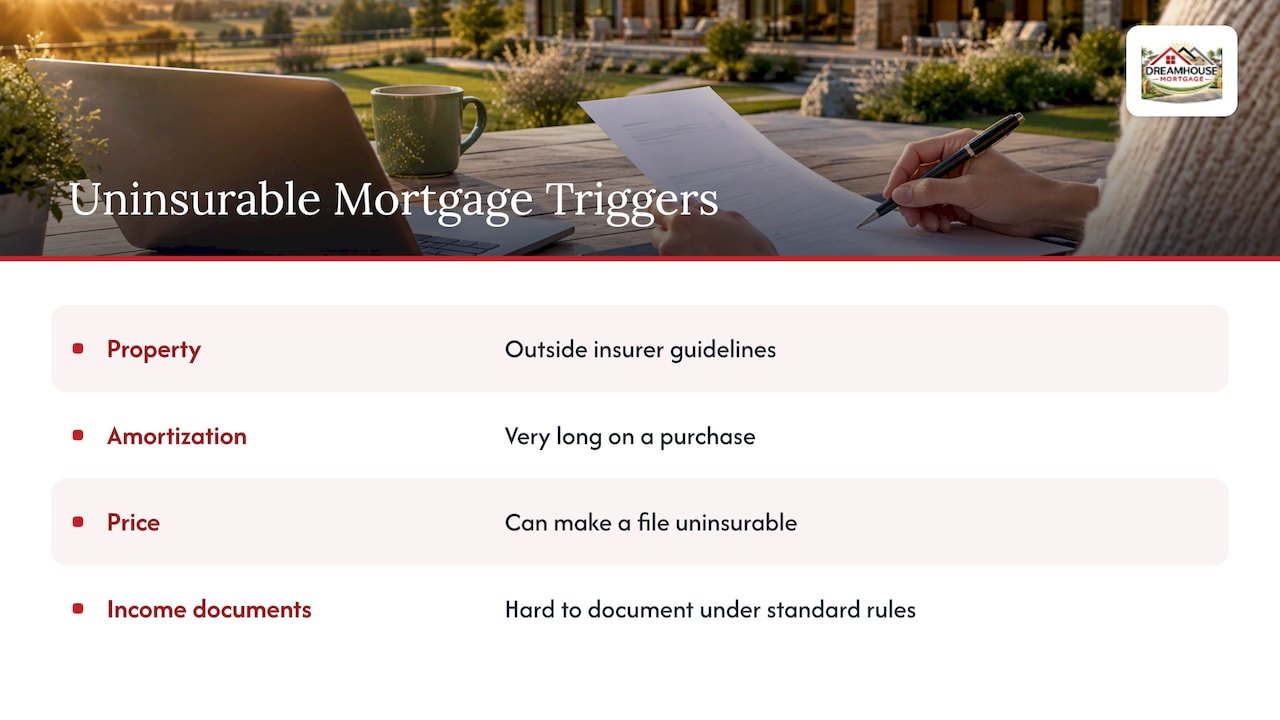
Having a 20% down payment does not guarantee an insurable mortgage. A file can be uninsurable because of the property, the amortization, the price or the income documentation. Common examples include a very long amortization on a purchase, a property outside insurer guidelines, or a borrower whose income is hard to document under standard rules.
That is not a dead end. Plenty of Alberta buyers close on uninsurable mortgages through banks, credit unions and alternative lenders. The cost can be a higher rate or fewer lender options, so it helps to know early. We list the warning signs in Uninsurable Mortgages in Canada: 5 Red Flags for Calgary Buyers.
Pro Tip: If you are close to 20% down, ask whether a gift from family, or a short delay while you save, would move you from insured to insurable. Document any gift with a gift letter and be ready to show the funds trail. Our guide to down payment types in Canada covers what lenders accept.
Does the category change your rate?
It can. Lenders price insured, insurable and uninsurable mortgages separately because their cost of funds and risk differ. Insured loans carry the lowest risk for the lender, since the insurer covers a default. CMHC notes that insurance helps lenders offer rates comparable to those usually reserved for larger down payments.
The rate alone does not tell you which route is cheaper. A buyer with 18% down who pays a premium may still pay a lower total than one who waits a year while prices move. A buyer with 20% down may compare an insurable rate against an uninsurable one on the same property. The comparison to run is total cost over your term, including the premium.
The stress test applies in both cases
The minimum qualifying rate, often called the stress test, is the greater of your contract rate plus 2% or 5.25% for uninsured mortgages, according to OSFI. OSFI describes the test as a safeguard so borrowers can keep paying if their income falls or rates rise. OSFI confirmed in August 2025 that the rate would stay at that level.
To see how it limits your budget, read our guides to the stress test for first-time buyers and the stress test in Alberta. Pre-approval is where you learn your qualifying amount before shopping.
First-time buyers: the 30-year amortization
This is where the insured category gives something extra. The federal government expanded 30-year amortizations on insured mortgages to all first-time buyers and all purchasers of new builds. A longer amortization lowers your monthly payment, which can help you qualify, though you pay more interest over time.
For a first-time buyer in Calgary, Airdrie or Cochrane with under 20% down, that can be a real advantage. Our page on the 30-year amortization for Alberta first-time buyers goes through the trade-offs, and so does our overview of amortization options in Canada.
The same reforms also opened insured refinancing for secondary suites. Under that measure, insured refinancing to add a secondary suite became available from January 15, 2025, which matters to Calgary homeowners considering a basement suite. If that is your plan, our Mortgage Refinancing options page is a good place to start.
Our perspective: choose the category before you choose the house
We see the same pattern with first-time buyers across Calgary and the bedroom communities. They pick a price range from a listing site, then discover that a few thousand dollars in down payment, or one property detail, changes the whole mortgage. Our view is that the category should be settled at the pre-approval stage, not at the offer stage.
Here is how we approach it:
- Map your down payment honestly. We count savings, RRSP Home Buyers’ Plan funds, and documented gifts, and we flag funds that need seasoning so they do not trigger questions during underwriting.
- Test both routes. If you are near 20%, we price the insured option and the insurable option side by side, so you see the premium, the rate and the payment.
- Check the property early. Some homes, such as certain rural or acreage properties around Rocky View County, may not fit standard insurance guidelines. Knowing that before you write an offer protects your deposit.
- Plan the renewal. The category you start in influences your options in year five, so we look at that before you sign.
Because we work with banks, credit unions, monoline lenders, alternative lenders and private lenders, we can look at each category across several lenders, not just one. The goal is to put you in the cheapest sound structure for your situation, and the answer is not always the same for two buyers on the same street.
— Guriqbal Chahal, MBA, PMP
Renewal: why the category matters again in year five
Your category follows you to renewal. If your mortgage is uninsured, meaning you had 20% or more equity, recent rule changes make shopping easier. OSFI no longer prescribes the minimum qualifying rate for uninsured borrowers who switch lenders at renewal. The federal government made a matching amendment to the insurance rules effective December 16, 2024.
In practice, a straight switch means moving to a new lender with the same loan amount and amortization, without re-qualifying at the stress test. For a Calgary homeowner whose term is ending, that gives you more room to compare offers rather than accept your current lender’s renewal letter by default. Details differ by lender, so confirm the conditions before you sign anything. Our Renew or Switch service reviews your renewal offer against the market, and if you want to change your loan, our comparison of a second mortgage vs refinance shows when each fits.
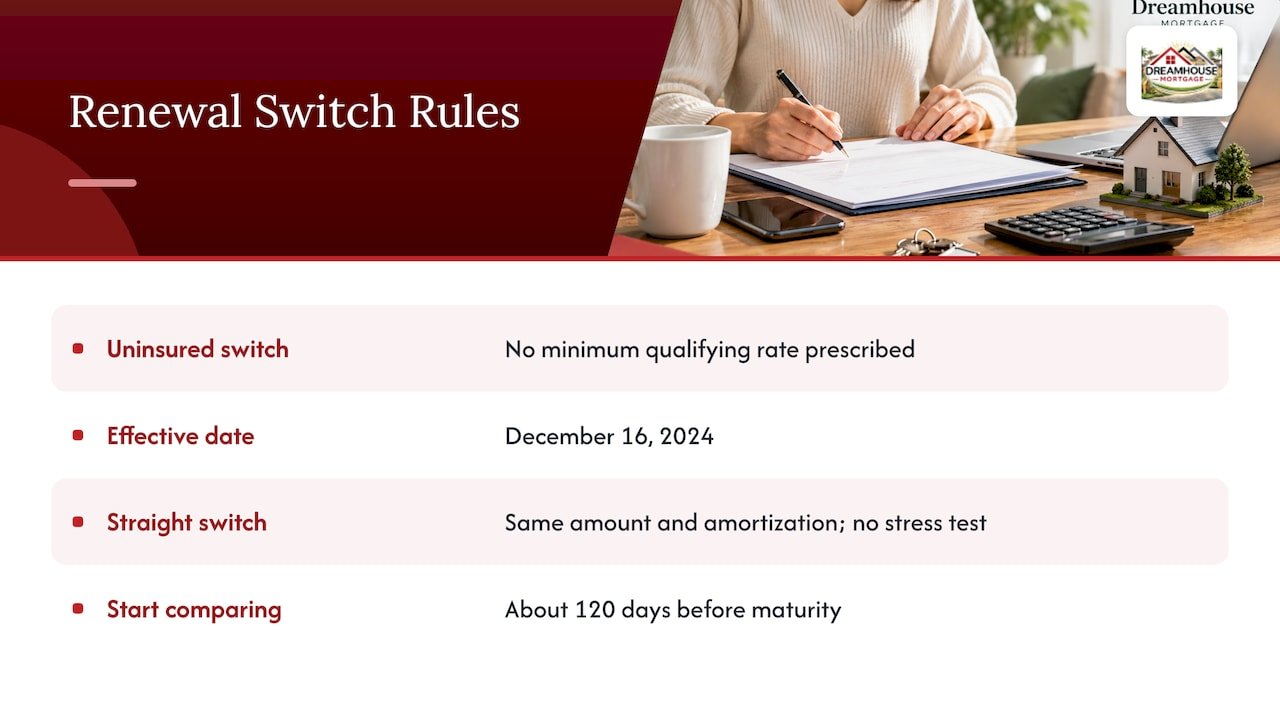
Pro Tip: Start looking about 120 days before your maturity date. Many lenders allow you to lock in a renewal rate early, and that gives you time to compare.
Common mistakes we see
- Assuming 20% down means a better rate automatically. Whether the file is insurable or uninsurable matters, and your broker should check this before you commit.
- Ignoring the premium in your budget. On the example above, the premium adds $20,800 to the balance. It affects your payment for the whole amortization.
- Treating default insurance as life insurance. It protects the lender only.
- Draining savings to hit exactly 20%. A buyer with no cash buffer for closing costs, moving and repairs takes on risk that a premium might have avoided.
- Waiting to get pre-approved. Rates and rules change, and an early pre-approval shows you which category you are in. See our pre-approval process guide for the documents to gather.
How we help you choose
DreamHouse Mortgage is a Calgary mortgage brokerage, founded in 2013, serving Calgary, Airdrie, Cochrane, Chestermere, Okotoks, High River, Rocky View County, Edmonton, Red Deer and surrounding Alberta communities. Our First Time Buyer Mortgage and Mortgage Pre-Approval services start with the question this article raises: which category are you in, and what is the lowest-cost route to your keys?
We compare lenders for you, explain the premium and the payment in plain numbers, and coordinate documents through to funding. To see what a first purchase looks like here, read our complete guide to first-time homebuyer mortgages in Calgary, or go straight to our Calgary pre-approval page.
Call Guriqbal Chahal, MBA, PMP, Mortgage Broker, at 403-966-6072. You can also find us on our Google Business Profile.
FAQ
How do I know if my mortgage is insured?
Check your mortgage commitment or closing documents for the words mortgage default insurance, CMHC, Sagen or Canada Guaranty. If your down payment was under 20%, your mortgage is insured. If you are unsure, your broker or lender can confirm it.
Do insured mortgages have better rates?
Often they do, because the insurer carries the default risk, so lenders can offer lower rates. Your premium is an added cost, though, so compare the total cost over your term, not just the rate. Pricing varies by lender and changes frequently.
Can I cancel mortgage default insurance once I have 20% equity?
No, in general the insurance stays for the life of that insured mortgage, and the premium is a one-time cost. If you later refinance with 20% or more equity, you may be able to move to an uninsured structure, depending on the lender and the property. Ask your broker to model that before you refinance.
Is an insurable mortgage the same as an uninsured mortgage?
Not quite. Both involve 20% or more down and no premium for you. An insurable mortgage also meets the insurance criteria, so the lender can insure it at its own cost. An uninsurable one does not, and that can affect rates and lender options.
Does the 5% minimum apply to a home in Cochrane or Airdrie?
Yes, the same federal rules apply across Alberta. You need 5% of the first $500,000 and 10% of the amount from $500,000 to $1,499,999, and the home must be eligible. Rural or unusual properties may need extra review.
Sources
- CMHC Mortgage Loan Insurance Explained
- CMHC general requirements for mortgage loan insurance
- CMHC mortgage loan insurance premium information
- CMHC FAQs on mortgage loan insurance
- What is CMHC Mortgage Loan Insurance?
- Policy Advisor: CMHC mortgage insurance calculator (Alberta tax treatment)
- Calgary real estate market, June 2026
- OSFI: Minimum qualifying rate for uninsured mortgages
- OSFI backgrounder on the minimum qualifying rate
- OSFI confirms the minimum qualifying rate
- OSFI: uninsured mortgage straight switches
- Canada.ca: Straight Switches and portfolio insurance
- Canada.ca: Delivering the Boldest Mortgage Reforms in Decades
- Canada.ca: Mortgage insurance rule changes for secondary suites
Recommended
- Uninsurable Mortgages in Canada: 5 Red Flags for Calgary Buyers
- Insured Mortgage Rules and Affordability in 2026: A Practical Guide for Canadian Homebuyers
- Mortgage Checklist Calgary: The Ultimate Proven Guide — Everything You Need Before Applying (2026)
- First Time Homebuyer Mortgage Calgary: The Complete 2026 Guide