An investment property mortgage is a loan used to purchase a residential property you will not occupy — a rental home, duplex, or multi-unit building held for income or appreciation. In Canada, these mortgages carry stricter rules than owner-occupied financing on three fronts: a minimum down payment that is higher than for owner-occupied properties; single-unit rentals are generally not insurable by CMHC, a rate premium modestly above insured owner-occupied rates, and tighter qualification under OSFI’s B-20 stress test.
The three differences that matter most:
- Down payment: Minimum down payment requirements increase with property size, with commercial treatment applying for five or more units.
- Rate premium: Rental-property 5-year fixed rates typically run higher than insured owner-occupied rates.
- Qualification: Lenders apply the B-20 stress test, count only a portion of rental income depending on method, and scrutinize your total debt service (TDS) ratio more closely.
If you want to know whether you qualify and what a rental property would cost to finance in Calgary, Airdrie, Cochrane, or anywhere in Alberta, a mortgage pre-approval with Guriqbal Chahal at Dreamhouse Mortgage (403-966-6072) gives you a concrete answer before you make an offer.
Table of Contents
- How lenders classify investment property mortgages in Canada
- What loan types do Canadian investors actually use?
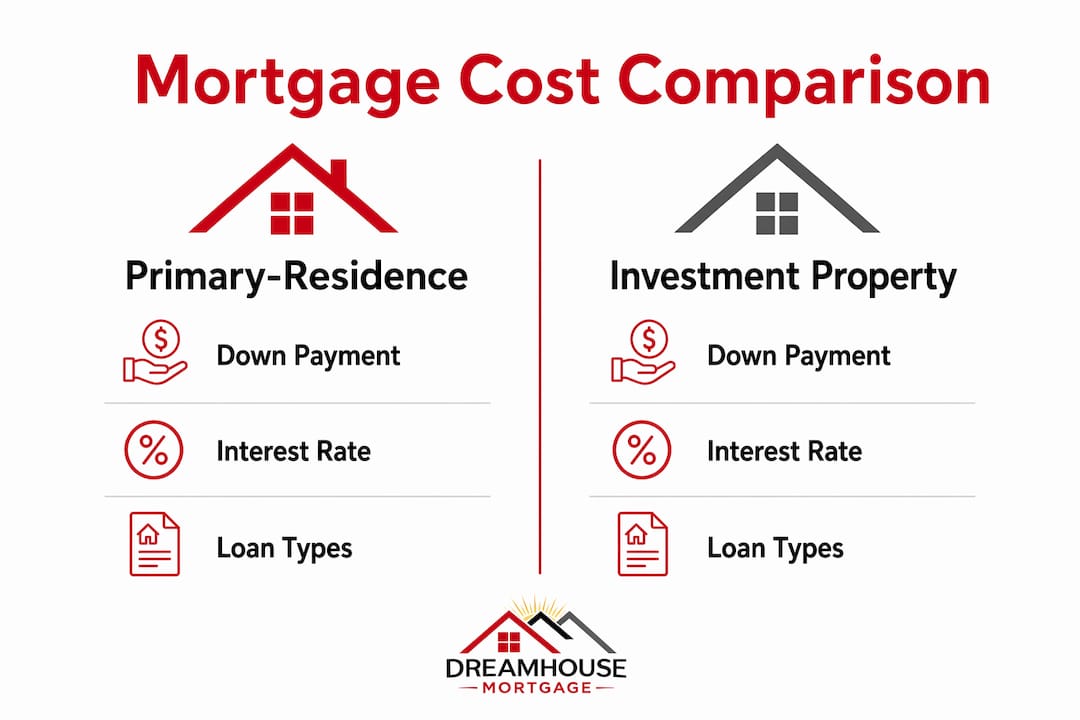
- How investment property mortgages compare to primary-residence mortgages
- How lenders qualify you for an investment property mortgage
- What does an investment property mortgage actually cost?
- Tax treatment and cash flow for Canadian rental properties
- What are the main risks of using mortgage leverage for rental property?
- How to choose the right mortgage for your investment property
- Why working with a mortgage broker matters for Alberta investors
- Key Takeaways
- Dreamhouse Mortgage serves Alberta investors across the province
- Useful sources
- FAQ
How lenders classify investment property mortgages in Canada
A non-owner-occupied mortgage is any residential loan where the borrower does not intend to live in the property. Lenders and regulators treat these differently from owner-occupied loans because the borrower’s primary motivation is financial return, not shelter — and that changes the risk profile.
OSFI, Canada’s federal banking regulator, sets underwriting expectations through Guideline B-20. Under B-20, lenders must qualify borrowers at the greater of the contract rate plus 2% or 5.25%, regardless of whether the property is owner-occupied or investment. OSFI clarified in September 2025 that its Capital Adequacy Requirements (CAR) guidance — which governs how lenders classify exposures for capital purposes — does not change B-20 borrower qualification rules. Rental income can still be used to qualify borrowers; the classification distinction is an internal bank capital matter, not a borrower eligibility barrier.
Regulatory clarity for investors: OSFI’s CAR guidance separates capital classification from borrower underwriting. Lenders can still count rental income toward your qualification under B-20 — the two frameworks operate independently.
Pro Tip: Ask any lender you speak with which rental income method they use: gross add-back, net rental income, or rental offset. The answer directly affects how much you can borrow. Different lenders use different methods, and a broker can match you to the lender whose method works best for your income structure.
What loan types do Canadian investors actually use?
Several financing paths exist for buying rental property in Canada. The right one depends on your income type, portfolio size, credit profile, and how quickly you need to close.

Conventional uninsured mortgages are the standard product for non-owner-occupied 1–4 unit residential properties. You need at least 20% down, and the loan is held by a bank, credit union, or monoline lender under standard B-20 rules. Most first-time investors in Calgary or Edmonton start here.
Portfolio and bank-held products are designed for repeat investors with multiple properties. Some lenders offer portfolio underwriting — qualifying the overall rental income and property values across your holdings rather than property by property. These products are not widely advertised and typically require a broker to access.
Private and alternative mortgages suit investors who need a fast closing, have non-traditional income, or hold a property that does not meet conventional criteria (unusual construction, rural acreage, or a property needing significant work). Rates are higher, but terms are flexible.
HELOC (Home Equity Line of Credit) against an existing property is a common way to fund a down payment on a rental. You draw equity from your primary residence or another property you own and use it as the down payment on the investment purchase. Interest on a HELOC used for income-producing purposes is generally tax-deductible in Canada.
Interest-only mortgages are available from select lenders for investment properties. You pay only the interest each month, which lowers the monthly payment and improves short-term cash flow. See the interest-only mortgage guide for how these structures work and when lenders permit them in Canada.
Commercial financing (5+ units) applies once a property crosses into five or more units. Underwriting shifts to a debt-service coverage ratio (DSCR) model — the property’s net operating income must cover the mortgage payment by a set margin. Down payment requirements rise, and amortization terms differ from residential products.
- Conventional uninsured (1–4 units, 20%+ down, B-20 qualified)
- Portfolio/bank-held (repeat investors, multi-property underwriting)
- Private/alternative (fast close, non-standard income or collateral)
- HELOC on existing equity (down payment source, tax-deductible interest)
- Interest-only (lower monthly payment, select lenders)
- Commercial/DSCR (5+ units, income-based underwriting)
How investment property mortgages compare to primary-residence mortgages
The differences between financing a rental and financing your own home are significant enough to change whether a deal makes financial sense. The table below shows the key dimensions side by side.

| Dimension | Primary Residence (Insured) | Investment Property (Non-Owner-Occupied) |
|---|---|---|
| Minimum down payment | 5% (under $500K) | 20% single-unit; 20–25% duplex/triplex; uninsurable by CMHC for single-unit |
| CMHC mortgage insurance | Available (required under 20%) | Not available for single-unit rentals |
| Typical 5-year fixed rate | Low-4% range (insured) | 4.49%–4.64% (uninsured rental) |
| Maximum amortization | 25 years (insured, new builds) | 25 years (CMHC Income Property, 2–4 units) |
| Rental income in qualification | Not applicable | 50%–80% counted (method varies by lender) |
| Stress test | Yes (contract rate + 2% or 5.25%) | Yes (same threshold) |
Key points on insurability and rental income:
- CMHC mortgage insurance is available for 2–4 unit non-owner-occupied properties (CMHC Income Property product) up to 80% LTV, with a maximum purchase price below $1,000,000 and a maximum amortization of 25 years.
- Single-unit non-owner-occupied rentals are not insurable — the loan must be conventional, which means higher rates and stricter lender criteria.
- Rental income treatment varies: CMHC allows up to 50% of gross rental income for 2-unit properties or a net rental income approach; for uninsured single-unit rentals, lenders apply their own add-back or offset rules, typically 50%–80%.
For a deeper look at down payment rules by property type, the Dreamhouse Mortgage guide covers the full breakdown.
How lenders qualify you for an investment property mortgage
Qualifying for a rental property mortgage involves more moving parts than a standard home purchase. Underwriters look at five areas:
- Personal income: Employment income, self-employment income, or pension — verified with T4s, Notices of Assessment (NOA), or business financials.
- Credit score: A minimum of 600 is required for CMHC-insured products; most conventional lenders prefer 680 or higher for investment properties.
- Existing debts: All monthly obligations feed into your TDS ratio. The maximum TDS threshold under CMHC Income Property rules is 44%; GDS maximum is 39%.
- Rental income treatment: Lenders use one of three methods. The rental-offset method subtracts 50% of gross rent from the property’s annual housing costs (principal, interest, taxes, and heat) before calculating debt service ratios. The gross add-back method adds a percentage of gross rent directly to your qualifying income. The net rental income method uses gross rents minus operating expenses. Using a 50%–80% rental offset can add $60,000–$100,000 to borrowing capacity in sample scenarios, which is why knowing which method a lender uses matters.
- Reserves and assets: Many lenders want to see 1.5–3 months of mortgage payments in liquid reserves after closing.
On the stress test: Every federally regulated lender in Canada must qualify you at the greater of your contract rate plus 2%, or 5.25% — whichever is higher. On a rental property at a 4.64% contract rate, you qualify at 6.64%. That gap meaningfully reduces the loan amount you can carry.
Documents typically required:
- Last two years of T4s or NOAs
- Recent pay stubs (90 days) or business financials (self-employed)
- Signed lease agreement or market rent appraisal for the subject property
- T776 (Statement of Real Estate Rentals) for existing rental properties
- Mortgage statements for all properties currently owned
- Bank statements showing down payment source and reserves
The mortgage pre-approval process for an investment property follows the same steps as a standard pre-approval but requires the additional rental income documentation listed above.
What does an investment property mortgage actually cost?
Rate and fee transparency matters before you run cash-flow numbers. Here is a realistic cost picture for a Canadian rental property mortgage.
Typical fees at closing:
- Appraisal: $400–$600 (lender-ordered; required for most investment properties)
- Legal fees: $1,200–$2,000 (title transfer, mortgage registration)
- Home inspection: $400–$600
- Property tax adjustment: prorated at closing
- Title insurance: $200–$400
- Lender administration fee: varies by lender; some charge $0, others up to $500
- Mortgage broker commission: paid by the lender, not the borrower, on funded deals
Rate context (2026 market):
| Product | Approximate 5-Year Fixed Rate |
|---|---|
| Insured owner-occupied | Low-4% range |
| Uninsured rental property | 4.49%–4.64% |
| Private/alternative lending | Varies; typically higher |
Worked example: On a $500,000 rental property with 20% down ($100,000), the mortgage is $400,000. At a 5-year fixed rate of 4.64% amortized over 25 years, the monthly payment is approximately $2,230. Over five years, the interest portion of those payments totals roughly $88,000 — all of which is tax-deductible against rental income in Canada.
Choosing a longer amortization lowers the monthly payment and improves cash flow but increases total interest paid. An interest-only structure reduces the monthly payment further but builds no equity. The amortization options guide explains the trade-offs in detail.
Tax treatment and cash flow for Canadian rental properties
Mortgage interest is deductible against rental income in Canada — that is one of the primary financial advantages of holding income property. The Canada Revenue Agency (CRA) allows investors to deduct reasonable expenses incurred to earn rental income.
Common deductible expenses:
- Mortgage interest (not principal)
- Property taxes
- Insurance premiums
- Repairs and maintenance (not capital improvements)
- Property management fees
- Advertising and tenant screening costs
- Accounting and legal fees related to the rental
Capital Cost Allowance (CCA): Investors can also claim CCA (depreciation) on the building portion of the property, which reduces taxable rental income. The caution: when you sell, CCA claimed is recaptured and added back to your income in the year of sale. For many investors, the recapture tax bill at sale outweighs the annual CCA benefit, so this decision warrants advice from a tax professional.
Pro Tip: Run a simple monthly cash-flow test before you buy: gross rent minus mortgage payment, property tax, insurance, property management (if applicable), and a 5–8% vacancy allowance. If the number is negative, the property relies on appreciation to generate a return — that is a different risk profile than a cash-flow-positive rental.
Simple cash-flow checklist:
- Gross monthly rent
- Less: mortgage payment (principal + interest)
- Less: property tax (monthly equivalent)
- Less: insurance (monthly equivalent)
- Less: vacancy allowance (5–8% of gross rent)
- Less: maintenance reserve (1% of property value annually, divided by 12)
- Less: property management fee (if applicable)
- = Net monthly cash flow
What are the main risks of using mortgage leverage for rental property?
Leverage amplifies both gains and losses. A 20% down payment means you control a $500,000 asset with $100,000 of your own capital — but it also means a 10% drop in property value wipes out half your equity.
Top risks for Alberta investors:
- Vacancy: Even one month of vacancy on a $2,200/month rental costs $2,200 in lost income while the mortgage, taxes, and insurance continue.
- Rate increases at renewal: A rental property financed at 4.64% today renews in five years at whatever the market rate is. A 1% rate increase on a $400,000 mortgage adds roughly $200/month to your payment.
- Maintenance and capital expenditure surprises: Roofs, furnaces, and plumbing do not follow a schedule. A $15,000 furnace replacement in year two can eliminate two years of positive cash flow.
- Leverage sensitivity: Higher loan-to-value means less buffer. If rents fall or costs rise, a thinly capitalized rental can become a liability quickly.
- Regulatory shifts: OSFI and CMHC rules change. Qualification methods, stress test thresholds, and insurance eligibility have all shifted in recent years. What qualifies today may not qualify at renewal.
- Insurance and liability exposure: Landlord insurance costs more than homeowner insurance. Inadequate coverage on a rental property is a significant financial risk.
Red flags lenders watch for: multiple properties with thin or negative cash flow, high TDS ratios, recent credit events, and undisclosed rental income on prior tax returns. Investors with existing portfolios should review their T776 filings before applying — lenders will.
For a practical guide to avoiding common investor mistakes, the Dreamhouse Mortgage rental property resource covers the most frequent financing errors and how to avoid them.
How to choose the right mortgage for your investment property
A checklist-based approach prevents the most common mistake: choosing a mortgage based on the lowest headline rate without accounting for total cost, flexibility, and qualification impact.
Decision checklist:
- Investment horizon: Are you holding for 5 years or 20? Longer holds favor lower-rate fixed products with good prepayment privileges. Short holds may favor variable or shorter terms.
- Cash flow vs. appreciation focus: Cash-flow investors prioritize lower monthly payments (longer amortization, interest-only where available). Appreciation investors may accept negative cash flow if the market supports it.
- Refinance plans: If you plan to refinance and pull equity (BRRRR strategy), choose a product with low or no prepayment penalties and flexible refinance terms.
- Portfolio scale: One property qualifies differently than five. Plan your qualification strategy across the portfolio, not just for the next purchase.
- Risk tolerance: Fixed rates provide payment certainty. Variable rates carry renewal risk but may cost less over a full cycle.
Lender and product evaluation points:
- Minimum down payment required by that lender for your property type
- Which rental income qualification method they use (offset, add-back, or net)
- Prepayment privileges (10/10, 15/15, or 20/20 — percentage of original principal you can prepay annually)
- Renewal and refinance flexibility (open vs. closed, portability)
- Amortization options available (25 years standard; interest-only where permitted)
Questions to ask a mortgage broker:
- Which lenders on your panel use the rental-offset method vs. gross add-back for my income profile?
- What is the maximum amortization available for this property type?
- Are there portfolio products available if I plan to buy more than two properties?
- What are the prepayment penalties if I refinance before the term ends?
- How does my existing rental portfolio affect qualification for this new purchase?
- What documents do I need to bring to the first appointment?
Compare offers using total interest cost over your expected hold period, not just the rate. A 4.49% rate with a 3% prepayment penalty can cost more than a 4.64% rate with a 1% penalty if you refinance in year three.
Why working with a mortgage broker matters for Alberta investors
A mortgage broker accesses products and lenders that are not available through a single bank’s branch. For investment properties specifically, this matters because rental-income qualification methods, portfolio products, and private lending options vary significantly across lenders — and the difference between methods can be $60,000–$100,000 in borrowing capacity.
Broker value for investors: CMHC accepts multiple rental income methods, and lenders pick the method that matches their risk appetite. A broker who knows which lender uses which method can match your income structure to the right product — something a single-bank relationship cannot do.
Guriqbal Chahal, MBA, PMP, is the Broker of Record at Dreamhouse Mortgage and has been serving Alberta investors since 2013. Dreamhouse Mortgage works with banks, credit unions, monoline lenders, alternative lenders, and private lenders across Alberta. The brokerage specializes in investment property financing, rental property mortgages, self-employed mortgages, and private mortgage solutions for clients in Calgary, Airdrie, Cochrane, Chestermere, Okotoks, Edmonton, Red Deer, and surrounding communities.
What to bring to a broker appointment:
- Last two years of NOAs and T4s
- Signed lease or market rent appraisal for the subject property
- T776 for any existing rental properties
- Mortgage statements for all current properties
- Bank statements (90 days) showing down payment and reserves
- Photo ID
Pro Tip: Book a qualification pre-check before you make an offer. Knowing your maximum purchase price, required down payment, and estimated monthly payment for a specific property type gives you a negotiating position — and prevents the frustration of a declined application after an accepted offer.
Call Guriqbal Chahal at 403-966-6072 or visit the Google Business Profile to schedule a consultation. Dreamhouse Mortgage provides investment property mortgage services across Alberta.
Key Takeaways
An investment property mortgage in Canada requires a minimum 20% down payment, carries a rate premium over insured owner-occupied mortgages, and demands stricter qualification — but mortgage interest is fully tax-deductible against rental income, which partially offsets the higher cost.
| Point | Details |
|---|---|
| Minimum down payment | 20% for single-unit rentals; 20–25% for duplex/triplex; uninsurable by CMHC for single-unit rentals. |
| Rate premium | Rental-property 5-year fixed rates run approximately 4.49%–4.64% vs. lower insured owner-occupied rates. |
| Rental income qualification | Lenders count a portion of rental income; using offset or add-back methods may significantly increase borrowing capacity. |
| Tax deductibility | Mortgage interest, property taxes, insurance, and repairs are deductible against rental income under CRA rules. |
| Dreamhouse Mortgage | Guriqbal Chahal at Dreamhouse Mortgage matches Alberta investors to the right lender and rental income method — call 403-966-6072. |
Dreamhouse Mortgage serves Alberta investors across the province

Dreamhouse Mortgage gives Alberta investors direct access to banks, credit unions, monoline lenders, alternative lenders, and private lenders — all through one broker relationship. Rather than applying to a single institution and accepting whatever rental income method that lender uses, you get a comparison across lenders whose qualification methods, rates, and product terms are matched to your specific income structure and property type.
Services available for investors include investment property mortgage sourcing, mortgage pre-approval, mortgage refinancing, interest-only structuring where applicable, and private mortgage solutions for non-standard properties or fast closings. Dreamhouse Mortgage also handles the full documentation and lender coordination process, from initial qualification through to funding.
The brokerage serves Calgary, Airdrie, Cochrane, Chestermere, Okotoks, High River, Rocky View County, Edmonton, Red Deer, and surrounding Alberta communities. Guriqbal Chahal negotiates rates and terms on your behalf — the broker rate negotiation process is explained in detail on the Dreamhouse Mortgage website.
Call Guriqbal Chahal, MBA, PMP at 403-966-6072 or visit the Google Business Profile to book a consultation. No obligation — just a clear picture of what you qualify for and what it will cost.
This article provides general information about Canadian mortgage rules and is not financial or legal advice. Confirm current qualification rules, tax treatment, and program eligibility with a licensed mortgage broker and a qualified tax professional for your specific situation.
Useful sources
- CMHC Income Property mortgage insurance — CMHC’s official product page for 2–4 unit non-owner-occupied properties: LTV limits, premium schedules, amortization rules, and eligibility criteria.
- CMHC Rental Income guidance — Explains the three accepted rental income qualification methods (gross add-back, net rental income, rental offset) and how each applies by property type.
- OSFI clarification on rental income and mortgage classification — OSFI’s September 2025 clarification separating CAR capital classification from B-20 borrower qualification rules.
- CRA Rental Income (T776) — CRA’s guide to reporting rental income, claiming deductible expenses, and understanding CCA rules for rental properties.
- Dreamhouse Mortgage — Investment Property Mortgage Calgary — Alberta-specific investment mortgage services, broker contact, and local guidance for Calgary-area investors.
- Dreamhouse Mortgage — Alberta Investment Property Mortgage Guide — Deep-dive guide on down payment requirements, rate comparisons, and investor strategies specific to Alberta.
FAQ
Is it harder to get a mortgage for an investment property?
Yes. Investment property mortgages require a minimum 20% down payment, are uninsurable for single-unit rentals, and apply the B-20 stress test — all of which reduce the loan amount you qualify for compared to an owner-occupied purchase.
How does rental income count toward mortgage qualification in Canada?
Lenders use one of three methods: a rental-offset (typically 50% of gross rent reduces your housing costs), a gross add-back (50%–80% of gross rent added to qualifying income), or a net rental income approach. The method used varies by lender and property type, and CMHC accepts multiple approaches depending on whether the property is owner-occupied or not.
What is the 2% rule for investment property?
The 2% rule is an informal screening guideline — not a Canadian regulatory standard — suggesting that a rental property’s monthly rent should equal at least 2% of its purchase price to generate positive cash flow. In most Canadian markets, including Calgary and Edmonton, properties rarely meet this threshold, so investors typically rely on detailed cash-flow analysis rather than this rule.
What is the minimum down payment for a rental property in Canada?
The minimum is 20% for a single-unit non-owner-occupied rental. For a duplex or triplex, lenders typically require 20–25%. Properties with five or more units are treated as commercial and generally require 25–35% down.
What is the 3-3-3 rule for mortgages?
The 3-3-3 rule is not a defined Canadian regulatory standard. Some brokers use informal frameworks to describe qualification thresholds, but no single “3-3-3” rule is established under OSFI B-20 or CMHC guidelines. For Canadian investment property qualification, the relevant thresholds are the stress test rate, GDS/TDS ratio limits (39%/44% under CMHC Income Property), and lender-specific credit and income requirements.