
You open your mortgage statement, scan the payment breakdown, and the reaction is usually the same. Too much is going to interest, not enough is shrinking the balance, and that amortisation date feels far away.
That feeling is common in Calgary and across Alberta, especially for homeowners juggling renewal decisions, rising household costs, and the question behind almost every refinance call I get: How can I pay down my mortgage faster without creating a new cash-flow problem somewhere else?
The good news is that a mortgage isn't as rigid as it first looks. In many cases, you've got more room to move than you think. The fastest strategies usually aren't complicated. They come down to understanding your contract, making sure extra payments go to principal, and deciding whether mortgage prepayment is the best use of your money right now.
Table of Contents
- That 25-Year Timeline Is Not Set in Stone
- Start by Reading Your Mortgage Contract
- Change Your Payment Frequency to Save Thousands
- Use Windfalls for Strategic Lump-Sum Payments
- Consider Advanced Options Like Refinancing
- Is Paying Down Your Mortgage Always the Smartest Move
- Your Mortgage-Free Faster Checklist and Next Steps
That 25-Year Timeline Is Not Set in Stone
A Calgary homeowner buys with a 25-year amortization because that keeps the payment manageable. Three years later, income is higher, a truck loan is gone, and the mortgage balance is no longer on the track they started with. The original schedule still shows 22 years left, but that does not mean 22 years is fixed.
A 25-year amortization is the starting setting. It is not a promise that you must stay in debt for 25 years, and it is not proof that speeding things up is always the right move either.
What matters in Alberta is how your mortgage was set up and what room your budget has. I see this often with oil and gas workers, commissioned salespeople, and self-employed borrowers whose income can swing from year to year. They may choose a longer amortization at the start for flexibility, then accelerate later when cash flow is stronger. That approach can make sense. It also needs some caution, because a plan that works in a strong income year can become uncomfortable fast if overtime disappears or business slows.
Small changes can move the timeline more than many homeowners expect. A payment increase, an accelerated biweekly schedule, or a lump sum applied early in the term can cut years off amortization and reduce interest paid. If you want to test the numbers against your own balance and rate, run them through this mortgage amortization calculator for Alberta payment scenarios.
The Alberta angle is not the stress test by itself. That rule is federal. The local issue is how Alberta borrowers often use flexibility because income is less predictable than in a straight salaried household. In practice, that means the best mortgage is often not the one with the lowest headline rate. It is the one that gives you useful prepayment room without creating penalty problems if you need to adjust later.
That is the part many lender statements do not make clear.
Your amortization can shrink if you use the options built into the mortgage and if the extra payments fit the rest of your finances. If you are carrying credit card debt, an expensive line of credit, or have not built an emergency fund, paying the mortgage down faster may not be the first move I would recommend.
The key point is simple. The schedule on day one is only the default route.
Start by Reading Your Mortgage Contract
Most payoff mistakes start before the first extra payment. They start when a homeowner assumes their mortgage works one way, but the contract says something else.

Find the prepayment clause first
Your mortgage agreement should be the first document you pull up. Not your lender's homepage. Not a general FAQ. The actual signed commitment or mortgage terms.
What you're looking for is the prepayment privilege section. This is the part that tells you whether you can:
- Increase your regular payment by a lender-approved amount
- Make lump-sum payments without penalty during the year
- Apply extra money directly to principal instead of just paying ahead on the next instalment
- Use a specific anniversary date or calendar window for lump sums
In Alberta, the most practical high-impact method is to make prepayments that are contractually allowed without penalty, typically through a lump sum and-or increased regular payment option. The exact limits are lender-specific, which is why the first step is to confirm your mortgage's specific allowances, as noted in Minster Bank's guide to paying off your mortgage faster.
A lot of borrowers have heard terms like 15/15 or 20/20. Those labels are shorthand, not a universal rule. One lender may let you raise the payment and also make an annual lump sum. Another may cap one option more tightly than the other. Some lenders let you do it online. Others want a branch form, a phone call, or a written instruction.
What your lender needs to confirm
Don't stop at reading the clause. Call and verify how the lender processes the payment.
Ask these questions directly:
- If I add money to my regular payment, does the extra amount go to principal immediately?
- Can I make a principal-only lump sum online, or does it need a manual instruction?
- What is my penalty-free prepayment limit for this term?
- Does my annual limit reset on the mortgage anniversary date or another date?
- If I change payment frequency, how will the extra amount be posted?
A good payoff plan starts with operations, not motivation. If the servicing setup is wrong, even disciplined extra payments can underperform.
One more point matters here. Keep records. If you make a lump sum, save the confirmation. If you increase your payment, check the next statement and confirm the balance moved the way it should have.
Homeowners often focus on the strategy but miss the plumbing. The contract and the servicing rules are the plumbing. Get that right first, and every other tactic works better.
Change Your Payment Frequency to Save Thousands
A common Alberta scenario looks like this. A homeowner switches to biweekly payments, assumes the mortgage will disappear years sooner, and then finds out later the lender merely split the monthly payment into two parts with little real acceleration. The schedule changed. The payoff plan did not.
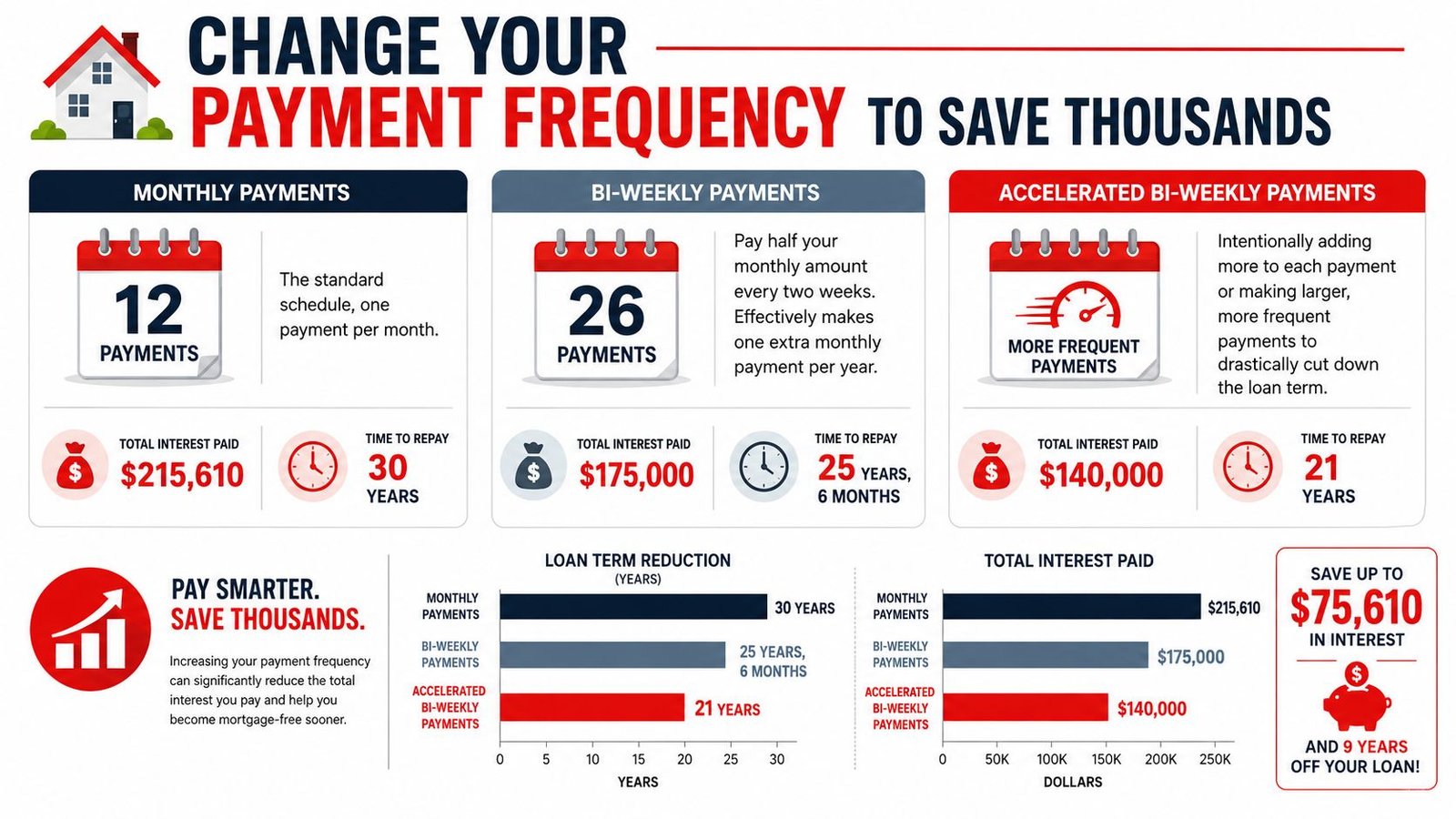
Monthly versus biweekly versus accelerated biweekly
Payment frequency matters, but only if you know which version you are choosing.
Many borrowers use "biweekly" as a catch-all term. Lenders do not. Standard biweekly usually means your regular monthly obligation is divided across the year. Accelerated biweekly means you pay a little more over the course of the year, and that extra amount reduces principal if the lender posts it properly.
Here is the practical difference:
| Payment setup | How it works | Main benefit | Main risk |
|---|---|---|---|
| Monthly | One payment each month | Simple budgeting | Slowest standard path |
| Biweekly | Half the monthly amount every two weeks | Can line up better with pay cycles | May not shorten amortisation much on its own |
| Accelerated biweekly | Higher total paid over the year through more frequent withdrawals | Automatic principal reduction without relying on memory | Only works as intended if the lender sets it up correctly |
For homeowners who are paid every two weeks, this can be one of the easiest ways to make progress without having to decide every month whether to send extra money. It turns a good intention into a system.
It also fits real household cash flow better. In Alberta, that matters for oil and gas workers, commission earners, and families managing uneven monthly costs such as utilities, childcare, and insurance. Smaller, more frequent withdrawals can be easier to absorb than one larger monthly payment, even when the annual total is higher.
If you want a local breakdown of how the math and setup differ, read this guide on biweekly vs monthly mortgage payments in Alberta.
A quick visual can make the difference easier to grasp:
The posting mistake that ruins the strategy
This is the part borrowers miss.
Changing frequency only helps if the extra amount is applied in a way that reduces the principal balance sooner. Some servicing systems hold partial payments and treat them as instalments in waiting until the full contractual payment is assembled. If that is how your mortgage is handled, the expected interest savings can shrink or disappear.
Ask the lender one direct question: If I switch to accelerated biweekly, what amount above my required payment goes to principal, and when is it posted?
Do not settle for a vague answer. "It should work" is not enough. You want the lender to confirm the exact withdrawal amount, how often it comes out, and whether the excess reduces principal right away.
Don't assume the word “biweekly” means “faster.” Ask how the payment is posted, when it is posted, and whether the excess reduces principal immediately.
I also tell clients to check the first statement after the change. If the balance does not move the way you expected, fix it early. A payment setup error left uncorrected for a year can waste a lot of effort.
One more Alberta-specific point. Some lenders give you flexibility to change frequency mid-term, while others make it clunky or tie the option to certain product types. If you have a monoline lender, a credit union mortgage, or a product with tighter servicing rules, confirm the process before you rely on this strategy. The math can be strong. The setup still decides whether it works.
Use Windfalls for Strategic Lump-Sum Payments
Regular payment changes are powerful because they automate progress. Lump sums are powerful for a different reason. They hit the balance all at once.
That matters most when the money would otherwise disappear into day-to-day spending. Tax refunds, bonuses, commissions, gifts, retained business cash, or money from a short period of aggressive saving can all become mortgage-reduction tools if the funds go straight to principal.
When lump sums work best
The best lump-sum payments are usually the ones you decide on in advance.
A few practical examples:
- Tax refund plan. If your refund arrives each year, pre-decide what portion goes to the mortgage.
- Bonus strategy. If your compensation includes a bonus, use part of it for principal before lifestyle creep absorbs it.
- Raise capture. If your income rises, direct the increase to a lump-sum savings bucket and deploy it once a year.
- Inheritance or family gift. Slow down and confirm the mortgage rules first. Large prepayments can be efficient, but only if they stay within your penalty-free allowance.
The benefit of a lump sum is that it reduces the outstanding balance immediately. From that point forward, less interest accrues on the amount you knocked off.
A simple way to think about the impact
You asked for practical guidance, so here's the right way to analyse a lump sum without inventing savings figures. Start with the balance, the mortgage rate, the remaining amortisation, and whether the lender lets you keep the regular payment unchanged after the prepayment. If the payment stays the same while the balance drops, more of each future payment starts working on principal.
Use this framework:
| Metric | Without Prepayment | With $10,000 Prepayment |
|---|---|---|
| Starting mortgage balance | Higher outstanding balance remains | Balance drops immediately by $10,000 |
| Interest charged going forward | Calculated on the full remaining balance | Calculated on a lower remaining balance |
| Share of future payments reaching principal | Lower at the start | Higher sooner |
| Amortisation path | Original schedule continues | Schedule can shorten if regular payments stay the same |
That table doesn’t pretend to give one universal result, because there isn’t one. The specific impact depends on your term, rate, timing, and contract mechanics.
Put windfalls to principal only after you confirm two things. First, the payment is penalty-free. Second, the lender will post it as principal-only, not as an early instalment.
Borrowers often do well with a simple annual habit. One lump sum each year, posted correctly and kept inside the mortgage rules, is often more realistic than trying to squeeze extra money out of every month.
Consider Advanced Options Like Refinancing
Refinancing is a contract reset, not just another way to make extra payments. That matters because a reset can either speed up your payoff plan or make it more expensive.
I usually tell Alberta homeowners to look at refinancing for one of two reasons. First, the current mortgage is too rigid. Some lenders give you limited lump-sum room, no payment increase option, or a product that is a poor fit if your goal is to shorten amortisation aggressively. Second, high-interest debt is eating up the monthly cash that could have gone toward the mortgage in the first place.
Debt consolidation is the cleaner example. If credit cards or unsecured lines of credit are costing far more than your mortgage rate, rolling that debt into a well-structured mortgage can improve cash flow. But the trade-off is real. You may lower the monthly strain while stretching short-term debt over a much longer period. That only helps if you then direct the payment savings to principal, instead of spending the difference.
Home equity products can also fit into that conversation. If you are weighing flexibility against fixed repayment, compare the pros and cons of a home equity loan versus a HELOC in Calgary before changing the mortgage itself.
The part borrowers often miss is cost.
In Alberta, a refinance can trigger a penalty if you break the mortgage before maturity. On a variable mortgage, that may be manageable. On a fixed mortgage, the penalty can be much larger, especially with major banks. I have seen homeowners focus on a lower new rate and miss the fact that the penalty wipes out most of the benefit for years.
Run the math on these points before signing anything:
- Penalty to break the current mortgage
- Legal, appraisal, and setup costs
- New rate and term
- Prepayment privileges on the replacement mortgage
- Whether the new structure shortens amortisation or just lowers the payment
- How long you expect to keep the property and mortgage
Qualification is another practical hurdle. Approval is not automatic just because you already own the home. Income, debt ratios, equity, and lender policy still matter. If your income has changed, your debts have grown, or the file was tight the first time, refinancing may not be available on terms that help.
A good refinance gives you better control over the mortgage and a clear path to faster principal reduction. A weak refinance just adds costs and resets the clock. In many cases, the better move is to keep the existing mortgage, use every prepayment privilege it allows, and wait until renewal to rebuild the structure without a break penalty.
Is Paying Down Your Mortgage Always the Smartest Move
No. Sometimes it is. Sometimes it isn’t.
This is the part many mortgage articles skip, and it’s where a lot of homeowners need the most honest advice.

The opportunity cost question
Every extra dollar sent to principal is a dollar you can’t use somewhere else. That’s not a criticism of prepaying. It’s the actual decision.
For Albertans, this matters even more on renewal cycles. The Bank of Canada’s overnight rate has been 2.75% since March 12, 2025, and many households renewing from earlier low-rate terms are facing very different payoff math, as noted in MySCCU’s discussion of ways to pay off your mortgage faster. The same source also points out the practical question homeowners should ask next: is prepaying the mortgage better than holding cash for emergencies, paying off higher-rate debt, or investing?
That’s the right question.
When faster payoff makes sense and when it might not
Paying down the mortgage faster often makes sense if:
- Your cash reserve is already healthy and a home repair or income interruption won’t push you onto expensive debt.
- Your other debts are under control and you’re not carrying balances that create more pressure than the mortgage does.
- You value certainty and want a guaranteed reduction in interest costs rather than market risk.
- You’re approaching retirement and want lower fixed monthly obligations.
It may not be the best move if:
- Your emergency fund is thin and one surprise expense would force borrowing.
- You’re carrying higher-rate debt elsewhere.
- You need liquidity for renovations, taxes, or uncertain income.
- Your broader financial plan would suffer because all spare cash is getting trapped in home equity.
The best mortgage strategy is the one that improves your whole balance sheet, not just the mortgage line on the statement.
A lot of people ask the mortgage question in isolation. They shouldn’t. If paying an extra amount into the mortgage leaves you cash-poor, you haven’t improved your position as much as you think.
Your Mortgage-Free Faster Checklist and Next Steps
If you want a cleaner action plan, use this checklist and do the steps in order.
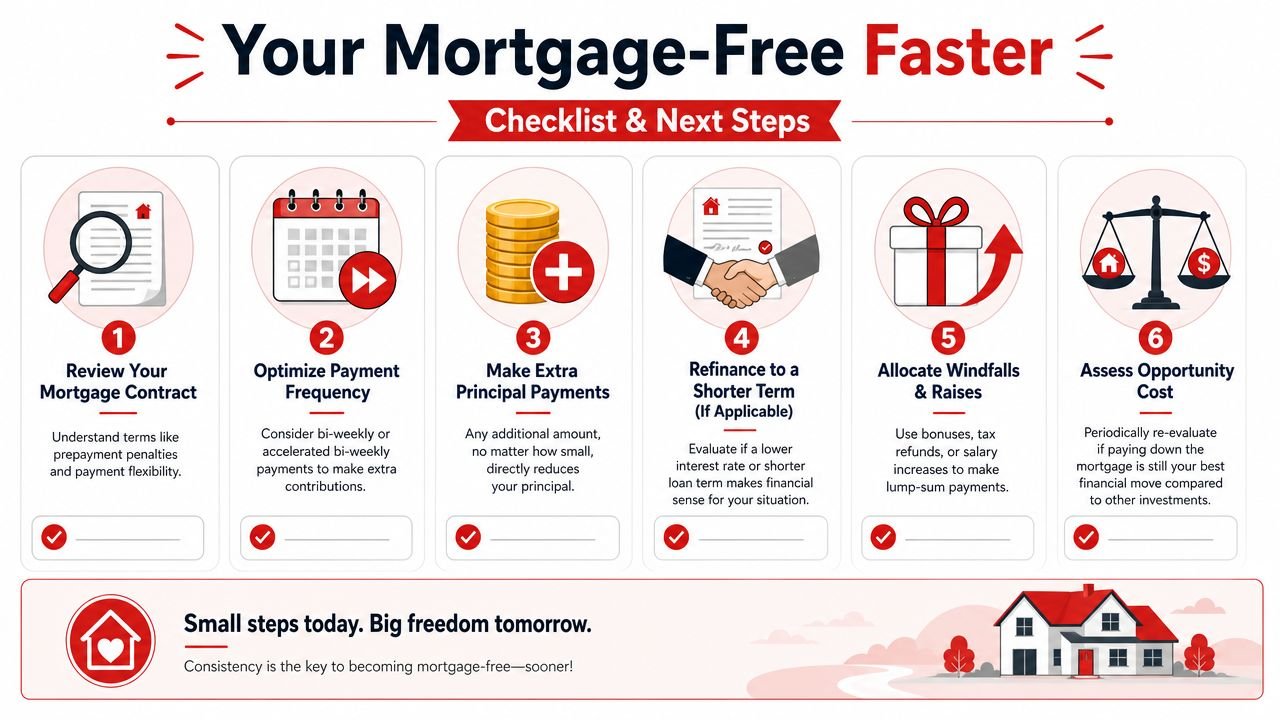
Start with the contract and the payment setup
- Pull your mortgage agreement and find the prepayment clause.
- Call the lender and confirm how extra payments are applied.
- Ask specifically about principal-only posting for payment increases, biweekly schedules, and lump sums.
If your lender can’t explain the process clearly, keep asking until they do.
Build a payoff plan that fits your real life
Use a mix of tactics, not just one:
- Switch frequency carefully if your lender confirms it accelerates principal.
- Set one annual lump-sum habit tied to a refund, bonus, or planned savings target.
- Review refinancing only when the structure improves your position, not just because a different product exists.
- Check opportunity cost before sending every extra dollar to the mortgage.
The homeowners who succeed at this usually don’t rely on motivation. They rely on systems. An automatic frequency change, a scheduled annual review, and a fixed rule for windfalls will beat a vague promise to “pay extra when possible.”
If you’re asking how can I pay down my mortgage faster, the practical answer is this. Read the contract. Use the lender’s penalty-free prepayment options. Confirm every extra dollar hits principal. Then make sure the plan still fits your broader financial life.
If you want help reviewing your options with DreamHouse Mortgage, speak with someone who can look at your current mortgage structure, renewal timing, refinance flexibility, and the trade-offs between faster payoff and keeping cash available. Contact Guriqbal Chahal, MBA, PMP
Mortgage Broker | Dreamhouse Mortgage
📞 403-966-6072