Verifying foreign down payment funds for an Alberta mortgage means providing a clear, traceable record of where your money came from, how it moved, and that it meets Canadian anti-money laundering (AML) standards. Under the Proceeds of Crime (Money Laundering) and Terrorist Financing Act, known as PCMLTFA, all federally regulated lenders in Canada require a 90-day history of every dollar used for a down payment, whether those funds originated in Calgary, Cochrane, or overseas. That requirement applies equally to newcomers arriving in Edmonton, first-time buyers in Airdrie, and anyone bringing savings from abroad. Dreamhouse Mortgage works with buyers across Alberta every day to organize this documentation correctly, preventing the delays that derail closings at the worst possible moment.
How to verify foreign down payment funds for Alberta mortgage: what documents you need
The documentation requirement for foreign mortgage down payment verification is specific and non-negotiable. Lenders do not accept a verbal explanation or a single bank statement. You need a complete file that traces your money from its original source to your Canadian account.
Core documents every lender requires
- 90-day bank statements from both the originating foreign institution and your Canadian account. Statements must show the account holder’s name, account number, and all transactions.
- Wire transfer receipts for every international transfer. These confirm the sending institution, the receiving institution, the amount, and the date.
- Proof of source of funds. This is the document that explains where the money came from before it entered your bank account. Acceptable sources under CMHC and lender guidelines include personal savings, proceeds from a property sale, inheritance, and non-repayable gifts from immediate family members.
- Gift letters, if any portion of your down payment is a gift. The letter must be signed by the donor, state the exact dollar amount, confirm the donor’s relationship to you, and explicitly state that no repayment is expected. Lenders treat any ambiguity in a gift letter as evidence of a loan, which disqualifies the funds entirely.
- Inheritance documentation, such as a probate order or executor’s letter, if funds came from an estate.
- Property sale agreements, if the source is proceeds from selling real estate abroad. A signed sale agreement and closing statement from the foreign transaction are required.
How large deposits are treated
Simply having money in your Canadian account is not enough. Any deposit exceeding 25% of your gross monthly income triggers a detailed review and requires a written explanation backed by corroborating documents. That threshold is low enough that a single wire transfer from overseas will almost always cross it. Lenders examine what they call “deposit velocity,” meaning they look at how quickly large sums appeared and whether the paper trail supports the stated source. A deposit with no matching wire receipt or foreign bank statement will stall your application.
Pro Tip: Gather your foreign bank statements in English or have them officially translated before submitting. Many lenders will not accept statements in a language other than English or French without a certified translation, and requesting one at the last minute adds weeks to your timeline.
How should you prepare fund transfers to meet the 90-day rule?
Timing is the single most controllable factor in foreign down payment verification. Down payment verification is the top cause of mortgage delays for newcomers, and the root cause is almost always a transfer that happened too late to generate the required history. Planning your transfers correctly eliminates that risk entirely.
Calculate your closing date first, then count back 90 days. If you plan to close on a Calgary home in october, your funds need to be in a Canadian account by early july. Work backward from your target date, not forward from when you feel ready.
Use official, traceable banking channels only. Wire transfers through licensed financial institutions create the paper trail lenders require. Cash transfers, informal money transfer services, or peer-to-peer payment apps do not generate the documentation that satisfies PCMLTFA requirements. Every dollar must move through a channel that produces a receipt with institution names, account numbers, and timestamps.
Build your paper trail before the transfer, not after. For offshore funds, creating documentation before the transfer is far easier than reconstructing it later. Take screenshots of your foreign account balances. Save foreign tax documents that show the funds are legitimate income or savings. Download and store transfer confirmations the moment each transaction completes.
Contact your mortgage broker before you transfer anything. Different lenders have different internal requirements beyond the federal minimums. Working with a broker helps you avoid rejected applications caused by documentation gaps that a specific lender considers disqualifying. Dreamhouse Mortgage can tell you exactly what each lender on their panel needs before you move a single dollar.
Keep all documents organized in one folder, digital and physical. Label each file clearly: “Foreign Bank Statement June 2026,” “Wire Transfer Receipt July 3 2026,” and so on. Lenders and brokers process dozens of files simultaneously. A well-organized submission gets reviewed faster.
Avoid splitting large transfers into smaller ones without explanation. Some buyers assume that smaller transfers attract less scrutiny. They do not. Lenders look at the cumulative picture, and unexplained patterns of multiple transfers can raise more questions than a single large wire with proper documentation.
Pro Tip: Ask your foreign bank for a letter confirming your account history and average balance over the past 12 months. This single document can answer multiple lender questions at once and is especially useful when your savings accumulated gradually over time.
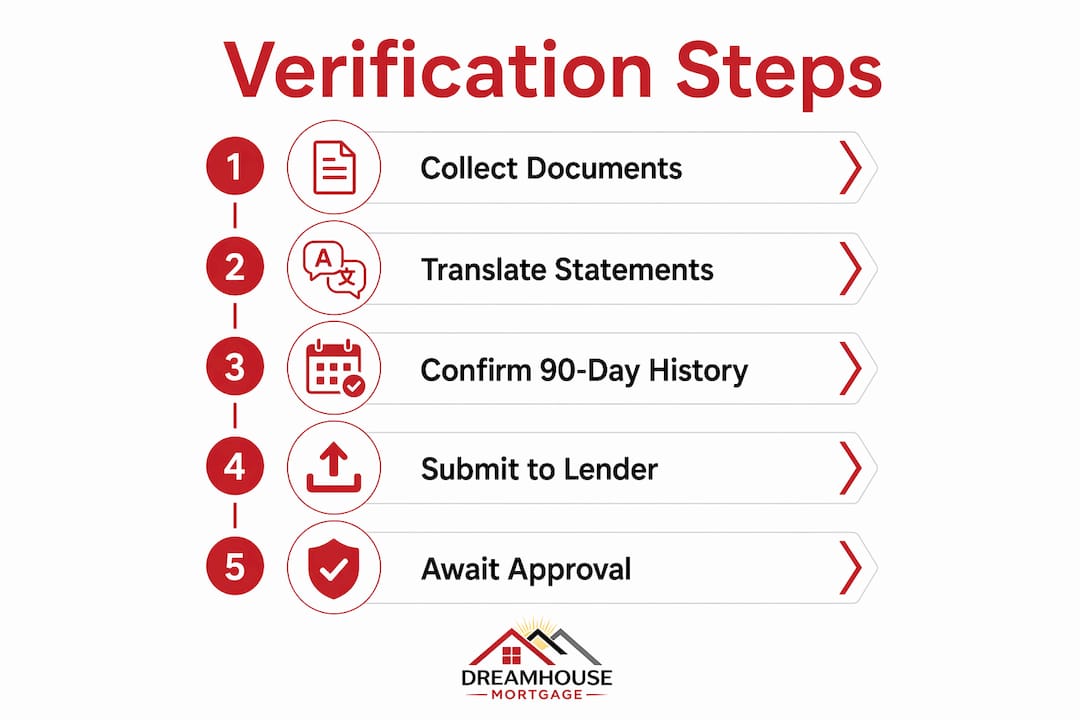
How do Alberta lenders and mortgage brokers verify foreign down payment funds?
The verification process follows a defined workflow under both PCMLTFA and updated 2026 FINTRAC rules. Understanding what happens on the lender’s side helps you prepare a file that moves through review without delays.
The lender’s review process
When your mortgage application arrives, the lender’s underwriting team performs Know Your Customer (KYC) checks and source-of-funds verification as part of their AML compliance program. Under 2026 FINTRAC requirements, mortgage brokers and lenders must maintain written AML programs and keep identity and source-of-funds records for five years. They are also required to file suspicious transaction reports if anything in the file raises a red flag. This is not optional. It is a federal obligation.
The underwriter will check:
- Whether the 90-day account history is complete and unbroken
- Whether every large deposit has a matching explanation and supporting document
- Whether the stated source of funds is consistent with the borrower’s profile and income
- Whether any gift funds are properly documented as non-repayable
- Whether the funds’ movement from the foreign account to the Canadian account is fully traceable
“Lenders expect mortgage brokers to integrate AML verification into the sales process, not treat it as a separate task. Brokers who request documentation early and consistently produce cleaner files, faster approvals, and fewer last-minute holds.” — PCMLTFA compliance best practices
How mortgage brokers fit into this process
Borrowers often mistakenly leave down payment documentation to their lawyers, assuming the legal team will sort it out at closing. Lawyers handle title transfer, not mortgage underwriting. The broker and lender must document the origin of funds during the application stage. Waiting until closing to address documentation gaps jeopardizes your closing date and can void your purchase agreement.
Dreamhouse Mortgage integrates AML documentation review into the mortgage application process from day one. For newcomers buying their first home in communities like Chestermere, Okotoks, or Red Deer, this means getting a checklist of required documents before any lender submission happens. You can review foreign income mortgage approval examples for Alberta to understand how different fund sources are documented in practice.
What causes delays
Incomplete documentation is the leading cause of underwriting holds. Specific triggers include:
- Missing wire transfer receipts for one or more transfers
- Foreign bank statements that do not cover the full 90-day window
- Gift letters that omit the repayment clause or the donor’s relationship
- Large deposits with no written explanation
- Funds that passed through an intermediary account without documentation of that step
Each of these issues adds days or weeks to your approval timeline. Lenders do not approve files with open questions about fund origin. They pause the file and request additional documentation, which resets the review clock.
What are the most common mistakes when verifying foreign funds?
Foreign down payment verification fails most often because of predictable, avoidable errors. Knowing these pitfalls in advance lets you sidestep them entirely.
Transferring funds too late. The 90-day rule is absolute. Transferring funds to a Canadian account 90 days ahead simplifies documentation and reduces last-minute requests. Buyers who transfer funds 30 or 60 days before closing consistently face holds.
Using undocumented transfer channels. Cash transfers, informal remittance services, or transfers through a friend’s account create gaps in the paper trail that lenders cannot accept under AML rules. Every transfer must go through a licensed financial institution.
Treating a gift as an informal arrangement. If a parent in Edmonton or a relative abroad sends money toward your down payment, that gift requires a formal gift letter. Without it, the lender classifies the funds as a loan and excludes them from your eligible down payment.
Assuming funds already in Canada need no documentation. Simply showing funds in a Canadian account is insufficient. Lenders look at the full history of how those funds arrived. If a large deposit appeared in your Canadian account six months ago with no explanation on file, the lender will still ask for documentation of its origin.
Ignoring lender-specific requirements. Federal rules set the floor, not the ceiling. Individual lenders can and do impose stricter internal standards. A broker who knows each lender’s specific requirements prevents you from submitting to the wrong lender with the wrong documentation.
Failing to document inherited funds properly. Inheritance is an accepted down payment source, but only with proper paperwork. A probate order, executor’s letter, or estate distribution statement is required. A family member’s verbal confirmation is not.
Leaving AML compliance to the last minute. Industry experts caution that treating AML as a compliance overlay rather than an integrated part of the mortgage process causes the most preventable delays. Start gathering documents the moment you decide to buy, not the week before your offer is accepted.
The fastest fix for most of these issues is working with an experienced Alberta mortgage broker early. A broker who specializes in New to Canada mortgage programs knows exactly which documents each lender requires and can flag gaps before they become problems.
Key Takeaways
Verifying foreign down payment funds for an Alberta mortgage requires a complete, traceable paper trail covering 90 days of fund history, proof of source, and compliance with PCMLTFA and 2026 FINTRAC AML rules.
| Point | Details |
|---|---|
| 90-day rule is mandatory | All lenders require a full 90-day history of down payment funds, domestic or foreign, under PCMLTFA. |
| Source of funds must be documented | Acceptable sources include savings, property sale proceeds, inheritance, and non-repayable family gifts with signed letters. |
| Large deposits trigger detailed review | Any deposit over 25% of gross monthly income requires a written explanation and corroborating documents. |
| Transfer timing determines approval speed | Moving funds to a Canadian account at least 90 days before closing prevents the most common mortgage delays for newcomers. |
| Broker involvement prevents costly errors | Working with an Alberta mortgage broker early ensures lender-specific documentation requirements are met before submission. |
Dreamhouse Mortgage helps Alberta buyers verify foreign funds
Navigating foreign down payment verification is straightforward when you have the right guidance from the start. Dreamhouse Mortgage, led by Guriqbal Chahal, MBA, PMP, specializes in first-time buyer and newcomer mortgages across Calgary, Airdrie, Cochrane, Chestermere, Edmonton, Red Deer, and surrounding Alberta communities. The team reviews your documentation before any lender submission, identifies gaps early, and matches your file to the lender whose requirements align with your fund sources.

Dreamhouse Mortgage’s mortgage broker services include full support for documenting international down payments, from reviewing foreign bank statements to preparing gift letters and coordinating with lenders on AML compliance. Whether your funds are coming from India, the Philippines, China, or anywhere else, the process is manageable with the right broker. Contact Guriqbal Chahal at 403-966-6072 or visit the Google Business Profile to schedule a consultation and get your mortgage moving in the right direction.
FAQ
What is the 90-day rule for foreign down payment funds?
The 90-day rule requires that all down payment funds, including those from foreign accounts, have a documented transaction history covering the 90 days before your mortgage closing date. This is a federal requirement under PCMLTFA that all Canadian lenders must enforce.
What documents prove the source of foreign down payment funds?
Lenders require 90-day bank statements from the originating foreign account, wire transfer receipts, and source-of-funds proof such as a property sale agreement, inheritance documents, or a signed non-repayable gift letter from an immediate family member.
Can a gift from a family member abroad be used as a down payment in Alberta?
Yes, a gift from an immediate family member is an acceptable down payment source under Canadian mortgage rules. The donor must sign a gift letter stating the exact amount, their relationship to you, and that no repayment is expected.
How long does foreign down payment verification take?
Verification typically takes two to four weeks if all documents are complete and submitted at the start of the application. Incomplete files or missing wire receipts can extend the review by several additional weeks.
Do lenders in Alberta have stricter rules than federal minimums for foreign funds?
Yes. Individual lenders can impose requirements beyond the federal PCMLTFA minimums. Working with a mortgage broker who knows each lender’s internal standards prevents mismatched applications and reduces the risk of a rejected file.