
Alberta investors rely on five core financing structures: interest-only mortgages, portfolio lending, conventional buy-to-rent, HELOC/equity recycling, and private or bridge lending. Each serves a different hold strategy. Rental property 5-year fixed rates in Canada are typically around 4.49%–4.64%, compared to about 4.04% for insured principal-residence mortgages. On a $400,000 mortgage, this means an extra cost of approximately $7,700–$10,500 over five years. CMHC provides mortgage insurance for 2–4 unit non-owner-occupied properties, which can improve LTV and amortization terms for qualifying investors.
Which strategy fits your situation:
- Interest-only: Long-term buy-and-hold investors maximizing monthly cash flow
- Portfolio lending: Investors building 3+ properties who need flexible lender sequencing
- Conventional buy-to-rent: Stable, fully amortizing financing for single rental units
- HELOC/equity recycling: Using existing home equity to fund new acquisitions
- Private/bridge lending: Short-term holds, flips, or deals that need fast funding
Call Guriqbal Chahal, MBA, PMP, Broker of Record at Dreamhouse Mortgage: 403-966-6072 | Google Business Profile
Pro Tip: Matching your file to the right lender methodology — not chasing the lowest headline rate — is what moves the needle on qualification.
Table of Contents
- How do lenders count rental income for qualification?
- Which lender terms affect your long-term returns most?
- How do you choose the right lender and strategy?
- What are the down payment rules for investment properties in Canada?
- When does refinancing or renewal improve your returns?
- How does your credit score affect investor mortgage terms?
- What are the tax implications for Alberta real estate investors?
- Can a co-investor or guarantor improve your mortgage options?
- How do multiple properties and cross-collateralization work?
- Dreamhouse Mortgage puts your investor strategy into action
- Key Takeaways
- FAQ
How do lenders count rental income for qualification?
Lenders use two main methods. The add-back approach counts a substantial portion of gross rent as income, directly increasing your total qualifying income. The offset method subtracts rental expenses from rent and applies only the net figure. The rental income treatment your lender uses can shift your qualification power by tens of thousands of dollars on a single property.

A-lenders (major banks) often apply the offset method, which is more conservative. Credit unions and B-lenders frequently use add-back, making them stronger options for investors with multiple properties. Correct lease documentation, consistent rental history, and clear allocation of tenant-paid utilities all improve your ratios regardless of method.
Which lender terms affect your long-term returns most?
Prepayment privileges, portability, and renewal flexibility matter as much as the rate itself for investors. Most lenders allow moderate annual lump-sum prepayments and payment increases without penalty. Portability lets you transfer your mortgage to a new property at renewal without triggering a break penalty, which is useful when you sell one asset and redeploy capital.
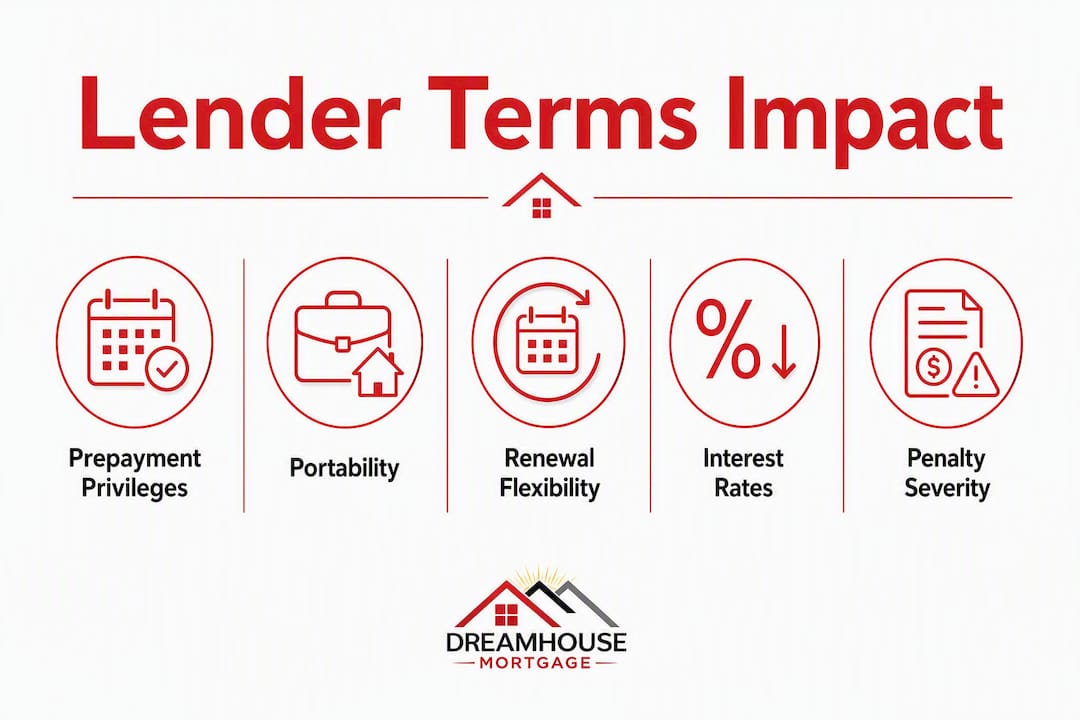
Closed terms carry lower rates but heavy penalties if you need to refinance early. For investors planning a value-add project or a refinance within 2–3 years, an open term or shorter fixed term often costs less overall; you can learn more about custom home construction financing options that support such projects. Review these terms before signing, not at renewal.
How do you choose the right lender and strategy?
A-lenders typically cap rental portfolios at 4–5 financed properties including your principal residence. B-lenders and credit unions allow more properties and apply more flexible income treatment. Private lenders are equity-based, move quickly, and carry higher costs — suited to bridge situations, not long-term holds.
Questions to ask before committing:
- Does this lender use add-back or offset for rental income?
- What is the prepayment privilege and penalty structure?
- How many financed properties does this lender allow?
- Is the mortgage portable at renewal?
Red flags include vague answers on penalty calculations, no written rate hold, and lenders who cannot explain their rental income methodology.
What are the down payment rules for investment properties in Canada?
Pure investment properties (non-owner-occupied, single unit) require a minimum 20% down payment and are generally uninsurable. Mortgage default insurance is required when the down payment is below 20%, with premiums ranging roughly 0.6%–4.5% depending on down payment size — but that threshold does not apply to single-unit rentals you will not occupy.
The exception is CMHC’s Income Property program, which covers 2–4 unit non-owner-occupied rentals up to 80% LTV with a maximum 25-year amortization. GDS/TDS limits and the federal stress test apply. For Alberta investors in Calgary, Airdrie, or Edmonton buying multi-unit properties, this can meaningfully improve financing terms.
When does refinancing or renewal improve your returns?
Refinancing works best when your property has appreciated enough to pull equity for a new acquisition, or when your current rate is materially above market at renewal. A mortgage refinance in Calgary typically takes 30–45 days from application to funding.
At renewal, switching lenders costs nothing in penalty and often produces a better rate. Investors who stay with their existing lender at renewal without negotiating typically leave money on the table. A broker can run a side-by-side comparison across multiple lenders before your renewal date.
How does your credit score affect investor mortgage terms?
A credit score above 680 generally qualifies for A-lender pricing. Scores in the 600–679 range push most files toward B-lenders or credit unions, which carry higher rates and fees. For investors, the documentation burden is heavier than for owner-occupied purchases: expect to provide two years of T1 Generals and Notices of Assessment, current leases, mortgage statements on all financed properties, and a property income/expense summary.
Self-employed investors face additional scrutiny. Lenders want to see consistent net income across two tax years, not just gross revenue. Structuring your file correctly before application — not after — is where a broker adds the most value.
What are the tax implications for Alberta real estate investors?
Mortgage interest on a rental property is tax-deductible against rental income, along with property taxes, insurance, maintenance, and property management fees. Capital cost allowance (CCA) is available but carries recapture risk on sale, so most investors use it selectively.
Alberta has no provincial sales tax and no provincial land transfer tax, which reduces acquisition costs compared to other provinces. Interest deductibility means a higher mortgage rate is less damaging to net returns than the gross rate suggests. Consult a Canadian tax professional for advice specific to your situation.
Can a co-investor or guarantor improve your mortgage options?
Adding a co-borrower with strong income or a clean credit profile can push a marginal file into A-lender territory. The co-borrower’s income is counted in full for qualification, and their credit score is factored into pricing. The trade-off: the mortgage appears on both parties’ credit bureaus and counts against both TDS ratios for future borrowing.
A guarantor provides security without taking title, which some investors prefer for ownership clarity. Lenders treat guarantors differently — some require them to qualify as if they were the primary borrower. Confirm the lender’s exact treatment before structuring the deal.
How do multiple properties and cross-collateralization work?
Each additional financed property reduces your remaining borrowing capacity because scheduled mortgage payments count against your TDS ratio regardless of actual cash flow. Careful lender sequencing — placing properties with lenders who apply add-back income treatment — preserves qualification room as your portfolio grows.
Cross-collateralization links two or more properties as security for a single loan. It can improve LTV terms but restricts your ability to sell or refinance individual assets independently. Most experienced Alberta investors avoid cross-collateralization unless the rate benefit is substantial and the exit strategy is clear. A real estate portfolio mortgage structured through a broker typically avoids this constraint.
Pro Tip: Target a debt service coverage ratio of 1.20x or higher, and budget 3%–8% of annual rent for vacancy and 5%–10% for capital expenditures before presenting a deal to a lender.
Dreamhouse Mortgage puts your investor strategy into action
Guriqbal Chahal, MBA, PMP, Broker of Record at Dreamhouse Mortgage, works with banks, credit unions, monoline lenders, and private lenders to match Alberta investors to the right financing structure. Dreamhouse Mortgage serves Calgary, Airdrie, Cochrane, Chestermere, Edmonton, Red Deer, and surrounding communities.

Here is what Dreamhouse Mortgage does for investor clients:
- Pre-approval and rental income packaging — correct file structure before lender submission
- Lender match and rate negotiation across multiple lender types
- Prepayment, portability, and term structure review
- Timeline and fee estimate from pre-approval to funding
Documents to have ready: T1 Generals and NOAs (two years), current leases, mortgage statements on all properties, property income/expense summary, and government-issued ID.
Typical timeline: pre-approval in 24–48 hours, conditional approval in 5–10 business days, funding in 30–45 days.
Call Guriqbal Chahal at 403-966-6072 or visit the Google Business Profile to book a consultation. For investment property mortgage services in Alberta, contact Dreamhouse Mortgage directly.
Key Takeaways
Alberta investors using the right mortgage strategy and lender combination can qualify for more properties, preserve cash flow, and reduce long-term financing costs compared to defaulting to a single bank.
| Point | Details |
|---|---|
| Rate premium is real | Rental property 5-year fixed rates are around 4.49%–4.64% versus 4.04% for insured principal residence mortgages, typically adding about $7,700–$10,500 over five years on a $400,000 mortgage. |
| Income treatment drives qualification | Lenders using add-back (50%–80% of gross rent) qualify investors for significantly more than offset-method lenders. |
| 20% down is the floor | Single-unit non-owner-occupied rentals require a minimum 20% down payment and are uninsurable under standard CMHC rules. |
| Portfolio limits vary by lender type | A-lenders typically cap financed properties at 4–5; B-lenders and credit unions allow more flexibility. |
| Dreamhouse Mortgage | Guriqbal Chahal matches Alberta investor files to the right lender type, income treatment, and term structure across Calgary, Edmonton, and surrounding communities. |
FAQ
What is the minimum down payment for a rental property in Alberta?
Single-unit non-owner-occupied rental properties require a minimum 20% down payment and do not qualify for standard mortgage default insurance. Multi-unit (2–4 unit) non-owner-occupied properties may qualify under the CMHC Income Property program at up to 80% LTV.
How does rental income affect my mortgage qualification in Canada?
Lenders apply either an add-back method (50%–80% of gross rent added to income) or an offset method (net rental income after expenses). The method your lender uses materially affects how much you can borrow.
What mortgage strategies work best for Alberta investors building a portfolio?
Portfolio lending through B-lenders or credit unions, combined with careful lender sequencing to preserve TDS room, is the most common approach. A broker who understands add-back income treatment and prepayment flexibility can extend your borrowing capacity across multiple properties.
Can Dreamhouse Mortgage help with investment property financing in Calgary and Edmonton?
Yes. Guriqbal Chahal at Dreamhouse Mortgage provides investment property mortgage services across Calgary, Edmonton, Airdrie, Cochrane, Red Deer, and surrounding Alberta communities, with access to banks, credit unions, monoline, and private lenders.
This article provides general information about Canadian mortgage financing and is not financial, legal, or tax advice. Confirm current rules and your specific situation with a qualified mortgage professional or tax advisor.
Recommended
- Ultimate Power Guide: Real Estate Portfolio Mortgage Alberta – Build a Scalable Property Empire in Calgary & Beyond
- Ultimate Investment Property Mortgage Alberta Guide: Down Payment, Rates & Secrets to Maximize Profit
- Investment Property Mortgage Calgary | DreamHouse
- The Ultimate Guide to Buying a Second Home in Alberta: The Truth About Second Home Mortgage Alberta Options