A mortgage draw is a scheduled partial disbursement of your construction loan, released only after a third-party inspector or appraiser confirms that a specific build milestone is complete. For a typical Alberta custom home, expect 3–4 draws tied to milestones such as foundation, lock-up, rough-ins, and final completion; a roughly 10% statutory holdback on each draw; and a 5–10 business day gap between inspection confirmation and funds arriving in your lawyer’s trust account. Budget bridge capital for that gap before you break ground.
The single most important step before construction starts: Confirm a written draw schedule with your lender, allocate a 15–20% contingency fund for cost overruns, and contact your mortgage broker early to coordinate inspections, holdbacks, and lien documentation. Waiting until a draw is due creates cash-flow pressure that is entirely avoidable.
Three actions to take right now:
- Confirm the written draw schedule and milestone definitions with your lender before signing.
- Budget for inspection fees ($200–$350 per visit), the 10% holdback per draw, and the 5–10 business day processing gap.
- Call Guriqbal Chahal, MBA, PMP at 403-966-6072 if you have questions about draw timing, lien waivers, or holdback administration.
Table of Contents
- What Are Mortgage Draws and How Do They Differ from a Regular Mortgage?
- What Does a Typical Alberta Draw Schedule Look Like?
- How Do You Request a Draw and What Does the Lender Verify?
- What Do You Actually Pay During the Draw Period?
- What Legal Protections Apply to Alberta Construction Draws?
- How Do You Prepare and Manage Draws to Avoid Delays?
- How Does the Construction Loan Convert to a Permanent Mortgage?
- How Dreamhouse Mortgage Helps Alberta Builders Manage Draws
- Key Takeaways
- The Draw Process Rewards Preparation, Not Patience
- Construction Draw Coordination for Alberta Builds
- Useful Canadian Sources and Next Steps
- FAQ
What Are Mortgage Draws and How Do They Differ from a Regular Mortgage?
A standard purchase mortgage pays out in a single lump sum on closing day. A construction mortgage works differently: the lender releases funds in stages, called draws or progress advances, each tied to a verified construction milestone. The lender never has a finished, marketable property as security until the build is complete, so staged disbursement is how they manage that risk.
Each draw follows a backward-looking process. Money moves only after work is done, not before. A third-party appraiser or inspector visits the site, confirms the milestone is complete, and submits a report. The lender then reviews invoices, checks for outstanding liens, and releases funds to your real estate lawyer’s trust account. Your lawyer verifies holdback obligations before passing the remainder to the builder.
During construction, you pay interest only on the amount drawn to date, not on the full approved loan amount. That interest portion grows with each draw. Once construction is complete and the loan converts to a permanent mortgage, payments shift to principal and interest on the full balance.
The practical impact: you will not have the full loan available at any point during the build. Builder payment schedules must align with draw timing, or you will need short-term bridge funds to cover the gap.
Pro Tip: Construction mortgages typically require a down payment or equity contribution of 20–30%, higher than a standard purchase mortgage. Confirm your equity position with your broker before applying so there are no surprises at approval.
What Does a Typical Alberta Draw Schedule Look Like?
Most Alberta construction mortgages use 3–4 progress draws for a standard custom build. Larger or more complex projects may use 5 or more. The number of draws affects cash-flow planning: fewer draws mean larger individual releases but longer gaps between them.

Sample draw percentage frameworks
The table below shows three common frameworks. Percentages represent the cumulative portion of the total loan released at each stage.
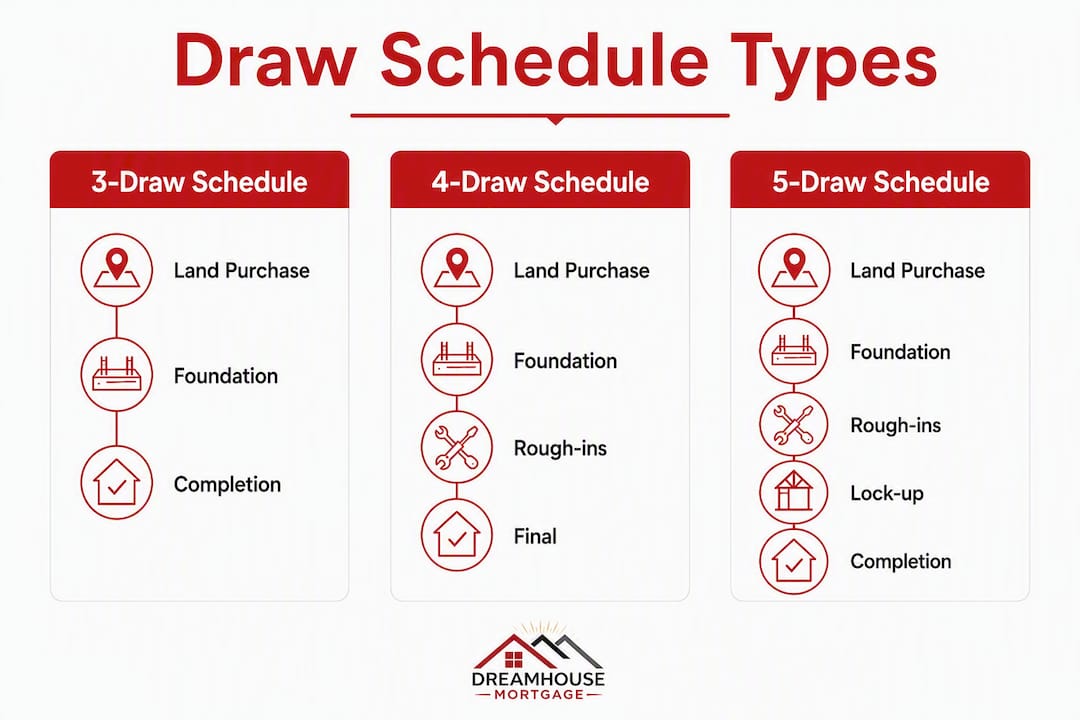
| Draw Stage | 3-Draw Schedule | 4-Draw Schedule | 5-Draw Schedule |
|---|---|---|---|
| Land / lot purchase (if applicable) | Up to 65–75% of land value | Up to 65–75% of land value | Up to 65–75% of land value |
| Foundation complete | 15–20% of build cost | 15–20% of build cost | 15–20% of build cost |
| Lock-up (framing, roof, windows) | 40–50% of build cost | 40–50% of build cost | 35–45% of build cost |
| Interior / rough-ins (drywall, mechanical) | — | ~75% of build cost | ~60% of build cost |
| Drywall / finishes | — | — | ~75% of build cost |
| Final completion | Remaining balance | Remaining balance | Remaining balance |
Source: WOWA.ca construction loan guide; Alberta New Home Construction Loan Process
If you do not already own the lot, the first draw can advance 65–75% of the land value to purchase it, depending on the lender. That advance is separate from the construction draw schedule and is typically processed at the same time as the initial loan approval.
Red flags to watch for in any draw schedule:
- Front-loaded draws that release more than 50% of funds before lock-up, with no corresponding milestone verification requirement.
- Milestones defined vaguely as “substantial progress” rather than specific, inspectable stages.
- No mention of inspector sign-off, lien waivers, or holdback percentages.
- Missing a final draw tied to an occupancy permit or completion certificate.
Each milestone in a properly structured schedule should specify the inspector sign-off required, the invoices to be submitted, and whether lien waivers from subcontractors are needed before funds release.
How Do You Request a Draw and What Does the Lender Verify?
The draw request process follows a consistent sequence. Knowing each step helps you anticipate delays and prepare documents in advance.
Step-by-step draw request process
- Borrower or builder submits a draw request to the lender, along with contractor invoices and a builder’s progress certificate confirming the milestone is complete.
- Lender orders an inspection or appraisal. A third-party appraiser visits the site to confirm the work matches the milestone definition in the draw schedule.
- Appraiser submits the inspection report. The lender reviews it against the draw schedule and the original cost breakdown.
- Lender reviews legal documentation. This includes checking for any registered liens, reviewing lien waivers from subcontractors, and confirming the statutory holdback amount.
- Lender releases funds to the lawyer’s trust account. Funds go to your real estate lawyer, who administers the holdback and confirms no liens are outstanding before releasing the net amount to the builder.
- Builder receives payment. The net draw amount (total draw minus holdback and any deducted fees) is transferred to the builder.
Documents lenders typically require per draw
- Signed contractor invoice for work completed at the milestone stage.
- Builder’s progress certificate or statutory declaration.
- Third-party inspection or appraisal report.
- Lien waivers from subcontractors and suppliers paid in the prior draw period.
- Updated project schedule showing remaining work and projected completion date.
- Proof of builder’s current insurance and license (often required only at the first draw).
Inspection fees typically run $200–$350 per visit. Some lenders deduct this fee directly from the draw proceeds; others bill the borrower separately. Confirm fee handling before you accept the draw schedule, because the difference affects your net cash available at each stage.
The 5–10 business day gap between inspection completion and funds arriving in the trust account is the most common source of builder payment friction. Pre-fund a small cash reserve to cover builder invoices during that window.
What Do You Actually Pay During the Draw Period?
Carrying costs during construction are real and often underestimated. Here is a breakdown of what to budget.
Interest payments
You pay interest only on the cumulative amount drawn, not on the full approved loan. Interest grows with each draw release. If your approved loan is $600,000 and you have drawn $200,000 after the foundation draw, your monthly interest payment is calculated on $200,000 at your construction loan rate.
Inspection and appraisal fees
At $200–$350 per inspection, a 4-draw schedule means $800–$1,400 in inspection costs alone. Some lenders deduct these from draw proceeds, which reduces the net funds available to the builder at each stage.
Statutory holdback
Alberta lenders commonly hold back 10% of each draw under provincial lien rules. On a $150,000 draw, $15,000 stays in holdback. That money is not lost; it is released after the lien period clears (typically about 45 days after substantial completion, provided no liens are filed). But it does reduce the cash available to pay your builder at each stage.
Sample draw calculation
| Item | Amount |
|---|---|
| Gross draw amount | $150,000 |
| Less 10% statutory holdback | ($15,000) |
| Less inspection fee (deducted by lender) | ($200–$350) |
| Net funds released to builder | $134,700 |
Your builder receives $134,700, not $150,000. Plan your builder payment schedule around the net figure.
Many lenders recommend a contingency fund on top of the total build cost to cover overruns during the typical 8–14 month build window. Without it, a cost overrun can stall a draw request or require private bridge financing at a higher rate.
What Legal Protections Apply to Alberta Construction Draws?
Alberta’s Prompt Payment and Construction Lien Act governs statutory holdbacks and lien rights on construction projects. Understanding it protects both you and your builder.
Key principle under Alberta lien law: The 10% statutory holdback is not optional. It exists to protect subcontractors and suppliers who have a right to file a lien against the property if they are not paid. Releasing the full draw to the builder before the lien period clears exposes the property owner to claims from unpaid trades.
The holdback is typically released about 45 days after substantial completion, provided no liens have been filed against the title. Your real estate lawyer monitors this period and confirms the title is clear before releasing holdback funds.
Practical steps to reduce lien risk in Alberta
- Require lien waivers from every subcontractor and supplier before approving each draw payment.
- Verify your builder’s payment history with subcontractors before signing the construction contract.
- Use a lawyer’s trust account for all draw disbursements, not direct transfers to the builder.
- Confirm with your lawyer exactly when the lien period starts and ends for each draw stage.
- Review the builder’s subcontractor list and confirm all trades are licensed and insured.
Pro Tip: Coordinate your draw request timing with your builder’s invoicing cycle. If the builder invoices subcontractors on the 1st of the month, submit your draw request at least two weeks earlier so inspection, lender review, and trust-account processing all complete before those invoices are due.
How Do You Prepare and Manage Draws to Avoid Delays?
Draw delays are almost always documentation problems. Having the right paperwork ready before the inspection request goes in cuts the 5–10 business day processing window as short as possible.
Documentation checklist for each draw
- Signed and itemized builder invoice for the completed milestone.
- Builder’s progress certificate or statutory declaration.
- Lien waivers from all subcontractors and suppliers paid in the prior period.
- Current project schedule with updated completion date.
- Proof of builder’s liability insurance and contractor license (first draw only, or on request).
- Any change-order documentation affecting the original cost breakdown.
For a complete Alberta mortgage document checklist, the mortgage documents guide for Alberta covers what lenders expect at each stage.
Questions to ask your lender before the first draw
- How are inspection fees handled: deducted from the draw or billed separately?
- What is the typical timeline from inspection completion to trust account deposit?
- What is the holdback percentage and how is it administered?
- What triggers conversion to the permanent mortgage and what documents are required?
Questions to ask your builder
- What is your invoicing cadence and how far in advance do you need draw funds?
- Who issues lien waivers for each subcontractor, and when?
- How are change orders documented and submitted to the lender?
- What is your process if a subcontractor files a lien?
Delay-avoidance tactics
- Confirm a written draw schedule with milestone definitions before construction starts.
- Pre-fund a short-term cash reserve of at least one draw cycle’s worth of builder payments.
- Appoint your real estate lawyer to monitor the trust account and flag any lien registrations immediately.
- Call your mortgage broker at the first sign of a timing conflict between the lender’s inspection schedule and the builder’s payment deadline. Early intervention prevents costly bridge financing.
How Does the Construction Loan Convert to a Permanent Mortgage?
The final draw and loan conversion are the most documentation-intensive steps in the entire process. Missing one item can delay your occupancy or lock you into a higher rate.
What triggers conversion: The lender requires 100% construction completion, a final inspection or appraisal confirming the home is complete and habitable, an occupancy permit (where required by the municipality), and sign-off that no liens are outstanding on the title. All holdback funds must also be cleared or held in trust pending the lien period.
Final draw mechanics
The last draw releases the remaining loan balance, minus any holdback still in trust. Before those holdback funds are released, your lawyer confirms the lien period has expired and no claims are registered. In Alberta, that window is typically about 45 days after substantial completion.
What the borrower must prepare for conversion
- Final home insurance policy naming the lender as loss payee.
- Updated property tax assessment or municipal tax certificate if required by the lender.
- Final appraisal confirming the completed home’s market value.
- Occupancy permit from the municipality.
- Closing paperwork for the permanent mortgage, including any updated income or employment verification.
Some construction-to-perm products allow borrowers to lock the take-out mortgage rate for 12–18 months in advance. Given that Alberta builds typically run 8–14 months, a rate lock secured at the start of construction can protect against rate increases during the build. Current Canadian mortgage rate trends are worth reviewing before you choose between a fixed and variable take-out rate.
Converting the construction loan is a frequent sticking point. Have final insurance, tax information, and a fresh appraisal ready before the final inspection is ordered, not after. Waiting until the lender asks for them adds weeks to the conversion timeline.
How Dreamhouse Mortgage Helps Alberta Builders Manage Draws
Dreamhouse Mortgage, founded in 2013 and headquartered in Calgary, provides broker-led draw coordination for construction mortgage clients across Alberta, including Calgary, Airdrie, Cochrane, Chestermere, Okotoks, Red Deer, and Edmonton.
Guriqbal Chahal, MBA, PMP, Broker of Record, works directly with clients to negotiate draw schedules with lenders, coordinate appraisal timing, review builder invoices and lien waivers before submission, and communicate with the lawyer’s trust account to keep disbursements on track. The brokerage has access to banks, credit unions, monoline lenders, alternative lenders, and private lenders, which means draw schedule terms, holdback administration, and rate-lock options can be compared across multiple products before you commit.
Local knowledge matters in Alberta construction financing. Familiarity with provincial lien rules under the Prompt Payment and Construction Lien Act, relationships with local appraisers in Calgary and surrounding communities, and direct experience with builder reputations in Cochrane, Airdrie, and Chestermere all reduce the risk of draw delays and lien surprises.
Pro Tip: Ask your broker to review the lender’s draw schedule before you sign the construction contract. Mismatches between the lender’s milestone definitions and the builder’s invoicing stages are the most common cause of draw delays, and they are easy to fix before construction starts.
For draw coordination, lender selection, and broker-negotiated rate options, call Guriqbal Chahal, MBA, PMP at 403-966-6072 or visit the Dreamhouse Mortgage Google Business Profile.
Key Takeaways
Construction draws are a staged disbursement system where funds release only after verified milestones, and Alberta borrowers must budget for a statutory holdback, inspection fees per draw, and a brief processing gap at every stage.
| Point | Details |
|---|---|
| Draw definition | Funds release in stages tied to verified milestones, not as a lump sum at closing. |
| Typical draw count | Most Alberta custom builds use 3–4 draws tied to foundation, lock-up, interior, and completion; larger projects may use 5 or more. |
| Statutory holdback | Expect a statutory holdback per draw in Alberta, released after a lien period following substantial completion if no liens are filed. |
| Inspection fees | Budget inspection fees per visit; some lenders deduct this fee from the draw proceeds. |
| Conversion to permanent mortgage | Requires final appraisal, occupancy permit, clear title, and final insurance before the loan converts to principal-and-interest payments. |
| Dreamhouse Mortgage | Guriqbal Chahal, MBA, PMP coordinates draw schedules, lender access, and lien documentation for Alberta builders. Call 403-966-6072. |
The Draw Process Rewards Preparation, Not Patience
Most borrowers who run into draw problems did not make a mistake during construction. They made it before construction started, by accepting a draw schedule they did not fully understand or by skipping the step of aligning the lender’s milestone definitions with the builder’s invoicing cycle.
The 10% holdback is the detail that surprises people most. On a $600,000 build with four draws, that holdback accumulates to $60,000 sitting in trust at various points during the project. That is not money the builder can use to pay subcontractors. Builders who are not told about this in advance sometimes invoice for the full draw amount, creating a shortfall that stalls the project.
The 5–10 business day processing gap is the second most common friction point. It is structural, not a lender error. The inspection has to happen, the report has to be reviewed, the lawyer has to check for liens, and the trust account has to process the transfer. That sequence takes time. A builder who expects payment on day one of a draw request will be waiting.
The fix for both problems is the same: a broker who reviews the draw schedule before you sign, confirms the holdback mechanics with the lender, and sets expectations with the builder about net payment amounts and timing. Rate-lock strategy for the take-out mortgage is worth addressing at the same time. Locking a rate at the start of a 12-month build, when rates are known, is a straightforward hedge that many first-time builders overlook until the build is nearly done.
Construction Draw Coordination for Alberta Builds
Dreamhouse Mortgage provides broker-led construction mortgage services for first-time builders and home buyers across Calgary, Airdrie, Cochrane, Chestermere, Red Deer, and Edmonton. The brokerage compares draw schedule terms, holdback administration, and rate-lock options across banks, credit unions, monoline lenders, and alternative lenders, so clients get a construction mortgage structure that fits their build timeline and cash-flow needs.

For first-time buyers building in Alberta, Dreamhouse Mortgage handles lender selection, draw schedule review, appraisal coordination, and lawyer/trust-account communication from start to conversion. Clients also get access to mortgage affordability planning and rate comparison tools to budget the full build cost before breaking ground.
To get help coordinating draws, reviewing your builder’s invoicing schedule, or locking a take-out rate for your permanent mortgage, call Guriqbal Chahal, MBA, PMP at 403-966-6072 or visit dreamhousemortgage.ca.
Useful Canadian Sources and Next Steps
| Resource | What It Covers |
|---|---|
| Alberta New Home Construction Loan Process | Alberta-specific draw schedules, holdback rules, and lender practices |
| WOWA.ca Construction Loans Guide | Canadian draw percentage frameworks, land advance rules, and processing timelines |
| RetireSmarter.ca Construction Mortgages | Interest-only payment structure and construction-to-perm conversion explained |
| NerdWallet Canada: Construction Mortgage | Inspection fees, down payment requirements, and conversion checklist |
| Dreamhouse Mortgage: Lender Access Explained | How a broker secures and compares construction mortgage products in Alberta |
Next steps:
- Confirm the written draw schedule with your lender and verify milestone definitions match your builder’s invoicing stages.
- Allocate a 15–20% contingency fund and a short-term cash reserve to cover the inspection-to-trust-account gap.
- Schedule the first inspection at least two weeks before the builder’s payment deadline.
- Contact your real estate lawyer to confirm holdback administration and lien monitoring.
- Call Guriqbal Chahal, MBA, PMP at 403-966-6072 to review your draw schedule and confirm lender options before construction starts.
This article provides general information about construction mortgage draws in Alberta and is not legal or financial advice. Confirm current lien rules, holdback requirements, and mortgage terms with a qualified mortgage broker and real estate lawyer before proceeding.
FAQ
What is a draw on a mortgage?
A mortgage draw is a partial release of construction loan funds tied to a verified build milestone. Funds are released only after a third-party inspector confirms the milestone is complete, not in a lump sum at closing.
How many draws does a typical Alberta construction mortgage have?
Most Alberta custom builds use 3–4 draws tied to stages such as foundation, lock-up, rough-ins, and final completion. Larger projects may use 5 or more draws depending on the lender and builder agreement.
What is the statutory holdback on a construction draw in Alberta?
Lenders commonly hold back 10% of each draw under Alberta’s Prompt Payment and Construction Lien Act. That holdback is released approximately 45 days after substantial completion, provided no liens are filed against the title.
How long does it take to receive funds after a draw inspection?
Expect a 5–10 business day gap between inspection confirmation and funds arriving in your lawyer’s trust account. Budget a short-term cash reserve to cover builder payments during that processing window.
When does a construction loan convert to a permanent mortgage?
Conversion is triggered by 100% construction completion, a final appraisal, an occupancy permit (where required), and confirmation that no liens are outstanding. Some lenders allow borrowers to lock the take-out mortgage rate up to 12–18 months in advance to protect against rate increases during the build.