Yes, you can qualify for a short-term rental (STR) mortgage in Canada, but lenders apply stricter underwriting than they do for owner-occupied purchases. Expect higher documentation requirements, conservative income calculations, and in most cases a minimum 20% down payment. The three numbers that matter most up front:
- Down payment / LTV: Minimum down payment is generally required for most non-owner-occupied STR properties; CMHC-insured options for 2–4 unit rentals offer relatively high LTV in qualifying cases.
- Debt ratios: Gross Debt Service (GDS) and Total Debt Service (TDS) thresholds align with CMHC guidance for small rental loans.
- Income documentation: Lenders expect thorough income documentation such as tax returns, platform payout statements, and an operating expense schedule.
Alberta investors in Calgary, Airdrie, Cochrane, Chestermere, Red Deer, or Edmonton can get a quick eligibility check by calling Guriqbal Chahal at Dreamhouse Mortgage: 403-966-6072.
Key Takeaways
Short-term rental mortgage qualification in Canada requires stricter documentation, conservative income offsets, and confirmed local compliance than a standard owner-occupied mortgage.
| Point | Details |
|---|---|
| OSFI IPRRE classification | STR mortgages dependent on property cash flow face higher lender capital requirements and tighter underwriting. |
| CMHC Income Property (2–4 units) | Allows up to 80% LTV with GDS 39% / TDS 44%; counts up to 50% of gross rental income for qualification. |
| Minimum down payment | Most non-owner-occupied STR properties require at least 20% down from conventional lenders. |
| Income documentation | Two years of T1 returns and platform payout statements are the baseline; lenders apply 50–65% offsets on gross revenue. |
| Dreamhouse Mortgage | Provides Alberta-focused STR mortgage packaging, lender access, and pre-approval support across Calgary, Airdrie, and Cochrane. |
Table of Contents
- How lenders classify and underwrite short-term rental mortgages
- What CMHC programs cover for 2–4 unit and 5+ unit rental properties
- Concrete qualification numbers to budget for
- What documents lenders need to verify STR income
- Which lender types work best for STR borrowers in Alberta
- Common reasons STR mortgage applications are declined
- Step-by-step application timeline and typical costs
- When private lenders, portfolio lending, or interest-only options make sense
- A broker’s perspective on what actually works for Alberta STR investors
- Dreamhouse Mortgage: Alberta STR financing support and next steps
- Sources
- FAQ
How lenders classify and underwrite short-term rental mortgages
Lenders often classify STR-dependent mortgages as Income-Producing Residential Real Estate (IPRRE), which triggers higher capital requirements and tighter underwriting. OSFI clarified that mortgages materially dependent on property cash flows should carry this classification, and that the underlying Guideline B-20 underwriting expectations remain unchanged. In plain terms: lenders face a higher capital charge, so they pass that cost to borrowers through stricter credit standards, lower LTV offers, and larger reserve requirements.
Practical underwriting changes you will encounter:
- Vacancy allowances: Lenders apply an offset, typically 5–10%, to reflect periods the property sits empty.
- Income offsets: Many lenders use only 50% of gross STR revenue, or a net rental income approach, rather than full platform receipts.
- Lower LTV options: Some lenders cap STR loans at 65–75% LTV without insurance.
- Reserve requirements: Lenders may require 3–6 months of mortgage payments held in liquid savings.
Pro Tip: Present STR income as a formal profit-and-loss statement, not a screenshot of your Airbnb dashboard. Lenders want to see gross revenue, platform fees, operating expenses, and net income on a single document.
What CMHC programs cover for 2–4 unit and 5+ unit rental properties
CMHC provides two distinct paths that can improve financing access for rental investors. The CMHC Income Property program covers 2–4 non-owner-occupied rental units and permits lenders to use up to 50% of gross rental income or a net rental-income approach when qualifying borrowers. The standard rental housing program applies to projects with at least five rental units and offers higher LTVs (up to 85% during construction), lower debt coverage ratio requirements, and longer amortization options.
| Program | Property type | Max LTV | GDS / TDS | Amortization | Borrower eligibility |
|---|---|---|---|---|---|
| CMHC Income Property | 2–4 non-owner-occupied units | Up to 80% | 39% / 44% | Up to 25 years | Canadian citizens or permanent residents |
| CMHC Standard Rental Housing | 5+ rental units | Up to 85% (construction) | Project-based DCR | Up to 40 years (eligible projects) | Proven management competence required |
Key constraints to verify before you apply:
- Citizenship or permanent residency is required for CMHC-insured products.
- Maximum purchase price and lending value limits apply to the Income Property program.
- The 5+ unit program requires demonstrated management experience and, for larger projects, a minimum net worth threshold.
CMHC insurance does not eliminate OSFI’s IPRRE classification. Lenders still apply B-20 underwriting standards, so insured access does not automatically mean easier approval on income verification.
Concrete qualification numbers to budget for
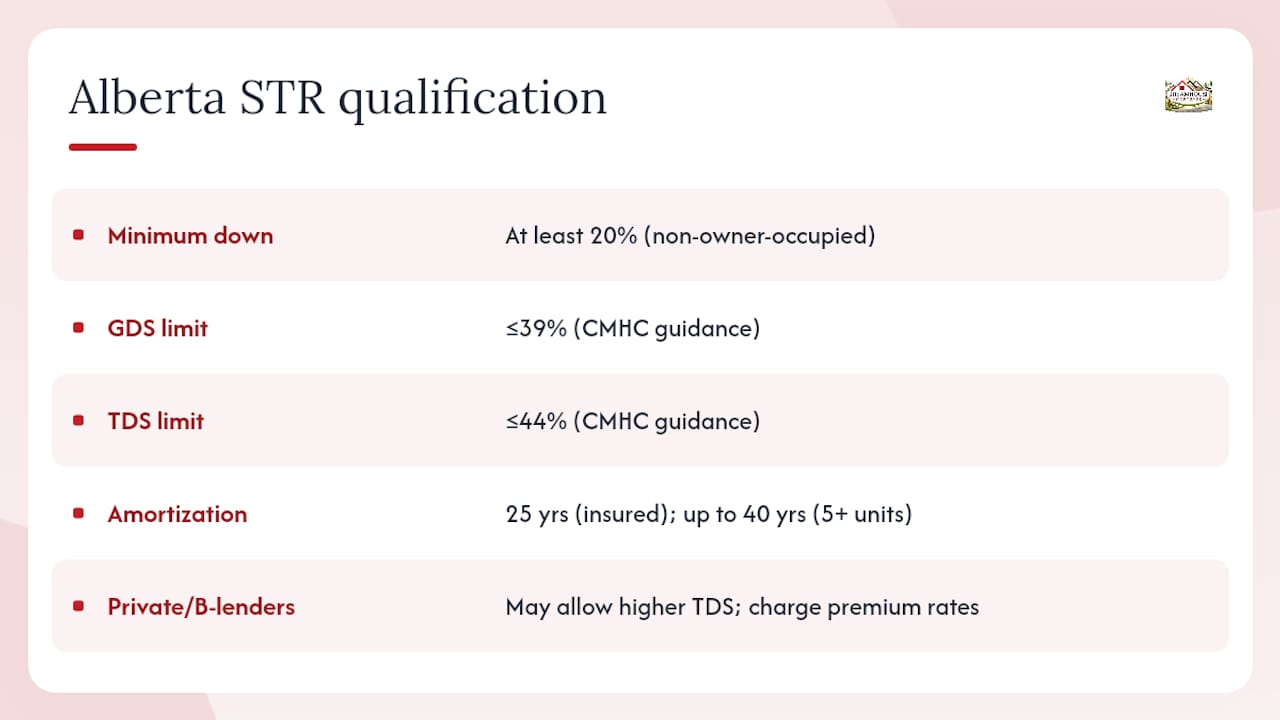
Most STR loans in Canada require at least 20% down for non-owner-occupied properties, with GDS at or below 39% and TDS at or below 44% under CMHC guidance. Amortization ranges from 25 years for insured loans to up to 40 years for eligible 5+ unit projects. Private and B-lenders may allow higher TDS ratios but charge premium rates in exchange.
Two quick income examples using common lender offsets:
Example 1 — 50% gross method: A Calgary STR generating $60,000 in annual platform revenue. The lender counts $30,000 as qualifying income. That $30,000 is added to your employment income before calculating GDS/TDS.
Example 2 — Net rental approach: Same property, with $20,000 in documented operating expenses. Net rental income is $40,000. The lender uses $40,000 as qualifying income, which is more favorable here. Lender choice of method matters significantly.
For Alberta-specific rate and qualification estimates, Dreamhouse Mortgage publishes current Calgary market context.
What documents lenders need to verify STR income
T1 tax returns, platform payout statements, and an operating expense schedule are the three documents lenders want first. Without all three, most mainstream lenders will either decline or apply the most conservative income offset available.
Full document checklist:
- Two years of T1 General tax returns showing rental income on Schedule L or Form T776.
- Platform payout reports (Airbnb, VRBO, or equivalent) covering at least 12–24 months.
- Bank statements confirming platform deposits match reported income.
- Operating expense schedule: cleaning fees, platform commissions, insurance, utilities, property management.
- Proof of municipal STR license or condo board approval where required.
- Property management contract if a third party manages the property.
- STR-specific insurance policy or quote confirming coverage for short-term guests.
Lenders typically apply a vacancy and expense offset of 50–65% of gross revenue when calculating qualifying rental income. The cleaner and more organized your package, the less likely an underwriter is to apply the most conservative offset.
Pro Tip: Export a CSV from your STR platform, reconcile it against your bank statements, and attach a one-page summary prepared by an accountant. This single step removes the most common underwriting delay.
Which lender types work best for STR borrowers in Alberta
Use mainstream lenders when you meet CMHC-type rules and have two or more years of documented STR income. Use alternative or private lenders when documentation is thin, the timeline is short, or the property does not fit standard program criteria. For a detailed breakdown of rental property mortgage qualification differences, Dreamhouse Mortgage covers the key distinctions between owner-occupied and investor underwriting.
Lender category overview:
- Banks and credit unions: Most conservative on STR income; require full documentation and strong credit. Best rates when you qualify.
- Monoline lenders: Competitive rates, often more flexible on income calculation than major banks, but still require solid documentation.
- B-lenders (alternative lenders): Accept shorter income history and higher TDS ratios; rates are 1–3% above prime lenders.
- Private lenders: Fastest approval, asset-based lending, minimal income documentation; rates are significantly higher and terms are short (typically 1–2 years).
A broker improves approval odds for Alberta investors by matching the file to the lender most likely to accept it, rather than applying to a single institution and getting declined. Dreamhouse Mortgage works with all lender categories across Calgary, Airdrie, Cochrane, and surrounding communities.
Pro Tip: Plan a refinance-after-stabilization strategy from day one. Buy with a B-lender or private lender, build 12–24 months of documented STR performance, then refinance to an A-lender for a lower rate.
Common reasons STR mortgage applications are declined
The most common red flags are insufficient documented income, municipal or condo STR restrictions, aggressive vacancy assumptions, and weak credit history. Each has a direct fix.
- Undocumented income: Provide 12–24 months of platform statements and matching T1 returns. Lenders need the paper trail.
- Municipal or condo restrictions: Verify STR licensing requirements in Calgary, Banff, Canmore, or your target municipality before applying. A property that cannot legally operate as an STR has no qualifying income.
- High vacancy assumptions: Use conservative occupancy projections (60–70%) in your income presentation. Lenders discount optimistic forecasts.
- Poor credit history: A credit score below 680 limits lender options significantly. Pay down revolving debt and resolve any collections before applying.
- Condo bylaw conflicts: Many Calgary condo corporations prohibit STRs. Confirm bylaw compliance in writing before the offer stage.
In Alberta mountain communities like Canmore and Banff, municipal licensing rules add an extra compliance layer. Verify current local bylaws early, as non-compliance disqualifies the income entirely.
Step-by-step application timeline and typical costs
A typical STR mortgage moves from pre-approval to funding in 30–60 days for conventional loans, or 14–21 days with a private lender.
- Pre-approval (Days 1–5): Submit income documents, credit authorization, and property details. Receive a conditional approval letter with rate hold.
- Property offer and acceptance (Days 5–15): Make an offer with a financing condition of 5–10 business days.
- Appraisal (Days 10–20): Lender orders an appraisal. STR properties often require an income-approach appraisal, which costs $400–$700 in Alberta.
- Underwriting (Days 15–30): Lender reviews the full file. Expect requests for additional STR income documentation.
- Commitment and conditions (Days 25–40): Sign the mortgage commitment and satisfy remaining conditions (insurance, title search).
- Closing and funding (Days 40–60): Lawyer completes the title transfer. Funds are advanced.
Typical costs to budget:
- Appraisal: $400–$700.
- CMHC premium (if insured): 0.60%–4.00% of the insured amount, added to the mortgage.
- Legal fees: $1,200–$2,000.
- Title insurance: $200–$400.
- Private lender fees: 1–3% of the loan amount if using a private lender.
When private lenders, portfolio lending, or interest-only options make sense
Private or portfolio lenders are appropriate when documentation is insufficient, the timeline is short, or you are refinancing short-term for repositioning. Interest-only structures are a documented strategy for investors seeking improved short-term cash flow, though they typically carry higher rates and stricter exit-plan expectations.
Decision checklist:
- Choose a B-lender when you have 12+ months of STR income but it falls short of A-lender thresholds.
- Choose a private lender when you need to close in under 21 days, have less than 12 months of income history, or are bridging to a refinance.
- Choose portfolio lending when you own multiple properties and want a single lender to underwrite the portfolio rather than each property individually.
- Consider interest-only when maximizing monthly cash flow during the first 1–2 years of ownership is the priority.
A typical exit plan: purchase with a private lender at 10–12% for 12 months, document STR performance, then refinance in Calgary to an A-lender at standard investment property rates.
A broker’s perspective on what actually works for Alberta STR investors
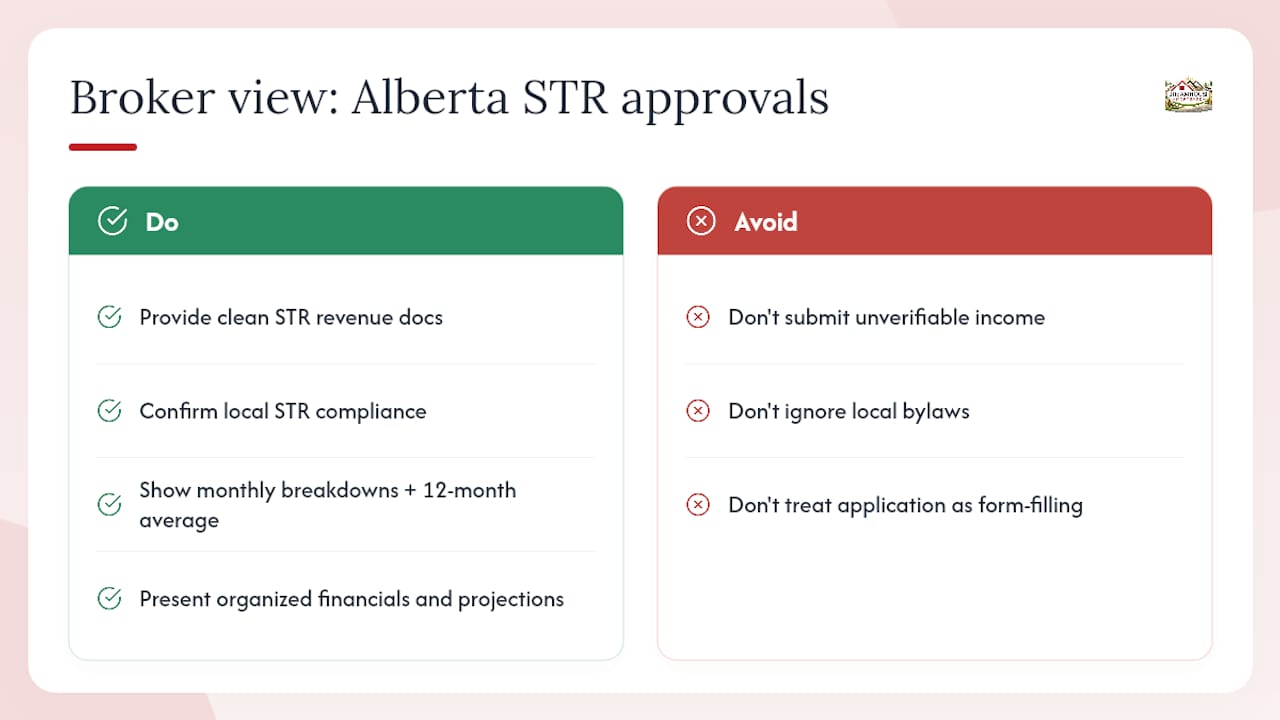
The single change that most improves approval odds is clean STR revenue documentation combined with confirmed local compliance. Lenders decline files not because the income is insufficient, but because the income cannot be verified or the property’s legal right to operate as an STR is unclear.
Alberta presents specific scenarios that require local knowledge. Seasonal vacation properties in mountain communities near Canmore generate strong summer revenue but show sharp winter gaps. Lenders applying a flat annual income average will undercount peak-season performance. Presenting monthly revenue breakdowns alongside a 12-month average gives underwriters a more accurate picture.
Calgary condo investors face a different challenge: many buildings have amended their bylaws to prohibit STRs since 2022, and some lenders now require written confirmation of bylaw compliance as a condition of approval. In Airdrie and Cochrane, where STR activity is lower volume, lenders may have less familiarity with local market data, making a professional income-approach appraisal more important than usual.
The investors who close successfully in Alberta are the ones who treat the mortgage application as a business presentation, not a form-filling exercise. Organized financials, a clear compliance record, and a realistic income projection are what move files through underwriting.
Dreamhouse Mortgage: Alberta STR financing support and next steps
Dreamhouse Mortgage gives Alberta STR investors direct access to banks, credit unions, monoline lenders, B-lenders, and private lenders, along with the packaging expertise to present STR income in the format each lender type requires. For investors who want to understand how a broker negotiates rates on their behalf, Dreamhouse Mortgage explains the process in full.
Services available for STR investors:
- STR mortgage pre-approval and lender matching across Alberta.
- CMHC Income Property and Standard Rental Housing guidance.
- Private lender sourcing for fast closings or thin-documentation files.
- Refinance planning for investors transitioning from B-lender to A-lender.
- Local support in Calgary, Airdrie, Cochrane, Chestermere, Red Deer, and Edmonton.
Call Guriqbal Chahal, MBA, PMP at 403-966-6072 or visit the Dreamhouse Mortgage investment property page to start your pre-approval. You can also find Dreamhouse Mortgage on Google for reviews and directions.
Sources
- Clarifying OSFI’s guidance on rental income and mortgage classification – Office of the Superintendent of Financial Institutions
- CMHC Income Property | CMHC
- Airbnb Mortgage Rules in Canada: Short-Term Rental Financing (2026) | WealthNorth
This article is general information, not a substitute for advice from a qualified financial advisor. Consult a qualified financial professional about your own circumstances before acting on anything here.
FAQ
What is the minimum down payment for a short-term rental mortgage in Canada?
Most lenders require at least 20% down for non-owner-occupied STR properties. CMHC-insured options for 2–4 unit rentals can allow up to 80% LTV in qualifying cases, but citizenship or permanent residency is required.
How do lenders calculate STR income for mortgage qualification?
Lenders commonly use either 50% of gross rental income or a net rental income approach, subtracting documented operating expenses from gross revenue. Two years of T1 returns and platform payout statements are typically required to use either method.
What does OSFI’s IPRRE classification mean for STR borrowers?
IPRRE classification means the lender must hold more capital against the loan, which usually results in stricter credit requirements, lower LTV offers, and larger reserve expectations for the borrower.
Can self-employed investors qualify for an STR mortgage in Alberta?
Yes. Self-employed borrowers can qualify, but lenders will scrutinize both business income and STR revenue. A mortgage broker familiar with Alberta lenders can match self-employed files to lenders with more flexible income verification policies.
When should an Alberta STR investor use a private lender?
A private lender makes sense when you need to close in under 21 days, have less than 12 months of documented STR income, or are bridging to a refinance after establishing a performance record. Rates are higher, but the exit plan is to refinance to an A-lender once 12–24 months of documented income exists.