
TL;DR:
- Mortgage brokers in Alberta access a wide network of 10 to 50+ lenders, offering better rates and product variety. Their lender relationships influence mortgage options, approval chances, and rates, especially for self-employed and complex profiles. Transparent, well-informed questions improve your chances of securing optimal mortgage solutions.
A mortgage broker is defined as a licensed intermediary who connects borrowers to multiple lenders, providing access to mortgage products and rates that no single bank or direct lender can match alone. For Alberta homebuyers in Calgary, Airdrie, Cochrane, Chestermere, and beyond, mortgage broker lender access explained simply means your broker shops dozens of lenders on your behalf, including banks, credit unions, monoline lenders, and private lenders, to find the product that fits your financial profile. Dreamhouse Mortgage, led by Guriqbal Chahal, MBA, PMP, operates exactly this way, working with a broad lender network to serve first-time buyers, self-employed professionals, newcomers to Canada, and investors across Alberta. Understanding how this access works, and where its limits lie, puts you in a far stronger position at the negotiating table.
How mortgage broker lender access works in Alberta
Mortgage brokers maintain relationships with 10 to 50+ lenders, including national banks, regional credit unions, monoline lenders, and private lenders. This means a single broker submission can be evaluated against a wide range of products simultaneously, rather than requiring you to apply separately at each institution.
The key mechanism behind this access is the wholesale lending channel. Wholesale rates through broker channels are often lower than retail rates because lenders save on branch overhead and marketing costs when they originate through brokers. Those savings are passed, at least in part, to the borrower. A homebuyer in Okotoks or Red Deer who walks into a bank branch receives the bank’s posted retail rate. A borrower who works with a broker may access a wholesale rate from that same institution at a lower cost.
In Alberta’s mortgage market, brokers typically access the following lender categories:
- National chartered banks such as TD Canada Trust, RBC, and Scotiabank, accessed through their broker divisions rather than retail branches.
- Credit unions including ATB Financial and Servus Credit Union, which serve Alberta borrowers with competitive products and flexible qualification criteria.
- Monoline lenders such as First National Financial and MCAP, which operate exclusively through the broker channel and have no retail presence.
- Alternative lenders including B-lenders like Home Trust and Equitable Bank, which serve borrowers who do not qualify under standard stress test rules.
- Private lenders, which are individual investors or mortgage investment corporations that fund short-term or non-conforming loans.
Broker access is also shaped by technology platforms. In Canada, systems like Filogix Expert and Velocity allow brokers to submit applications to multiple lenders from a single interface, reducing processing time and administrative errors. The lenders a broker can access through these platforms depend on the broker’s licensing, brokerage agreements, and submission volume history.
Pro Tip: Ask any broker you interview to list the top 10 lenders they submitted files to in the past 12 months. This tells you more about their actual lender relationships than any marketing claim.
What limits broker lender access and how it affects you
Not all brokers offer the same depth of lender access. This is the part of understanding mortgage brokers that most borrowers overlook, and it has real consequences for the rate and product you receive.

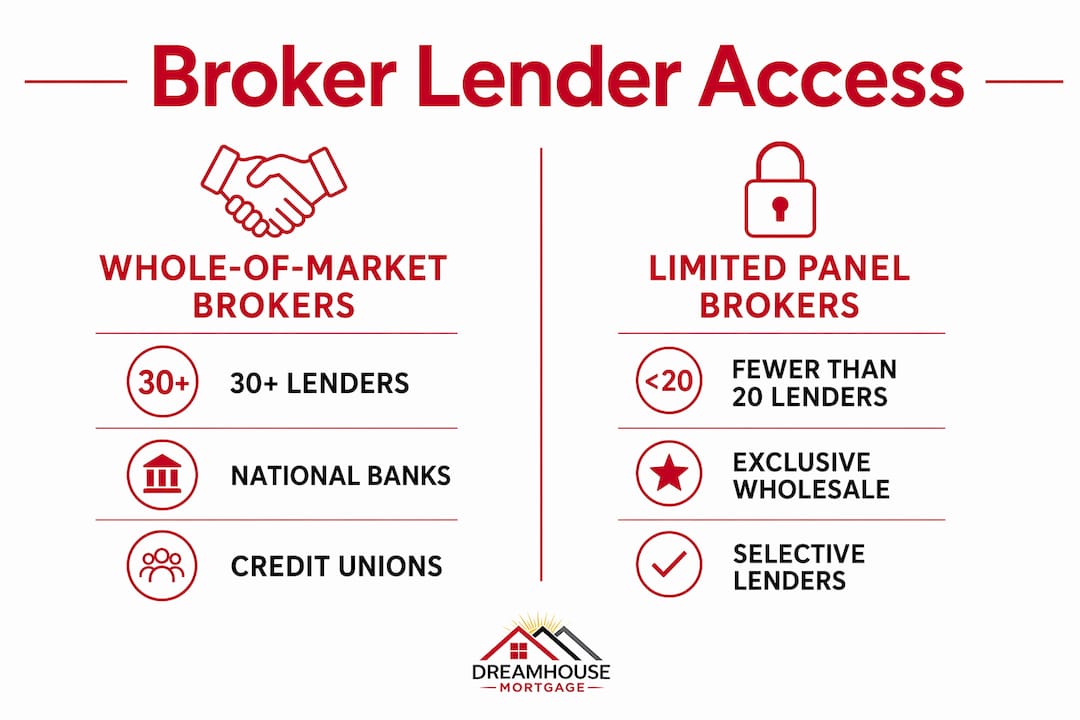
The industry recognizes three broad categories of broker lender access:
| Broker type | Lender access | What it means for you |
|---|---|---|
| Whole-of-market broker | 20 to 50+ lenders across all categories | Maximum product choice and rate competition |
| Panel broker | 5 to 20 pre-selected lenders | Moderate choice, but some lenders excluded |
| Tied or captive broker | 1 to 3 lenders, often affiliated | Limited competition, possible rate disadvantage |
Exclusive wholesale lender relationships limit brokers’ ability to shop the full market, resulting in a filtered rather than complete market view for borrowers. This matters most when you have a complex financial profile, such as self-employment income, a recent credit event, or a property type that falls outside standard guidelines.
Volume commitments add another layer of complexity. Volume-based lender panels create tiers of broker access that materially affect loan pricing and product availability. A broker who sends significant volume to a specific lender may receive preferential rates or faster approvals from that lender. The trade-off is that the broker may be less motivated to submit your file elsewhere, even if another lender offers a better product for your situation.
Market fragmentation is a documented reality in Alberta and across Canada. Brokers can be locked out of major wholesale lenders depending on exclusive agreements, which means some mortgage products are simply unavailable through certain brokerages. A borrower in Calgary comparing two brokers may receive materially different rate quotes not because of their own financial profile, but because of the lender networks each broker maintains.
Pro Tip: Ask your broker directly: “Which major lenders do you NOT have access to?” A confident, specific answer signals transparency. Vague or defensive responses are a warning sign.
To identify whether a broker offers whole-of-market access or a limited panel, ask for a written list of lenders they are approved to submit to. Reputable brokers in Alberta, including those serving Cochrane, Chestermere, and Rocky View County, will provide this without hesitation. You can also compare broker vs. bank options to understand how lender access differences translate into real rate outcomes.
How broker compensation works and why it matters
Broker compensation in Alberta follows two primary models. Lender-paid commissions range from 0.5% to 2.75% of the mortgage amount, while borrower-paid fees typically fall between 1% and 2%. In most standard residential mortgage transactions in Alberta, the lender pays the broker’s commission, meaning the borrower pays nothing directly to the broker at closing.
Transparency is legally required. Canadian mortgage regulations mandate that brokers disclose their compensation sources and amounts to borrowers before a mortgage is finalized. This disclosure must identify which lender is paying the commission and the amount or rate of that compensation.
The conflict of interest risk is real and worth understanding:
- A broker earning a 1.2% finder’s fee from Lender A and a 0.8% fee from Lender B has a financial incentive to recommend Lender A, even if Lender B’s product is a better fit for your situation.
- Broker steerage occurs when a borrower is directed toward a higher-commission lender rather than the most suitable product. Asking for a breakdown of compensation from all lenders considered is the most direct way to protect yourself.
- Volume bonuses and trailer fees from specific lenders can further skew recommendations in ways that are not immediately visible to borrowers.
- Borrower-paid fee models, more common with alternative or private lenders, are often used when the borrower’s profile does not qualify for standard lender-paid commission products.
The practical comparison between broker fees and direct lender fees is straightforward. When you apply directly at a bank, the bank’s internal mortgage specialist is also compensated, typically through salary and performance bonuses tied to product sales. That compensation is not disclosed to you. A broker’s compensation, by contrast, is subject to mandatory disclosure under Canadian mortgage rules. This makes the broker model more transparent in practice, provided you ask the right questions.
Call Guriqbal Chahal, MBA, PMP, Mortgage Broker at 403-966-6072 to get a clear breakdown of lender options and compensation structures before you commit to any mortgage product. You can also review broker fee structures in detail to understand exactly what to expect.
How lender access affects your mortgage approval in Alberta
The practical impact of broker lender access on your mortgage approval depends heavily on your borrower profile. For straightforward applications, such as a salaried employee with strong credit purchasing a resale home in Calgary or Airdrie, most brokers with reasonable lender access will produce competitive results. The real advantage of broad lender access shows up in complex situations.
Here is how lender access translates into real outcomes for different Alberta borrower profiles:
- Self-employed borrowers. Retail banks apply rigid income verification rules that disqualify many self-employed professionals, even those with strong net worth. Brokers access lenders specializing in non-traditional income profiles, including stated-income programs and bank statement underwriting available through alternative lenders like Equitable Bank and Home Trust.
- New to Canada borrowers. Newcomers without Canadian credit history face automatic declines at most retail bank branches. Brokers with access to New to Canada programs through lenders like RBC’s broker division or specialized alternative lenders can structure approvals using foreign credit references and employment letters.
- Credit-challenged borrowers. A borrower with a prior consumer proposal or a credit score below 620 will not qualify for an insured mortgage through a major bank. Brokers with B-lender and private lender relationships can place these files, often with a clear path back to A-lender rates within two to three years.
- Investment property buyers. Rental property financing in Alberta involves different stress test calculations and down payment requirements than owner-occupied purchases. Brokers with access to lenders that specialize in investor portfolios, including certain monoline lenders, can structure financing that a single bank cannot offer.
- Rural and acreage properties. Properties in Rocky View County, High River, or rural areas outside Calgary often fall outside standard appraisal guidelines. Brokers with private lender relationships can fund these purchases when chartered banks decline.
The mortgage process with a broker averages 30 to 60 days, during which the broker coordinates document collection, lender submissions, and underwriting communication on your behalf. This centralized coordination reduces the administrative burden on borrowers significantly compared to managing multiple direct lender applications.
Pro Tip: If you are self-employed or have a non-standard income source, ask your broker specifically which lenders on their panel have approved similar borrower profiles in the past 6 months. Past placement experience is the strongest indicator of future approval success.
The role of mortgage brokers in Alberta extends beyond rate shopping. Brokers who understand local market conditions in Calgary, Cochrane, and Airdrie can match your file to lenders who are actively competing for Alberta business, which changes both the rate and the approval timeline.
Key takeaways
Mortgage broker lender access is the single most important factor determining whether you receive a competitive rate and approval, because it defines the universe of products your broker can actually offer you.
| Point | Details |
|---|---|
| Broker lender range | Brokers access 10 to 50+ lenders, including banks, credit unions, monolines, and private lenders. |
| Wholesale rate advantage | Broker channels provide wholesale rates lower than retail branch rates due to reduced lender overhead. |
| Access is not equal | Panel and tied brokers offer fewer lenders, which limits rate competition and product fit for borrowers. |
| Compensation transparency | Canadian rules require brokers to disclose lender-paid commissions ranging from 0.5% to 2.75%. |
| Complex profiles benefit most | Self-employed, credit-challenged, and rural property buyers gain the most from broad broker lender access. |
What I have learned about broker lender access in Alberta
Working with Alberta borrowers across Calgary, Airdrie, Cochrane, and Red Deer since 2013, I have seen one pattern repeat itself consistently. Borrowers who ask no questions about lender access almost always leave money on the table. Not because their broker is dishonest, but because the broker defaults to familiar lenders, the ones they submit to most often, rather than the ones best suited to that specific borrower’s situation.
The fragmentation in Canada’s wholesale mortgage market is real. Brokers who manage relationships with 30 or more lenders face genuine operational complexity. The path of least resistance is to work with five or six trusted lenders and route most files through them. That works fine for straightforward applications. For self-employed professionals in Calgary, newcomers to Canada buying in Chestermere, or investors financing rental properties in Edmonton, that default approach can mean a higher rate, a longer approval timeline, or an outright decline.
My advice is direct: treat your broker interview like a job interview. Ask which lenders they are approved with. Ask which lenders they submitted the most files to last year. Ask whether they receive volume bonuses from any lender. A broker who answers these questions clearly and specifically is a broker who has nothing to hide and a lender network worth using.
The borrowers I see succeed most consistently are the ones who come in prepared with those questions. They get better rates, faster approvals, and mortgage structures that actually fit their financial goals rather than the lender’s product menu.
— Guriqbal Chahal, MBA, PMP
Access Alberta’s best lender network with Dreamhouse Mortgage
Dreamhouse Mortgage works with banks, credit unions, monoline lenders, alternative lenders, and private lenders across Alberta to find the right mortgage product for your situation. Whether you are buying your first home in Calgary, refinancing in Cochrane, or investing in a rental property in Airdrie, the lender network matters as much as the rate.

Guriqbal Chahal, MBA, PMP, brings over a decade of Alberta mortgage experience to every file, with transparent broker fee structures and clear disclosure of all lender options considered. Dreamhouse Mortgage serves Calgary, Airdrie, Cochrane, Chestermere, Okotoks, Red Deer, Edmonton, and surrounding communities. Call Guriqbal Chahal, MBA, PMP, Mortgage Broker at 403-966-6072 for a free consultation and find out exactly which lenders are competing for your mortgage today.
FAQ
What is mortgage broker lender access?
Mortgage broker lender access refers to the network of banks, credit unions, monoline lenders, alternative lenders, and private lenders a broker is approved to submit mortgage applications to. Brokers typically access 10 to 50+ lenders, giving borrowers more product options than a single bank can provide.
Do all Alberta mortgage brokers have the same lender access?
No. Broker lender panels vary significantly, with some brokers accessing 30 or more lenders and others restricted to a small panel of preferred institutions. Borrowers should ask any broker for a list of lenders they are approved with before proceeding.
How does broker lender access help self-employed borrowers in Alberta?
Brokers access lenders who specialize in non-traditional income verification, including stated-income and bank statement programs not available at retail bank branches. This is particularly valuable for self-employed professionals in Calgary, Edmonton, and Red Deer who cannot document income through standard T4 slips.
Does using a mortgage broker cost more than going directly to a bank?
In most standard Alberta residential mortgage transactions, the lender pays the broker’s commission, so the borrower pays nothing directly. Broker compensation of 0.5% to 2.75% is paid by the lender and must be disclosed to the borrower under Canadian mortgage regulations.
What questions should I ask a mortgage broker about their lender access?
Ask which lenders they are approved with, which lenders they submitted the most files to in the past year, and whether they receive volume bonuses from any specific lender. Call Guriqbal Chahal, MBA, PMP, Mortgage Broker at 403-966-6072 to get straightforward answers and a full review of your Alberta mortgage options.
Recommended
- Mortgage Broker Fees Explained for Calgary & Alberta
- Mortgage Terms Explained Alberta Mortgage Glossary: 60 Essential Terms Every Calgary Buyer Must Know (2026)
- Mortgage Broker vs. Bank Calgary Alberta: The Shocking Truth Nobody Tells You [2026]
- How to Get a Lower Mortgage Rate Alberta: Broker vs Bank (Best Strategies to Save Thousands in 2026)
- Home For Sale Listings