Yes, you can get a mortgage in Canada without a Canadian credit history. CMHC’s Newcomers program is available to both permanent and non-permanent residents who are legally authorized to work in Canada, and it explicitly allows alternative credit evidence in place of a Canadian credit score. Statistics Canada data confirms that newcomers represent a growing share of Canada’s population, which is exactly why lenders and insurers have built dedicated programs around this need.
The most realistic routes for a newcomer mortgage without credit history in Canada are:
- CMHC/newcomer-insured mortgage using alternative credit evidence (international credit report, bank reference letter, rent history)
- Manual underwriting through lenders willing to assess foreign documentation and compensating factors
- Monoline or alternative lenders with more flexible approval criteria
- Private lenders as a short-term, higher-cost option
- Co-signer or guarantor with established Canadian credit
- Larger down payment to reduce lender risk and improve approval odds
Pro Tip: Contact a broker before you assume you don’t qualify. Many newcomers in Calgary, Airdrie, and Cochrane are approved through CMHC’s newcomer path without a single Canadian credit account on file.
Key Takeaways
A newcomer mortgage without credit history is possible in Canada through CMHC’s newcomer program, manual underwriting, alternative lenders, a co-signer, or a larger down payment, with the right documentation assembled in advance.
| Point | Details |
|---|---|
| CMHC newcomer program | Available to permanent and non-permanent residents; accepts international credit reports and foreign bank reference letters. |
| LTV up to 95% | CMHC mortgage loan insurance allows up to 95% LTV on qualifying 1- and 2-unit properties, requiring as little as 5% down. |
| Alternative credit evidence | Rent history, utility records, foreign bank statements, and landlord letters all strengthen a newcomer application. |
| Fastest credit-building steps | Open a Canadian bank account and get a secured credit card immediately; document rent payments from day one. |
| Dreamhouse Mortgage | Provides newcomer mortgage pre-approvals, documentation review, and lender matching across Calgary, Airdrie, Cochrane, Edmonton, and Red Deer. |
Table of Contents
- How do newcomer mortgage programs work for people with no Canadian credit?
- What are your practical mortgage options with little or no Canadian credit?
- What documents do lenders commonly accept from newcomers?
- How do lenders actually evaluate risk when your credit history is limited?
- What steps can you take now to improve your mortgage approval odds?
- What costs and timeline should you expect as a newcomer applicant?
- Why does working with a local Alberta broker make a real difference for newcomers?
- A broker’s perspective: what to prioritize first as a newcomer in Alberta
- Dreamhouse Mortgage: newcomer mortgage services in Alberta
- Sources
- FAQ
How do newcomer mortgage programs work for people with no Canadian credit?
CMHC’s Newcomers program is the most accessible entry point for first home loan without credit in Canada. It covers permanent residents and non-permanent residents alike, with no minimum period of Canadian residency required. The key requirement is that at least one borrower or guarantor must be legally authorized to work in Canada.
When Canadian credit history is limited or absent, CMHC may accept:
- An international credit report from the borrower’s country of origin
- A letter of reference from a foreign financial institution
- Rent and utility payment history as proof of financial reliability
- Bank statements showing consistent savings behavior
For some insured products, CMHC may require at least one borrower or guarantor to have a minimum credit score, though alternative credit evidence can substitute where a score is not available. Where that score does not exist, the alternative evidence above can substitute. A broker familiar with CMHC minimum credit score requirements in Alberta can clarify which path applies to your specific situation.
Statistic: Under CMHC mortgage loan insurance, 1- and 2-unit properties can be financed up to a high loan-to-value ratio when eligibility criteria are met, allowing for a relatively low down payment.
One eligibility note worth knowing: the Prohibition on the Purchase of Residential Property by Non-Canadians Act restricts certain non-Canadian buyers from purchasing residential property in Canada. Non-permanent residents should confirm their eligibility status before applying. Canada is a reliable starting point for that check.
What are your practical mortgage options with little or no Canadian credit?
Newcomers in Alberta have several routes. Each carries different costs, approval criteria, and timelines.
CMHC/newcomer-insured program. This is the preferred path for most newcomers. It allows a down payment as low as 5% on properties up to $500,000 (with a sliding scale above that threshold), and it accepts alternative credit evidence. The trade-off is a mortgage default insurance premium added to the loan. For most newcomers in Calgary, Airdrie, or Cochrane who have documented rent history and a foreign bank reference, this is the fastest and most affordable route.
Manual underwriting. Some lenders will assess a file without a Canadian credit score if the borrower provides strong compensating factors: stable employment, a large down payment, clean foreign credit documentation, and a solid savings history. This path requires more paperwork but can result in competitive rates.

Monoline and alternative lenders. These lenders operate outside the traditional bank model and often have more flexible underwriting criteria. Rates may be slightly higher than the big banks, but approval is more accessible for newcomers with no credit history mortgage situations.
Private lenders. A short-term option when other routes are unavailable. Private lenders charge higher interest rates and fees, and the intent is typically to refinance into a conventional mortgage once Canadian credit is established. Use this path only when necessary and with a clear exit plan.
Co-signer or guarantor. A Canadian resident with established credit co-signs the mortgage, reducing lender risk. The co-signer is legally responsible for the debt if the primary borrower defaults. This arrangement works well for newcomers with family already in Canada.
Pro Tip: A larger down payment (20% or more) eliminates the mortgage default insurance requirement entirely and gives lenders more comfort when Canadian credit history is thin. If you have access to foreign savings or a gift from family, this can be the most direct path to approval.
What documents do lenders commonly accept from newcomers?
Ratehub’s newcomer mortgage guidance lists the standard documents lenders and insurers expect from applicants with limited Canadian credit history. Assembling these before you approach a lender or broker shortens the approval timeline significantly.
Employment and income proof:
- Signed employment contract or job offer letter
- Recent pay stubs (3–6 months where available)
- Employment letter confirming position, salary, and start date
Financial history and down payment:
- Canadian bank statements (3–6 months) showing savings and regular deposits
- International bank statements confirming the source of down payment funds
- Gift letter if down payment funds come from a family member
- Proof of sale of foreign property, if applicable
Alternative credit evidence:
- International credit report (from the borrower’s home country)
- Letter of reference from a foreign bank or financial institution
- Proof of on-time rent payments (landlord letter or bank records)
- Utility, telecom, and insurance payment records showing consistent payment history
Identification and status documents:
- Passport and government-issued photo ID
- Work permit, study permit, or permanent resident card
- Proof of legal authorization to work in Canada
Ask your broker to review this list against the specific lender’s requirements before you submit. Some lenders accept digital copies of foreign documents; others require certified translations. Knowing this in advance avoids delays.
How do lenders actually evaluate risk when your credit history is limited?
Lenders assess newcomer applications through a combination of quantitative ratios and qualitative factors. Understanding both helps you prioritize what to strengthen before applying.
Primary quantitative checks:
- Loan-to-value (LTV): The ratio of the mortgage amount to the property’s appraised value. Lower LTV means less risk for the lender. At 80% LTV or below, mortgage default insurance is not required.
- Gross Debt Service (GDS) ratio: Housing costs (mortgage payment, property taxes, heating) as a percentage of gross income. Lenders typically want this below 32–39%.
- Total Debt Service (TDS) ratio: All debt obligations as a percentage of gross income. Most lenders cap this at 44%.
- Down payment: Minimum 5% for insured mortgages on properties up to $500,000; 10% on the portion between $500,000 and $999,999; 20% for properties at $1,000,000 or above.
Qualitative factors lenders weigh:
- Length and stability of Canadian employment
- Consistency and authenticity of foreign documentation
- Source and history of down payment funds
- Residency status (permanent vs. non-permanent resident)
- Presence of a co-signer with Canadian credit
Statistic: Mortgage loan insurance through CMHC allows qualified newcomers to access up to 95% LTV on 1- and 2-unit properties, a threshold that would otherwise require a 20% down payment under conventional (uninsured) lending rules.
A larger down payment directly reduces LTV and lender risk, which can offset the absence of a Canadian credit score. For newcomers in Edmonton or Red Deer with strong foreign savings, this is often the most effective single lever. Reviewing down payment types in Canada before your application helps you understand which sources qualify.
What steps can you take now to improve your mortgage approval odds?
Building a stronger application does not require years of waiting. Several actions produce measurable results within months.
Immediate steps (do these now):
- Open a Canadian bank account and begin depositing income regularly.
- Apply for a secured credit card and use it for small, recurring purchases.
- Set up automatic payments for rent, utilities, and telecom bills.
- Gather your international credit report and request a reference letter from your foreign bank.
- Collect 3–6 months of bank statements from your home country showing savings history.
3–12 month steps:
- Pay your secured credit card balance in full every month to build a positive Canadian payment record.
- Ask your landlord for a written confirmation of on-time rent payments.
- Document consistent monthly savings in your Canadian account.
- Inquire with your lender or broker about rent-reporting services that submit payment history to Canadian credit bureaus.
- Consider a larger down payment if your savings allow, to reduce LTV and improve lender confidence.
Canada.ca advises newcomers to start building Canadian credit immediately and to speak with a bank early in the process. Alberta-focused brokers similarly recommend secured credit cards and documented rent history as the fastest practical steps for newcomers in Calgary, Airdrie, Cochrane, and surrounding communities.
Pro Tip: A secured credit card combined with 6 months of documented, on-time rent payments is the single fastest combination for building an alternative credit profile that lenders and insurers will recognize.
What costs and timeline should you expect as a newcomer applicant?
Planning your finances and timing realistically prevents surprises after an offer is accepted.
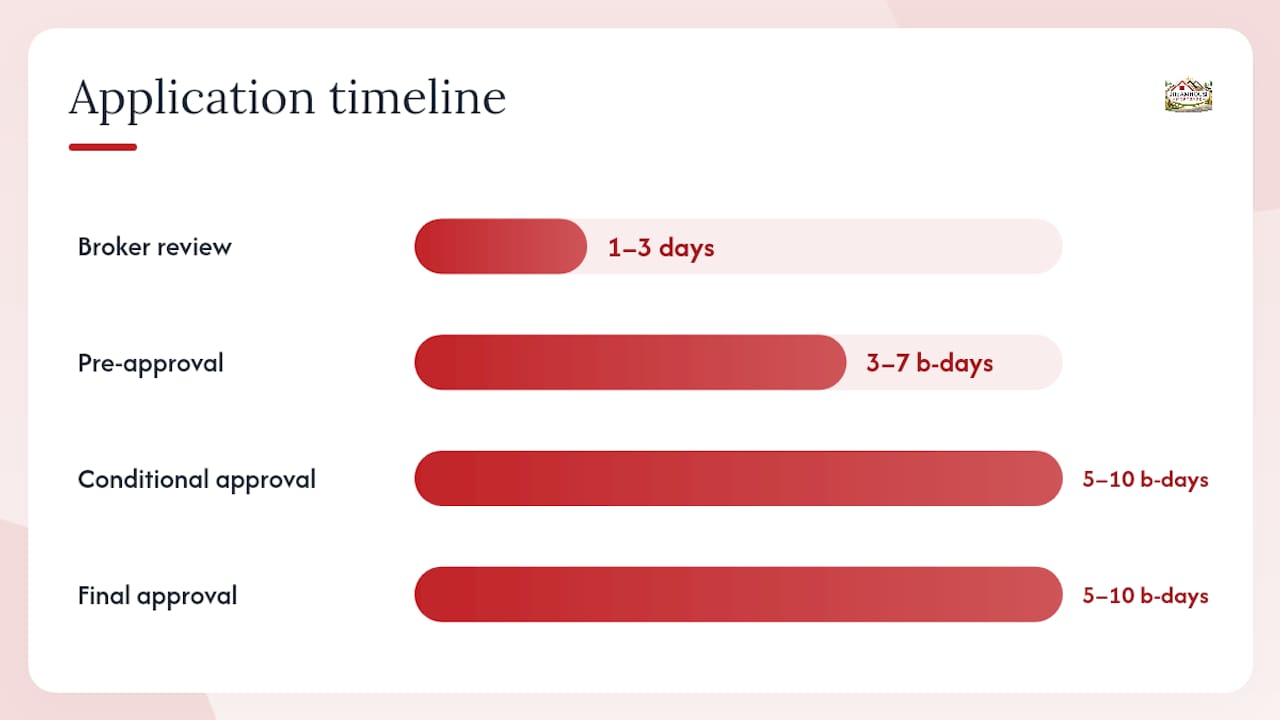
Typical application timeline:
- Broker consultation and document review: 1–3 days
- Mortgage pre-approval: 3–7 business days (longer if foreign documents require verification)
- Conditional approval after accepted offer: 5–10 business days
- Final approval and funding: 5–10 business days after conditions are met
Cost elements to budget for:
- Down payment: Minimum down payment varies based on property price, with lower percentages allowed for insured mortgages on properties under a certain threshold.
- Mortgage default insurance premium: Added to the loan amount for insured mortgages; the premium percentage varies by LTV ratio
- Appraisal fee: Typically $300–$500, required by most lenders
- Legal/notary fees: Typically $1,000–$1,500 in Alberta
- Land transfer tax: Alberta does not charge a provincial land transfer tax, though a title transfer fee applies
- Higher interest rate premium: Alternative or private lenders charge above standard rates; the gap narrows once Canadian credit is established
Statistic: CMHC mortgage loan insurance covers 1- to 4-unit properties, with up to 95% LTV available for qualifying newcomers on 1- and 2-unit properties, reducing the required down payment significantly compared to conventional lending.
Private insurer newcomer programs (through Canada Guaranty or Sagen) may require applicants to have been in Canada within a specific residency window and set minimum down payment rules that vary by purchase price. Ratehub’s newcomer mortgage summary outlines these program-specific constraints in detail. Reviewing best mortgage rates for newcomers in Alberta before you commit to a lender helps you compare rate trade-offs across insured and alternative products.
Why does working with a local Alberta broker make a real difference for newcomers?
A mortgage broker does more than find a rate. For newcomers with no Canadian credit history, a broker’s lender access and documentation expertise can be the difference between an approval and a declined file.
Specific ways a broker helps newcomers:
- Matches your profile to lenders and insurers known to accept international documentation
- Reviews your alternative credit package before submission to identify gaps
- Advises on down payment sourcing rules and gift letter requirements
- Negotiates insurer flexibility on alternative credit evidence
- Explains the mortgage stress test and how your income qualifies under Canadian debt-service rules
- Provides pre-approval faster by pre-validating foreign documents against lender requirements
Local Alberta market knowledge matters here. Lender appetite and pricing vary across Calgary, Airdrie, Cochrane, Chestermere, Okotoks, Edmonton, and Red Deer. A broker active in these markets knows which lenders are currently approving newcomer files and at what terms.
Dreamhouse Mortgage offers newcomer mortgage services in Alberta that include documentation checklist review, lender matching for applicants without Canadian credit history, and pre-approval support tailored to permanent and non-permanent residents across Calgary, Airdrie, Cochrane, Edmonton, and Red Deer.
Friendly Financial Group also provides general information on mortgage loan insurance and newcomer lending considerations for those researching their options.
Understanding how a broker negotiates on your behalf is covered in detail at mortgage broker rate negotiation explained. For newcomers, that negotiation often includes not just rate but also insurer flexibility on alternative credit documentation.
A broker’s perspective: what to prioritize first as a newcomer in Alberta
The most common mistake newcomers make is waiting. They assume they need a full year of Canadian credit history before speaking to a broker. That assumption costs them months of rent payments that could have been equity.
The two actions that move the needle fastest are opening a Canadian bank account with consistent deposits and applying for a secured credit card immediately. Pair those with a letter from your foreign bank and 3–6 months of documented rent payments, and you have a credible alternative credit package that CMHC and several lenders will work with.
Alberta’s market, particularly in Calgary and the surrounding communities of Airdrie, Cochrane, and Chestermere, has lenders actively approving newcomer files. The key is presenting the right documentation to the right lender. Dreamhouse Mortgage works with newcomers at exactly this stage, helping them understand what they have, what they need, and which lender is the right fit before a single application is submitted.
Dreamhouse Mortgage: newcomer mortgage services in Alberta
Dreamhouse Mortgage works with newcomers across Calgary, Airdrie, Cochrane, Edmonton, Red Deer, and surrounding Alberta communities who are ready to buy a home without an established Canadian credit history.

Services for newcomers include new-to-Canada mortgage pre-approvals, documentation checklist review, lender matching for alternative credit profiles, and access to banks, credit unions, monoline lenders, alternative lenders, and private lenders. Guriqbal Chahal, MBA, PMP, reviews each file personally and identifies the most suitable path based on your residency status, employment, down payment, and available credit documentation.
Start with a mortgage pre-approval in Calgary or call Guriqbal Chahal directly at 403-966-6072 to discuss your situation. You can also find Dreamhouse Mortgage on Google to read client reviews and confirm office details.
Sources
Official and authoritative resources to verify program rules and eligibility:
Always check the CMHC and Canada.ca pages directly for the most current eligibility rules, as program details can change.
This article is general information, not a substitute for advice from a qualified financial advisor. Consult a qualified financial professional about your own circumstances before acting on anything here.
FAQ
Can a newcomer get a mortgage in Canada with no credit history?
Yes. CMHC’s Newcomers program allows permanent and non-permanent residents to qualify using alternative credit evidence such as international credit reports, foreign bank reference letters, and documented rent history in place of a Canadian credit score.
What is the minimum down payment for a newcomer mortgage in Canada?
For insured mortgages on properties up to $500,000, the minimum down payment is 5%. Properties priced between $500,000 and $999,999 require 5% on the first $500,000 and 10% on the remainder.
Does having a co-signer help a newcomer get approved?
A co-signer with established Canadian credit significantly reduces lender risk and can make approval possible when the primary borrower has no Canadian credit history. The co-signer is legally responsible for the debt if the primary borrower defaults, so both parties should understand the commitment before proceeding.
How long does it take to get a newcomer mortgage approved in Alberta?
Pre-approval typically takes 3–7 business days when alternative documents are ready; final approval and funding generally follow within 10–20 business days after a conditional offer is accepted. Foreign document verification can extend the timeline, which is why assembling your package before you start house hunting matters.
How can Dreamhouse Mortgage help newcomers in Calgary and Alberta?
Dreamhouse Mortgage provides newcomer mortgage pre-approvals, documentation review, and lender matching for applicants without Canadian credit history across Calgary, Airdrie, Cochrane, Edmonton, and Red Deer. Contact Guriqbal Chahal at 403-966-6072 to discuss your specific situation.