
Self employed mortgage income proof is defined as the collection of tax returns, financial statements, and bank records that Canadian lenders require to verify a self-employed borrower’s qualifying income. Unlike salaried employees who submit a T4 slip and a pay stub, self-employed professionals in Calgary, Edmonton, Airdrie, and Cochrane must build a complete financial picture from multiple documents. Lenders treat fluctuating self-employed income as a higher risk than steady employment income, so documentation requirements are more extensive. Dreamhouse Mortgage works with self-employed borrowers across Alberta every day, and the single biggest obstacle to approval is an incomplete or poorly organized income file. Getting this right before you apply saves weeks of delays and protects your rate hold.
What income documents do self-employed borrowers need?
The standard document package for income verification self employed applicants covers both personal and business financial records going back two years. Two years of signed personal tax returns are the foundation. That means your complete T1 General returns, including all schedules, for the two most recent tax years. Lenders read every line, not just the summary page.

For incorporated business owners, lenders also require corporate T2 returns for the same two-year period. Sole proprietors and partnerships submit their personal returns with the business income schedules attached. The key difference from salaried income verification is that there is no single document that captures everything. You are assembling a case, not handing over one form.
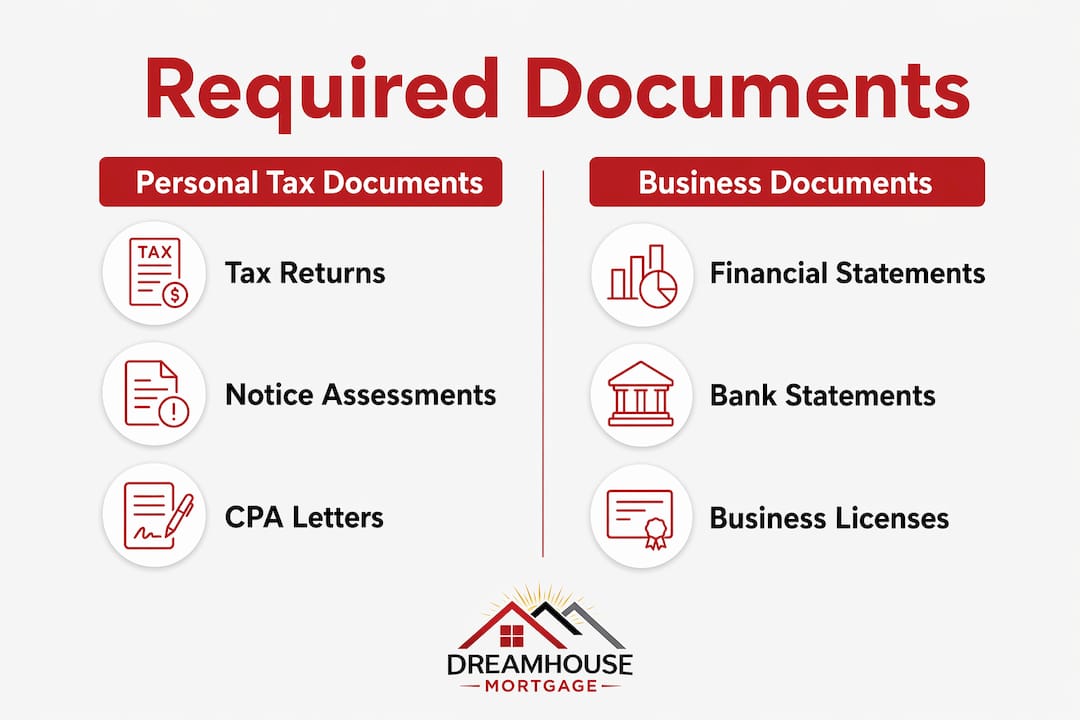
Personal tax documents
- Two years of signed T1 General personal tax returns with all schedules
- Notice of Assessment (NOA) from the Canada Revenue Agency for each year
- T1 Schedule 1 and any business income schedules (such as the T2125 Statement of Business Activities for sole proprietors)
- T5 slips if you pay yourself dividends from a corporation
Business financial documents
- Two years of corporate T2 returns (for incorporated businesses)
- Year-to-date profit and loss statement, ideally prepared or reviewed by a Chartered Professional Accountant (CPA)
- 12–24 months of business bank statements showing consistent deposits
- Articles of incorporation or business registration documents confirming ownership
CPA letters verifying business ownership, continuity, and the duration of self-employment reduce underwriting delays and increase lender confidence. Not every lender requires this letter, but providing it proactively removes a common sticking point.
| Document | Purpose | Timeframe Required |
|---|---|---|
| T1 General personal tax returns | Establishes net taxable income | 2 years |
| Notice of Assessment (CRA) | Confirms filed and accepted returns | 2 years |
| T2125 or corporate T2 | Shows business income and expenses | 2 years |
| Year-to-date P&L statement | Bridges gap between last tax year and today | Current year |
| Business bank statements | Confirms consistent cash deposits | 12–24 months |
| CPA letter | Verifies business status and ownership | Current, dated within 60 days |
Pro Tip: Request your Notices of Assessment directly from My Account on the Canada Revenue Agency website. Lenders will not accept photocopies of tax returns without the matching NOA, and missing NOAs are the most common reason for document resubmissions in Alberta mortgage files.
How do lenders calculate qualifying income for self-employed individuals?
Lenders use net taxable income, not gross revenue, to calculate how much mortgage you qualify for. This is the single most misunderstood fact in self employed mortgage qualification explained to first-time buyers. Your bank account may show $180,000 in annual deposits, but if your T1 General reports $65,000 in net income after business expenses, the lender qualifies you on $65,000.

Qualifying income is net taxable income after expenses, which is often significantly lower than the gross cash flow visible in bank statements. This surprises many self-employed borrowers who have been aggressively writing off expenses to reduce their tax bill. The tax strategy that saves you money in april can shrink your borrowing power in october.
Why write-offs reduce your mortgage qualification
Every legitimate business deduction you claim reduces your net income on paper. Home office expenses, vehicle costs, equipment purchases, and professional fees all lower the number lenders use to calculate your maximum mortgage. A freelance consultant in Calgary who earns $120,000 gross but claims $55,000 in expenses reports $65,000 in net income. At current stress test rates, that difference can mean qualifying for $200,000 less in mortgage financing.
Lenders do make some adjustments. They may add back non-cash expenses such as depreciation (Capital Cost Allowance in Canadian tax terminology) to arrive at a slightly higher qualifying figure. However, these add-backs are limited and lender-specific. The add-back income mortgage approach is worth understanding before you file your next return.
Key insight: Lenders prioritize stable and predictable income and require documentation of business cash flow to confirm an active, ongoing operation. A single strong year does not qualify you. Lenders average the two most recent years of net income, so a declining income trend can reduce your qualifying amount even further.
Bank statement mortgages as an alternative
Bank statement loans allow qualification based on gross business cash flow rather than net taxable income. This path exists for borrowers whose tax returns significantly understate their actual cash position. The trade-off is real: these products carry higher interest rates and require larger down payments than conventional insured mortgages. They are offered through alternative lenders and private lenders, not the major chartered banks. Dreamhouse Mortgage works with multiple lender types across Canada, including those offering bank statement programs for self-employed borrowers in Alberta.
Most conventional lenders require two years of self-employment history to qualify for a standard mortgage. One year may be accepted if you have a documented history of related employment in the same field before going self-employed. That exception requires strong supporting documentation and is not guaranteed.
What strategies improve mortgage approval for self-employed applicants?
The most effective strategy for self employed mortgage qualification criteria is planning your tax filings with your mortgage timeline in mind. Borrowers should plan tax filings one to two years ahead of a mortgage application to balance tax minimization with showing enough qualifying income. This does not mean paying more tax than necessary. It means being deliberate about which deductions you claim and when.
The following steps give self-employed borrowers in Calgary, Cochrane, Chestermere, and surrounding Alberta communities the strongest possible application file.
File your last two years of tax returns on time. Late filings raise red flags with lenders and delay the NOA documents you need. File by the April 30 deadline for sole proprietors and the June 15 deadline for self-employed individuals, but pay any balance owing by April 30 to avoid interest.
Limit aggressive write-offs in the year before you apply. Reducing deductions in your final pre-application tax year raises your reported net income. Work with your CPA to find the right balance between tax savings and mortgage qualification.
Prepare a current year-to-date profit and loss statement. If your last filed tax return is from the prior year, lenders want to see that your income has continued or grown. A CPA-prepared P&L carries more weight than a self-prepared spreadsheet.
Maintain 12–24 months of business bank statements. Consistent monthly deposits tell a story of business stability. Irregular or declining deposits raise questions that require additional explanation.
Avoid new debts and large financial changes during the application process. Avoid new debts and large financial changes during the mortgage process. A new vehicle loan or business line of credit taken out during underwriting can change your debt-to-income ratio and stall approval.
Build cash reserves covering 6–12 months of mortgage payments. Maintaining reserves of 6–12 months of payments reassures lenders of your repayment ability. Document these reserves in a dedicated savings or investment account.
Target a credit score of 620 or higher. Credit scores of 620 or higher improve approval chances and access to better rates. Self-employed borrowers with scores above 700 qualify for a wider range of lender products and lower rate premiums.
Obtain a CPA letter confirming business ownership and continuity. This letter should be dated within 60 days of your application and confirm your ownership percentage, the business start date, and that the business is currently operating.
Down payment requirements in Alberta
Self employed mortgage down payment requirements vary by loan type and property use. Conventional insured mortgages for a primary residence require a minimum 5% down payment on the first $500,000 of purchase price and 10% on the portion above $500,000, up to $1.5 million. Down payment requirements range from 3–5% for conventional loans to 10–20% or more for bank statement and alternative lending products. Investment properties in Calgary and Edmonton require a minimum 20% down payment regardless of employment type. A larger down payment always strengthens a self-employed application by reducing lender risk.
Pro Tip: If your net income on paper is too low for the mortgage amount you need, ask Dreamhouse Mortgage about the Stated Income or Business for Self (BFS) programs offered by certain Canadian lenders. These programs use a combination of income documentation and industry benchmarks to qualify borrowers whose tax returns understate actual earnings.
How to prepare your mortgage income proof documentation step by step
Organizing your documents before you contact a lender cuts weeks off the approval timeline. The following sequence reflects the order in which lenders review a self-employed mortgage file.
Compile two years of signed T1 General personal tax returns with all schedules. Confirm each return is signed and matches the corresponding Notice of Assessment from the Canada Revenue Agency.
Gather two years of Notices of Assessment. Download these directly from My Account on the CRA website. Lenders require the official CRA version, not a copy of what you submitted.
Collect corporate T2 returns if you operate through a corporation. Include financial statements attached to the T2, specifically the balance sheet and income statement.
Prepare a current year-to-date profit and loss statement. Have your CPA prepare or review this document. It should cover the period from january 1 of the current year to within 30–60 days of your application date.
Pull 12–24 months of business bank statements. Download official statements from your financial institution. Highlight or annotate regular income deposits to make the pattern clear for the underwriter.
Request a CPA letter. The letter should confirm your business name, your ownership percentage, the date the business was established, and that the business is currently active.
Review your personal credit report. Pull your report from Equifax Canada or TransUnion Canada and resolve any errors or outstanding collections before submitting your mortgage application.
Document your down payment and cash reserves. Provide 90 days of statements for every account contributing to your down payment. Lenders trace the source of funds to confirm no undisclosed loans.
| Preparation Step | Timing Before Application |
|---|---|
| File outstanding tax returns | 6–12 months prior |
| Reduce aggressive write-offs | 1–2 tax years prior |
| Build cash reserves | 6–12 months prior |
| Prepare year-to-date P&L | 30–60 days prior |
| Request CPA letter | Within 60 days of application |
| Pull credit report and resolve issues | 3–6 months prior |
| Collect bank statements | Ongoing; pull at application |
Communicate with your mortgage broker before you gather documents. Lender requirements differ, and a broker who specializes in self-employed mortgages in Calgary will tell you exactly which documents each lender on their panel requires. Submitting the wrong version of a document wastes time and can trigger a second round of underwriting requests. Timing matters: most lenders want documents dated within 90–120 days of the application, so pulling statements too early means pulling them again.
Understanding why banks decline self-employed mortgages in Canada is equally useful preparation. The most common reasons are insufficient net income, incomplete tax filings, and unexplained bank deposits. Addressing these issues before you apply puts you in control of the outcome.
Key Takeaways
Self-employed borrowers in Alberta qualify for mortgages by providing two years of tax returns, CRA Notices of Assessment, a current profit and loss statement, and 12–24 months of business bank statements, with net taxable income as the qualifying figure.
| Point | Details |
|---|---|
| Net income is the qualifying figure | Lenders use net taxable income after expenses, not gross revenue or bank deposits. |
| Two years of history is the standard | Most lenders require two full years of self-employment history documented through filed tax returns. |
| CPA letter reduces delays | An accountant letter confirming business ownership and continuity speeds up underwriting approval. |
| Down payment affects loan options | Conventional insured mortgages require 5% down; alternative and bank statement loans require 10–20% or more. |
| Plan tax filings with your mortgage in mind | Reducing write-offs one to two years before applying raises your qualifying income on paper. |
Dreamhouse Mortgage helps self-employed borrowers get approved
Self-employed professionals in Calgary, Airdrie, Okotoks, Red Deer, and Edmonton face a more complex mortgage process than salaried applicants. Dreamhouse Mortgage specializes in exactly this situation. The team works with banks, credit unions, monoline lenders, and alternative lenders to match your income documentation to the right product.
Guriqbal Chahal, MBA, PMP, Mortgage Broker at Dreamhouse Mortgage, reviews your income file before submission and identifies gaps that could slow approval. Whether you need a mortgage pre-approval or guidance on which lender program fits your income structure, the process starts with one conversation. For contractor and freelancer mortgage options specific to your situation, Dreamhouse Mortgage has the lender access and experience to find the right fit.
Call Guriqbal Chahal at 403-966-6072 or connect through the Google Business Profile to book a consultation.
FAQ
What is the minimum self-employment history needed for a mortgage in Canada?
Most lenders require two years of self-employment history. One year may be accepted if you have documented related employment in the same field immediately before going self-employed.
Why does my net income on my tax return differ from my bank deposits?
Lenders calculate qualifying income based on net taxable income after expenses, not gross deposits. Business deductions reduce your reported net income, which directly lowers the mortgage amount you qualify for.
What is a bank statement mortgage and when should I consider it?
A bank statement mortgage qualifies you based on gross business cash flow rather than net taxable income. Bank statement loans carry higher interest rates and larger down payment requirements, making them best suited for borrowers whose tax write-offs significantly understate actual earnings.
How much down payment do self-employed borrowers need in Alberta?
The minimum down payment for a primary residence is 5% on the first $500,000 of purchase price under standard insured mortgage rules. Alternative and bank statement loan products typically require 10–20% or more.
Does a CPA letter really make a difference in mortgage approval?
Yes. A CPA letter verifying business ownership and continuity reduces underwriting delays and gives lenders documented confirmation that your business is active and ongoing.