The difference between a broker and agent mortgage professional is defined by licensing authority, supervisory responsibility, and legal accountability within the mortgage industry. A mortgage broker holds a senior license and is legally responsible for compliance within a brokerage. A mortgage agent operates under that broker’s supervision and cannot work independently. Both professionals help you secure financing, but their authority, scope, and accountability differ in ways that directly affect your mortgage outcome in Calgary, Airdrie, Cochrane, Edmonton, and across Alberta.
What is the difference between broker and agent mortgage licensing in Alberta?
Licensing is the clearest dividing line between a mortgage broker and a mortgage agent. In Alberta, mortgage professionals are regulated under a tiered licensing framework that assigns different levels of authority based on education, experience, and demonstrated competency.
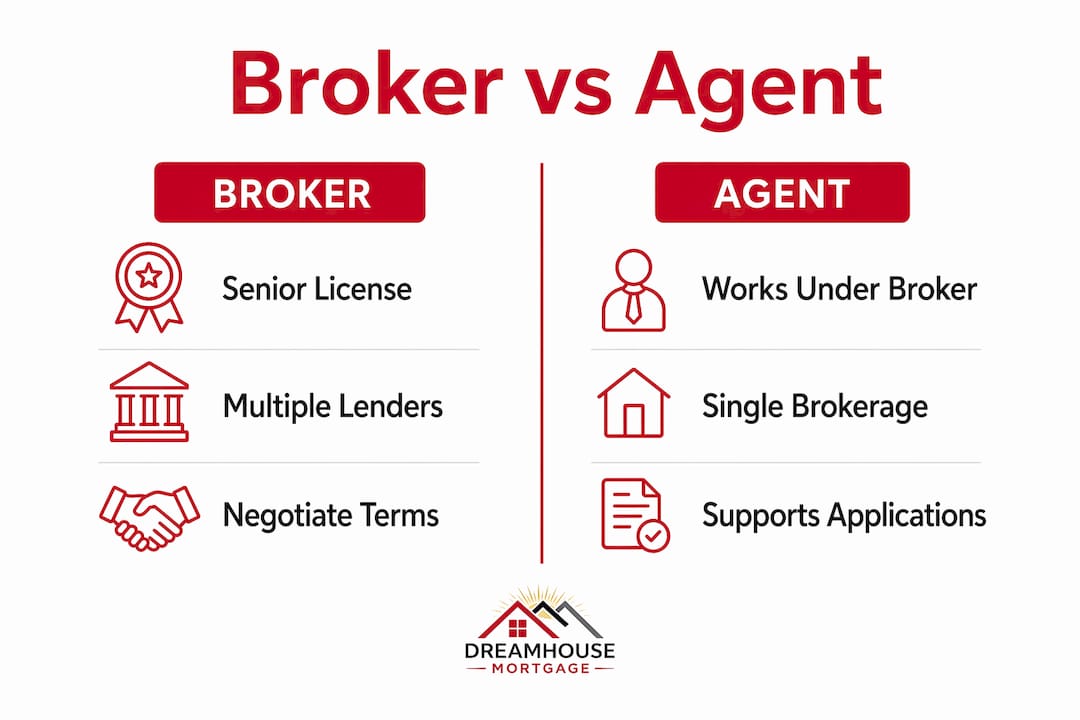
A mortgage broker holds a senior license. Brokers carry greater authority and are legally responsible for compliance, supervision, and the overall conduct of the brokerage. To qualify for broker status, a professional must typically complete advanced education and accumulate at least two years of hands-on experience as a licensed agent. That experience requirement exists because brokers assume legal accountability for every transaction processed under their license.
A mortgage agent, by contrast, operates within a brokerage under broker supervision. Agents cannot operate independently and must have brokerage sponsorship at all times. The tiered framework creates two practical levels of agents: those newer to the field who handle straightforward transactions, and more experienced agents who take on broader client files while still working under broker oversight.
- Broker license: Requires advanced education, minimum two years of agent experience, and full compliance responsibility
- Agent license: Requires brokerage sponsorship, operates under broker supervision, and cannot assume compliance duties independently
- Licensing progression: Agents typically need two years under broker supervision before becoming eligible for broker licensure
- Legal accountability: The broker of record is the legal principal responsible for all regulatory compliance within the brokerage
Pro Tip: Before working with any mortgage professional in Alberta, ask directly whether you are speaking with a licensed broker or a licensed agent. That single question tells you who holds legal accountability for your file.
How do mortgage brokers and agents differ in roles and responsibilities?
The practical difference between a mortgage broker and a mortgage agent shows up most clearly in what each professional can do on your file. Both will collect documents, communicate with lenders, and guide you through the application process. The distinction is in authority and independence.

A mortgage broker acts as an intermediary to multiple lenders. Brokers shop multiple lenders and negotiate loan terms independently, without requiring another professional’s sign-off. That independence matters when your file requires creative structuring, such as a self-employed mortgage in Calgary, a rental property purchase in Chestermere, or a private mortgage solution for a non-standard borrower profile.
A mortgage agent assists in completing applications under broker supervision. The agent facilitates communication, gathers documents, and presents options, but complex decisions and lender negotiations typically involve the supervising broker. For most standard purchase transactions in communities like Okotoks, Cochrane, or Red Deer, a well-supported agent can handle the file efficiently from start to finish.
Here is how the responsibilities break down in a typical Alberta mortgage transaction:
- Initial consultation: Both brokers and agents conduct needs assessments and review your financial profile, income, and down payment.
- Lender selection: The broker independently selects from banks, credit unions, monoline lenders, and alternative lenders. The agent recommends options within the brokerage’s lender network, subject to broker review.
- Application submission: Both professionals prepare and submit your mortgage application and supporting documents to the chosen lender.
- Negotiation: The broker negotiates rate and terms directly with lenders. The agent supports this process but does not hold independent negotiating authority.
- Compliance and approval: The broker of record signs off on compliance requirements. The agent coordinates client communication and document collection through to funding.
Understanding these steps helps you know who to call when your file hits a complication. If your lender requests additional conditions or your application requires restructuring, the broker’s involvement becomes the deciding factor.
What are typical compensation structures and how do they affect you?
Mortgage broker and agent compensation directly affects your total borrowing cost, even when you never write a check to either professional. Understanding how each is paid protects you from surprises at closing.
Mortgage brokers are most commonly paid by the lender, not by you directly. Broker commissions often range from 1% to 2% of the loan amount, paid at closing by the lender. That cost is embedded in the mortgage product itself, which is why broker fees impact final loan costs even when they are not listed as a line item on your statement. Borrowers who do not ask about compensation often assume the service is entirely free, which is not always accurate.
Mortgage agents receive a portion of the broker’s commission or a fixed fee arranged within the brokerage. The agent does not typically charge you separately. However, compensation structures may incentivize steering toward certain lenders, which is why disclosure matters. You have the right to ask your mortgage professional which lenders they work with and how they are compensated for each product.
Key points every Alberta borrower should know about compensation:
- Lender-paid commissions: The most common model. The lender pays the broker a finder’s fee. You pay nothing directly, but the cost is built into the rate or product.
- Borrower-paid fees: Less common in Canada but possible. Always confirm in writing before signing anything.
- Add-ons and points: Some brokers charge points at closing or add fees to the loan amount. Ask for a full breakdown of mortgage broker commission before proceeding.
- Disclosure requirements: In Alberta, mortgage professionals are required to disclose material conflicts of interest. Ask directly if your broker or agent receives a higher commission for recommending a specific lender.
- Comparison shopping: Brokers are not always legally obligated to obtain the absolute best deal. Comparing offers from multiple sources remains your best protection.
Pro Tip: Ask your mortgage professional to show you at least two or three lender options side by side, including the rate, term, prepayment privileges, and any penalties. A transparent professional will do this without hesitation.
When should you choose a mortgage broker vs a mortgage agent?
The right choice depends on your financial profile, the complexity of your transaction, and the level of independent oversight you want on your file. Most Alberta borrowers do not need to choose between a broker and an agent directly. They choose a brokerage, and the brokerage assigns the right professional based on the file.
A competent mortgage agent under a qualified brokerage can efficiently handle straightforward mortgage applications. If you are a salaried employee in Calgary buying your first home with a standard down payment, an experienced agent working under a licensed broker will serve you well. The agent has full access to the brokerage’s lender network and can secure competitive rates without broker intervention on every step.
Complex files are a different story. Self-employed borrowers in Edmonton, investors purchasing rental properties in Rocky View County, newcomers to Canada, or borrowers with past credit challenges benefit from direct broker involvement. The broker’s independent authority and deeper lender relationships produce better outcomes when the file requires negotiation or creative structuring.
| Borrower profile | Best fit | Why |
|---|---|---|
| Salaried first-time buyer, standard down payment | Licensed agent under experienced broker | Straightforward file, efficient process |
| Self-employed professional in Calgary | Licensed mortgage broker | Requires income structuring and lender negotiation |
| Investment property buyer in Chestermere | Licensed mortgage broker | Complex qualification, multiple lender types |
| Newcomer to Canada in Airdrie | Licensed mortgage broker | Specialized programs, alternative lender access |
| Renewal with no changes, clean credit | Licensed agent under experienced broker | Standard transaction, no complex negotiation needed |
Pro Tip: When evaluating a brokerage, ask who will be the primary contact on your file and whether the broker of record reviews all approvals. That answer tells you how much direct broker oversight your transaction will receive.
How do mortgage brokers and agents work with other real estate professionals in Alberta?
Buying a home in Calgary, Cochrane, or Red Deer involves more than one professional. Your real estate agent finds the property. Your mortgage broker or mortgage agent secures the financing. These are distinct roles, and keeping them separate protects your interests.
A real estate agent’s job is to represent you in the property transaction, negotiate the purchase price, and guide you through offers and inspections. A mortgage broker or agent’s job is to secure the best available financing for that purchase. The two roles require different licenses, different training, and different fiduciary obligations.
Dual licensing as a real estate agent and mortgage broker can create conflicts of interest, particularly when a single professional earns commissions on both the property sale and the mortgage. This arrangement is legal in some Canadian jurisdictions but requires careful scrutiny. A professional earning fees on both sides of your transaction has a financial incentive that may not always align with your best outcome.
Key considerations when working with multiple professionals on an Alberta home purchase:
- Confirm separate representation: Your real estate agent and your mortgage professional should have no financial relationship that affects your transaction.
- Coordinate timelines carefully: Mortgage pre-approval in Calgary should happen before you make an offer. Your mortgage professional needs to know your purchase timeline to coordinate lender conditions and funding dates.
- Ask about referral arrangements: If your real estate agent refers you to a specific mortgage professional, ask whether a referral fee is involved. Conflicts of interest require disclosure under Alberta’s regulatory framework.
- Verify credentials independently: Check that your mortgage professional holds a valid Alberta license before signing any documents.
Working with a brokerage that has established relationships with Alberta lenders, clear disclosure practices, and a licensed broker of record overseeing every file gives you the strongest protection throughout the transaction.
Dreamhouse Mortgage: broker expertise for Calgary and Alberta buyers
Dreamhouse Mortgage is a licensed Alberta mortgage brokerage headquartered in Calgary, serving buyers and investors in Airdrie, Cochrane, Chestermere, Okotoks, High River, Rocky View County, Edmonton, Red Deer, and surrounding communities. Guriqbal Chahal, MBA, PMP, serves as Broker of Record, providing direct broker oversight on every file.

Whether you are a first-time buyer in Calgary, a self-employed professional in Edmonton, or an investor purchasing a rental property in Chestermere, Dreamhouse Mortgage connects you with banks, credit unions, monoline lenders, and alternative lenders to find the right product for your situation. The team handles qualification, document collection, lender selection, and rate negotiation from pre-approval through to funding. Contact Guriqbal Chahal, MBA, PMP, Mortgage Broker, Dreamhouse Mortgage at 403-966-6072 or visit the Google Business Profile to get started.
Key takeaways
A mortgage broker holds a senior license with independent authority and legal compliance responsibility, while a mortgage agent operates under broker supervision and cannot act independently on complex files.
| Point | Details |
|---|---|
| Licensing hierarchy | Brokers hold senior licenses; agents must work under broker sponsorship and supervision. |
| Roles and authority | Brokers negotiate independently with lenders; agents support applications under broker oversight. |
| Compensation transparency | Ask for a full breakdown of commissions and lender options before committing to any product. |
| Choosing the right professional | Complex or non-standard files benefit from direct broker involvement; standard files suit experienced agents. |
| Conflict of interest | Dual real estate and mortgage roles require disclosure; always confirm separate representation. |
FAQ
What is the main difference between a mortgage broker and a mortgage agent?
A mortgage broker holds a senior license with independent authority and legal compliance responsibility. A mortgage agent operates under broker supervision and cannot work independently or assume compliance duties.
Can a mortgage agent in Alberta get me the same rates as a broker?
Yes, in most cases. Agents supported by experienced brokers have access to the same lender network and can secure competitive rates for standard transactions. Complex files may require direct broker involvement.
How do I know if my mortgage professional is a broker or an agent?
Ask directly. Confusion often arises because many professionals do not volunteer this distinction. You can also verify credentials through Alberta’s mortgage licensing registry.
Do I pay more if I use a mortgage broker instead of going directly to a bank?
Not necessarily. Most broker commissions are paid by the lender, not by you. However, broker fees are embedded in the mortgage product, so asking for full compensation disclosure before signing is the right move.
Should I use a mortgage broker for a first-time home purchase in Calgary?
Yes. A licensed mortgage broker in Calgary gives you access to multiple lenders, independent rate negotiation, and direct oversight on your file. Dreamhouse Mortgage specializes in first-time buyer mortgages across Calgary, Airdrie, Cochrane, and surrounding Alberta communities.