A private mortgage lender in Canada is a non-bank individual or entity that lends money secured by real property, approving loans based primarily on property equity rather than income or credit scores. This distinction makes private mortgage options Canada borrowers rely on fundamentally different from bank financing. Where a bank scrutinizes your T4 slips, credit history, and stress test results, a private lender asks one core question: is there enough equity in the property to secure the loan? For Albertans in Calgary, Airdrie, Cochrane, Chestermere, Edmonton, and Red Deer who cannot qualify through traditional channels, understanding private mortgage lender Canada options is a practical necessity, not a last resort.
What is a private mortgage lender Canada explained for borrowers?
Private mortgage lending is the practice of individuals, syndicates, or Mortgage Investment Corporations (MICs) funding real estate loans outside the chartered bank system. The industry term is “private lending,” and it sits within Canada’s broader alternative lending sector alongside credit unions and B-lenders. Private lenders do not take deposits, do not follow the Office of the Superintendent of Financial Institutions (OSFI) stress test rules, and are not bound by the National Housing Act insured mortgage guidelines. That regulatory separation is exactly why they can approve borrowers that banks decline.
The role of private lenders in the Canadian mortgage market is to fill a genuine financing gap. Self-employed borrowers with complex income, investors with multiple properties, homeowners recovering from credit events, and buyers purchasing non-standard properties in rural Alberta all represent profiles that private lenders serve regularly. Dreamhouse Mortgage, a Calgary-based brokerage founded in 2013, works with private lenders across Alberta to connect these borrowers with appropriate financing.

Private lenders range from wealthy individuals lending their own capital to regulated MICs that pool investor funds. MICs offer more predictable terms and oversight compared to individual private lenders. That structure matters when you are evaluating risk and transparency before signing a mortgage commitment.
How do private mortgage lenders approve loans in Canada?
Private lender approval centers on the property, not the borrower’s financial profile. The lender orders an independent appraisal, calculates the loan-to-value (LTV) ratio, and decides whether the equity cushion is large enough to protect their capital if the borrower defaults. Private lenders generally cap loans at 75%–80% LTV for first mortgages and 65%–75% combined LTV when multiple mortgages are registered against the same property. That cap is the single most important number in any private mortgage application.
Approval criteria: private vs. traditional lenders
| Criteria | Private lender | Traditional bank |
|---|---|---|
| Primary approval factor | Property equity (LTV) | Income, credit score, stress test |
| Minimum credit score | None required | Typically 680+ |
| Income verification | Minimal or none | Full documentation required |
| Stress test | Not applicable | Required under OSFI B-20 |
| Approval timeline | 3–10 days | 2–4 weeks |
| Typical loan term | 6–24 months | 1–5 years (amortized) |
Private mortgage approval typically completes in 3–10 days, compared to 2–4 weeks for a bank. That speed advantage is critical for borrowers facing a firm closing date or a time-sensitive refinance.
The key documents a private lender typically requests include:
- A current property appraisal from a certified appraiser
- Proof of property ownership and title search
- Existing mortgage statements showing current balance
- A brief summary of the borrower’s financial situation
- A clear explanation of the loan purpose and exit strategy
Provincial licensing rules apply to anyone arranging private mortgages. In Alberta, mortgage brokers and agents must hold a license under the Real Estate Act and are regulated by the Real Estate Council of Alberta (RECA). Licensed brokers in provinces such as Ontario and BC are regulated by FSRA and BCFSA respectively. Working with a licensed broker is the safest way to access private lenders in any province.
Pro Tip: Before you apply, get a current market value estimate for your property. Knowing your approximate LTV ratio before the formal appraisal tells you whether a private lender will realistically approve your request.
What are the costs, terms, and risks of private mortgages in Canada?
Private mortgages carry significantly higher costs than bank financing. Interest rates range from 7% to 15% or higher, with loan terms typically between 6 and 24 months. Those numbers reflect the lender’s elevated risk and the short-term nature of the product. A borrower paying 12% annually on a $300,000 private mortgage carries a monthly interest cost of $3,000. That figure puts the cost of private lending in concrete terms that a percentage alone does not convey.
Typical fee structure
Fees in private lending stack up quickly. Borrowers should budget for all of the following:
- Lender fee: 1%–3% of the loan amount, paid at closing
- Broker fee: 1%–2% of the loan amount, paid at closing
- Appraisal fee: $300–$600 depending on property type and location
- Legal fees: $1,500–$2,500 for independent legal advice and title registration
- Renewal fee: 0.5%–1.5% if the term is extended at maturity
On a $300,000 loan, combined lender and broker fees alone can reach $15,000. That cost is deducted from the advance, meaning the borrower receives less than the full loan amount at funding.
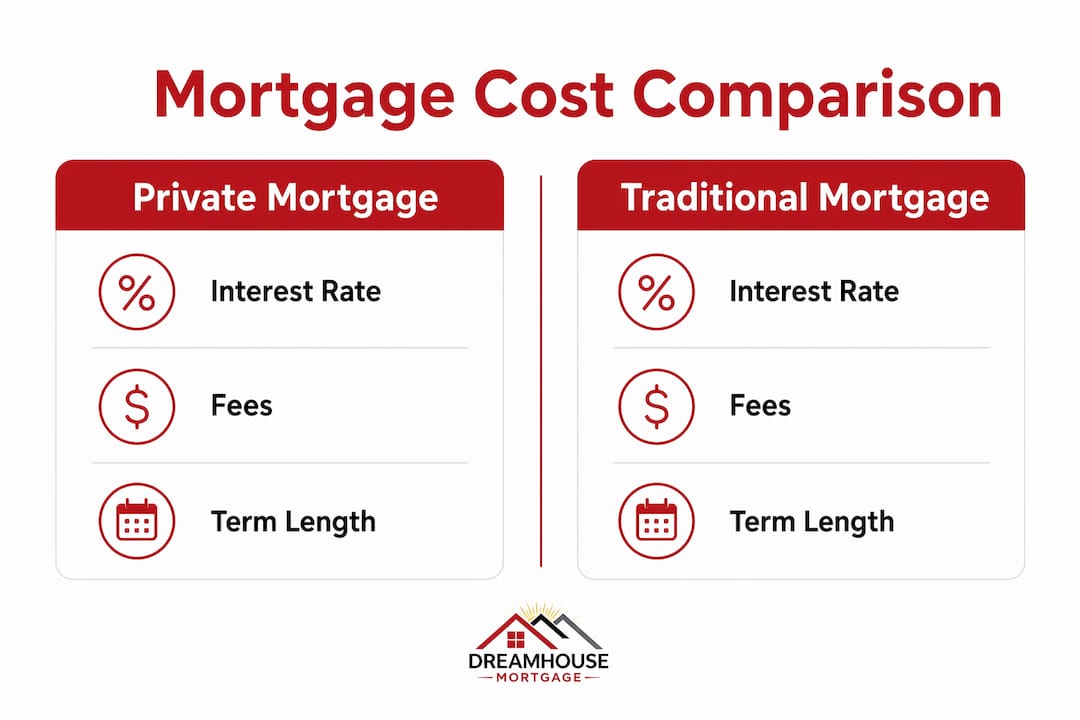
Cost comparison: private mortgage vs. traditional mortgage
| Cost element | Private mortgage | Traditional mortgage |
|---|---|---|
| Interest rate | 7%–15%+ | 4%–6% (approximate 2026 range) |
| Lender fee | 1%–3% | None |
| Broker fee | 1%–2% | None (paid by lender) |
| Term length | 6–24 months | 1–5 years |
| Payment structure | Interest-only common | Principal and interest |
| Renewal risk | High cost if not refinanced | Standard renewal process |
Most private mortgages are structured as interest-only payments. The full principal remains due at maturity. That structure keeps monthly payments lower during the term but creates a hard deadline: the borrower must refinance or sell before the term ends.
Failure to refinance or sell before term ends leads to costly renewals or forced property sales. This is the most common financial mistake private mortgage borrowers make. A lender can charge a renewal fee and a higher rate at maturity, and the borrower has little negotiating power at that point.
Pro Tip: Calculate the total cost of the private mortgage including all fees, not just the interest rate. A 10% rate with 3% in fees on a 12-month term costs more than a 12% rate with 1% in fees. Run the full numbers before you commit.
The risks of private mortgages extend beyond cost. Because terms are short and rates are high, private mortgages are not designed as permanent solutions. They are bridge financing. Borrowers who treat them as long-term products often find themselves trapped in a cycle of expensive renewals that erode their equity over time.
How can borrowers safely find private mortgage lenders in Alberta?
Finding reputable private lenders in Canada requires working through licensed professionals. The private lending market is largely unregulated at the lender level, which means individual lenders face fewer disclosure requirements than banks. A licensed mortgage broker acts as the compliance layer between the borrower and the lender.
Mortgage brokers match borrower profiles to lenders, shop for the best available rates and terms, and confirm that all fees are disclosed before the borrower signs anything. That service is not optional in private lending. It is the primary consumer protection mechanism available.
Follow these steps to find a reputable private mortgage lender in Alberta:
- Verify your broker’s license. Search the RECA public registry at reca.ca to confirm your broker holds a current Alberta mortgage broker license. Never work with an unlicensed individual.
- Ask for a full fee disclosure in writing. A legitimate broker provides a written cost breakdown before you commit. Any broker who resists this request is a red flag.
- Request lender references or credentials. Established private lenders have a track record. Ask your broker how long the lender has been active and whether they have funded similar deals in Alberta.
- Avoid guaranteed approval promises. No legitimate lender guarantees approval. Any lender or broker promising guaranteed approval regardless of your situation is using a predatory sales tactic.
- Use community networks carefully. Real estate investor groups in Calgary, Edmonton, and Red Deer sometimes connect borrowers with private lenders directly. Always verify any lender through your licensed broker before proceeding.
Dreamhouse Mortgage maintains relationships with a network of vetted private lenders across Alberta. Borrowers in Airdrie, Cochrane, Okotoks, and Chestermere can access that network through a single broker consultation rather than searching independently.
Pro Tip: Check whether the private lender is a MIC or an individual investor. MICs operate under the Income Tax Act and carry more structural oversight than individual lenders. That added layer of accountability often translates to clearer terms and fewer surprises at closing.
Using a licensed mortgage broker is the most reliable way to access regulated private lending channels and secure terms that protect your interests. Brokers who specialize in alternative lending understand which lenders are active in specific Alberta markets and which deal types each lender prefers.
What steps should borrowers take before and after getting a private mortgage?
Preparation before applying for a private mortgage directly affects the terms you receive. Borrowers who arrive with complete documentation, a clear loan purpose, and a defined exit strategy get faster approvals and better rates. Borrowers who arrive unprepared give lenders and brokers less to work with, which often results in higher fees.
Follow this process from application through to exit:
- Prepare full disclosure for your broker. Share your complete financial picture including income, debts, credit history, and property details. Your broker cannot match you with the right lender without accurate information. Hiding problems delays the process and can kill the deal at funding.
- Understand the deal structure before signing. Confirm the interest rate, lien position, term length, payment schedule, and all fees in writing. Know whether the mortgage is registered as a first or second charge on title. Second mortgages carry higher rates because they sit behind the first lender in priority.
- Hire independent legal counsel. Private mortgage transactions require a real estate lawyer. Do not use the lender’s lawyer. Your lawyer reviews the commitment letter, confirms the terms match what was disclosed, and protects your interests at closing.
- Build your exit strategy before the term starts. The exit strategy is not an afterthought. It is the plan you execute before the private mortgage matures. Common exits include refinancing into a bank or B-lender product once your credit or income situation improves, or selling the property at a profit. Discuss the exit timeline with your broker on day one.
- Monitor your credit and income during the term. The goal of a private mortgage is to create time to qualify for better financing. Use that time actively. Pay down other debts, file tax returns on time, and build your credit score. Borrowers who improve their financial profile during a 12-month private term often qualify for competitive mortgage rates at renewal through a bank or alternative lender.
Pro Tip: Ask your broker to pre-qualify you with a B-lender or bank at the same time as arranging the private mortgage. Knowing your refinance path before you start the private term removes the pressure of scrambling for options at maturity.
Negotiating fees through your broker is both possible and expected. Brokers who place regular volume with a private lender have leverage to reduce lender fees or negotiate a lower rate for strong files. A home equity loan with a clear property value and low LTV is a strong file. Present it that way.
Dreamhouse Mortgage helps Albertans access private mortgage solutions
Private mortgage lending requires expert guidance to navigate safely. Dreamhouse Mortgage, led by Guriqbal Chahal, MBA, PMP, provides Albertans with direct access to vetted private lenders, transparent fee structures, and a clear refinancing plan from day one.
Whether you are in Calgary, Edmonton, Airdrie, Cochrane, or Red Deer, Dreamhouse Mortgage matches your property profile to the right lender and negotiates terms that protect your equity. The brokerage also handles broker rate negotiation to reduce your total borrowing cost. For a free consultation, contact Guriqbal Chahal at 403-966-6072 or book your free mortgage consultation online. You can also find Dreamhouse Mortgage on Google.
Key Takeaways
Private mortgages in Canada are short-term, equity-based loans that fill a financing gap for borrowers who cannot qualify through banks, but they require a clear exit strategy and a licensed broker to use safely.
| Point | Details |
|---|---|
| Approval is equity-based | Private lenders cap loans at 75%–80% LTV and focus on property value, not income or credit. |
| Costs are significantly higher | Rates run 7%–15%+ with lender and broker fees adding 2%–5% of the loan amount at closing. |
| Terms are short by design | Most private mortgages run 6–24 months and are not intended as permanent financing solutions. |
| Exit strategy is mandatory | Plan your refinance or sale before the term starts to avoid costly renewals or forced property sales. |
| Licensed brokers are essential | A RECA-licensed broker provides fee transparency, lender vetting, and consumer protection in every deal. |
FAQ
What is a private mortgage lender in Canada?
A private mortgage lender is a non-bank individual, syndicate, or Mortgage Investment Corporation that funds real estate loans secured by property equity. Approval is based primarily on the property’s loan-to-value ratio rather than the borrower’s income or credit score.
What interest rates do private mortgage lenders charge in Canada?
Private mortgage interest rates in Canada typically range from 7% to 15% or higher, depending on the property, LTV ratio, and borrower risk profile. Lender and broker fees of 2%–5% are charged separately at closing.
How fast can a private mortgage be approved in Alberta?
Private mortgage approvals in Alberta typically complete within 3–10 days, compared to 2–4 weeks for a traditional bank mortgage. Speed depends on how quickly the property appraisal and title search are completed.
Do I need a mortgage broker to access private lenders in Canada?
Working with a RECA-licensed mortgage broker is the safest way to access private lenders in Alberta. Brokers verify lender credentials, disclose all fees upfront, and match your property profile to lenders who fund that type of deal.
What happens if I cannot refinance before my private mortgage term ends?
If you cannot refinance or sell before the term ends, the lender can renew at a higher rate and charge an additional renewal fee. In the worst case, the lender can demand full repayment, which may force a property sale. Planning your exit strategy before the term begins prevents this outcome.
Recommended
- Self Employed Mortgage Lender Types in Canada: Complete 2026 Guide
- Self Employed Mortgage Lender Types in Canada: Complete 2026 Guide
- Newcomer Mortgage Calgary: The Ultimate 2026 Guide for New to Canada Mortgage borrowers to Buy a Home Faster
- Insured Mortgage Rules and Affordability in 2026: A Practical Guide for Canadian Homebuyers
- Ready for your home search in Calgary?