
A self employed lender comparison guide is a structured framework that helps independent professionals identify which mortgage lenders and loan programs best match their income documentation, credit profile, and financing goals. Self-employed borrowers in Alberta face a distinct qualification process compared to salaried employees. Lenders assess business income differently, require specific documents like T1 Generals and Notices of Assessment, and apply varying underwriting standards depending on whether you qualify through a conventional, insured, or alternative lending channel. This guide covers the full picture: mortgage options available in Alberta, how lenders verify your income, what criteria matter most when comparing lenders, and how to prepare an application that gets approved.
What self employed mortgage options are available in Alberta?
Self-employed borrowers in Alberta have access to three broad categories of mortgage financing. Each category carries different qualification standards, down payment requirements, and interest rate levels. Knowing which category fits your situation is the first step in any self employment loan comparison.
Conventional and CMHC-insured mortgages
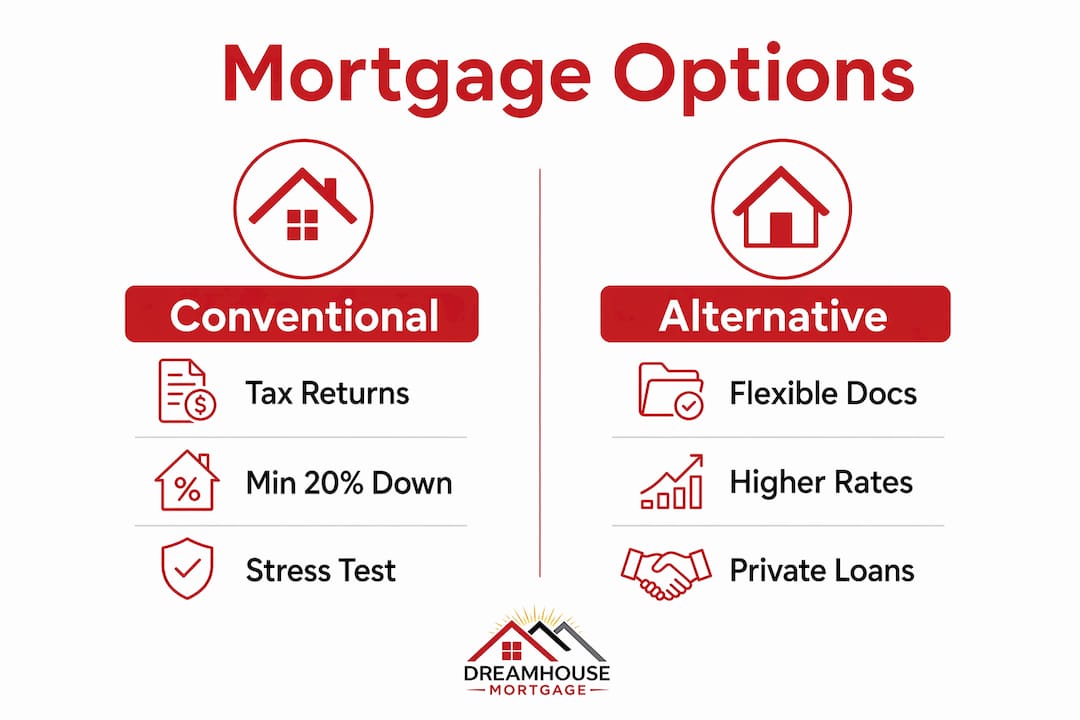
Conventional mortgages require a minimum 20% down payment and no mortgage default insurance. CMHC-insured mortgages allow down payments as low as 5% but require Canada Mortgage and Housing Corporation insurance premiums. Both programs accept self-employed applicants who can demonstrate income through two years of filed tax returns, T1 Generals, and Notices of Assessment. Lenders use your net income after business expenses, which often produces a lower qualifying income than your actual cash flow.

The mortgage stress test applies to all federally regulated lenders in Canada. You must qualify at the greater of your contract rate plus 2%, or the Bank of Canada’s minimum qualifying rate. This rule affects how much you can borrow, so knowing your qualifying income before you apply saves time and avoids surprises.
Alternative and private lending options
Alternative lenders, including credit unions, monoline lenders, and private mortgage companies, offer more flexible underwriting for self-employed borrowers. These lenders may accept bank statements, business financials, or stated income with strong compensating factors like a large down payment or high credit score. Alternative lending in Alberta fills the gap between chartered bank programs and private financing.
Private lenders sit at the far end of the spectrum. They prioritize property value and equity over income verification. Interest rates are higher, terms are shorter, and fees apply. Private lending works best as a short-term bridge while you build a stronger income record.
Key differences across mortgage categories
- Conventional and insured mortgages: Lowest rates, strictest income documentation, stress test applies
- Alternative lender mortgages: Moderate rates, flexible income verification, bank statements accepted
- Private mortgages: Highest rates, minimal income documentation, equity-focused approval
- Bank statement programs: Income calculated from 12–24 months of deposits minus an expense ratio, useful when tax returns show low net income
- Asset utilization programs: Liquid assets imputed as income to qualify for larger loan amounts when taxable income is low
The right category depends on your income documentation, credit score, and how much you can put down. Most Alberta borrowers start with conventional or insured programs and move to alternative lenders only when needed.
How do lenders evaluate self-employed income and what documentation is needed?
Lenders verify self-employed income through a defined set of documents and a review of your business history. The process is more detailed than a salaried application, but it follows a clear structure you can prepare for.
Confirm your self-employment history. Lenders require at least two years of consistent self-employment history. Some programs accept 12 consecutive months of active business operations with strong supporting financials. This requirement exists because lenders want evidence of income stability, not just a recent uptick.
Gather your tax documents. The primary documents are your T1 General tax returns for the past two years, along with the corresponding Notices of Assessment from the Canada Revenue Agency. These confirm your filed income and that your taxes are paid and current. Lenders treat CRA-confirmed income as the most reliable baseline.
Prepare your business financials. Profit and loss statements, business bank statements, and corporate financial statements (if incorporated) support your application. These documents show your actual cash flow and help lenders understand the gap between gross revenue and net taxable income.
Verify your ownership stake. Lenders require at least 25% business ownership to use business bank statements for income qualification. If you own less than 25%, you must qualify on personal income documents only. This threshold directly affects your debt-to-income ratio calculation.
Understand the expense ratio adjustment. For bank statement programs, lenders calculate your qualifying income by taking total deposits over 12–24 months and subtracting an expense ratio. The expense ratio varies by industry and lender. A contractor may face a different ratio than a consultant. Knowing your ratio in advance helps you project your qualifying income accurately.
Compile supporting business documents. A business license, GST/HST registration, articles of incorporation, or a letter from your accountant confirming your self-employment status all strengthen your file. Alberta lenders, particularly those serving Calgary, Airdrie, Cochrane, and Chestermere, see a high volume of self-employed applications and expect a complete package.
Pro Tip: Request a copy of your Notices of Assessment directly from CRA My Account before you apply. Lenders will ask for them, and having them ready speeds up the review process by several days.
What criteria should you use to compare the best lenders for self-employed mortgages?
Comparing lenders as a self-employed borrower requires a different lens than a standard mortgage search. Rate matters, but it is not the only factor. The best lenders for self employed borrowers combine competitive pricing with underwriting experience specific to variable income files.
Interest rates and loan costs
Conventional mortgage rates for self-employed borrowers who qualify on tax returns are generally comparable to salaried applicants. Alternative lender rates run higher, reflecting the added risk of flexible income verification. Non-QM style bank statement programs typically require 10%–20% down and carry higher rates than conventional loans. That rate premium is the cost of qualifying on cash flow rather than net taxable income.
Always compare the annual percentage rate, not just the advertised rate. Lender fees, broker fees, and prepayment penalties all affect the true cost of the mortgage over its term.
Lender experience with self-employed files
Not all lenders handle self-employed applications with equal skill. A lender who processes mostly salaried files may apply rigid checklists that disadvantage your application. Lenders and brokers who specialize in self-employed mortgage Calgary files understand how to read business financials, interpret income fluctuations, and present your file to underwriting in the strongest possible way.
Key comparison criteria at a glance
- Qualifying income method: Does the lender accept bank statements, tax returns, or both?
- Down payment flexibility: What is the minimum down payment for your income type?
- Credit score threshold: What is the minimum score for each program?
- Prepayment privileges: Can you make lump-sum payments or increase monthly payments without penalty?
- Portability: Can you transfer the mortgage to a new property if you move?
- Broker access: Does the lender work through mortgage brokers, giving you access to rate negotiation?
Pre-approval and buying power
Getting a mortgage pre-approval before you search for a property is the single most effective step you can take. Pre-approval confirms your qualifying income, locks in a rate for a defined period, and tells sellers you are a serious buyer. In competitive Alberta markets like Calgary and Okotoks, sellers favor pre-approved offers. The pre-approval process also surfaces documentation gaps early, giving you time to fix them before a purchase deadline creates pressure.
| Comparison factor | Conventional lender | Alternative lender | Private lender |
|---|---|---|---|
| Income verification | Tax returns, NOA | Bank statements, financials | Equity-based, minimal docs |
| Minimum down payment | 5%–20% | 10%–20% | 15%–35% |
| Interest rate level | Lowest | Moderate | Highest |
| Stress test applies | Yes | Varies | No |
| Best for | Strong tax return income | Cash-flow-rich, low net income | Short-term or bridge financing |
How to prepare your application and avoid common mistakes
Preparation separates approved applications from declined ones. Working with a mortgage specialist who understands self-employed documentation makes the approval process comparable to a salaried application. The mistakes below are the most common reasons self-employed applications stall or get declined.
Build a business narrative
Traditional checklist methods fail self-employed borrowers whose income is irregular. Lenders respond better to a clear explanation of your business’s trajectory than to raw numbers alone. Prepare a one-page business summary that explains what your business does, why income varied in a given year, and what your forward outlook looks like. A contract renewal, a new client, or a completed project can all support a positive income story. This narrative does not replace documentation. It frames it.
Separate your finances clearly
Keeping business and personal accounts separate improves lender trust and simplifies income verification. Mixed accounts create confusion about which deposits are business revenue and which are personal transfers. Open a dedicated business account if you have not already, and run all business income through it consistently for at least 12 months before applying.
Common application mistakes to avoid
- Under-documenting income: Submitting only tax returns when bank statements would show higher qualifying income
- Inconsistent records: Deposits in bank statements that do not match revenue reported on tax returns
- Ignoring credit score: A score below 680 limits your lender options significantly in Alberta
- High debt-to-income ratio: Carrying large personal or business debts reduces your qualifying loan amount
- Applying without a pre-approval: Skipping pre-approval means you may not know your real budget until you are already in a purchase negotiation
- Missing CRA compliance: Outstanding tax balances or unfiled returns are automatic disqualifiers at most lenders
Pro Tip: Run a mock underwriting exercise with your mortgage broker before submitting a formal application. Testing conventional qualification first, then alternative programs, often identifies the most favorable loan program early and can save you money on rates and fees.
What are the steps to conducting a lender comparison?
A structured lender comparison process protects you from choosing a mortgage based on rate alone. Follow these steps to evaluate your options thoroughly before committing.
Define your financing goals. Decide how much you need to borrow, what monthly payment fits your budget, and whether you prioritize the lowest rate, the most flexible terms, or the fastest approval. Goals vary. A Calgary contractor buying a primary home has different priorities than a Red Deer consultant purchasing a rental property.
Gather at least three lender offers. Contact a mix of chartered banks, credit unions, and alternative lenders, or work with a mortgage broker who can access multiple lenders at once. Collect written rate quotes with full terms, including amortization period, prepayment privileges, and any applicable fees.
Compare total cost, not just rate. Calculate the total interest paid over the mortgage term for each offer. Factor in lender fees, appraisal costs, and any broker fees. A lower rate with high fees can cost more than a slightly higher rate with no fees.
Evaluate prepayment and portability options. Prepayment privileges let you pay down your mortgage faster without penalty. Portability lets you take your mortgage to a new property. Both features matter if your business income grows or your housing needs change.
Assess lender responsiveness. How quickly does the lender respond to your questions? Do they have experience with self-employed files in Alberta? A lender who understands why banks decline self-employed applications is better positioned to approve yours.
Confirm post-approval requirements. Some lenders request updated documents between approval and funding. Know what they will ask for so you are not caught off guard at closing. Also review your renewal options early. Mortgage renewal strategy affects your long-term cost as much as the initial rate.
| Step | Action | Output |
|---|---|---|
| Set goals | Define loan amount, budget, and priorities | Clear financing target |
| Collect offers | Get 3+ written quotes from different lender types | Comparable rate and term data |
| Compare total cost | Include fees, penalties, and rate in cost calculation | True cost per lender |
| Check flexibility | Review prepayment and portability terms | Long-term fit assessment |
| Verify lender fit | Confirm self-employed experience and Alberta market knowledge | Confidence in underwriting |
| Plan for renewal | Review renewal terms and broker support options | Lower long-term cost |
Key Takeaways
Self-employed borrowers in Alberta secure the best mortgage outcomes by matching their income documentation to the right lender category and preparing a complete, consistent application file before approaching any lender.
| Point | Details |
|---|---|
| Match income docs to lender type | Tax return income suits conventional lenders; bank statements suit alternative lenders. |
| Two-year history is standard | Most lenders require at least two years of self-employment history to qualify. |
| 25% ownership threshold matters | You must own at least 25% of your business to use business bank statements for income. |
| Pre-approval is non-negotiable | Pre-approval confirms your budget and strengthens your offer in competitive Alberta markets. |
| Business narrative improves approval odds | A clear explanation of income fluctuations can convert a borderline file into an approval. |
Dreamhouse Mortgage helps self-employed borrowers in Alberta
Self-employed professionals in Calgary, Airdrie, Cochrane, Chestermere, Okotoks, Edmonton, and Red Deer work with Dreamhouse Mortgage to access lenders who understand variable income files. Guriqbal Chahal and the Dreamhouse Mortgage team compare rates and terms across banks, credit unions, monoline lenders, alternative lenders, and private lenders to find the right fit for your situation.
Dreamhouse Mortgage handles documentation review, income analysis, and broker rate negotiation on your behalf, so you get competitive terms without spending weeks managing lender conversations yourself. The team also guides you through add-back income strategies that can increase your qualifying income using allowable business expense adjustments under Canadian mortgage guidelines.
Contact Guriqbal Chahal, MBA, PMP, Mortgage Broker, Dreamhouse Mortgage at 403-966-6072 or visit the Dreamhouse Mortgage Google Business Profile to book a consultation and get a personalized rate comparison for your self-employed mortgage.
FAQ
What documents do self-employed borrowers need for a mortgage in Alberta?
Self-employed borrowers typically need two years of T1 General tax returns, Notices of Assessment from CRA, business bank statements, and proof of business ownership such as a business license or articles of incorporation.
How do lenders calculate income for self-employed mortgage applicants?
Lenders use net income from tax returns for conventional programs, or calculate income from 12–24 months of bank statement deposits minus an expense ratio for alternative lending programs.
What credit score do self-employed borrowers need to qualify?
Most conventional and insured mortgage programs in Alberta require a minimum credit score of 680. Alternative lenders may accept lower scores with a larger down payment or strong business financials.
Can a mortgage broker help self-employed borrowers get better rates?
A mortgage broker with self-employed experience accesses multiple lenders at once, compares programs, and negotiates on your behalf, which typically produces better rates and terms than applying directly to a single lender.
How long does it take to get a self-employed mortgage approved in Alberta?
Approval timelines vary by lender and documentation completeness. A well-prepared file submitted through a mortgage broker can receive conditional approval within a few business days at many Alberta lenders.