
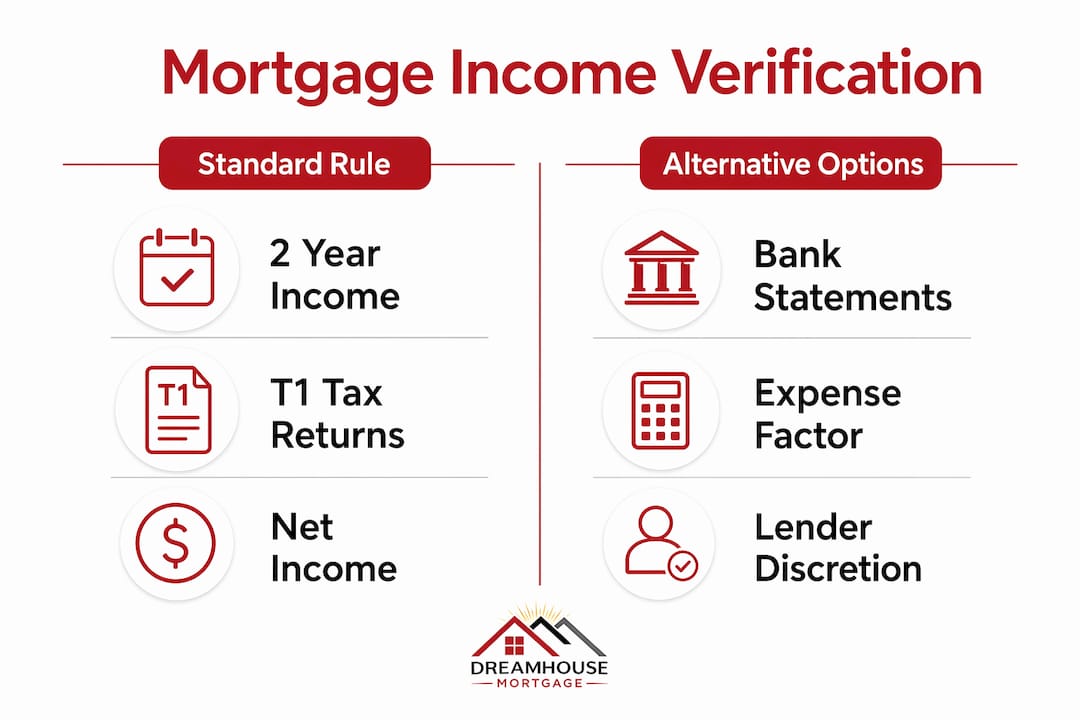
The two year self employment mortgage rule is the standard Canadian lenders use to confirm that self-employed borrowers have a reliable, documented income history before approving a mortgage. Most major lenders and mortgage insurers in Canada require at least two years of self-employment income history, verified through personal and business tax returns, before they will consider your application. This rule applies whether you are a freelancer in Calgary, a contractor in Airdrie, or a business owner in Red Deer. Understanding this requirement before you apply is the difference between a smooth approval and a costly delay. Dreamhouse Mortgage works with self-employed professionals across Alberta to prepare applications that meet these standards from the start.
What does the two year self employment mortgage rule actually require?
The two year self employment mortgage rule is defined as a lender requirement for a minimum of two years of documented self-employment income history to qualify for a mortgage. This is not a suggestion. It is a firm underwriting standard applied by banks, credit unions, and monoline lenders across Canada as of 2026.
The rule exists because self-employed income is variable. A salaried employee receives a consistent paycheck that a lender can verify in minutes. A self-employed borrower’s income can shift significantly from year to year, which makes lenders require a longer track record to confirm the income is stable and likely to continue.

Self-employed borrowers are defined as individuals with 25% or greater ownership in a business, or those who receive income outside of a standard employment arrangement. This definition covers sole proprietors, incorporated business owners, freelancers, and independent contractors in Alberta. If you fall into any of these categories, the two year rule applies to you.
The standard also applies to mortgage insurers such as Canada Mortgage and Housing Corporation (CMHC). Insured mortgages, which are required when your down payment is below 20%, carry the same two year income verification requirement. This means the rule affects both insured and conventional mortgage applications.
What documents do lenders require to verify self-employment income?
Self-employment mortgage eligibility depends entirely on documentation. Self-employment is primarily a documentation hurdle rather than a disqualifier. Preparation is what separates approved applications from declined ones.
Lenders in Alberta require the following documents to verify self-employment income:
- T1 General tax returns: Two years of personal tax returns, including all schedules and the Notice of Assessment from the Canada Revenue Agency (CRA) for each year.
- T2125 Statement of Business Activities: This form details your gross business income, allowable expenses, and net profit. Lenders read this closely.
- Business financial statements: Year-to-date profit and loss statements, and sometimes audited or reviewed financial statements for incorporated businesses.
- Business bank statements: Typically 3–6 months of statements showing consistent cash flow and regular business activity.
- CPA or accountant letter: A letter from a licensed accountant confirming your business ownership percentage, years of operation, and income stability.
- Business registration documents: Proof that your business is legally registered and operating in Alberta.
Lenders focus on net income, not gross revenue. A contractor billing $200,000 per year but claiming $140,000 in expenses qualifies on $60,000 of net income. That distinction matters enormously for how much mortgage you can access.
Clean, separate business and personal accounts and a CPA letter verifying income stability help speed underwriting and improve lender confidence. Mixing personal and business transactions in one account raises red flags and slows the approval process.
Pro Tip: File your taxes on time every year and request your CRA Notice of Assessment immediately after filing. Lenders will not accept tax returns without the corresponding Notice of Assessment, and delays in obtaining these documents can push back your closing date.
For a full breakdown of required self-employed mortgage documents in Calgary and Alberta, Dreamhouse Mortgage has published a detailed 2026 guide covering every document category lenders request.
Are there exceptions to the two year self employment rule?
Exceptions to the standard self-employment mortgage eligibility rule exist, but they are narrow and require strong supporting evidence. The most recognized exception allows a borrower to combine one year of self-employment with two years of prior related employment or education in the same industry to satisfy the two year history requirement.
This exception is meaningful for professionals who transitioned from salaried work into self-employment. A civil engineer who worked for a Calgary firm for five years and then launched an independent consulting practice one year ago may qualify under this exception. The key is that the prior employment and the current self-employment must be in the same field.
The following factors support an exception application:
- Prior related employment: Two or more years of salaried or hourly work in the same industry as your current self-employment.
- Relevant education or certifications: A degree or professional designation directly related to your business strengthens the case for income continuity.
- No employment gaps over one month: Lenders expect no gaps larger than one month in employment history during the last 12 months. A gap signals instability.
- Strong credit score: A credit score above 700 signals financial responsibility and offsets the shorter self-employment history.
- Cash reserves: Documented savings of 3–6 months of mortgage payments show the lender you can cover payments during a slow business period.
Underwriters value education and prior industry experience as positive compensating factors that can offset shorter self-employment duration. A borrower who spent years as a licensed electrician before starting their own electrical contracting business in Cochrane presents a very different risk profile than someone who launched a brand-new business with no related background. Lenders recognize that distinction, and a skilled mortgage broker can present your file in a way that highlights those strengths.
Lender discretion plays a real role here. Not every lender applies exceptions the same way. Alternative lenders and credit unions in Alberta often have more flexibility than the major chartered banks. Dreamhouse Mortgage works with a broad network of lenders to find the right fit for borrowers who fall just outside the standard two year window.
What alternative mortgage options exist if you do not meet the two year requirement?
Self-employed borrowers who cannot yet meet the standard two year income verification requirement have real options. The most common alternative is a bank statement mortgage, sometimes called a stated income or non-traditional income mortgage in the Canadian context.
Bank statement mortgages qualify borrowers based on monthly cash deposits rather than net taxable income from tax returns. Instead of averaging two years of T1 net income, the lender reviews 12–24 months of business bank statements and calculates average monthly deposits as the qualifying income base. This approach benefits borrowers whose gross revenue is strong but whose net income is reduced by legitimate business deductions.
The trade-offs are real and worth understanding before you apply:
| Feature | Conventional mortgage | Bank statement mortgage |
|---|---|---|
| Income verification | Net income from T1 tax returns | Average monthly bank deposits |
| Down payment required | As low as 5% (insured) | Typically 20% or more |
| Minimum credit score | 640 (conventional, Canada) | Around 620 minimum |
| Interest rate | Standard lender rates | Generally higher than conventional |
| Lender type | Banks, credit unions, monolines | Alternative and private lenders |
Bank statement lenders apply an expense factor to gross deposits when calculating qualifying income. If your business deposits $15,000 per month and the lender applies a 40% expense factor, your qualifying income becomes $9,000 per month. Understanding this calculation helps you estimate your maximum loan amount before you apply.
Bank statement mortgages suit borrowers who are in their first year of self-employment, have strong cash flow but low net taxable income, or need to move quickly on a property purchase before their two year history is complete. The higher down payment requirement of 20% or more means you need more equity or savings upfront.
Pro Tip: If you are 12–18 months into self-employment, consider using this period to build your bank statement history, keep deposits consistent, and avoid large irregular transfers. Lenders look for predictable, recurring deposits rather than sporadic large amounts.
For more detail on alternative self-employed mortgage lenders in Calgary, Dreamhouse Mortgage has published a 2026 guide covering lender types, qualification criteria, and rate expectations for non-traditional income borrowers.
How do lenders calculate qualifying income for self-employed mortgages?
Lenders calculate qualifying income for self-employed mortgages using net profit reported on tax returns, not gross business revenue. This is the single most important number in your mortgage application, and most self-employed borrowers underestimate how much their deductions affect it.
The process works as follows:
- Identify net business income: Lenders pull the net income figure from your T1 General return, specifically the net self-employment income after all allowable business expenses are deducted.
- Average two years of net income: The lender adds your net income from year one and year two, then divides by two. If your income was $80,000 in year one and $100,000 in year two, your qualifying income is $90,000.
- Apply the mortgage stress test: Your qualifying income is then tested against the Bank of Canada qualifying rate to confirm you can afford the mortgage at a higher interest rate than your actual contract rate.
- Assess income trend: If your income declined from year one to year two, many lenders will use the lower year’s figure rather than the average. A declining income trend raises underwriting concerns.
- Add back allowable deductions: Some lenders, particularly alternative lenders, will add back certain non-cash deductions such as depreciation (Capital Cost Allowance) to increase your qualifying income. This is called add-back income and it can meaningfully improve your borrowing power.
Lenders primarily use net profit after expenses reported on tax returns, not gross business income. Many self-employed borrowers reduce taxable income through aggressive deductions, which lowers their qualifying income at the same time. This creates a real tension between tax planning and mortgage eligibility.
The strategic implication is direct. If you plan to apply for a mortgage within the next two years, speak with both your accountant and your mortgage broker before filing your taxes. Claiming every possible deduction may reduce your tax bill today but shrink the mortgage you qualify for tomorrow. Some borrowers choose to claim fewer deductions in the one or two years before applying to show stronger net income on paper.
Mortgage lenders evaluate income consistency and the likelihood that income will continue when underwriting applications. A borrower with two years of stable or growing net income is far easier to approve than one with volatile swings. Consistency is the signal lenders want to see.
Pro Tip: Keep your personal and business bank accounts completely separate. Lenders and underwriters review account statements closely. Commingled funds create confusion about your actual business income and can trigger additional documentation requests that delay your approval.
Dreamhouse Mortgage: expert support for self-employed borrowers in Alberta
Self-employed professionals in Calgary, Airdrie, Cochrane, Chestermere, Okotoks, and across Alberta face a more complex mortgage process than salaried borrowers. Dreamhouse Mortgage specializes in exactly this situation.

Guriqbal Chahal, MBA, PMP, Mortgage Broker and Broker of Record at Dreamhouse Mortgage, works directly with self-employed clients to organize documentation, identify the right lender from a broad network, and present applications in the strongest possible light. Whether you meet the standard two year requirement or need an alternative path, Dreamhouse Mortgage has access to banks, credit unions, monoline lenders, alternative lenders, and private lenders across Alberta. The team also handles mortgage broker rate negotiation to secure competitive terms for self-employed clients who might otherwise accept whatever a single lender offers.
Contact Guriqbal Chahal, MBA, PMP, Mortgage Broker, Dreamhouse Mortgage at 403-966-6072 or visit the Google Business Profile to book a consultation.
Key Takeaways
The two year self employment mortgage rule requires documented net income history across two tax years, and preparation of the right documents is the most direct path to approval.
| Point | Details |
|---|---|
| Two year income requirement | Lenders require two years of T1 tax returns and business financials to verify stable self-employment income. |
| Net income is the qualifying figure | Lenders use net profit after deductions, not gross revenue, to calculate how much mortgage you qualify for. |
| Exceptions exist with prior employment | One year of self-employment plus two years of related salaried work can satisfy the two year requirement. |
| Bank statement mortgages fill the gap | Borrowers under two years in business can qualify through alternative lenders using monthly deposit history. |
| Document preparation drives approval | Clean accounts, CPA letters, and filed tax returns with Notices of Assessment are the foundation of every successful application. |
FAQ
What is the two year self employment mortgage rule in Canada?
The two year self employment mortgage rule requires self-employed borrowers to provide at least two years of documented income history, typically through T1 tax returns and CRA Notices of Assessment, before most Canadian lenders will approve a mortgage application.
Can I get a mortgage with less than two years of self-employment?
Yes. You may qualify by combining one year of self-employment with two or more years of prior related employment in the same industry, provided there are no employment gaps over one month and you have strong compensating factors such as a good credit score and cash reserves.
What income figure do lenders use for self-employed mortgage qualification?
Lenders use net profit reported on your T1 General tax return, averaged across two years. Gross revenue and total business deposits are not used for conventional mortgage qualification, though alternative lenders may use bank deposit averages.
What is a bank statement mortgage and who is it for?
A bank statement mortgage qualifies borrowers based on average monthly business deposits rather than net taxable income. It suits self-employed borrowers with strong cash flow but low net income due to deductions, and typically requires a 20% or greater down payment.
How does Dreamhouse Mortgage help self-employed borrowers in Calgary?
Dreamhouse Mortgage connects self-employed clients in Calgary and across Alberta with lenders who specialize in non-traditional income verification, prepares documentation packages, and negotiates rates and terms on behalf of borrowers. Contact Guriqbal Chahal at 403-966-6072 to start the process.