The mortgage broker application process steps are the defined sequence of actions you take to secure home financing through a licensed broker in Alberta, from your first consultation through to final funding. The full process typically takes 4–6 weeks, covering pre-approval, document submission, lender selection, underwriting, and settlement. For first-time home buyers in Calgary, Airdrie, Cochrane, Edmonton, or Red Deer, understanding each step before you start removes guesswork and prevents costly delays. Canadian mortgage rules, including federal stress test requirements and Know Your Client (KYC) compliance standards, apply at every stage. Working with a licensed Alberta mortgage broker like Dreamhouse Mortgage gives you access to multiple lenders and a guided process built around your specific financial profile.
What documents do you need to start a mortgage broker application?
Gathering the right documents before your first broker meeting is the single fastest way to speed up your approval. Lenders cannot begin underwriting until they have verified your income, identity, and financial history. Missing even one item can push your timeline back by days or weeks.
Core documents every applicant needs
The standard mortgage application checklist includes the following items:
- Government-issued photo ID. A valid Canadian passport, driver’s license, or permanent resident card satisfies KYC identity verification requirements.
- Proof of income. Provide your two or three most recent pay stubs from your employer. Salaried employees should also include a recent letter of employment confirming your position, salary, and start date.
- Tax returns and Notices of Assessment. Your last two years of Canada Revenue Agency (CRA) Notices of Assessment confirm your declared income and any outstanding tax balances.
- Bank statements. Three months of statements from all accounts show your savings, spending patterns, and the source of your down payment.
- Down payment confirmation. A 90-day history of the account holding your down payment is required to confirm the funds are not borrowed.
- Property details. Once you have an accepted offer, provide the signed Agreement of Purchase and Sale, MLS listing, and property tax information.
Additional documents for self-employed buyers
Self-employed buyers in Calgary and across Alberta face a higher documentation standard. Lenders require two years of personal and business tax returns, CRA Notices of Assessment for both years, and recent business bank statements. Some lenders also request a business license or accountant’s letter confirming the business is active. Dreamhouse Mortgage works with self-employed clients regularly and knows which lenders apply the most flexible income verification policies in Alberta.
KYC and AML compliance in Canada
Canadian mortgage brokers must comply with federal Anti-Money Laundering (AML) and KYC regulations under the Financial Transactions and Reports Analysis Centre of Canada (FINTRAC). This means your broker will verify your identity, confirm the source of your down payment funds, and document your financial background before submitting any application. These steps are not optional. They protect both you and the lender.
Pro Tip: Scan and organize all documents into clearly labeled PDF files before your first meeting. A single digital folder with named files (e.g., “T4-2024,” “BankStatement-March2026”) lets your broker upload everything in one submission and reduces back-and-forth requests.
How does a mortgage broker evaluate your financial position?
A mortgage broker assesses your borrowing capacity by analyzing four core factors: income stability, credit score, existing debt, and available down payment. This evaluation determines which lenders are a realistic fit before any application is submitted. Submitting to the wrong lender wastes time and can generate unnecessary credit inquiries.
Debt-to-income and the stress test
Canadian lenders apply a mortgage stress test under federal Office of the Superintendent of Financial Institutions (OSFI) guidelines. Your broker calculates your Gross Debt Service (GDS) and Total Debt Service (TDS) ratios to confirm you qualify. Lenders also apply a serviceability buffer of approximately 3% above the contract interest rate to confirm you can still afford payments if rates increase. That buffer means your qualifying rate is higher than the rate you will actually pay. A broker runs these numbers before selecting a lender, so you only apply where you have a strong chance of approval.
Credit score and income stability
Your credit score directly affects which lenders will consider your application and at what rate. Most Canadian institutional lenders prefer a score of 680 or higher for standard insured mortgages. A broker reviews your full credit report, identifies any issues, and advises on whether to address them before applying. Income stability matters equally. Lenders want to see at least two years of consistent employment or self-employment history. Gaps, recent job changes, or commission-based income require additional documentation and sometimes a different lender category.
How brokers select the right lender for you
Dreamhouse Mortgage works with banks, credit unions, monoline lenders, alternative lenders, and private lenders across Alberta. After evaluating your profile, your broker matches you with lenders whose products align with your credit, income type, property location, and down payment size. Brokers must disclose fees and compensation and explain their lender recommendations in plain language as part of their fiduciary duty to you. That transparency means you understand exactly why a specific lender is recommended and what it costs. You are never left guessing.
- Banks and credit unions suit buyers with strong credit and stable employment.
- Monoline lenders often offer lower rates for standard purchases and are accessible only through brokers.
- Alternative lenders serve buyers with bruised credit, non-traditional income, or higher TDS ratios.
- Private lenders provide short-term solutions for complex situations where institutional approval is not yet possible.
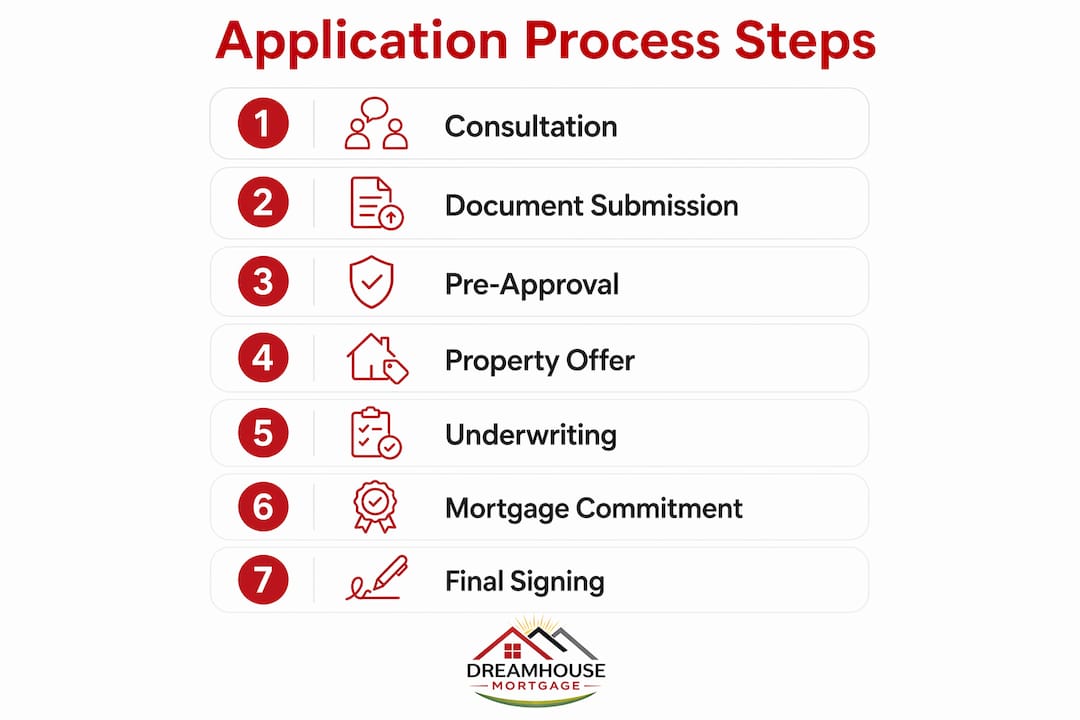
What are the step-by-step mortgage broker application process steps?
The mortgage broker application process follows a clear sequence. Each stage has a defined purpose and a typical timeframe. Knowing what comes next keeps you prepared and reduces stress.

Step 1: Initial consultation (Day 1)
Your broker reviews your financial goals, income, credit, and timeline. This meeting takes 30–60 minutes and can happen in person, by phone, or by video. You discuss how much you want to borrow, your target property type, and your preferred communities, whether that is Calgary, Cochrane, Chestermere, Okotoks, or elsewhere in Alberta. Your broker explains the questions to ask at this stage to make sure you leave with a clear picture of your options.
Step 2: Document collection and application packaging
After the consultation, you submit your document package. Your broker does not simply forward your paperwork to lenders. A skilled broker writes a cover letter that explains your financial situation, addresses any potential concerns, and frames your application positively before the underwriter reviews it. This application packaging significantly increases approval chances compared to submitting documents alone. The cover letter is one of the most underappreciated parts of the process.

Step 3: Pre-approval (1–5 business days)
Pre-approval is a conditional commitment from a lender based on your income, credit, and down payment. The pre-approval stage typically takes 1–5 business days. It gives you a confirmed maximum purchase price and locks in a rate for 90–120 days while you search for a property. Pre-approval is not a guarantee of final funding, but it is a strong signal that you qualify. Sellers and real estate agents in Calgary and Airdrie take pre-approved buyers more seriously in competitive markets.
Step 4: Property selection and offer
Once pre-approved, you search for a property within your confirmed budget. When you find a home and make an offer, your real estate agent includes a financing condition in the Agreement of Purchase and Sale. This condition gives you time to complete full mortgage approval after the offer is accepted.
Pro Tip: Set financing conditions of 7–10 business days rather than 5. Underwriting and property appraisal together can take up to 10 business days, especially for rural or unique properties in Rocky View County or High River. A tight 5-day condition risks expiring before approval is complete.
Step 5: Formal underwriting and approval (3–10 business days)
Formal underwriting is the lender’s full review of your application, documents, and the specific property. The lender orders an appraisal to confirm the property’s market value supports the loan amount. Underwriting typically takes 3–10 business days. Your broker monitors the file, responds to any lender conditions, and keeps you updated throughout. Respond to any requests from your broker immediately. Delays in answering lender questions are one of the most common causes of extended timelines.
Step 6: Mortgage commitment and conditions
Once the lender approves your application, they issue a mortgage commitment letter outlining the loan amount, interest rate, term, and conditions. Common conditions include proof of property insurance, a final pay stub, or a signed copy of the Agreement of Purchase and Sale. Your broker reviews every condition with you and confirms what you need to provide and by when.
Step 7: Lawyer review and funding
Your broker sends the mortgage instructions to your real estate lawyer. You meet with your lawyer to sign the mortgage documents, confirm the title transfer, and pay closing costs. The lender releases funds to the lawyer, who completes the transaction. You receive the keys.
| Stage | Typical Timeframe | Key Action |
|---|---|---|
| Initial consultation | Day 1 | Review goals, income, and credit |
| Document collection | Days 1–3 | Submit full document package |
| Pre-approval | 1–5 business days | Receive conditional rate hold |
| Formal underwriting | 3–10 business days | Lender reviews property and file |
| Mortgage commitment | 1–2 business days | Review and satisfy conditions |
| Funding and closing | 1–2 business days | Sign with lawyer, receive keys |
What causes delays in the mortgage application process?
Delays in mortgage approval almost always trace back to one of four sources: incomplete documentation, slow employer verification, appraisal backlogs, or financial changes during the approval period. Knowing these risks in advance lets you avoid them.
The most common delay triggers
- Missing or incomplete documents. Unorganized documentation is the top cause of extended underwriting times. A single missing bank statement or unsigned form can pause the entire file.
- Slow employer verification. Lenders sometimes contact your employer directly to verify your income letter. If your HR department is slow to respond, your timeline extends. Notify your employer in advance that a verification call may come.
- Appraisal delays. Properties in rural areas, acreages in Rocky View County, or unique homes in smaller Alberta communities can take longer to appraise because fewer comparable sales exist. Budget extra time for these property types.
- Financial changes during approval. Taking on new debt, changing jobs, or making large unexplained deposits between pre-approval and funding can trigger a full re-review. Avoid any major financial changes until after your mortgage closes.
- Slow document responses from the buyer. Your broker cannot move the file forward without your timely responses. Check your email and phone daily during the active approval period.
Providing a complete, well-indexed digital document package at the start of your application is the single most effective action you can take to speed up your mortgage approval. Speed of approval correlates directly to the quality and completeness of your initial submission. Buyers who submit everything correctly on day one consistently experience shorter timelines and fewer lender conditions.
How an experienced broker reduces your risk
Dreamhouse Mortgage takes a proactive approach to delay prevention. Your broker reviews your full document package before submission, identifies gaps, and requests missing items before the lender ever sees the file. The broker’s cover letter addresses any credit or income nuances upfront, reducing the chance of a lender condition that stalls the process. Experienced brokers also know which lenders have faster turnaround times in the current Alberta market, and they route your application accordingly.
Dreamhouse Mortgage: expert guidance for Alberta home buyers
Dreamhouse Mortgage has helped first-time home buyers across Calgary, Airdrie, Cochrane, Chestermere, Edmonton, and Red Deer navigate every stage of the mortgage process since 2013.

Guriqbal Chahal, MBA, PMP, Broker of Record at Dreamhouse Mortgage, provides personalized mortgage advice, access to multiple lenders, and clear explanations of your options at every step. Whether you need a competitive rate negotiation or a full walkthrough of your mortgage affordability factors, Dreamhouse Mortgage delivers transparent, efficient service from consultation to keys. Contact Guriqbal Chahal directly at 403-966-6072 or visit the Dreamhouse Mortgage Google Business Profile to book your consultation today.
Key takeaways
The mortgage broker application process in Alberta follows a defined sequence, and completing each step correctly, starting with a full document package, is the fastest path to approval.
| Point | Details |
|---|---|
| Full documents from day one | Submitting a complete, organized package at the start reduces underwriting delays significantly. |
| Pre-approval takes 1–5 business days | Pre-approval locks in your rate and confirms your budget before you make an offer. |
| Set 7–10 day financing conditions | Shorter conditions risk expiring before underwriting and appraisal are complete. |
| Broker packaging improves approvals | A broker’s cover letter addresses financial nuances before the lender reviews your file. |
| Avoid financial changes during approval | New debt or job changes between pre-approval and funding can trigger a full re-review. |
FAQ
What are the main mortgage broker application process steps?
The main steps are: initial consultation, document collection, pre-approval, property selection, formal underwriting, mortgage commitment, and funding. The full process typically takes 4–6 weeks from start to finish.
How long does mortgage pre-approval take in Alberta?
Pre-approval generally takes 1–5 business days once your broker has received your complete document package. A faster submission leads to a faster decision.
What documents do I need for a mortgage application in Canada?
You need government-issued photo ID, recent pay stubs, two years of CRA Notices of Assessment, three months of bank statements, and a 90-day history of your down payment funds. Self-employed buyers also need two years of personal and business tax returns.
Why should I use a mortgage broker instead of going directly to a bank?
A mortgage broker accesses multiple lenders, including banks, credit unions, monoline lenders, and alternative lenders, and compares options on your behalf. Brokers must disclose their compensation and explain their recommendations, which gives you full transparency on the advice you receive.
What is a financing condition and how long should it be?
A financing condition is a clause in your purchase offer that gives you time to secure full mortgage approval after your offer is accepted. Setting the condition at 7–10 business days is recommended to allow enough time for underwriting and property appraisal without the condition expiring prematurely.