First-time home buyers in Alberta are defined as individuals purchasing their first residential property who qualify for specific mortgage rules, government programs, and financing options designed to make homeownership more accessible. Under Canadian federal standards, you qualify as a first-time buyer if you have not owned a principal residence in the current year or in any of the four preceding calendar years. Alberta adds a distinct advantage to this definition: the province uses a flat-fee land title transfer system instead of the percentage-based land transfer taxes charged in Ontario or British Columbia, which directly reduces your closing costs from day one.
Understanding Alberta’s mortgage environment in 2026 requires knowing three key frameworks: the OSFI mortgage stress test, CMHC insured mortgage rules, and federal financial assistance programs like the First Home Savings Account (FHSA) and the Home Buyers’ Plan (HBP). These are not optional considerations. They determine how much you can borrow, how much you need upfront, and how much the government will help you get there. This guide covers all three in detail, with specific numbers and current rules.
What mortgage options and stress test rules apply to first-time buyers in Alberta?
The mortgage stress test is the single most important qualification hurdle for first-time buyers in Alberta. The stress test qualifying rate requires you to qualify at the higher of your contract rate plus 2%, or a floor rate of 5.25%. This means if your lender offers you a 4.5% rate, you must prove you can afford payments at 6.5%.

Two debt ratio limits govern how much you can borrow under this test. Your Gross Debt Service (GDS) ratio cannot exceed 39%, meaning your housing costs (mortgage, property taxes, heat, and half of condo fees) cannot exceed 39% of your gross income. Your Total Debt Service (TDS) ratio cannot exceed 44%, meaning all debt payments combined cannot exceed 44% of your gross income. These GDS and TDS limits are the math behind every mortgage approval decision.
Insured vs. uninsured mortgages in 2026
The insured mortgage price cap increased to $1.5 million in 2026, up from the previous $1 million threshold. This means you can now put down less than 20% on homes priced up to $1.5 million and still qualify for CMHC mortgage insurance. That change opens insured financing to a much wider range of Calgary and Edmonton properties than before.
First-time buyers purchasing new construction also qualify for a 30-year amortization on insured mortgages. A 30-year term reduces your monthly payment by roughly 8% compared to the standard 25-year term. The trade-off is a 0.20% surcharge on your CMHC insurance premium and significantly more total interest paid over the life of the loan.
Credit unions and stress test flexibility
Provincially regulated credit unions in Alberta are not always subject to OSFI’s B-20 stress test guidelines. This means some Alberta credit unions can use alternative underwriting criteria, which can help buyers with borderline debt ratios qualify for a mortgage. This is not a loophole. It is a legitimate structural difference between federally and provincially regulated lenders that Dreamhouse Mortgage helps clients navigate.
Pro Tip: Since november 21, 2024, renewals with the same lender that do not involve new loan capital are exempt from the stress test. If rates rise after you buy, staying with your current lender at renewal avoids a full requalification.
- Insured mortgages: available for homes up to $1.5 million with less than 20% down
- 30-year amortization: available for first-time buyers on new construction with insured financing
- Stress test floor: 5.25% or contract rate plus 2%, whichever is higher
- GDS cap: 39% of gross income
- TDS cap: 44% of gross income
- Credit unions: may apply alternative qualifying criteria outside OSFI rules
OSFI is also focusing on high loan-to-income mortgages, meaning overall debt load matters even after you pass the stress test. Keeping non-mortgage debt low is not just good practice. It directly protects your borrowing capacity.
How do down payment requirements and government programs help Alberta buyers?
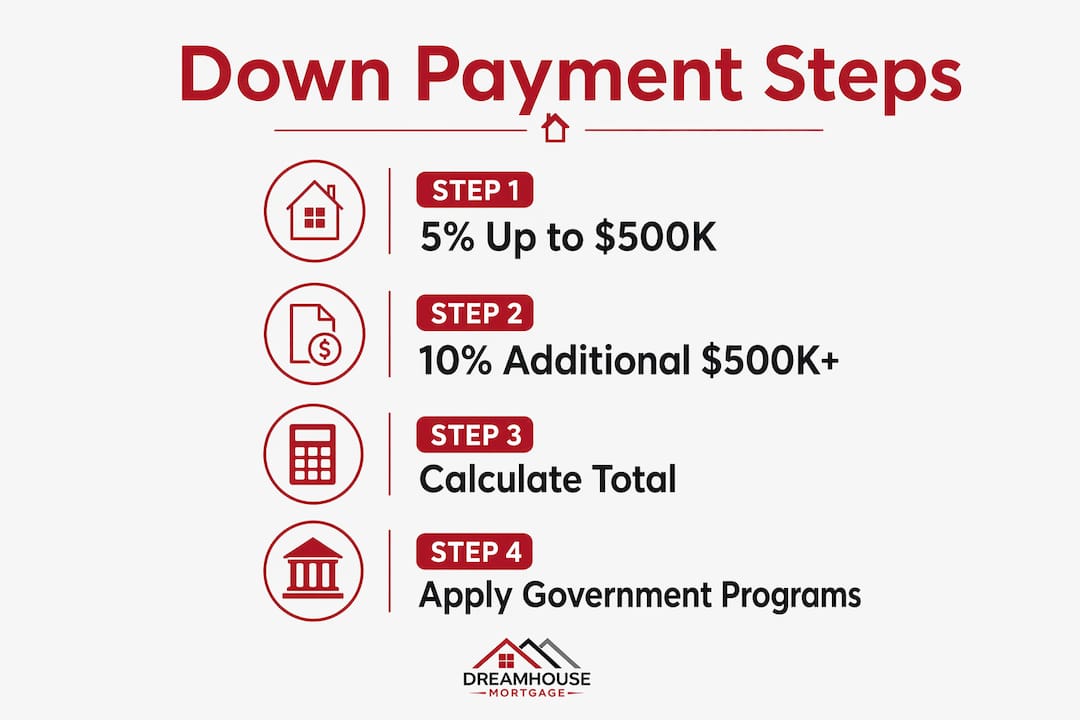
Down payment rules in Alberta follow a tiered federal structure that catches many buyers off guard. Experts note that first-time buyers frequently miscalculate the required down payment for homes priced above $500,000, leading to unexpected shortfalls at the offer stage.
| Home Price | Minimum Down Payment Required |
|---|---|
| Up to $500,000 | 5% of the full purchase price |
| $500,001 to $1,500,000 | 5% on the first $500,000, plus 10% on the remainder |
| Above $1,500,000 | 20% of the full purchase price |
For a $750,000 home in Calgary, the minimum down payment is $25,000 (5% of $500,000) plus $25,000 (10% of $250,000), totaling $50,000. That is not 5% of $750,000, which would be $37,500. The difference of $12,500 surprises buyers who do not run the tiered math in advance.
Federal programs that reduce your upfront burden
Three federal programs directly support first home mortgage options for eligible buyers in Alberta.
- First Home Savings Account (FHSA): Contributions are tax-deductible, and withdrawals for a qualifying home purchase are tax-free. The lifetime contribution limit is $40,000. This account combines the best features of an RRSP and a TFSA specifically for home buyers.
- Home Buyers’ Plan (HBP): You can withdraw up to $60,000 per person from your RRSP tax-free for a down payment. A couple can access up to $120,000 combined. Repayment begins two years after withdrawal and must be completed within 15 years.
- First-Time Home Buyers’ Tax Credit (HBTC): This federal credit provides up to $1,500 in tax relief in the year you purchase your home. It does not reduce your down payment, but it offsets closing costs and improves cash flow in a high-expense year.
The First-Time Home Buyer Incentive program was discontinued on March 31, 2024, and is no longer accepting applications. Buyers who heard about it from older sources should remove it from their planning entirely.
Alberta’s closing cost advantage
Alberta uses a flat-fee land title system with a $50 base fee plus $2 per $5,000 of property value. On a $600,000 home, that works out to approximately $290 in title transfer costs. In Ontario, the same purchase would trigger a land transfer tax of roughly $8,475. That difference stays in your pocket in Alberta.
Pro Tip: Stack the FHSA and HBP together. You can use both in the same purchase year, giving a couple access to $40,000 from FHSAs plus up to $120,000 from RRSPs for a combined down payment pool of up to $160,000.
What steps should Alberta first-time buyers follow for mortgage pre-approval?
Mortgage pre-approval is the process by which a lender reviews your income, credit, and debt to confirm the maximum amount they will lend you before you make an offer on a home. Pre-approval is not a guarantee of final approval, but it gives you a firm budget and signals to sellers that you are a serious buyer. In competitive markets like Calgary and Airdrie, sellers frequently favor offers from pre-approved buyers.
- Pull your credit report. Check your Equifax and TransUnion reports before applying. Errors on your credit file can reduce your score and your approved amount. Dispute any inaccuracies at least 60 days before you plan to apply.
- Calculate your GDS and TDS ratios. Add up your expected housing costs and all existing debt payments. Divide each by your gross monthly income. If your TDS exceeds 44%, pay down debt before applying.
- Gather your documents. Lenders require two years of T4s or Notices of Assessment, recent pay stubs, three months of bank statements, and proof of down payment source. Self-employed buyers need two years of business financials.
- Combine incomes where possible. Adding a co-borrower’s income to the application increases your maximum mortgage by improving both GDS and TDS ratios. Reducing non-mortgage debts before applying has the same effect.
- Choose your amortization period deliberately. A 25-year amortization builds equity faster and costs less in total interest. A 30-year amortization lowers your monthly payment and may help you qualify for a larger loan. Review the amortization trade-offs with a broker before deciding.
- Work with a licensed mortgage broker. A broker accesses multiple lenders simultaneously, including banks, credit unions, monoline lenders, and alternative lenders. That breadth of access often produces better rates and terms than approaching a single institution directly.
- Lock in your rate hold. Most lenders offer a 90-to-120-day rate hold with a pre-approval. If rates rise before you close, your locked rate protects you. If rates fall, you can request the lower rate.
The pre-approval process in Alberta typically takes 24–72 hours once all documents are submitted. Buyers who prepare their documents in advance move faster and face fewer delays at the offer stage.
Which Alberta communities are best suited for first-time home buyers?
Alberta offers a range of communities that balance affordability, amenities, and growth potential for buyers entering the market. The best neighborhoods for first-time buyers combine reasonable home prices, access to employment, good schools, and transit connections.
- Calgary (northeast and southeast quadrants): Communities like Saddle Ridge, Taradale, and Cranston offer newer homes at prices below the city average. These areas have strong transit links via the CTrain Green Line expansion and established school infrastructure.
- Airdrie: Located 30 minutes north of Calgary, Airdrie consistently ranks among Alberta’s fastest-growing cities. Detached homes remain more affordable than comparable Calgary properties, and the community has a strong family-oriented character with good schools and parks.
- Cochrane: Situated west of Calgary along the Bow River, Cochrane attracts buyers who want small-town character with proximity to the mountains. Home prices are competitive, and the town has seen consistent residential development in communities like Heartland and Sunset Ridge.
- Chestermere: This lakeside city east of Calgary offers a lifestyle appeal that drives demand. Prices remain below inner-city Calgary levels, and the community is well-suited for buyers who commute to Calgary’s southeast employment corridor.
- Red Deer: Centrally located between Calgary and Edmonton, Red Deer offers some of the most affordable detached housing in Alberta. Buyers who work remotely or in central Alberta industries find strong value here relative to the two major cities.
- Edmonton (south and southwest areas): Communities like Windermere, Terwillegar, and Heritage Valley offer newer construction with good amenity access. Edmonton’s overall home prices remain lower than Calgary’s, giving first-time buyers more purchasing power.
When evaluating neighborhoods, prioritize proximity to your workplace, school quality if you have children, and access to public transit. Affordability matters, but a long commute adds real costs in time and fuel that erode the savings from a lower purchase price.
Dreamhouse Mortgage: expert guidance for Alberta first-time buyers
Buying your first home in Alberta involves more decisions than most buyers anticipate. Dreamhouse Mortgage, led by Guriqbal Chahal, MBA, PMP, has guided first-time buyers across Calgary, Airdrie, Cochrane, Chestermere, Okotoks, Red Deer, and Edmonton since 2013.

Dreamhouse Mortgage works with banks, credit unions, monoline lenders, and alternative lenders to find the most competitive rates and terms for your specific situation. The brokerage specializes in mortgage broker rate negotiation, which means you get access to multiple lender offers rather than a single institution’s posted rate. For first-time buyers navigating stress tests, CMHC rules, and government programs simultaneously, that expertise translates directly into better outcomes. Call Guriqbal Chahal at 403-966-6072 or visit the Dreamhouse Mortgage Google Business Profile to schedule a consultation.
Key Takeaways
First-time home buyers in Alberta who combine federal assistance programs, understand the 2026 stress test rules, and work with a licensed mortgage broker secure better rates, lower upfront costs, and faster approvals than those who approach lenders alone.
| Point | Details |
|---|---|
| Stress test qualifying rate | You must qualify at your contract rate plus 2%, or 5.25%, whichever is higher. |
| Tiered down payment math | Homes above $500,000 require 10% on the portion above that threshold, not 5% on the full price. |
| FHSA and HBP stacking | Couples can combine both programs for a down payment pool of up to $160,000. |
| Alberta closing cost advantage | Alberta’s flat-fee title system saves buyers thousands compared to provinces with land transfer taxes. |
| Credit union flexibility | Provincially regulated Alberta credit unions may qualify buyers outside OSFI stress test rules. |
FAQ
What is the mortgage stress test for first-time buyers in Alberta?
The stress test requires you to qualify at the higher of your contract rate plus 2%, or a floor of 5.25%. Your GDS ratio must stay at or below 39% and your TDS ratio at or below 44%.
How much down payment do I need for a $700,000 home in Alberta?
The minimum down payment is $45,000: 5% of the first $500,000 ($25,000) plus 10% of the remaining $200,000 ($20,000). The tiered structure applies to all homes priced between $500,000 and $1.5 million.
Can I use both the FHSA and the Home Buyers’ Plan together?
Yes. You can use both programs in the same purchase year. A couple can access up to $40,000 from FHSAs combined with up to $120,000 from RRSPs under the HBP for a total down payment pool of up to $160,000.
Is the First-Time Home Buyer Incentive still available in 2026?
No. The First-Time Home Buyer Incentive was discontinued on March 31, 2024, and is no longer accepting applications. Buyers should focus on the FHSA, HBP, and the First-Time Home Buyers’ Tax Credit instead.
Do Alberta credit unions apply the same stress test as banks?
Not always. Provincially regulated credit unions in Alberta are not required to follow OSFI’s B-20 guidelines and may use alternative qualifying criteria, which can help buyers with higher debt ratios secure mortgage approval.