
TL;DR:
- Most Alberta homeowners use cash-out refinancing or a HELOC to access home equity, depending on their needs. Refinancing offers fixed rates for large expenses, while HELOCs provide flexible, revolving credit for phased spending. Choosing the right option depends on your goals, timeline, and qualification status.
For most Canadian homeowners, a cash-out refinance or a home equity line of credit (HELOC) covers the majority of equity-access needs. Cash-out refinancing works best for large, one-time expenses where a fixed rate and predictable payments matter. A HELOC fits phased spending, emergency buffers, or ongoing renovation draws. A fixed home equity loan (second mortgage) suits homeowners who want a lump sum without disturbing their existing mortgage. Reverse mortgages are appropriate only for homeowners 55 and older who need non-recourse income and cannot qualify for conventional products.
The core trade-off: cash-out refinancing typically offers the lowest rate but requires full requalification under the federal mortgage stress test and carries prepayment penalties if you break mid-term. A HELOC avoids breaking your mortgage but comes with a variable rate and requires spending discipline. Home equity loans and private mortgages cost more but have flexible qualification criteria.
Quick goal-to-product map:
- Renovation in Calgary or Airdrie (large, one-time cost): Cash-out refinance or home equity renovation mortgage
- Debt consolidation in Edmonton or Red Deer: Cash-out refinance (replaces high-interest debt with mortgage-rate debt)
- Emergency buffer or phased spending in Cochrane or Chestermere: HELOC (revolving, draw only what you need)
- Retirement income supplement (55+) in any Alberta community: Reverse mortgage (no monthly payments required)
Pro Tip: Before choosing any equity-access product, check whether you are mid-term on your mortgage. Breaking early to refinance can trigger a prepayment penalty that wipes out months of interest savings. A broker can run the break-even math before you commit.
Table of Contents
- 1. What each equity-access option actually does in Canada
- 2. Side-by-side comparison of the main equity-access options
- 3. How to choose the right equity-access option for your situation
- 4. Costs, eligibility rules, and the typical timeline in Alberta
- 5. Why Alberta homeowners use a mortgage broker for equity access
- Key Takeaways
- The case for patience and precision in equity access
- Dreamhouse Mortgage helps Alberta homeowners access equity the right way
- Useful sources and next steps
- FAQ
1. What each equity-access option actually does in Canada
Understanding the mechanics of each product prevents costly surprises at the lender’s desk.
Cash-out refinance
A cash-out refinance replaces your existing mortgage with a new, larger one. The difference between the new loan amount and your outstanding balance is paid to you in cash. Ratehub explains that Canadian homeowners can typically refinance up to 80% of the appraised value of their home, less the outstanding mortgage balance. You must fully requalify, which means passing the federal stress test on the new, higher loan amount. If you are mid-term, expect a prepayment penalty, often calculated as three months’ interest or an interest rate differential (IRD), whichever is greater.
Alberta example: A Calgary homeowner with a property and a remaining mortgage could access equity up to 80% of their home’s value minus their mortgage balance, using the funds for renovations and debt consolidation.
Home equity line of credit (HELOC)
A HELOC is a revolving, secured line of credit tied to your home. Most HELOCs in Canada carry a variable rate priced near the lender’s prime rate. Canada.ca outlines two common structures: standalone HELOCs and readvanceable HELOCs, which are bundled with a mortgage. Readvanceable products automatically increase your available credit as you pay down your mortgage principal. Lenders generally require at least 20% equity for a readvanceable product and more for a standalone HELOC. The maximum borrowable amount is typically up to 65% of the home’s appraised value.
The risk is behavioral. Because payments are often interest-only, many borrowers pay down little or no principal unless they set up a structured repayment plan. Variable rates also mean your payment can rise when the Bank of Canada raises its policy rate.
Alberta example: An Edmonton homeowner uses a $100,000 HELOC to fund a basement suite renovation in three phases over 18 months, drawing only what each phase requires and keeping interest costs lower than a lump-sum loan.
Home equity loan (second mortgage)
A home equity loan delivers a lump sum at a fixed interest rate, registered as a second lien on your property. Your existing mortgage stays in place. According to Canada.ca’s borrowing guidance, second mortgages are available through banks, credit unions, trust companies, and private lenders. Fixed payments make budgeting straightforward. The trade-off is a higher rate than a first-mortgage refinance, because the second-lien position carries more risk for the lender.
Alberta example: A Red Deer homeowner who locked in a low first mortgage rate three years ago takes a $75,000 second mortgage to fund a garage addition, avoiding the penalty of breaking the first mortgage.
Reverse mortgage
Reverse mortgages are available to Canadian homeowners aged 55 and older. The lender advances funds against the home’s equity, and no monthly payments are required. Interest accrues and is repaid when the home is sold or the borrower moves out. Canada.ca notes that the maximum borrowable amount is typically up to 55% of the appraised value, and interest rates are generally higher than conventional mortgage or HELOC rates. Because interest compounds without regular payments, the outstanding balance grows over time.
Reverse mortgages are appropriate for asset-rich, income-poor retirees who need cash flow and plan to stay in their home long-term. They are not a good fit for homeowners who want to preserve equity for heirs or who could qualify for a conventional product.
Niche alternatives
Private mortgages, personal lines of credit, and borrowing against prepaid mortgage amounts are worth knowing. Private lenders charge materially higher rates than regulated lenders but have flexible income and credit criteria, making them relevant for self-employed borrowers in Calgary or Cochrane who cannot pass the stress test. Personal lines of credit are unsecured and carry higher rates still, but they do not put the home at risk. For readers weighing these routes, Dreamhouse Mortgage’s private mortgage guide covers the qualification landscape in detail.
2. Side-by-side comparison of the main equity-access options
The table below maps each product to the dimensions that matter most for Alberta homeowners choosing among the best refinancing options for home equity access.
| Option | Best for | Funds received | Rate type | Effect on existing mortgage | Max LTV (approx.) | Stress test required | Typical fees |
|---|---|---|---|---|---|---|---|
| Cash-out refinance | Large one-time needs, debt consolidation | Lump sum | Fixed or variable | Replaces existing mortgage | 80% | Yes, full requalification | Appraisal, legal, possible prepayment penalty |
| HELOC | Phased spending, emergency buffer | Revolving credit | Variable (prime-based) | Second lien or readvanceable add-on | 65% | Yes (federally regulated lenders) | Appraisal, legal, admin fees |
| Home equity loan (2nd mortgage) | Lump sum without breaking first mortgage | Lump sum | Fixed | Second lien, first mortgage stays | 80% combined | Varies by lender type | Appraisal, legal, higher rate premium |
| Reverse mortgage | Retirement income, 55+ homeowners | Lump sum or installments | Fixed or variable (higher) | Replaces or adds lien | 55% | No income qualification | Setup, appraisal, legal, accruing interest |
| Private mortgage | Cannot pass stress test, short-term bridge | Lump sum | Fixed (higher) | Second lien | Varies | No (private lenders) | Lender fee, broker fee, legal |
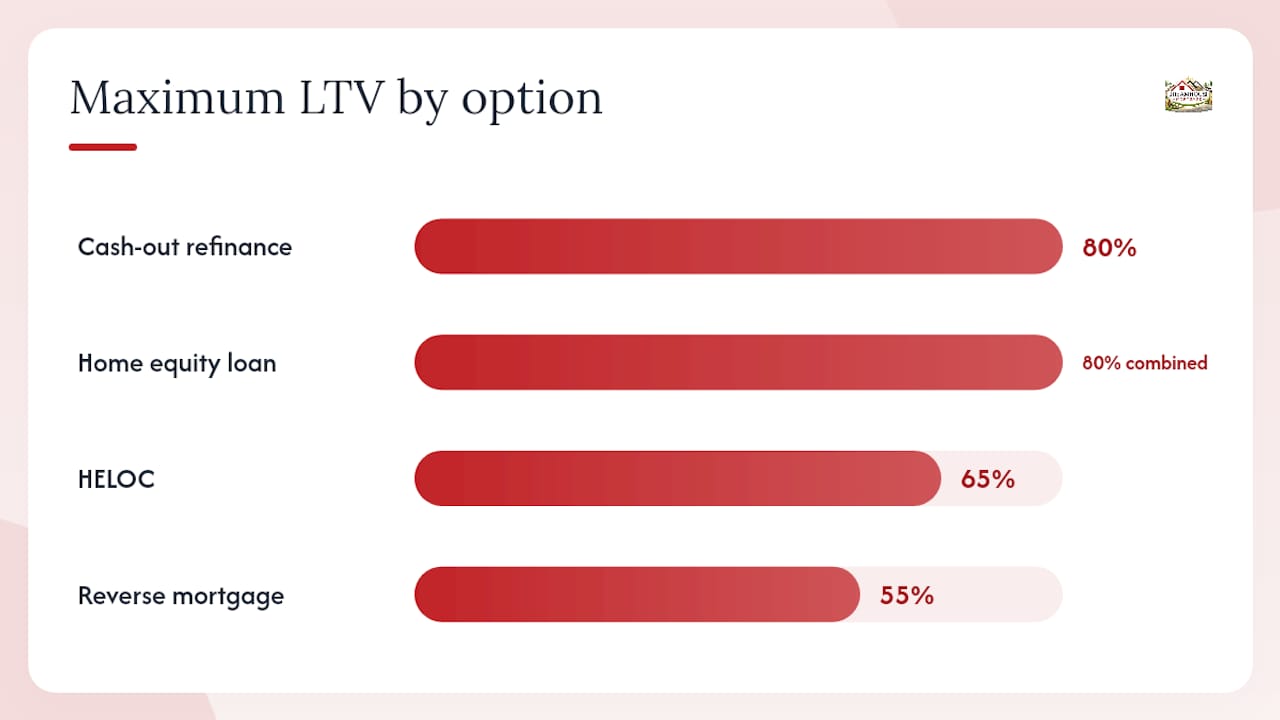
LTV figures sourced from Canada.ca’s home equity borrowing page.
Case example 1 — Large renovation lump sum: A Chestermere homeowner needs $180,000 to add a legal secondary suite. Their mortgage is up for renewal in four months. Waiting for renewal and doing a cash-out refinance at renewal avoids the prepayment penalty entirely, delivers a fixed rate, and replaces the old mortgage cleanly. Total cost: appraisal (~$400–$600), legal fees (~$1,000–$1,500), and the new mortgage rate.
Case example 2 — Phased small-business renovation: An Airdrie homeowner is converting a detached garage into a home office over 12 months, spending roughly $8,000–$12,000 per phase. A HELOC lets them draw incrementally, pay interest only on what is drawn, and repay between phases. A lump-sum refinance would mean paying interest on the full $40,000 from day one.
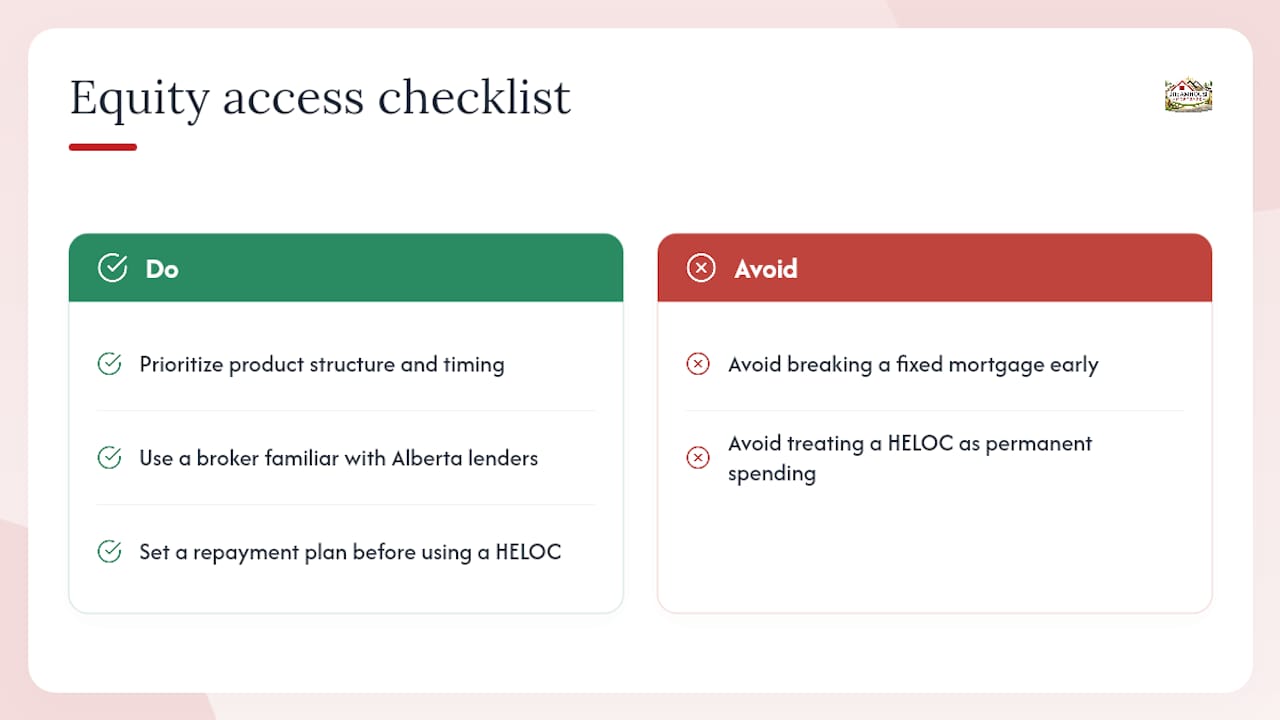
Risk callout: Variable-rate HELOCs can see payment increases when the prime rate rises. Homeowners who draw the full limit and make only interest payments may find the balance unchanged after years of payments. Set a principal repayment schedule from the start.
Repossession risk: Every equity-access product is secured against your home. Missed payments on a HELOC, second mortgage, or reverse mortgage can lead to power of sale proceedings. Borrow only what your cash flow can service.
3. How to choose the right equity-access option for your situation
A clear decision framework cuts through product marketing and focuses on your actual numbers.
Decision flow
Goal → Amount → Timeline → Rate tolerance → Qualification likelihood → Product
Start with the goal. Debt consolidation and large one-time costs point toward a cash-out refinance or home equity loan. Flexible, phased spending points toward a HELOC. Retirement income for a 55+ homeowner points toward a reverse mortgage.
Then check the amount. If you need more than 65% LTV, a HELOC alone will not cover it. If you need more than 80% LTV, no conventional product will qualify.
Timeline matters because breaking a mortgage mid-term triggers a prepayment penalty. If your renewal is within six months, waiting is often cheaper than refinancing now.
Pre-application checklist
Work through these before contacting any lender:
- Run the stress test — Federally regulated lenders qualify borrowers at the higher of the contract rate plus 2%, or the Bank of Canada’s published qualifying rate. Confirm your income and debt ratios pass before applying.
Questions to ask your lender or broker
- Will this product replace my existing mortgage or sit as a second lien?
- What qualifying rate are you using for the stress test?
- What is the prepayment penalty if I break my current mortgage today?
- Are there annual fees, inactivity fees, or renewal fees on this HELOC?
- What happens to my HELOC limit if my home value drops?
- Can I convert a variable HELOC balance to a fixed-rate segment?
Red flags
- A lender who promises LTV above 80% on a conventional refinance without explaining the product structure.
- No written fee disclosure before you sign.
- Pressure to draw the maximum credit limit immediately.
- A lender who does not ask about your income, employment, or existing debts.
Pro Tip: Comparing lenders across banks, credit unions, and alternative lenders before applying can reduce your rate and fees materially. A broker does this comparison for you at no direct cost.
4. Costs, eligibility rules, and the typical timeline in Alberta
Typical fees to budget for
- Lender administration fee: — Varies by lender; some waive this for preferred clients or broker-referred files.
- Prepayment penalty: — The largest potential cost. For a fixed-rate mortgage, this is usually the greater of three months’ interest or the IRD. For a variable-rate mortgage, it is typically three months’ interest. Ratehub’s refinancing guide notes that even a small rate difference between lenders can affect whether the penalty is worth paying.
Qualification rules
Canada.ca confirms that federally regulated lenders apply the stress test to all refinancing and HELOC applications. You must demonstrate affordability at the qualifying rate, regardless of how much equity you hold. Self-employed borrowers or those with reduced income may not pass the stress test at a bank or credit union, even with significant equity. In those cases, alternative lenders or private lenders apply their own criteria, typically at higher rates.
LTV caps by product: 80% for a cash-out refinance, approximately 65% for a HELOC, and approximately 55% for a reverse mortgage.
Tax note
Withdrawing equity from your home is not taxable income in Canada when the funds are used for personal purposes such as renovations, debt repayment, or living expenses. If you use borrowed funds to earn investment income, the interest may be tax-deductible. This distinction matters for homeowners in Calgary or Edmonton who are also real estate investors. Confirm the treatment with a qualified tax professional before proceeding.
5. Why Alberta homeowners use a mortgage broker for equity access
A mortgage broker compares products across banks, credit unions, monoline lenders, alternative lenders, and private lenders simultaneously. For equity access, that breadth matters because not every lender offers every product, and rate and fee differences across lender types can be significant.
What a broker does for equity-access files:
- Shops rates and product structures across multiple lenders in a single application process
- Calculates prepayment penalties and runs the break-even analysis before you commit
- Coordinates the appraisal, legal, and lender documentation requirements
- Identifies whether a bank, credit union, or alternative lender is the right fit given your income, credit, and LTV
- Explains stress-test implications and helps structure the application to maximize approval likelihood
- Finds private lending options for self-employed borrowers or those with non-traditional income in communities like Cochrane, Chestermere, or Rocky View County
Dreamhouse Mortgage has served Alberta homeowners since 2013. Led by Guriqbal Chahal, MBA, PMP, Broker of Record, the brokerage works with clients across Calgary, Edmonton, Airdrie, Cochrane, Chestermere, Okotoks, High River, Red Deer, and surrounding communities. The team handles home equity loan and refinancing files from initial qualification through to funded proceeds, including appraisal coordination and lender selection.
For homeowners comparing a HELOC versus a home equity loan in Calgary, local lender knowledge is practical. Regional appraisers, credit union products specific to Alberta, and lenders familiar with Calgary and Edmonton property values all affect the outcome of an equity-access application.
When to call a broker specifically:
- You are mid-term on your mortgage and need to weigh the penalty against the benefit of refinancing now
- You are self-employed or have variable income and are unsure whether you will pass the stress test
- You want to compare a HELOC, a second mortgage, and a cash-out refinance side by side before deciding
- You have been declined by your primary bank and need to know what alternative lenders can offer
Contact Guriqbal Chahal, MBA, PMP, Mortgage Broker, Dreamhouse Mortgage at 403-966-6072 or visit the Google Business Profile to read client reviews and confirm office details.
Key Takeaways
For most Alberta homeowners, a cash-out refinance or HELOC covers the majority of equity-access needs, but the right choice depends on your goal, timeline, and ability to pass the federal stress test.
| Point | Details |
|---|---|
| Match product to goal | Cash-out refinance for large one-time needs; HELOC for phased or flexible spending; second mortgage to avoid breaking a low-rate first mortgage. |
| Know your LTV limits | Conventional refinancing caps at 80% LTV, HELOCs at 65%, and reverse mortgages at 55% of appraised value. |
| Stress test applies | Federally regulated lenders require full requalification on income and credit, even when you have substantial equity. |
| Budget for all costs | Appraisal, legal fees, discharge fees, and possible prepayment penalties add up; run the full cost before committing. |
| Dreamhouse Mortgage | Guriqbal Chahal and the Dreamhouse Mortgage team compare lenders across Alberta and handle equity-access files from Calgary to Red Deer. |
The case for patience and precision in equity access
Most homeowners focus on the rate. The rate matters, but the structure of the product and the timing of the application often have a larger financial impact. A homeowner who breaks a fixed mortgage six months early to access equity at a slightly lower rate can easily pay $8,000–$15,000 in prepayment penalties, erasing the benefit of the lower rate for two or three years.
The stress test is the other underestimated factor. Homeowners with strong equity but reduced income, recent self-employment, or a gap in employment history are sometimes surprised to find they do not qualify at a federally regulated lender. That is not the end of the road. Credit unions, alternative lenders, and private lenders each have different criteria, and a broker who knows the Alberta lender landscape can identify the right fit without a series of declined applications that damage your credit score.
The HELOC is the product most likely to be misused. The revolving structure and interest-only payment option make it easy to draw funds without a repayment plan. Homeowners who treat a HELOC as a permanent source of spending money rather than a structured borrowing tool can find themselves with a large, growing balance and no clear path to repayment. The product itself is not the problem. The absence of a repayment plan is.
Dreamhouse Mortgage helps Alberta homeowners access equity the right way

Dreamhouse Mortgage offers mortgage refinancing in Calgary and across Alberta, including cash-out refinancing, HELOC setup, home equity loans, and private mortgage solutions for homeowners who need a non-bank option. The brokerage compares products from banks, credit unions, monoline lenders, and alternative lenders, handling the full process from appraisal coordination to funded proceeds.
Guriqbal Chahal, MBA, PMP, Broker of Record, has worked with Alberta homeowners since 2013 across Calgary, Airdrie, Cochrane, Chestermere, Okotoks, Edmonton, Red Deer, and surrounding communities. Whether you are refinancing to fund a renovation, consolidating debt, or exploring a HELOC for the first time, the team provides a clear comparison of your options before you apply.
Call Guriqbal Chahal at 403-966-6072 or visit the Dreamhouse Mortgage Google Business Profile to get started. Have your most recent property assessment, mortgage statement, and income documents ready for a faster consultation.
This article provides general information about home equity access options in Canada and is not financial or legal advice. Confirm current qualification rules, rates, and tax treatment with a qualified mortgage professional or tax advisor before proceeding.
Useful sources and next steps
Canadian government and industry references:
- Borrowing against home equity – Canada.ca
- Home equity lines of credit – Canada.ca
- Mortgage Refinance in Canada | Reasons, Methods and Costs | Ratehub.ca
- HELOC vs Home Equity Loan Canada 2026: Which One, When, and Why – NorthMarkets
- When Should I Refinance My Mortgage in Canada? (2026 Decision Framework) | WealthNorth
Dreamhouse Mortgage resources:
- Home equity loan vs HELOC in Calgary — local comparison for Calgary homeowners
- Home equity renovation mortgage Calgary — using equity to fund renovations
- Mortgage glossary — plain-language definitions for LTV, stress test, readvanceable, and more
Key LTV reference figures (sourced from Canada.ca):
| Product | Maximum LTV (approx.) | Stress test required |
|---|---|---|
| Cash-out refinance | 80% of appraised value | Yes |
| HELOC | 65% of appraised value | Yes (federally regulated lenders) |
| Home equity loan (2nd mortgage) | 80% combined LTV | Varies by lender |
| Reverse mortgage | 55% of appraised value | No income qualification |
Call Guriqbal Chahal at 403-966-6072 to confirm current rates and qualification requirements for your specific property and situation.
FAQ
Is it smart to refinance your home to pull out equity?
Refinancing to access equity can make sense when the funds serve a clear purpose such as debt consolidation or a renovation that adds value, and when the cost of breaking your mortgage is lower than the financial benefit. Run the full cost calculation, including prepayment penalties and closing costs, before deciding.
How much can you borrow through a cash-out refinance in Canada?
Canadian lenders typically allow you to refinance up to 80% of your home’s appraised value, less your outstanding mortgage balance. The exact amount depends on your income, credit, and the lender’s qualifying criteria under the federal stress test.
What is the difference between a HELOC and a home equity loan in Canada?
A HELOC is a revolving line of credit with a variable rate, allowing you to draw and repay repeatedly up to your limit. A home equity loan delivers a fixed lump sum at a fixed rate with set monthly payments. NorthMarkets’ comparison notes that HELOCs typically carry lower initial rates but expose borrowers to rate increases, while home equity loans offer payment certainty.
Does accessing home equity affect your credit score in Canada?
Applying for a refinance, HELOC, or home equity loan triggers a hard credit inquiry, which can temporarily lower your score by a small amount. A large increase in your total debt load can also affect your credit utilization ratio. Making payments on time on the new product will rebuild and strengthen your credit profile over time.
When does a reverse mortgage make sense for Alberta homeowners?
A reverse mortgage is appropriate for homeowners aged 55 and older who need cash flow, plan to stay in their home long-term, and cannot or do not want to qualify for a conventional product. Because interest accrues without monthly payments, the balance grows over time, which reduces the equity available to heirs. It is not a suitable product for homeowners who expect to sell within a few years.
Recommended
- Home Equity Loan Alberta | DreamHouse Mortgage
- Home Equity Loan vs HELOC in Calgary | Smart Borrowing Choices That Could Cost or Save You Thousands
- Home Equity Renovation Mortgage Calgary | Unlock & Transform 2026
- Debt Consolidation Calgary | DreamHouse Mortgage
- Genius Mind Academy https://geniusmind.sg/
- Harmonizing Technology
- Tyre Shop