Most Alberta buyers can qualify for a vacation or second-home mortgage, provided they clear two gates: a minimum down payment that varies by property type and purchase price, and the federal mortgage stress test, which requires you to qualify at your contract rate plus 2% or the current benchmark rate, whichever is higher. If your credit score sits at 680 or above and your combined debt ratios stay within lender guidelines, you are in a strong position to move forward.
Quick eligibility checklist:
Credit score: 680+ for most A-lenders; 600–679 may qualify with B-lenders or credit unions at higher rates
Down payment: 5% on the first $500,000 and 10% on the portion above $500,000 for CMHC-insurable owner-occupied second homes; 20%+ for non-insurable or seasonal properties
Debt ratios: Gross Debt Service (GDS) at or below 39% and Total Debt Service (TDS) at or below 44%, calculated across both your primary and vacation home payments
A mortgage pre-approval is the fastest way to confirm exactly where you stand. For a quick eligibility check before you make an offer, consider contacting a qualified mortgage broker familiar with Alberta lenders.
Key Takeaways
Qualifying for a vacation-home mortgage in Alberta requires meeting both borrower and property standards, with the stress test and combined TDS ratio being the most common limiting factors.
| Point | Details |
|---|---|
| Down payment range | 5% on the first $500,000 and 10% above $500,000 for CMHC-insurable owner-occupied second homes; 20%+ for seasonal or investment properties. |
| GDS and TDS limits | Lenders apply approximately 39% GDS and 44% TDS ceilings across both your primary and vacation-home payments. |
| Stress test applies | You must qualify at your contract rate plus 2% or the benchmark rate, whichever is higher, for both insured and uninsured mortgages. |
| Property standards matter | Year-round access, winterization, potable water, and standard insurance availability are required by most A-lenders. |
| Dreamhouse Mortgage | Guriqbal Chahal provides vacation-home pre-approvals and lender access across Alberta; call 403-966-6072 for a tailored eligibility check. |
Table of Contents
- What counts as a vacation home in Canada, and why does the classification matter?
- Who qualifies as a borrower for a vacation-home loan?
- What property characteristics do lenders require for vacation homes?
- Down payment expectations and CMHC rules for second homes in Canada
- How lenders calculate affordability: GDS, TDS, and the stress test for second homes
- What mortgage products are available for vacation homes in Canada?
- If you rent your vacation home, when does it become an investment property?
- What documents do you need and what does the timeline look like?
- CMHC rules for second homes: what Alberta buyers need to know
- Step-by-step action plan to get pre-approved for a vacation home in Alberta
- What Alberta buyers often get wrong about vacation-home financing
- Mortgage brokers in Alberta help buyers qualify for vacation-home financing by navigating lender channels, documenting eligibility, and explaining requirements.
- Sources
- FAQ
What counts as a vacation home in Canada, and why does the classification matter?
Lenders and CMHC draw a clear line between three property types: your primary residence, an owner-occupied second home, and an investment property financing guide. The classification determines your minimum down payment, whether CMHC mortgage loan insurance is available, and how strictly lenders scrutinize the file.
An owner-occupied second home is a property you intend to use personally for a meaningful portion of the year. You may rent it occasionally, but personal use is the primary purpose. A primary residence is where you live most of the year. An investment property is purchased primarily to generate rental income, regardless of whether you occasionally stay there.
Lenders rely on your stated intended use at application, supported by the property’s characteristics and your overall financial picture. Declaring a property as a second home when it will be rented full-time is a material misrepresentation, and lenders do check. For a deeper look at how these classifications affect financing, the second home mortgage Alberta guide covers local lender policies in detail.
Key financing differences by property type:
- Owner-occupied second home: CMHC insurance potentially available; down payment as low as 5–10% on qualifying properties; standard amortization up to 25 years (with limited 30-year exceptions)
- Primary residence: Same CMHC rules; lowest rates; most lender options
- Investment/rental property: Minimum 20% down payment required; CMHC insurance not available; rental income counted at a discount; rates typically higher
Who qualifies as a borrower for a vacation-home loan?
Credit score expectations
Most A-lenders (major banks and monoline lenders) want a credit score of 680 or higher for a second-home mortgage. A score in the 600–679 range does not disqualify you, but it shifts your options toward credit unions and B-lenders, which carry higher rates and sometimes stricter property requirements. Scores below 600 generally require private financing, which comes with significantly higher costs.
A single missed payment or a high credit utilization ratio can drop a score by 30–50 points. Before applying, pay revolving balances below 30% of their limits and avoid opening new credit accounts in the 90 days before your application.
Income documentation
Lenders want to see a consistent, verifiable income picture. Standard documents include:
- Two years of T4 slips and Notices of Assessment (NOA)
- Recent pay stubs (typically the last 30–60 days)
- Employment letter confirming salary, position, and tenure
- For self-employed borrowers: two years of T1 Generals, business financial statements, and NOAs
Self-employed buyers in Calgary, Airdrie, and Cochrane often face additional scrutiny because stated income can vary year to year. A broker familiar with Alberta lenders can match your income profile to the right channel.
Reserves and down payment sources
Lenders accept several down payment sources: personal savings, proceeds from a HELOC on your primary residence, gifted funds from an immediate family member (with a signed gift letter), and RRSP withdrawals under the Home Buyers’ Plan where eligible. Using a HELOC increases your total debt load, so factor that payment into your TDS calculation before committing. The mortgage down payment types in Canada guide explains each source and its documentation requirements.
Pro Tip: Pay down revolving debt (credit cards, lines of credit) in the 60–90 days before applying. Even a $5,000 reduction in outstanding balances can meaningfully improve your TDS ratio and push you into a better lender tier.
What property characteristics do lenders require for vacation homes?
Property standards for vacation-home financing are stricter than for a primary residence. Lenders assess the property’s marketability and their ability to recover funds if the loan defaults, so non-standard features raise flags quickly.
Most A-lenders require the following for a standard vacation-home mortgage:
- Single-unit dwelling on a permanent foundation
- Year-round road access (not seasonal or water-access only)
- Year-round habitability: insulated, heated, winterized
- Potable water supply (municipal or tested well)
- Adequate sewage (municipal sewer or inspected septic system)
- Standard property insurance available from a recognized insurer
Properties that frequently cause financing complications include unwinterized three-season cottages, island-access-only properties, properties on leased land (common in some Alberta resort communities), and properties with shared-well arrangements. Lenders view recreational properties as higher risk, and the result is higher down payment requirements and stricter property criteria.
Warning: Properties with water-access only, leased land, or no year-round road access are routinely declined by major banks. Credit unions, B-lenders, and private lenders are often the only viable channels for these files, and they typically require 25–35% down or more.
Cottage insurance also differs from standard home insurance. Lenders require proof of appropriate coverage before closing, and some insurers will not cover properties left vacant for extended periods. Confirm insurability before removing conditions on any offer.
Down payment expectations and CMHC rules for second homes in Canada
When CMHC insurance applies
CMHC permits insured financing for certain owner-occupied second homes when the borrower and property meet specific eligibility criteria: the borrower must be a Canadian citizen or permanent resident, the property must be in Canada and suitable for year-round occupancy, and the purchase must fall within CMHC’s lending-value limits. When those conditions are met, the minimum equity rules for homeowner loans apply: 5% on the first $500,000 of lending value and 10% on the remainder, with a maximum amortization of 25 years (30-year amortization is available in limited circumstances).
CMHC insurance is not available for investment properties, properties that are not suitable for year-round occupancy, or properties with non-standard access. When insurance is unavailable, you need a conventional uninsured mortgage, which requires a minimum 20% down payment and typically carries a slightly higher rate.
Down payment scenarios
| Scenario | Typical minimum down payment | CMHC insurable | Amortization |
|---|---|---|---|
| Owner-occupied second home, year-round access, under $500K | 5% on first $500K, 10% above | Yes, if property qualifies | Up to 25 years |
| Owner-occupied second home, year-round access, over $500K | 5% on first $500K, 10% on remainder | Yes, if property qualifies | Up to 25 years |
Note: The minimum down payment for a qualifying owner-occupied second home (with year-round access) is 5% on the first $500,000 of the purchase price and 10% on the amount above $500,000, as per CMHC rules. This tiered structure applies to both under and over $500K scenarios.
| Seasonal/three-season cottage | 20%+ (lender dependent) | No | Up to 25–30 years (lender dependent) |
| Investment/rental property | 20% minimum | No | Up to 25–30 years (lender dependent) |
For down payment rules contrasting second home versus investment property, the key dividing line is owner-occupancy intent. Declare the property accurately at application.
Pro Tip: If you own your primary residence with significant equity, a HELOC can fund the down payment on a vacation home without depleting savings. Structure it carefully: the HELOC payment adds to your TDS, so run the ratio calculation before drawing funds. The home equity loan vs HELOC guide explains the tradeoffs.
How lenders calculate affordability: GDS, TDS, and the stress test for second homes
GDS and TDS defined
The Gross Debt Service (GDS) ratio measures your housing costs (mortgage principal and interest, property taxes, heat, and 50% of condo fees if applicable) as a percentage of gross income. The Total Debt Service (TDS) ratio adds all other debt payments (car loans, credit cards, student loans, other mortgages) to that housing cost figure. Typical GDS and TDS guideline ceilings used by lenders are approximately 39% and 44% respectively, though some lenders apply tighter limits.
When you apply for a vacation-home mortgage, lenders include the carrying costs of both your primary residence and the vacation property in the calculation. This is where many buyers are surprised: the combined payment load often pushes TDS above the threshold even when each property is affordable on its own.
The stress test
The federal mortgage stress test requires lenders to qualify you at the greater of your contract rate plus 2% or the current benchmark qualifying rate. This means if your offered rate is 5.5%, you must qualify at 7.5%. The stress test applies to both insured and uninsured mortgages at federally regulated lenders.
Worked example
Assume a buyer in Calgary has a gross annual income of $120,000 and an existing primary mortgage with monthly payments of $2,100 (principal, interest, taxes, heat combined). They want to purchase a vacation property near Cochrane with a purchase price of $450,000 and a 20% down payment ($90,000), leaving a $360,000 mortgage.
- Stress-test qualifying rate: contract rate of 5.5% + 2% = 7.5%
- Monthly payment on $360,000 at 7.5% over 25 years: approximately $2,660
- Add property taxes and heat for the vacation home: approximately $400/month
- Total housing costs (both properties): $2,100 + $2,660 + $400 = $5,160/month
- GDS on vacation home alone: ($2,660 + $400) / ($120,000 / 12) = $3,060 / $10,000 = 30.6% (within 39% ceiling)
- TDS including primary mortgage: $5,160 / $10,000 = 51.6% (exceeds 44% ceiling)
At $120,000 gross income, this buyer’s TDS exceeds the guideline. To qualify, they could increase the down payment to reduce the vacation-home mortgage, pay down other debts to free up TDS room, or extend the amortization period where the lender permits it.
Actionable steps to improve GDS/TDS:
- Increase the down payment to reduce the mortgage balance and monthly payment
- Pay off car loans, credit card balances, or lines of credit before applying
- Extend the amortization to 25 or 30 years (where available) to lower the qualifying payment
- Consider a co-borrower whose income can be added to the qualifying calculation
What mortgage products are available for vacation homes in Canada?
Vacation-home financing in Canada runs across several product categories, each suited to a different borrower and property profile. Major banks are more conservative on seasonal or non-standard cottages, while credit unions, monoline lenders, and B-lenders offer more flexibility with tradeoffs in rate or terms.
Product categories:
- CMHC-insured conventional: Available for qualifying owner-occupied second homes; lowest down payment (5–10%); rates comparable to primary residence; 25-year amortization maximum
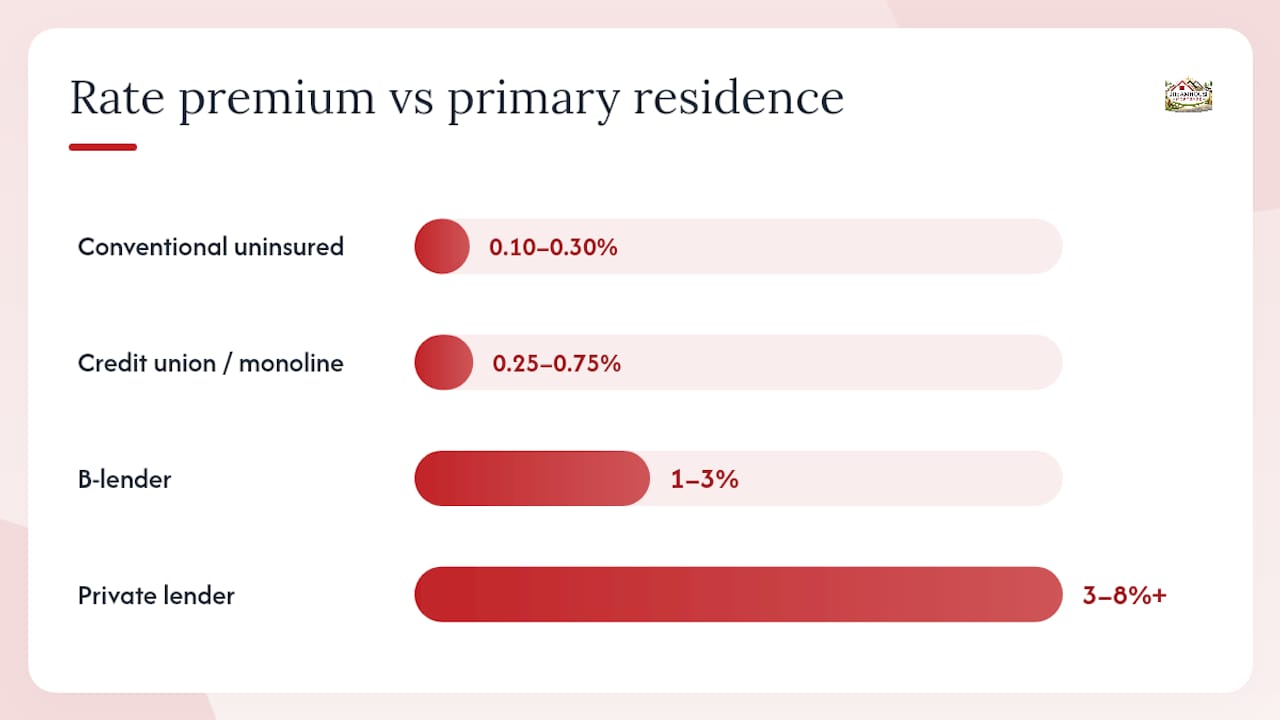
- Conventional uninsured (20%+ down): No CMHC premium; available for a wider range of property types; rates typically 0.10–0.30% above insured rates; amortization up to 25–30 years depending on lender
- Credit union / monoline: More flexible on property type and income documentation; rates vary; often the best channel for non-standard properties in Alberta communities like Airdrie, Cochrane, and Chestermere
- B-lenders: Accept lower credit scores and non-standard properties; rates typically 1–3% above A-lender rates; shorter terms common
- Private lenders: Last resort for complex files; rates significantly higher; short terms (1–2 years); useful as a bridge while improving qualification profile
| Product category | Typical minimum down payment | Credit score range | Rate premium vs. primary residence |
|---|---|---|---|
| CMHC-insured (owner-occupied second home) | 5–10% | 680+ | Minimal (CMHC premium applies) |
| Conventional uninsured | 20% | 680+ | 0.10–0.30% |
| Credit union / monoline | 20–25% (property dependent) | 620–680+ | 0.25–0.75% |
| B-lender | 20–35% | 550–680 | 1–3% |
| Private lender | 25–40% | Flexible | 3–8%+ |
For buyers considering a vacation property that may also generate rental income, the interest-only mortgage for investment property guide covers an additional product option worth reviewing.
Pro Tip: A mortgage broker with Alberta lender relationships can submit your file to multiple channels simultaneously. In markets like Calgary, Red Deer, and Edmonton, this access often means the difference between a declined file at one lender and an approval at another with comparable terms.
If you rent your vacation home, when does it become an investment property?
The owner-occupied second-home classification holds as long as personal use remains the primary purpose. When rental activity exceeds roughly 50% of the year, most lenders and the Canada Revenue Agency treat the property as an investment property. That shift carries real financing consequences.
Decision rules lenders apply:
- Occasional short-term rental (Airbnb, VRBO) while you use the property personally: generally still qualifies as a second home
- Property rented for the majority of the year with limited personal use: reclassified as investment property
- Property purchased primarily to generate rental income with no meaningful personal use: investment property from the start
When a property is classified as an investment property, the minimum down payment rises to 20%, CMHC insurance is not available, and lenders scrutinize rental income carefully. Lenders typically count only 50–80% of gross rental income when calculating qualifying income, and most require two years of tax returns showing rental history or a formal rental market appraisal. Big banks often apply a 50% rental income offset; more flexible lenders may use 70–80% with a market appraisal.
Short-term rental income (nightly or weekly) receives additional scrutiny because of its seasonal variability. Lenders applying conservative underwriting may discount it further or exclude it entirely without a strong two-year income history.
Tax treatment also changes: rental income becomes taxable, capital cost allowance may apply, and the principal residence exemption is affected. Consult a Canadian tax professional before structuring a vacation property as a rental.
What documents do you need and what does the timeline look like?
Document checklist
Preparing your documents before you make an offer speeds up the approval process considerably. Lenders in Alberta typically require:
- Government-issued photo ID (two pieces)
- Two years of T4 slips and Notices of Assessment
- Recent pay stubs (last 30–60 days) or, for self-employed buyers, two years of T1 Generals and business financials
- Three months of bank statements showing down payment funds
- Gift letter (if any portion of the down payment is gifted)
- HELOC statement if using home equity as the down payment source
- Property details: MLS listing, accepted offer, and legal description
- Property tax assessment for the vacation property
- Proof of cottage or vacation-property insurance (required before closing)
For a complete local checklist, the mortgage checklist Calgary guide covers every document category in detail.
Typical timeline and costs
- Pre-approval: 1–3 business days once documents are submitted
- Accepted offer to firm approval: 5–10 business days (longer if an appraisal is required)
- Appraisal: Required for most vacation properties; typically $400–$600 in Alberta
- Legal fees: $1,200–$2,000 for a real estate lawyer in Calgary or surrounding communities
- CMHC premium (if applicable): Added to the mortgage balance; premium percentage depends on LTV
- Closing: Typically 30–90 days from accepted offer
Seasonal and property-specific items to confirm before removing conditions:
- Year-round road access confirmed in writing
- Well water test (potability and flow rate)
- Septic system inspection (age, condition, capacity)
- Zoning confirmation (residential vs. recreational)
- Insurance quote obtained and coverage confirmed
- Winterization status verified by a qualified inspector
CMHC rules for second homes: what Alberta buyers need to know
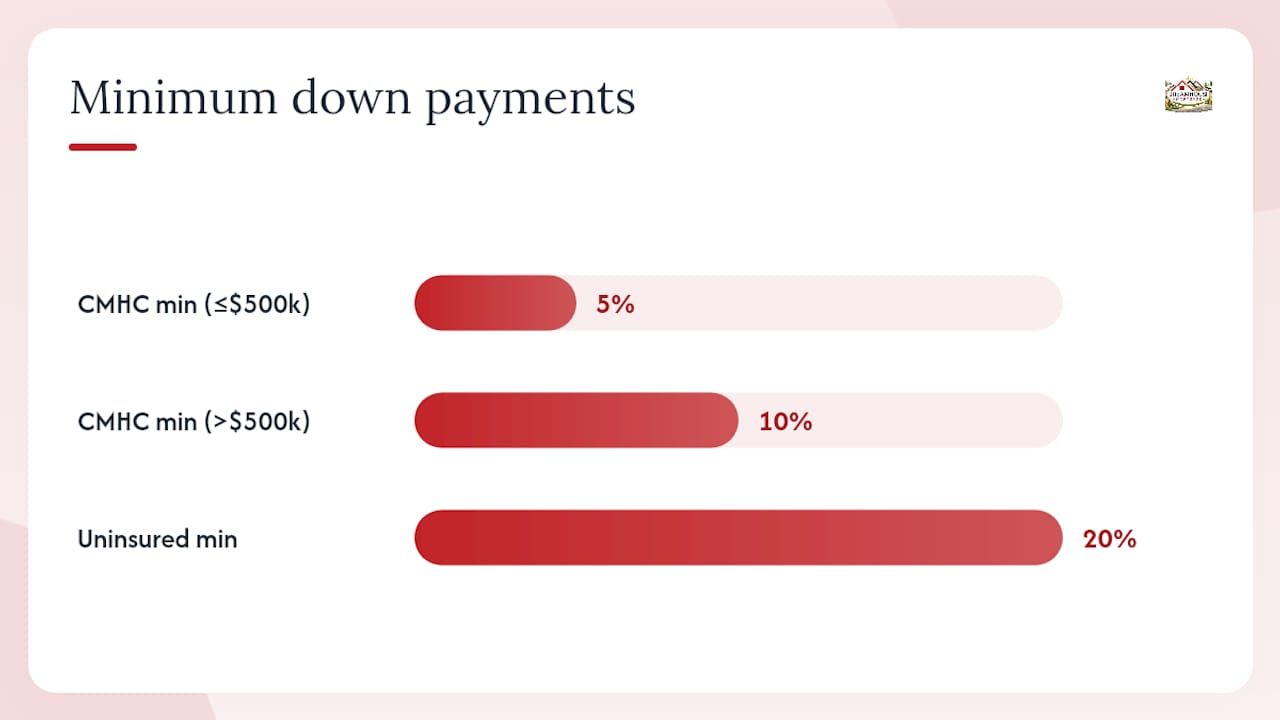
CMHC mortgage loan insurance is a federal program that allows buyers to purchase with less than 20% down, with the insurance premium protecting the lender against default. For second homes, CMHC eligibility requires the borrower to be a Canadian citizen or permanent resident, the property to be in Canada and suitable for year-round occupancy, and the purchase to fall within CMHC’s lending-value limits.
CMHC eligibility essentials for second homes:
- Borrower must be a Canadian citizen or permanent resident
- Property must be in Canada
- Property must be suitable for year-round occupancy and have year-round access
- Minimum equity: 5% on the first $500,000 of lending value; 10% on the portion above $500,000
- Maximum amortization: 25 years for most homeowner loans (30-year amortization available in limited circumstances)
- Property must not be primarily for rental or investment purposes
CMHC insurance is not available for seasonal or three-season properties, properties accessible only by water or seasonal road, or properties on leased land. When CMHC insurance is unavailable, the buyer must bring 20% down and accept conventional uninsured terms. This pushes many Alberta cottage buyers toward credit unions and B-lenders, which have more flexible property criteria.
CMHC insurance premiums are calculated as a percentage of the insured mortgage amount and vary by LTV ratio. The premium is added to the mortgage balance and amortized over the loan term. For CMHC premium calculations specific to Alberta, the Dreamhouse Mortgage resource covers each LTV tier.
Structuring your application to retain CMHC eligibility:
- Confirm year-round road access before selecting a property
- Ensure the property is winterized and suitable for year-round habitation
- Keep the purchase price within CMHC’s maximum lending-value threshold
- Declare the property as owner-occupied second home accurately
- Address any property condition issues before the appraisal
Step-by-step action plan to get pre-approved for a vacation home in Alberta
Assess your finances. Calculate your current GDS and TDS ratios including your primary mortgage. Identify how much additional debt service you can carry before hitting the 44% TDS ceiling.
Determine your down payment source. Confirm whether funds are in savings, a HELOC, or an RRSP. Document the source with three months of statements. If using a HELOC, factor the payment into your TDS.
Check your credit report. Pull your credit report from Equifax Canada or TransUnion Canada. Dispute any errors and pay down revolving balances before applying.
Get pre-approved, declaring the property as a second home. This is critical. Declaring it as a primary residence when it is not is a misrepresentation. A pre-approval for a second home sets accurate expectations on rate, down payment, and qualifying amount.
Identify the right lender channel. For a standard year-round property in Calgary or Airdrie, an A-lender or monoline lender is likely the right fit. For a seasonal property near Cochrane or a rural acreage near Red Deer, a credit union or B-lender may be necessary.
Engage a mortgage broker. A broker with Alberta lender relationships can run your file across multiple channels, identify the best rate and terms, and flag property issues before you make an offer.
Make an offer with appropriate conditions. Include financing, inspection, and insurance conditions. Use the inspection period to confirm well, septic, access, and zoning.
Submit full documentation and proceed to approval. Once conditions are satisfied and the appraisal is complete, the lender issues a formal commitment. Your lawyer handles the closing.
Buyers in Calgary, Airdrie, Cochrane, Chestermere, Red Deer, and Edmonton can contact Dreamhouse Mortgage directly for a tailored pre-approval check that accounts for both properties in the qualifying calculation.
What Alberta buyers often get wrong about vacation-home financing
The most common surprise I see in Alberta vacation-home files is the property itself failing the lender’s criteria after the buyer has already fallen in love with it. A cabin near Cochrane with seasonal road access, an unwinterized lake property near Red Deer, or a leasehold lot in a resort community near Calgary can all look like straightforward purchases until the lender’s underwriter reviews the property details.
The second surprise is the TDS calculation. Buyers who qualify comfortably for their primary mortgage often assume a second property will be straightforward. When both mortgage payments, taxes, and heat are stacked together, TDS frequently exceeds 44% even on a solid income. The fix is usually a larger down payment on the vacation property, paying off a car loan first, or adjusting the purchase price.
Down payment source is the third issue. Funds sitting in a TFSA or RRSP are straightforward. A HELOC draw is also acceptable, but it adds a monthly payment that lenders count in full against TDS. Gifted funds require a signed gift letter and a paper trail showing the funds came from an immediate family member.
In Alberta, credit unions have consistently approved files that major banks declined, particularly for non-standard properties. Local knowledge matters here. A broker who works regularly with Alberta credit unions and B-lenders can route your file to the right channel on the first submission rather than after a bank decline.
Mortgage brokers in Alberta help buyers qualify for vacation-home financing by navigating lender channels, documenting eligibility, and explaining requirements.
Qualifying for a vacation-home mortgage involves more moving parts than a standard purchase: two properties in the debt-ratio calculation, stricter property standards, CMHC eligibility questions, and lender channels that vary by property type. Dreamhouse Mortgage handles all of it from one point of contact.
Guriqbal Chahal and the Dreamhouse Mortgage team provide vacation-home mortgage pre-approvals, lender access across banks, credit unions, monoline lenders, B-lenders, and private lenders, CMHC eligibility guidance, and rate negotiation on your behalf. The brokerage serves Calgary, Airdrie, Cochrane, Chestermere, Okotoks, Red Deer, Edmonton, and surrounding Alberta communities.
When you call, expect a straightforward eligibility check: Guriqbal will review your income, existing debt, down payment source, and property type, then confirm which lender channels are the best fit and what documents you need to move forward.
Call Guriqbal Chahal, MBA, PMP at 403-966-6072 or find Dreamhouse Mortgage on Google to book your vacation-home mortgage consultation.
Sources
- CMHC — Second home (Mortgage Loan Insurance Homeownership programs)
- Cottage & Second Home Mortgage in Canada: How to Finance a Recreational Property (2026) | WealthNorth
This article is general information, not a substitute for advice from a qualified financial advisor. Consult a qualified financial professional about your own circumstances before acting on anything here.
FAQ
How do you qualify for a vacation home mortgage in Canada?
You qualify by meeting borrower requirements (credit score of 680+ for A-lenders, verifiable income, and adequate down payment) and passing the federal stress test, which requires you to qualify at your contract rate plus 2% or the benchmark rate. Your combined GDS and TDS ratios across both your primary residence and the vacation property must stay within lender guidelines, typically 39% and 44% respectively.
Is it harder to get a mortgage for a vacation home than a primary residence?
Yes, for two reasons: lenders apply stricter property standards (year-round access, winterization, standard insurability), and your debt ratios must absorb two properties simultaneously. Seasonal or non-standard properties are routinely declined by major banks, pushing buyers toward credit unions or B-lenders.
What is the minimum down payment for a second home in Canada?
For an owner-occupied second home that meets CMHC eligibility, the minimum down payment is 5% on the first $500,000 and 10% on the amount above $500,000. For seasonal properties or investment properties, lenders typically require 20% or more, and CMHC insurance is not available.
What income do I need to qualify for a $500,000 vacation-home mortgage in Alberta?
The required income depends on your existing debt load and the stress-test qualifying rate. As a general reference, a $500,000 mortgage at a 7.5% qualifying rate over 25 years carries a monthly payment of roughly $3,670. Adding your primary mortgage and other debts, and keeping TDS at or below 44%, most buyers need a gross household income of $130,000–$160,000 or more, depending on their existing obligations. A mortgage pre-approval gives you the exact figure for your situation.
When should you use a mortgage broker for a vacation-home purchase in Alberta?
A mortgage broker is particularly useful when the property is non-standard (seasonal access, rural location, leasehold), when your income is self-employed or variable, or when a bank has already declined your file. Brokers with Alberta lender relationships can access credit unions, monoline lenders, and B-lenders that are not available through direct bank applications, which materially improves approval odds on complex files.