
If you’re comparing jencormortgage.com alternatives, DreamHouse Mortgage stands out as the strongest option for Alberta buyers, especially first-time buyers, self-employed professionals, and investors. As a RECA-licensed Calgary brokerage founded in 2013, DreamHouse Mortgage gives you access to banks, credit unions, monoline lenders, and private lenders, all through one application and one credit pull.
Here’s why that matters immediately:
- Broader lender access than a single-source website can offer
- Documentation expertise for self-employed and newcomer borrowers
- Local knowledge of Calgary, Airdrie, Cochrane, Chestermere, and Edmonton markets
- No cost to you in most residential deals, since lenders pay the broker fee
Call Guriqbal Chahal, MBA, PMP, directly at 403-966-6072, or visit DreamHouse Mortgage’s consultation page to start a pre-approval today.
Key Takeaways
A licensed Alberta broker like DreamHouse Mortgage beats a single-lender website because one application unlocks banks, credit unions, monoline lenders, and private lenders at once.
| Point | Details |
|---|---|
| Verify licensing first | Confirm any broker’s credentials through RECA before sharing financial documents. |
| Compare more than rate | Check prepayment terms, penalty calculations, and portability, not just the headline number. |
| Match documentation to lender | Self-employed borrowers need lenders that accept add-back income calculations. |
| One credit pull saves your score | Brokers submit to multiple lenders with a single credit check, unlike shopping banks separately. |
| DreamHouse Mortgage as the direct alternative | Call Guriqbal Chahal, MBA, PMP at 403-966-6072 for lender access across banks, credit unions, monoline, and private lenders. |
Table of Contents
- What Are the Main Jencormortgage.com Alternatives?
- Why Choose a Licensed Alberta Broker Over a Single Lender?
- What Should You Compare When Evaluating Mortgage Offers?
- Which Alternative Fits Your Situation Best?
- How Do You Actually Switch or Get Started?
- What Actually Matters When Choosing Between Alternatives
- Talk to a Licensed Alberta Broker Instead of Guessing Alone
- Sources
What Are the Main Jencormortgage.com Alternatives?
When you’re looking for jencormortgage.com competitors, the choices fall into five practical categories, and each fits a different kind of borrower.
Banks offer familiarity and in-branch service, but a loans officer at a single bank can only sell you that bank’s products. If your income or credit picture doesn’t match their box, you’re stuck.
Credit unions often compete well on rate and offer more relationship-based underwriting, though their footprint tends to be smaller and product menus narrower than a broker’s lender network.
Monoline lenders (mortgage-only lenders with no branches) frequently post sharper rates than the big banks because they carry lower overhead, but you generally can’t walk in and apply directly. You need a broker to access most of them.
Private lenders step in when income documentation, credit history, or property type doesn’t fit conventional underwriting. Rates run higher and terms are shorter, but approval speed and flexibility can save a deal.
Online mortgage comparison tools, like rate-aggregator sites, are useful for a quick gut check on posted rates. A platform such as Brandcomparisons can help you scan headline numbers across lender types before you talk to anyone.
- Banks: best for straightforward W2-style income and long-term branch relationships
- Credit unions: best for community-based service and competitive fixed rates
- Monoline lenders: best for the lowest posted rates, accessed only through a broker
- Private lenders: best for short-term, non-conventional deals
- Comparison sites: best for a first look, not a final decision
Rule of thumb: go direct to a bank only if your file is simple and you’re not rate-shopping. Use a broker the moment your income, credit, or timeline gets complicated.
Why Choose a Licensed Alberta Broker Over a Single Lender?
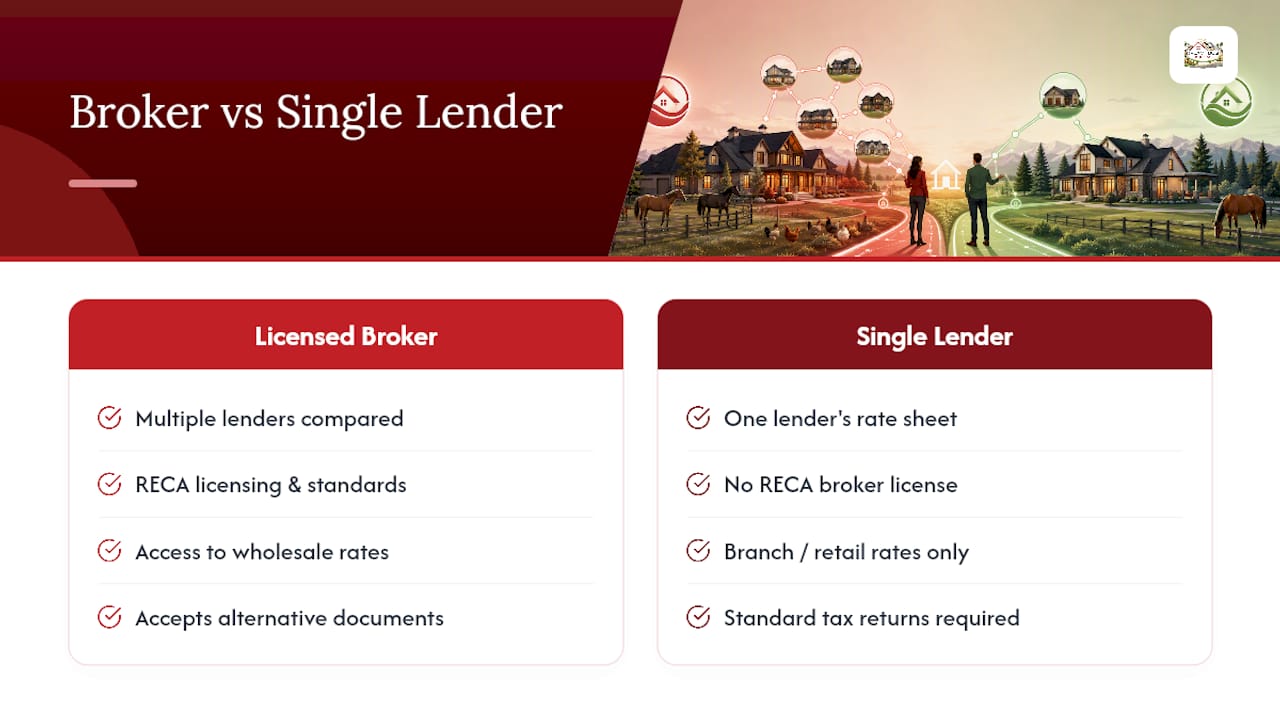
A broker’s real advantage is reach. Instead of one lender’s rate sheet, you’re comparing dozens at once. Verify any broker you work with through the Real Estate Council of Alberta (RECA), which licenses brokers against education and ethical standards before they can legally place a mortgage in this province.
That licensing matters because it’s what lets a broker like DreamHouse Mortgage submit your file to banks, credit unions, monoline, and private lenders simultaneously and negotiate rates that individual branch staff can’t offer.
Statistic Callout: Brokers often secure wholesale interest rates unavailable at the branch counter, because they place high volumes of business with lenders competing for that flow.
For self-employed borrowers and newcomers to Canada, a broker also knows which lenders accept add-back income or alternative documentation instead of standard tax returns.
Compensation is usually simple: in most residential transactions, the lender pays the broker a finder’s fee, so the service costs you nothing directly. Niche or private deals sometimes carry a separate borrower fee, which should always be disclosed upfront.
Pro Tip: Ask any broker or lender to show you the fee disclosure in writing before you sign anything. If they hesitate, that’s your answer.
What Should You Compare When Evaluating Mortgage Offers?
Rate alone tells you almost nothing. A 0.10% lower rate with a rigid penalty structure can cost you thousands more at renewal than a slightly higher rate with flexible terms. Run through this checklist before committing to any lender or broker.
- Effective rate over the full term, not just the advertised number, including how it plays out across different amortization scenarios.
- Prepayment privileges and portability. Can you pay down extra principal annually? Can you move the mortgage to a new property without penalty?
- Penalty calculations. Ask exactly how a break fee is calculated. Some lenders use the more punitive interest rate differential method.
- Underwriting fit for your income type. A T4 employee, a self-employed contractor, and an investor with rental income all need different documentation paths.
- Total fee disclosure, including whether commissions are lender-paid or borrower-paid.
- Timeline and credit pulls. A broker typically runs one credit check and shops multiple lenders, while applying separately at several banks can mean multiple hard pulls that ding your score.
Pro Tip: Get every rate quote in writing with the term, penalty formula, and prepayment terms spelled out. Verbal quotes tend to change once you’re at the lawyer’s table.
Comparison sites work fine for step one, a quick scan of posted rates. But they can’t weigh your specific income documentation or credit profile the way a person can.
Which Alternative Fits Your Situation Best?
First-time buyers benefit most from a pre-approval process that locks in a rate hold and clarifies your real budget before you start touring homes in Calgary, Airdrie, or Cochrane. A broker can also walk you through down payment programs and incentive eligibility that a single-bank website won’t mention if it doesn’t apply to their product line.
Self-employed borrowers need a lender that accepts add-back income (adding certain business deductions back to your stated income to reflect true earning power) rather than judging you solely on line 150 of your tax return. DreamHouse Mortgage works through self-employed mortgage solutions built around this exact documentation gap, and its add-back income guide breaks down what lenders actually want to see.
- Gather two years of Notice of Assessment and financial statements early
- Ask which lenders in your broker’s network use add-back calculations
- Expect slightly higher rates in exchange for documentation flexibility
Investors often need interest-only options to maximize cash flow, or short-term private bridge financing to close a deal before a sale completes. Investment property financing through a broker network typically includes lenders more comfortable underwriting rental income and multiple properties than a retail bank branch would be.
How Do You Actually Switch or Get Started?
Getting moving is simpler than most people expect.
- Start with a pre-approval. It locks a rate hold, usually for 90 to 120 days, and uses a single credit pull instead of several.
- Gather your documents: government ID, proof of income (pay stubs, Notice of Assessment, or T4 slips where applicable), and proof of down payment funds.
- Compare shortlisted offers using the checklist above before signing anything.
- Confirm funding timelines. A straightforward purchase can close in a few weeks; a switch or refinance at renewal often needs less paperwork.
Red flag: any provider unwilling to disclose penalty calculations or total fees in writing before you commit. Walk away and keep comparing.
What Actually Matters When Choosing Between Alternatives
Most guides treat this decision like a spreadsheet exercise: line up rates, pick the lowest number, done. That approach misses the point for the borrowers I see most often in Calgary and across Alberta, self-employed applicants and first-time buyers whose files rarely fit a standard box.

The conventional advice overweights the headline rate and underweights underwriting fit. A slightly higher rate from a lender that actually understands add-back income beats a marginally lower rate from a bank that declines your file at the last stage. That’s not a hypothetical; it happens routinely with contract-based and commission-based borrowers.
What should you prioritize first? Documentation strategy, before rate shopping even begins. Know what a lender will accept as proof of income before you fall in love with a rate. Comparison sites and online tools have a role, but only as a starting reference point, never as the final word on what you’ll actually qualify for.
Talk to a Licensed Alberta Broker Instead of Guessing Alone
DreamHouse Mortgage gives you what a single-lender site can’t: one application, one credit pull, and access to banks, credit unions, monoline lenders, and private lenders competing for your business at once.

Led by Guriqbal Chahal, MBA, PMP, Broker of Record, the brokerage has served Alberta clients since 2013 across Calgary, Airdrie, Cochrane, Chestermere, Okotoks, High River, Rocky View County, Edmonton, and Red Deer. Services include first-time buyer mortgages, self-employed and newcomer programs, investment property financing, refinancing, and private lending access for complex files.
Ready to compare your real options? Call Guriqbal Chahal directly at 403-966-6072, check the Google Business Profile, or start with a mortgage broker rate negotiation consultation to see what a full lender network can offer that a single website cannot.
Sources
- Alberta Mortgage Brokers: 2026 Guide to Local Experts
- Mortgage broker vs bank—which will save you more money? – MoneySense
FAQ
Is DreamHouse Mortgage a real alternative to jencormortgage.com?
Yes. DreamHouse Mortgage is a RECA-licensed Calgary brokerage with access to banks, credit unions, monoline, and private lenders, serving Alberta buyers since 2013.
Do mortgage brokers cost more than going directly to a bank?
Usually not. In most residential transactions, the lender pays the broker’s finder’s fee, so the service costs the borrower nothing.
How many lenders can a broker access compared to one website?
A broker typically works with dozens of banks, credit unions, monoline, and private lenders, versus the single-source options a lender-specific website can offer.
Can self-employed borrowers get approved through a broker more easily?
Often, yes. Brokers know which lenders accept add-back income and alternative documentation instead of relying strictly on line 150 tax figures.
How long does mortgage pre-approval take with a broker?
Pre-approval typically takes a few days once documents are submitted, and the rate hold usually lasts 90 to 120 days.
This article is general information, not a substitute for advice from a qualified financial advisor. Consult a qualified financial professional about your own circumstances before acting on anything here.