
If you can document two full years of stable income, aim first for a prime, full-documentation insured mortgage. If your tax returns understate what you actually earn, CMHC Self-Employed or the Sagen Business-for-Self (Alt-A) program are usually your next best routes. If neither fits, a private lender or a Home Equity Line of Credit can bridge you while you rebuild your documentation. The fastest way through this maze is a broker who can shop your file across all four paths at once.
Here is the recommended try sequence, in order:
- Prime / A Lender full-doc mortgage — lowest rates, but requires two clean years of Notice of Assessment (NOA) income that matches your lifestyle.
- CMHC Self-Employed insured program — flexible documentation with government-backed insurance, ideal if your down payment sits below 20%.
- Sagen Business-for-Self (Alt-A) — accepts stated or business-for-self income for borrowers with at least two years in business and imperfect write-offs.
- Private lenders / private mortgages — fast, equity-based approval when documentation or credit issues rule out the above.
- HELOC — a short-term bridge if you already own property and need liquidity while sorting out a purchase.
- Rent-to-own — a niche fallback, mainly for borrowers rebuilding credit before a future purchase.
If any of this sounds like your situation, call Guriqbal Chahal, MBA, PMP, Mortgage Broker at Dreamhouse Mortgage at 403-966-6072 — he places self-employed files with the lender tier that actually fits your documents, not the one that’s easiest to advertise.
Key Takeaways
The best mortgage programs for self-employed borrowers depend on documentation strength and down payment size, not on income alone, and matching those two factors to the right lender tier is what separates approval from decline.
| Point | Details |
|---|---|
| Documentation decides your tier | Two clean years of NOAs point you toward prime; thin or write-off-heavy income points toward CMHC Self-Employed or Sagen Business-for-Self. |
| Down payment sets insurability | Under 20% down generally requires an insured product; 20% or more opens uninsured B lender and private options. |
| Add-backs need accountant support | Depreciation and owner salary adjustments can raise qualifying income, but lenders require documented proof. |
| Dreamhouse Mortgage places across all tiers | Broker access to prime, alternative, and private lenders helps match self-employed files to the program that actually approves them. |
This article is general information, not a substitute for advice from a qualified financial advisor. Consult a qualified financial professional about your own circumstances before acting on anything here.
Table of Contents
- Best Mortgage Programs for Self-Employed Borrowers Compared
- How Do You Choose the Right Program for Your File?
- What Documents Will Lenders Ask You For?
- How Do Lenders Actually Calculate Self-Employed Income?
- What Can You Do Right Now to Improve Approval Odds?
- What Should You Expect During Pre-Approval?
- Why Work With a Local Alberta Broker on a Self-Employed File?
- An Editorial Take on Self-Employed Mortgage Programs
- Talk to Dreamhouse Mortgage About Your Self-Employed File
- Sources
- FAQ
Best Mortgage Programs for Self-Employed Borrowers Compared
Self-employed income is not one thing to a lender. It’s a puzzle made of NOAs, T2125 statements, GST/HST filings, and whatever your accountant decided to write off last April. The program that fits your file depends less on what you want and more on what your paperwork can prove.
Dreamhouse Mortgage works across every tier below, from prime banks to private lenders, because no single lender fits every self-employed file. That’s the practical value of broker placement: submitting the same application to the wrong lender wastes weeks; submitting it to the right one can mean approval in days.
A few of these deserve more context than a table row allows.
Traditional mortgages remain the cheapest option, but only if your NOAs actually reflect what you take home. Many self-employed Albertans write off enough that their net income looks thinner than their real cash flow, knocking them out of prime lending before they even apply.
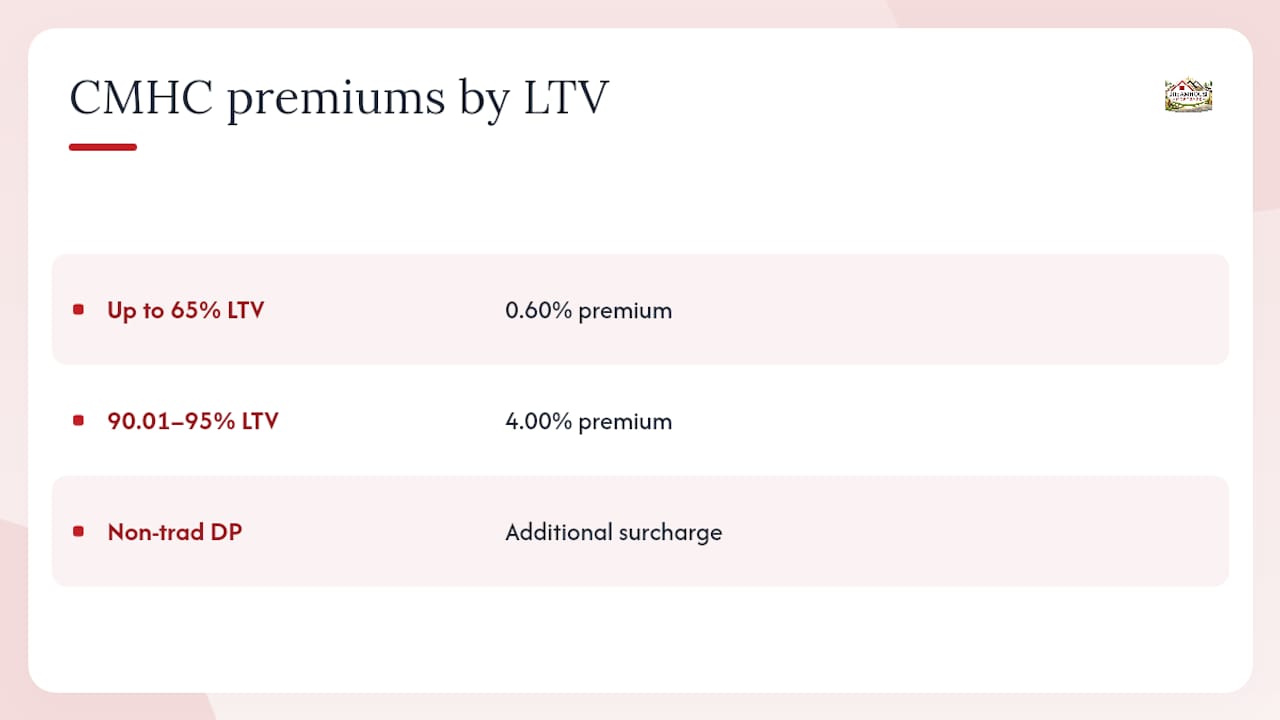
CMHC’s self-employed stream allows more flexible documentation while maintaining mortgage insurance, which generally offers access to favorable rates. The trade-off is CMHC’s premium schedule: coverage at up to 65% LTV runs 0.60% of the loan amount, while borrowing between 90.01% and 95% LTV pushes the premium to 4.00%, with a further surcharge for non-traditional down payment sources.
Sagen’s Business-for-Self program exists precisely for borrowers whose write-offs are legitimate but make their taxable income look worse than their actual earnings. Sagen requires a minimum of two years in business and accepts documents like a business license, GST/HST return summary, and audited financials prepared by a chartered accountant in place of a straightforward T1.
Private lenders and HELOCs both trade rate for speed or flexibility. A private mortgage can close in days when a bank would take weeks, but expect fees on top of a materially higher rate. A HELOC, by contrast, only works if you already have equity to draw against, so it’s a tool for existing homeowners rather than a path to a first purchase.
How Do You Choose the Right Program for Your File?
Start with what you can actually document, not what you’d prefer to qualify for.
- Two years of provable NOA income that matches your lifestyle? Head toward a traditional prime mortgage. It’s the cheapest lending tier and the fastest to approve when your paperwork is clean.
- Limited documentation, thin down payment, or write-offs that suppress your taxable income? CMHC Self-Employed or Sagen Business-for-Self are built for exactly this gap, and both still allow an insured mortgage.
- Strong equity but weak paperwork, bad credit, or a tight closing deadline? A private lender is the realistic route, understanding you’ll pay a premium for that flexibility.
Your down payment size often decides the category before anything else does. Anything under 20% down generally pushes you toward an insured product like CMHC Self-Employed, since Canadian mortgage rules require insurance below that threshold. Once you’re at 20% or more, you open the door to uninsured B lender or private products that skip the insurer’s documentation rules entirely, at the cost of a higher rate.
Before applying anywhere, answer these three questions honestly: How many years of consistent NOAs can you produce? How much of your reported income reflects real cash flow versus write-offs? How much can you put down without draining your reserves?
Then ask any broker or lender three more: Which lender tier fits my actual file, not my ideal one? What add-backs will you accept, and what proof do you need for them? What happens to my rate and terms if my file doesn’t qualify at the tier we start with?
Pro Tip: Bring your last two years of NOAs and T2125 forms to your first broker conversation, even if they’re not perfect. A broker can often see a qualifying path in five minutes that would take you weeks to figure out alone.
What Documents Will Lenders Ask You For?
Every self-employed application in Canada runs through some version of the same paperwork gauntlet. Assemble it before you apply, and you’ll cut weeks off your approval timeline.
- Two years of Notices of Assessment (NOAs) and matching T1 General returns with Statement of Business or Professional Activities (T2125).
- Business financial statements, compiled or audited depending on lender tier, especially for incorporated borrowers.
- GST/HST return summaries, which many lenders use to sanity-check reported revenue.
- Six to twelve months of business and personal bank statements, kept separate rather than blended.
- Business registry confirmation proving how long you’ve operated and under what structure.
- An accountant’s letter explaining income reasonableness, especially when write-offs are heavy.
Add-backs come into play when your net income understates your real cash flow. Lenders will often add back non-cash items like depreciation and amortization, and sometimes reclassify owner salary versus dividends, but the acceptability and size of any add-back varies by lender and usually needs accountant support in writing.
The most common pitfalls are simple to avoid once you know them: missing or outdated NOAs, personal and business expenses run through the same account, and outstanding tax arrears that spook underwriters. Fixing any of these before you apply, rather than explaining them after a decline, saves real time.

How Do Lenders Actually Calculate Self-Employed Income?
Most lenders average your last two years of net income from line 15000 on your NOAs, then apply add-backs where they’re supported by your accountant. That averaged, adjusted figure becomes your qualifying income, not your headline revenue.
- Prime lenders lean on net income approaches: your NOA figure, possibly adjusted with add-backs, drives your qualifying number.
- Some alternative lenders instead use gross-deposit approaches, reviewing business bank deposits directly rather than relying solely on tax filings.
- Business-for-Self programs blend both, weighing stated income against reasonableness for your industry and tenure.
Once your qualifying income is set, every Canadian lender applies the federal stress test, qualifying you at either your contract rate plus 2% or 5.25%, whichever is higher. For self-employed borrowers whose qualifying income is already trimmed by averaging and conservative add-backs, this stress test can shrink your approved purchase price more sharply than it does for a salaried applicant with the same take-home pay.
What Can You Do Right Now to Improve Approval Odds?
Approval odds for self-employed borrowers usually come down to preparation, not luck. Work through these in order.
- Resolve any tax arrears immediately. Outstanding balances with the CRA are one of the fastest ways to get declined, regardless of income.
- Order your NOAs and consolidate your banking. Keep business and personal accounts separate so a lender can trace cash flow without guesswork.
- Get a year-to-date profit and loss statement and an accountant letter. These carry real weight with underwriters when your most recent tax year isn’t filed yet.
- Move toward CPA-prepared or audited financials if you’re incorporated. This alone opens doors that compiled statements don’t.
- Increase your down payment or add a co-borrower if your qualifying income is tight. Either move shifts your loan-to-value or debt ratios in your favor.
- Improve your credit score before applying, since self-employed files already carry more underwriting scrutiny, and a strong score offsets some of that.
Applying directly to one bank makes sense if your documentation is clean and your income is straightforward. The moment your file has write-offs, mixed income sources, or a tenure just under two years, a broker’s lender access and ability to negotiate exceptions becomes the more efficient path.
Pro Tip: If your accountant already has your year-end financials drafted, send them to your broker before they’re finalized. Sometimes small, legitimate adjustments to how income is categorized can move you into a materially better lender tier.
What Should You Expect During Pre-Approval?
Pre-approval for a self-employed borrower involves more back-and-forth than for a salaried one, mainly around documentation completeness rather than income size itself.
- Initial document review, typically NOAs, T2125s, and bank statements. Prime lenders can turn this around in a few business days; alternative and private lenders sometimes faster, since their underwriting is less standardized.
- Refreshing your file if it goes stale. A pre-approval typically holds for 90 to 120 days; beyond that, expect to update NOAs or year-to-date financials to keep it valid.
- Moving from pre-approval to funding once you have an accepted offer, which usually adds a property appraisal and a final income re-verification before closing.
Delays for self-employed applicants almost always trace back to incomplete documentation rather than the underwriting decision itself, which is exactly why assembling your paperwork early matters more than shopping for the lowest advertised rate.
Why Work With a Local Alberta Broker on a Self-Employed File?
Guriqbal Chahal, MBA, PMP, is the Broker of Record at Dreamhouse Mortgage, an Alberta brokerage founded in 2013 that serves Calgary, Airdrie, Cochrane, Chestermere, Red Deer, Edmonton, and surrounding communities. The brokerage works across banks, credit unions, monoline lenders, alternative lenders, and private lenders, which matters most for self-employed files that don’t fit a single lender’s checklist.
- Direct access to multiple lender tiers for stated income mortgages rather than a single institution’s product menu.
- Hands-on document preparation, including add-back income guidance for borrowers whose write-offs complicate their qualifying income.
- Local knowledge of Calgary-area self-employed mortgage approval patterns, useful when a lender’s underwriting is unfamiliar with a specific industry or business structure.
A self-employed file rarely fails because the borrower doesn’t earn enough. It fails because the paperwork doesn’t tell the lender the story the borrower’s bank account already knows.
Client testimonials and case studies specific to self-employed placements will be added here upon publication.
An Editorial Take on Self-Employed Mortgage Programs
The conventional advice on self-employed mortgages treats documentation as an obstacle to minimize. That’s backward. Documentation is the entire game. A borrower earning $150,000 with messy books will lose to a borrower earning $90,000 with clean, well-explained financials, every time, at every lender tier.
What’s overrated is the hunt for the lowest advertised rate before your file even qualifies for that lender’s tier. I’d rather see a self-employed borrower spend a month tightening their bookkeeping and add-back documentation than spend that same month rate-shopping products they can’t yet get approved for.
What the data actually supports is this: fit comes before price. A Sagen Business-for-Self approval at a slightly higher rate beats a declined prime application. An insured CMHC Self-Employed mortgage with a properly documented file beats a private lender’s speed if you have the time to prepare. The reader’s first move should be an honest inventory of their own paperwork, not a rate comparison spreadsheet.
— Guriqbal Chahal, MBA, PMP
Talk to Dreamhouse Mortgage About Your Self-Employed File
Dreamhouse Mortgage is the alternative to guessing which lender will actually approve your file. Instead of applying blind to one bank and hoping your write-offs don’t sink the application, a consultation matches your NOAs, T2125s, and business financials against the lender tier most likely to say yes on the first try.
Bring your last two years of NOAs, your T2125 or business financial statements, and a rough idea of your available down payment. From there, Guriqbal Chahal, MBA, PMP, Mortgage Broker, reviews your file against prime, CMHC Self-Employed, Sagen Business-for-Self, and private lender options to find the strongest fit, including a look at how mortgage broker rate negotiation plays out once you’ve qualified with the right lender.
Call 403-966-6072 or visit the Alberta self-employed mortgage consultation page to book a review of your file. You can also find Dreamhouse Mortgage’s Google Business Profile for reviews and contact details.
Sources
- CMHC Self-Employed Mortgage Loan Insurance | CMHC
- Business for Self (Alt. A) – Sagen
- Self-Employed Mortgage Canada: How to Qualify in 2026
FAQ
Can self-employed individuals get a mortgage in Canada?
Yes. Self-employed borrowers qualify through prime lenders with two years of clean NOAs, or through CMHC Self-Employed, Sagen Business-for-Self, B lenders, or private lenders when documentation is thinner.
How much income do I need to qualify for a $500,000 mortgage?
It depends on your down payment, debt load, and the interest rate used under the federal stress test, which qualifies you at your contract rate plus 2% or 5.25%, whichever is higher. A broker can run this calculation against your specific NOAs and down payment.
How much mortgage can I get with a $70,000 salary?
Your borrowing power depends on your debt service ratios, the stress test rate, and your down payment, not salary alone. For self-employed borrowers, lenders typically average two years of NOA income rather than using a single year’s figure.
Who offers the best mortgage rate right now?
Rates shift by lender tier and by borrower file, and the lowest advertised rate is only available if your documentation qualifies you for that specific lender. Dreamhouse Mortgage compares rates across prime, alternative, and private lenders to find the best fit for your actual file, not just the lowest headline number.
What is the difference between CMHC Self-Employed and Sagen Business-for-Self?
CMHC Self-Employed is a government-backed insured program with published premiums by loan-to-value, while Sagen’s Business-for-Self is a private insurer program built around stated or business-for-self income for borrowers with at least two years in business.