
For most healthy Canadian homebuyers, personal term life insurance beats bank mortgage insurance for protecting a home. Term life gives you a named beneficiary instead of the lender, locks in a level benefit instead of a shrinking one, and typically costs less if you qualify while young and healthy, according to Ratehub’s comparison of the two products.
- Beneficiary control: your family decides how the payout gets used, not the bank.
- Level coverage: the death benefit stays the same for the whole term, even as your mortgage balance shrinks.
- Lower cost for younger, healthier buyers: premiums lock in at the start and don’t rise with the bank’s schedule.
The exceptions matter. If you’re closing in days and have no term policy in place, if a health issue makes you hard to insure elsewhere, or if you only need short-term bridge coverage, bank mortgage insurance can still serve a purpose.
Key Takeaways
For most healthy Canadian homebuyers, personal term life insurance protects a mortgage more effectively than bank mortgage insurance because it offers named beneficiaries, level coverage, and typically lower cost.
| Point | Details |
|---|---|
| Beneficiary control matters most | Term life pays your named beneficiaries directly; mortgage insurance pays only the lender. |
| Cost gap favors term life | Bank mortgage insurance can cost roughly 60 to 80 percent more than comparable term life coverage. |
| Underwriting timing changes claim risk | Term life underwrites upfront; mortgage insurance risks post-claim underwriting denials. |
| Coverage shape differs over time | Mortgage insurance declines with your balance; term life holds a level benefit for the full term. |
| Local guidance speeds up coverage | DreamHouse Mortgage helps Alberta buyers coordinate term life quotes alongside mortgage pre-approval. |
Table of Contents
- Mortgage Insurance vs Term Life: How Bank Coverage Actually Works
- What Personal Term Life Insurance Does For Your Mortgage
- 7 Key Differences That Decide Which Option Fits You
- Cost Example: Sample Premium Math For Common Canadian Scenarios
- Which Should You Choose? A Decision Guide For Alberta Buyers
- How To Get Covered In Canada: Steps, Timelines, And Broker Support
- Tax Implications Of Mortgage Insurance vs Term Life Insurance In Canada
- How Each Insurance Type Affects Estate Planning And Inheritance
- Comparing Claim Complexity And Timelines For Each Option
- Sources
Mortgage Insurance vs Term Life: How Bank Coverage Actually Works
Mortgage (creditor) insurance is the optional policy your bank or lender offers when you sign your mortgage documents. It is not the same thing as CMHC mortgage default insurance, which is mandatory when your down payment is under 20% and protects the lender, not your family. Mortgage life insurance is a separate, optional add-on, and Canada’s Financial Consumer Agency of Canada is explicit that it’s your choice to buy it, not a condition of getting the loan.
Here’s how it behaves once you have it:
- The payout goes directly to the lender, applied to your outstanding mortgage balance, not to your family.
- Coverage declines as you pay down principal, even though your premium often stays flat for the life of the policy.
- Most applications skip a medical exam upfront, which feels convenient at signing.
- That convenience carries risk: insurers can investigate your health history after a claim is filed, a practice known as post-claim underwriting, and deny payment if they find undisclosed conditions.
What Personal Term Life Insurance Does For Your Mortgage
Term life insurance is a policy you buy independently, naming your own beneficiaries, who receive a tax-free lump sum if you die during the term. That payout isn’t restricted to paying off the mortgage. It can cover funeral costs, replace lost income, fund a child’s education, or clear other debts, based on guidance from Sun Life Canada’s comparison of mortgage and life insurance.
Several features make term life a stronger fit for mortgage protection:
- Level benefit: your coverage amount stays fixed for the entire term, regardless of how much mortgage principal you’ve repaid.
- Portability: the policy stays with you no matter which lender holds your mortgage, so refinancing or switching banks never puts your coverage at risk.
- Upfront underwriting: because insurers assess your health before issuing the policy, your family faces far less risk of a denied claim after the fact, an approach Canada Life notes is standard for individually underwritten term policies.
- Flexible term lengths: you can match the policy to your mortgage amortization or extend it to cover other financial goals.
7 Key Differences That Decide Which Option Fits You
Once you line these two products up side by side on Brandcomparisons, the decision usually becomes obvious.
- Beneficiary: mortgage insurance pays your lender; term life pays the people you name. If something happens to you, your spouse or kids get the money directly with term life instead of the bank absorbing it first.
- Cost: bank mortgage insurance can run roughly 60 to 80 percent more than comparable term life coverage over the life of a mortgage, particularly for younger, healthier applicants.
- Underwriting timing: term life underwrites you before approval; mortgage insurance often underwrites after a claim, when it’s too late to fix a paperwork gap.
- Portability: term life insurance follows you through any refinance or lender switch; mortgage insurance is often tied to that specific lender and can lapse when you move your mortgage.
- Coverage shape: mortgage insurance shrinks as your balance shrinks; term life holds steady, so your family isn’t underinsured in year 15 just because your mortgage is smaller.
- Flexibility of payout: mortgage insurance only pays down the mortgage; term life proceeds can go anywhere your family needs them.
- Longevity and renewal: mortgage insurance typically ends when the mortgage is paid off or the lender relationship ends; term life runs on its own schedule and can be renewed or laddered independently of your mortgage status.
Taken together, these differences explain why financial planners often steer healthy applicants toward locking in medically underwritten term life early, while their premiums and health both work in their favor.
Cost Example: Sample Premium Math For Common Canadian Scenarios
Numbers make this easier to picture. Take three Alberta buyers, each carrying a $400,000 mortgage on a 25-year amortization, non-smokers in good health.
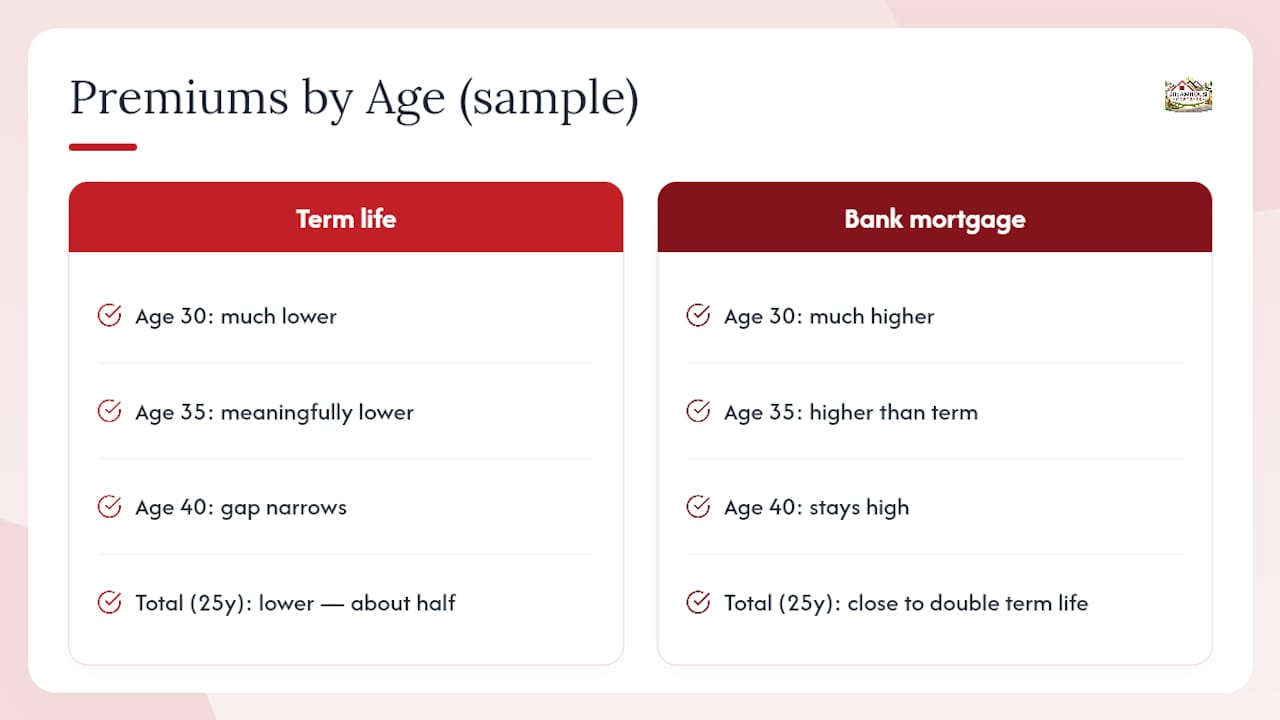
A 30-year-old buyer typically sees the widest gap between the two products, since term life premiums are cheapest when medical risk is lowest. A 35-year-old still benefits from a meaningfully lower term life premium than an equivalent bank policy. By 40, the gap narrows somewhat as term life premiums rise with age, but bank mortgage insurance premiums usually stay just as high (or higher) for the same declining coverage.
Across a full mortgage term, total premiums for bank mortgage insurance often land close to double what comparable term life coverage would cost for the same initial coverage amount. If you invested that premium difference instead of paying it to the bank, the gap compounds further over 20 to 25 years.
Your actual numbers shift based on smoker status, overall health, and the size of your mortgage, so treat these as directional rather than a quote. Understanding your mortgage amortization schedule helps you match a term length to how long you’ll actually need the coverage.
Which Should You Choose? A Decision Guide For Alberta Buyers
Term life insurance is usually the better move if you’re healthy, have time before closing to complete underwriting, and want your family (not the bank) to control the payout. Bank mortgage insurance can be acceptable as a stopgap if you’re closing within days, have a health condition that makes outside coverage difficult, or want temporary protection while a term policy is underwritten.
- Get term life quotes from a broker who can compare multiple Canadian insurers at once, rather than a single bank product.
- If your term life won’t be active before closing, ask your lender about temporary mortgage insurance to bridge the gap.
- Before accepting any bank product, confirm in writing who the beneficiary is, whether the policy is portable, and what happens if you switch lenders.
- Ask directly about cost per $100,000 of coverage, cancellation terms, and whether any refund applies if you cancel early.
Pro Tip: If you’re buying in Calgary, Airdrie, Cochrane, Red Deer, or Edmonton, ask your mortgage broker to run term life quotes alongside your mortgage pre-approval. Comparing both at once often reveals savings you’d miss shopping separately.
How To Get Covered In Canada: Steps, Timelines, And Broker Support
Getting properly insured doesn’t need to slow down your closing. A typical path looks like this:
- Apply for term life through an independent broker as soon as you have an accepted offer, since underwriting can take one to three weeks depending on medical requirements.
- Ask your lender about short-term bridge mortgage insurance if your term policy won’t be active by possession day.
- Compare quotes across multiple Canadian insurers rather than accepting the first bank offer.
- Confirm your coverage amount matches your actual mortgage balance and any co-signer’s needs.
DreamHouse Mortgage, led by Broker of Record Guriqbal Chahal, MBA, PMP, coordinates this process for clients across Calgary, Airdrie, Cochrane, Chestermere, and Edmonton, working alongside lenders and insurance partners so financing and protection line up on the same timeline.
Pro Tip: Ask your broker to request term life quotes at the same time they submit your mortgage application. It avoids a scramble in the final week before closing.
Buyers who wait until the week of closing to think about mortgage protection almost always end up settling for whatever the bank offers at the signing table, rather than the coverage that actually fits their family.
Tax Implications Of Mortgage Insurance vs Term Life Insurance In Canada
Both products share one important trait: the death benefit is paid out tax-free to whoever receives it, whether that’s your lender under a mortgage insurance policy or your named beneficiaries under a term life policy. Canada doesn’t tax life insurance proceeds as income, so there’s no tax bill waiting for your family when a claim is paid.
The difference shows up in who controls that tax-free money, not in how much tax is owed. With mortgage insurance, the tax-free payout goes straight to the bank, and your estate never sees it, so there’s nothing left for your executor to manage or distribute. With term life, the tax-free lump sum lands with your named beneficiaries directly, often outside your estate altogether if beneficiaries are named on the policy rather than “estate.”
That distinction has real consequences during probate. In Alberta, probate fees and delays apply to assets that pass through your estate. A term life policy with named beneficiaries typically bypasses probate entirely, meaning your spouse or children can access funds within weeks, not months. A mortgage insurance payout never touches probate either, since it goes to the lender directly, but it also never gives your family a cent to work with beyond the mortgage itself.
Premiums for either product aren’t tax-deductible for a personal residence, so there’s no annual tax benefit tied to the monthly cost. The financial upside comes from cost and flexibility, not from a tax break, which is one more reason the comparison usually comes down to price and control rather than tax strategy.
How Each Insurance Type Affects Estate Planning And Inheritance
Estate planning is where the practical differences between these two products become obvious. Bank mortgage insurance was never designed to be part of your estate plan. It exists to guarantee the lender gets repaid, full stop. Once that balance is cleared, nothing flows to your spouse, your kids, or anyone else you’d name in a will.

Term life insurance, on the other hand, functions as a genuine estate-planning tool. Because you choose the beneficiaries, you can direct funds to a surviving spouse, split proceeds among children, or name a trust for minor beneficiaries. That flexibility matters if your family situation is anything other than simple. Blended families, business partners who co-own property, or parents wanting to treat multiple children fairly all benefit from a policy that lets them decide the payout structure rather than a bank formula tied purely to loan balance.
There’s also a coverage-gap issue that estate planners flag often. Mortgage insurance ends the moment your mortgage is paid off or refinanced elsewhere, leaving your family with zero life insurance protection at exactly the point your estate might need liquidity for probate fees, final expenses, or supporting a surviving spouse. Term life keeps running on its own schedule, independent of your mortgage status, so it continues supporting your broader estate plan even after the house is paid off.
If you’re building a will or updating beneficiary designations in Alberta, a term life policy gives your estate lawyer and executor something concrete to work with. A mortgage insurance policy gives them nothing, since the funds never reach the estate at all.
Comparing Claim Complexity And Timelines For Each Option
Filing a claim is where the two products diverge most sharply, and it’s often the difference families feel most acutely at the worst possible time. Term life claims, because the policy was underwritten upfront with full medical disclosure, tend to move faster. Insurers already know your health history was verified before the policy was issued, so there’s less to investigate when a beneficiary files. Straightforward term life claims in Canada are commonly settled within a few weeks of the insurer receiving the required documents, which include a death certificate and a completed claim form.
Mortgage insurance claims are a different story. Because most bank policies skip detailed medical underwriting at application, the insurer often conducts a full investigation into your medical history only after a claim is filed. This is the post-claim underwriting risk mentioned earlier, and it’s not theoretical. If the insurer finds a pre-existing condition you didn’t disclose (even one you weren’t aware was relevant), it can delay or deny the claim entirely, leaving your family responsible for a mortgage they believed was covered.
That structural difference means term life generally offers both a faster and more predictable claims process. Your beneficiaries know what to expect because the underwriting work happened years earlier, at the time you were healthy and had every incentive to disclose accurately. With mortgage insurance, your family finds out how thorough that underwriting was only after they’ve already filed a claim, which is the worst possible moment to discover a gap in coverage.
Broker’s Quick Note: Common Mistakes And One Practical Tip
The most common mistake I see is buyers accepting the bank’s mortgage insurance offer at the signing table without ever requesting a term life quote. It’s presented as the default, but it rarely is the best value. My practical advice: apply for medically underwritten term life within 30 days of your closing date so coverage is active almost immediately. If you’re buying anywhere in Alberta, reach out to DreamHouse Mortgage for guidance specific to your situation.
— Guriqbal Chahal, MBA, PMP
Get Mortgage And Protection Advice Built For Alberta Buyers
DreamHouse Mortgage helps Alberta buyers coordinate financing and mortgage protection in one conversation, instead of leaving insurance as an afterthought at the signing table.

Whether you’re purchasing your first home in Calgary, refinancing in Airdrie, or comparing lenders in Cochrane, Chestermere, or Red Deer, having a broker who can negotiate your mortgage rate while pointing you toward the right term life coverage saves both time and money. DreamHouse Mortgage works with banks, credit unions, monoline, and alternative lenders across Alberta, so you get options rather than a single bank’s product lineup. If you’re weighing mortgage insurance against term life for an upcoming purchase, refinance, or renewal, call Guriqbal Chahal, MBA, PMP, Mortgage Broker, at 403-966-6072, or visit the Google Business Profile to book a consultation and get quotes tailored to your mortgage.
Sources
- Optional mortgage insurance products — Financial Consumer Agency of Canada
- Mortgage insurance vs. Life insurance — Canada Life
- Mortgage Insurance vs. Life Insurance — Ratehub
- Smartmortgageinsurance
FAQ
Why Avoid Mortgage Life Insurance?
Bank mortgage insurance pays your lender rather than your family, offers declining coverage as your balance shrinks, and carries post-claim underwriting risk that can lead to denied claims after you’ve already been paying premiums.
At What Age Does Mortgage Insurance Stop?
Bank mortgage insurance typically ends when your mortgage is paid off, refinanced, or moved to a different lender, rather than at a specific age, so coverage can disappear well before retirement if you switch lenders.
What Are The Downsides Of Having Mortgage Insurance?
The main downsides are a payout that goes only to the lender, coverage that declines while premiums often stay flat, and the risk that an insurer investigates your health history only after you file a claim.
At What Point Do You Not Need Mortgage Insurance?
You may not need it once you have adequate personal term life insurance in place that names your own beneficiaries, since that policy already protects your family and covers the mortgage balance if needed.
Is Term Life Better For Mortgage Protection In Canada?
For most healthy applicants, yes. Term life insurance typically costs less, keeps a level benefit, and lets your family control the payout instead of sending it straight to the bank.
This article is general information, not a substitute for advice from a qualified financial advisor. Consult a qualified financial professional about your own circumstances before acting on anything here.
Recommended
- Maximum Insured Mortgage Home Price Explained: Powerful Insights to Buy More Home in 2026
- Insured Mortgage Rules and Affordability in 2026: A Practical Guide for Canadian Homebuyers
- 5-Year vs. 3-Year vs. 2-Year Mortgage Term Comparison Alberta: The Ultimate 2026 Winner
- Mortgage Terms Explained Alberta Mortgage Glossary: 60 Essential Terms Every Calgary Buyer Must Know (2026)