Yes, construction mortgages are available across Alberta, and most builders and buyers use one of two paths: a construction-to-permanent mortgage or a broker-arranged progress-draw loan. The fastest way to confirm what you qualify for is a document check with a broker who knows Alberta lenders. Call Call Guriqbal Chahal at 403-966-6072 to get started.
TL;DR:
- Construction loans in Alberta require a large down payment of 20% to 35%, with existing land equity reducing upfront cash needs.
- Funds are released in stages linked to inspections at milestones like foundation and framing, with interest paid only on amounts drawn.
- Most construction mortgages in Alberta are either a single-close construction-to-permanent or a two-close standalone loan, each with distinct legal and financing costs.
- Lenders demand thorough documentation, including fixed-price contracts, permits, and appraisals, with stricter scrutiny for self-employed borrowers.
- Working with a broker ensures proper sequencing of inspections and draws, reducing delays and improving chances of timely funding throughout the build.
Table of Contents
- How Construction Mortgages Work in Alberta
- Who Qualifies and What Documents Alberta Lenders Require
- Down Payment, Rates, and Carrying Costs During Construction
- Draw Schedule, Inspections, and Lien Holdbacks in Alberta
- Choosing a Lender and the Approval Process in Alberta
- Checklist and Common Pitfalls for Alberta Builders
- Builder and Lender Insurance Requirements You Need to Know
- Tax Implications and Rebates for Alberta Construction Mortgages
- A Broker’s Take on Financing a Build in Alberta
- Get Your Alberta Construction Mortgage Sorted With DreamHouse Mortgage
- Sources
- FAQ
How Construction Mortgages Work in Alberta
A construction mortgage in Alberta funds your project in installments rather than a single lump sum, which protects both you and the lender from paying for work that isn’t finished. You have two structural choices, and picking the right one shapes everything from your closing costs to your renewal timeline.
Construction-to-permanent mortgages close once. You get approved, draw funds as the build progresses, and the loan automatically converts into a standard mortgage at completion, no second application, no second set of legal fees. Standalone construction loans close twice: once to fund the build, and again when you refinance into permanent financing after occupancy. The two-close route sometimes gets you a more competitive rate on the permanent side, but it also means paying legal and appraisal costs twice.
Either way, construction loans release funds in stages tied to inspections, and you pay interest only on the amount actually drawn, not the full approved amount. Lenders also require an “as-if-complete” appraisal upfront, which values the finished home based on your plans, not the empty lot.
A typical draw schedule breaks down like this:
- Foundation complete: roughly 15% to 20% of funds released
- Framing complete: roughly 20% to 25%
- Lock-up (windows, doors, roof): roughly 20% to 25%
- Drywall and mechanical rough-in: roughly 15% to 20%
- Final completion and occupancy: roughly 15% to 20%
Who Qualifies and What Documents Alberta Lenders Require
Alberta lenders underwrite construction files more carefully than resale purchases, because they’re financing a project that doesn’t exist yet. Most A-lenders want a credit score in the high 600s or above, stable and verifiable income, and a debt service ratio that holds up under the mortgage stress test. Self-employed applicants need two years of tax returns and Notice of Assessments; salaried applicants need recent pay stubs and an employment letter.
Beyond your personal financials, the project itself gets scrutinized just as hard. Have these ready before you apply:
- A fixed-price builder contract (lenders strongly prefer this over cost-plus arrangements)
- Stamped architectural or engineering plans
- Municipal building permits for your county or city
- An itemized cost breakdown covering every trade and material category
- Builder references and proof of liability insurance
- Land title or purchase agreement if you’re buying the lot separately
If you already own your lot outright, that equity often counts toward your down payment requirement, which can meaningfully reduce the cash you need at closing. Buying land and building at the same time usually means a larger cash outlay upfront, since the lender can’t lean on existing equity.
Pro Tip: Get your builder contract reviewed by your broker before you sign it. A vague scope of work is the single most common reason Alberta construction files get delayed at the underwriting stage.
Down Payment, Rates, and Carrying Costs During Construction
Budgeting for a build means planning for more than the mortgage itself. Down payment requirements for construction loans commonly run 20% to 35% of the total project cost, well above the minimum for a standard insured resale purchase. That gap exists because the lender is taking on more risk: a half-built house has no resale value if the project stalls.
Rates for construction mortgages in Canada typically sit above resale mortgage rates, and where you land depends on lender type:
- Big banks: most conservative underwriting, often the lowest rates for straightforward builds
- Credit unions: frequently more flexible for custom or non-standard construction, competitive pricing
- B-lenders and private lenders: higher rates, but useful when income or credit doesn’t fit A-lender boxes
Carrying costs add up fast. Expect interest-only payments on drawn funds, inspection fees at every milestone, and a contingency buffer for the unexpected. Progress inspection costs and holding costs are frequently overlooked by first-time builders, and they hit your cash flow between draws, not at the end. Budget for affordability beyond the mortgage payment itself.
Draw Schedule, Inspections, and Lien Holdbacks in Alberta
Most Alberta construction mortgages run on three to five draws, and each milestone maps to a percentage of total funding: foundation, framing, lock-up, drywall and mechanical, and final completion. Before each draw releases, a lender-appointed inspector visits the site to confirm the work matches what’s been billed.
You typically pay the inspection fee, not the lender, and that cost is worth budgeting for separately since it recurs at every stage. Alberta’s Prompt Payment and Construction Lien Act sets a lien holdback window, and lenders commonly hold back funds for a period of several weeks after substantial completion to protect against subcontractor liens filed late in the process.
Draw delays usually trace back to the same handful of causes:
- Incomplete or unclear documentation submitted for the inspection
- An unlicensed or uninsured subcontractor flagged during review
- Scheduling the inspection after the work is done instead of coordinating it in advance
- Change orders that were never documented or approved by the lender
Coordinating inspection timing with your builder’s schedule, rather than scrambling after the fact, is what keeps a project funded on time.
Choosing a Lender and the Approval Process in Alberta
Not every lender treats construction financing the same way, and matching your project to the right one matters more here than with a standard resale mortgage. Big banks tend to favor straightforward, contractor-built homes with fixed-price contracts. Credit unions often show more flexibility for custom or owner-managed builds, particularly when they have an existing relationship with your builder. B-lenders and private lenders fill gaps for self-employed applicants or non-standard projects, though at a rate premium.
This is where working with a broker changes the outcome. A broker matches your project to the lender most likely to approve it and coordinates draws and inspections so funding doesn’t stall mid-build.
The approval sequence generally runs:
- Pre-approval based on income, credit, and project budget
- Full underwriting of the builder contract, plans, and permits
- As-if-complete appraisal and final commitment
- First draw released after foundation inspection passes
- Subsequent draws through framing, lock-up, and completion
- Conversion to permanent mortgage once occupancy is granted
Confirm conversion terms with your lender before you sign, since some require a second approval at completion.
Checklist and Common Pitfalls for Alberta Builders
A well-prepared file moves faster through underwriting and stays funded through every draw. Before you apply, confirm you have:
- A budget with 10% to 15% contingency built in, not added as an afterthought
- A fixed-price contract with a clearly defined scope of work
- All municipal permits secured before the first draw request
- Proof of builder liability insurance on file
The pitfalls that trip up otherwise well-organized borrowers are predictable: under-budgeting for inspection and holdback costs, vague change-order language that creates disputes mid-build, and thin builder references that raise questions during underwriting.
Pro Tip: Keep your contingency fund in a separate account from your day-to-day cash. Commingling it makes it too easy to spend on non-construction expenses before you actually need it for an overrun.
Tying each draw to a certified inspection, rather than a verbal confirmation from your builder, is the single best risk-management habit you can build into the process.
Builder and Lender Insurance Requirements You Need to Know
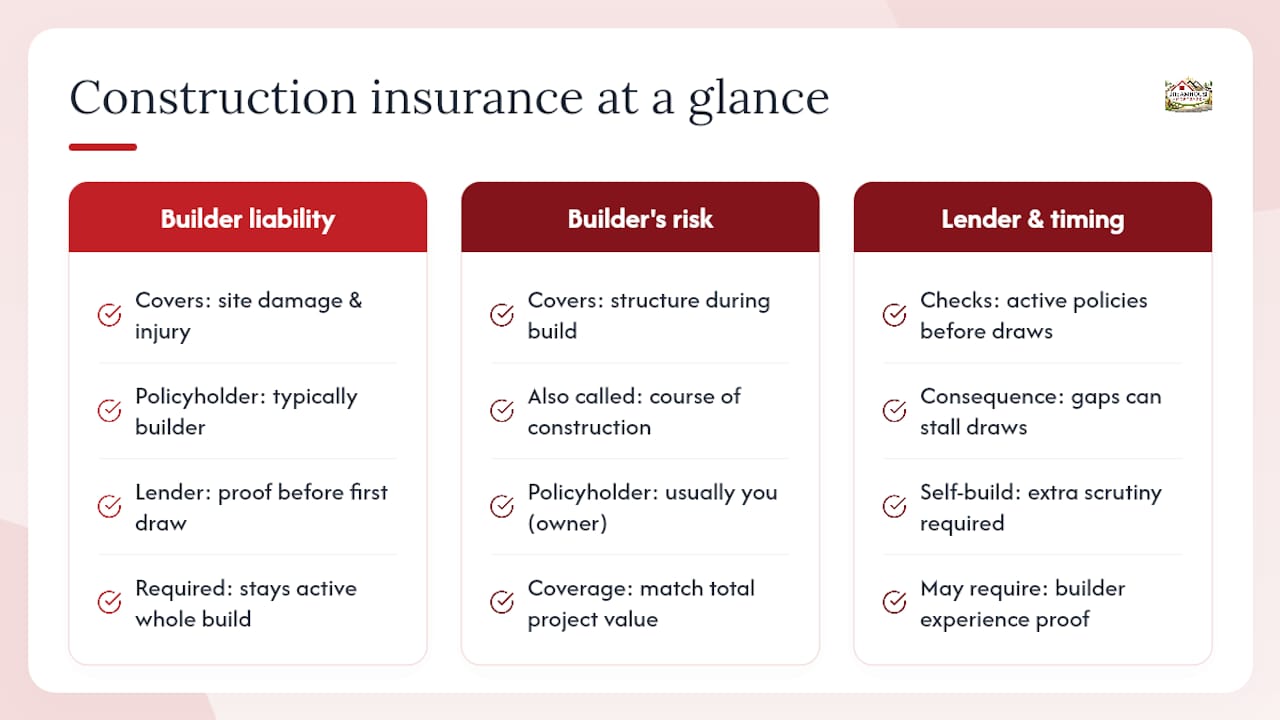
Two separate insurance conversations happen on every Alberta construction file, and confusing them causes real delays. The first is your builder’s liability insurance, which protects against damage or injury on the job site during construction. Lenders typically require proof of this before releasing the first draw, and it needs to stay active through the entire build, not just at closing.
The second is course of construction insurance, sometimes called builder’s risk insurance. This covers the structure itself against fire, theft, vandalism, and weather damage while it’s incomplete and uninsurable under a standard homeowner policy. Most lenders make this a condition of funding, and you, not your builder, are usually the policyholder. Coverage needs to match your total project value and convert into standard homeowner insurance the moment you receive your occupancy permit.
If you’re using a licensed general contractor, ask for their certificate of insurance directly, don’t take their word that coverage exists. Self-build projects, where you’re acting as your own general contractor, face even more scrutiny here: lenders may require proof of construction management experience or hold back a larger contingency until later draws, partly because there’s no licensed contractor’s insurance backing the site.
Gaps in coverage at any point during the build can stall a draw entirely, since inspectors and lenders both check for active policies before releasing funds. Building the insurance renewal dates into your draw timeline avoids a last-minute scramble.
Tax Implications and Rebates for Alberta Construction Mortgages
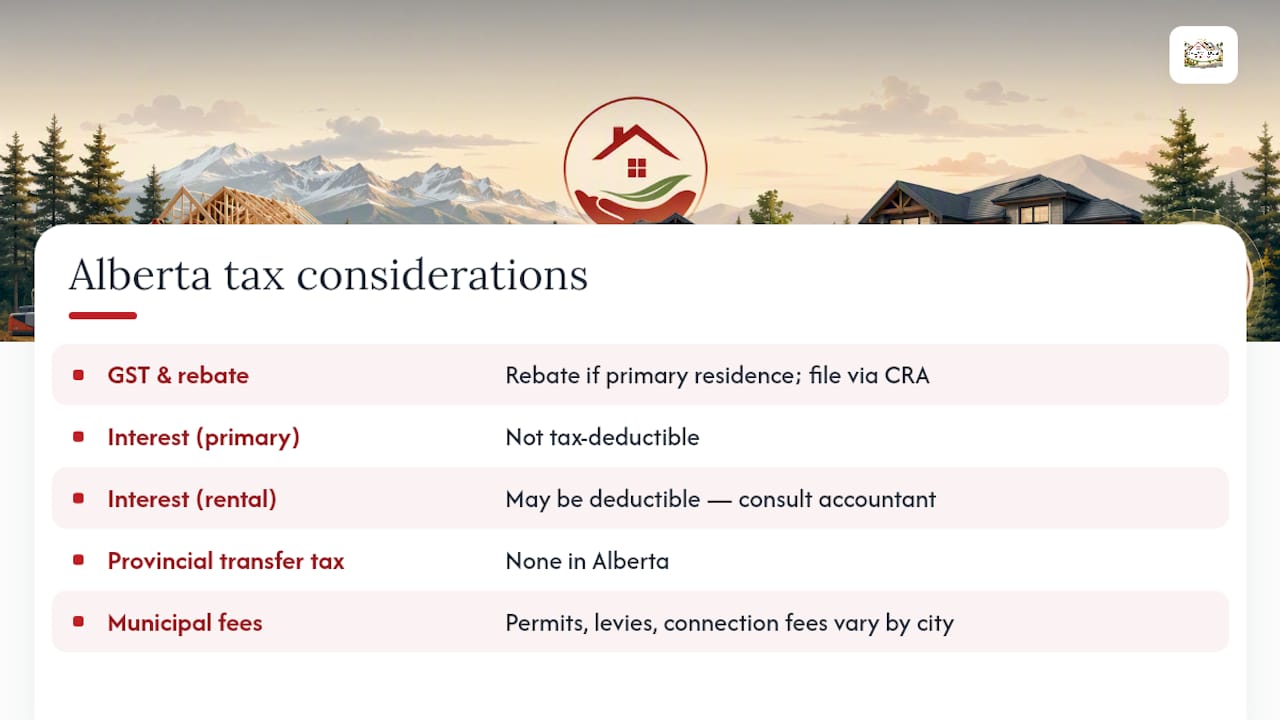
Building a new home in Alberta comes with a few tax considerations that catch first-time builders off guard. GST applies to new home construction, though the federal New Housing Rebate can recover a portion of that GST if the home becomes your primary residence and falls under the applicable price threshold. This rebate is calculated separately from your mortgage and filed through the Canada Revenue Agency, not through your lender.
Interest on a construction mortgage for your primary residence is not tax-deductible, which surprises buyers who assume it works like a business loan. If you’re building an investment or rental property, the interest carrying costs during construction may be treated differently for tax purposes, and that distinction is worth reviewing with an accountant before you finalize your financing structure.
Alberta itself does not levy a provincial land transfer tax, which is a genuine advantage compared to some other provinces, but municipal permit fees, development levies, and utility connection charges still apply and should be built into your total project budget from the start. These fees vary by municipality, whether you’re building in Calgary, Cochrane, or Airdrie, so confirm current rates with your local planning department before finalizing your cost breakdown.
None of this replaces advice from a tax professional, but knowing where the mortgage ends and the tax questions begin helps you avoid budgeting for a rebate that may not apply to your specific project.
A Broker’s Take on Financing a Build in Alberta
The biggest misconception about construction financing in Alberta isn’t about rates. It’s about timing. Buyers assume the hard part is finding a lender willing to fund a build, when the real risk is a funding gap opening up between draws because nobody built the inspection schedule into the cash flow plan from day one.
That gap is where projects stall, not because the money isn’t there, but because it wasn’t sequenced correctly against permits, inspections, and holdback timing. Working with a broker who has coordinated Alberta builds before, in Calgary, Cochrane, and Airdrie specifically, means someone is tracking those dates against your builder’s schedule instead of you discovering a shortfall two weeks before framing inspection.
DreamHouse Mortgage has served Alberta clients since 2013, and construction files get the same document preparation and lender matching as every purchase or refinance we handle. If you’re planning a build, apply now or call Guriqbal Chahal, MBA, PMP directly to walk through your project before you sign a builder contract.
— Guriqbal Chahal, MBA, PMP
Get Your Alberta Construction Mortgage Sorted With DreamHouse Mortgage
DreamHouse Mortgage gives you one broker managing lender matching, document prep, and draw coordination instead of you chasing three separate institutions on your own timeline. That matters most on a construction file, where a missed inspection date or a mismatched lender can stall funding for weeks.

Since 2013, DreamHouse Mortgage has worked with builders and first-time buyers across Calgary, Airdrie, Cochrane, and the surrounding Rocky View communities, matching each project to the lender, whether a big bank, credit union, or B-lender, most likely to approve it on reasonable terms. We handle the builder contract review, the as-if-complete appraisal coordination, and the draw scheduling so funds keep releasing on time through every phase of your build. Our team also negotiates rate and term directly with lenders on your behalf, which is where a broker’s rate negotiation makes a measurable difference on a construction file’s total carrying cost.
Ready to see what you qualify for? Call Guriqbal Chahal, MBA, PMP, Mortgage Broker at DreamHouse Mortgage at 403-966-6072, or view our Google Business Profile to see how we’ve helped Alberta clients fund their builds.
This article is general information, not a substitute for advice from a qualified financial advisor. Consult a qualified financial professional about your own circumstances before acting on anything here.
Sources
- Guide To Construction Mortgages In Canada – Forbes Advisor Canada
- Wowa
- Construction Loans in Canada: How They Work (2026) | WealthNorth
- How a construction mortgage works – NerdWallet Canada
FAQ
How difficult is it to get a construction mortgage in Alberta?
It’s more document-intensive than a resale mortgage, since lenders review your builder contract, permits, and stamped plans alongside your personal credit and income, but a complete file with a fixed-price contract moves through underwriting without much friction.
Can I get a construction mortgage to build a house in Canada?
Yes, construction mortgages are widely available across Canada, including throughout Alberta, through big banks, credit unions, and alternative lenders, structured as either construction-to-permanent or standalone draw financing.
How much down payment do I need for a construction mortgage in Alberta?
Down payment requirements typically run 20% to 35% of the total project cost, though existing land equity can count toward that amount if you already own your lot.
How does a construction mortgage work in Canada?
Funds release in stages tied to inspections at each construction milestone, you pay interest only on the amount drawn so far, and the loan either converts automatically into a permanent mortgage or requires a second closing at completion.
What happens if my construction mortgage doesn’t convert automatically?
Some lenders require a second application and closing once you receive your occupancy permit, so confirm this detail with your lender or broker before signing your initial construction financing agreement.