A gift letter is mandatory whenever gifted money forms part of your down payment on a Canadian mortgage. The letter must name the donor and recipient, state their relationship, list the exact dollar amount, identify the property, and confirm the money is a true gift with no repayment or security expected. It needs signatures and a date. Before you deposit a cent, call Guriqbal Chahal at Dreamhouse Mortgage to confirm your lender’s preferred wording.
TL;DR:
- Gift letters must clearly identify the donor and recipient, specify the exact amount, and state that the funds are a non-repayable gift with no security interest.
- Accepted donors typically include immediate family members such as parents, grandparents, spouses, and occasionally siblings, but other relatives or friends may not qualify.
- Lenders require proof of funds, transfer confirmation, and deposit records, with seasoning periods varying from immediate to up to 90 days, especially for international gifts.
- For overseas gifts, additional documentation like foreign bank statements and longer seasoning periods are necessary to satisfy lender due diligence.
- Legal safeguards are recommended if a gift might be disputed later, especially in cases involving blended families or future repayment expectations, as a gift letter alone does not prevent disputes.
Table of Contents
- What Is a Gift Letter Mortgage Document and Why Do Lenders Require It?
- Who Can Give a Down Payment Gift in Canada?
- What Must a Gift Letter for a Down Payment Include?
- What Proof of Funds Do Lenders Need Beyond the Letter?
- How Do Self-Employed Buyers and Overseas Gifts Change the Rules?
- Does a Gift Letter Protect You From Family Disputes Later?
- What’s the Step-by-Step Checklist Before You Submit?
- How Dreamhouse Mortgage Supports Alberta Buyers With Gifted Down Payments
- Get Your Gift Letter Reviewed Before You Submit
- Sources
- FAQ
What Is a Gift Letter Mortgage Document and Why Do Lenders Require It?
A mortgage gift letter is a signed statement proving that money handed to a homebuyer is a genuine, non-repayable gift rather than a disguised loan. Lenders need this in writing because an undisclosed loan changes your debt load, and that skews the gross debt service (GDS) and total debt service (TDS) ratios used to qualify you. If a “gift” actually carries a repayment expectation, your real debt picture looks nothing like what the lender approved.
Mortgage default insurers, including CMHC, Sagen, and Canada Guaranty, set rules that lenders must follow on insured mortgages, and gifted funds get extra scrutiny under those rules. Whether your mortgage is insured or conventional changes how much flexibility you have with gifted funds, and it’s worth reviewing the different mortgage down payment types in Canada before you assume your situation qualifies. One relief for Canadian buyers: there is no federal gift tax, so the money itself isn’t taxed. Lenders still trace its origin to satisfy anti-money-laundering requirements, which is exactly what a gift letter and supporting paperwork accomplish.
Who Can Give a Down Payment Gift in Canada?
Most Canadian lenders accept gifts from immediate family without hesitation. That typically includes:
- Parents and grandparents
- A spouse or common-law partner
- Siblings
Extended family, such as aunts, uncles, or cousins, gets accepted by some lenders but rejected by others, so this is not a safe assumption to make on your own. Gifts from friends or business associates are rarely accepted anywhere, because lenders read those as informal loans dressed up as gifts, and that undermines the entire purpose of the letter.
Donor eligibility rules also vary by mortgage insurer, which matters most on insured, high-ratio mortgages. Confirm who qualifies as an acceptable donor during pre-approval, not after you’ve already collected the money. A quick call to Dreamhouse Mortgage before funds move can save you from restructuring the gift later, especially if your down payment sits close to the minimum threshold.
What Must a Gift Letter for a Down Payment Include?
Lenders across Alberta look for the same core fields, even when the exact form differs from bank to bank. A compliant letter needs:
- Full legal names and addresses of both donor and recipient
- The exact relationship between them (parent, grandparent, sibling, spouse)
- The precise gift amount in dollars
- The address of the property being purchased
- An explicit statement that the funds are a gift, with no repayment expected and no security or interest registered against the property
- Signatures from the donor (and often the recipient) plus the date
Notarization is rarely mandatory for a standard gift letter, though some lenders request a witness signature when the gift is unusually large or comes from outside Canada. A lawyer’s involvement becomes more common at that scale, mostly to protect the donor rather than to satisfy the lender.
A simple, lender-friendly template reads something like this: “I, [donor name], confirm that I have gifted $[amount] to [recipient name], my [relationship], to be used toward the purchase of the property at [address]. This is a genuine gift with no repayment expected and no interest in the property retained by me.” Most banks and credit unions supply their own version, and using the lender’s exact template avoids wording problems that can delay your file at underwriting.
What Proof of Funds Do Lenders Need Beyond the Letter?
A signed gift letter alone rarely satisfies underwriting. Lenders want a paper trail showing the money actually existed, moved, and landed where it’s supposed to.
- Donor proof of funds. Recent bank or investment statements showing the donor had the money available before the transfer.
- Transfer confirmation. An e-transfer receipt, wire confirmation, or deposited bank draft showing the money left the donor’s account.
- Recipient deposit record. A bank statement showing the exact amount landing in your account, dated close to the transfer.
Seasoning expectations vary by lender. Some accept the funds immediately with no waiting period, while others require the money to sit in your account for 15, 30, or 90 days before closing, treating it as evidence the funds are stable and traceable. Longer seasoning windows tend to apply to gifts arriving from outside Canada, where lenders and insurers want a clearer paper trail before they’ll count the money toward your qualifying down payment. Ask your broker which window applies to your specific lender well before your closing date approaches.
How Do Self-Employed Buyers and Overseas Gifts Change the Rules?
Self-employed borrowers sometimes need to show they contributed a minimum share of the down payment from their own resources. Some programs won’t let a gift fully replace that requirement, even when the total down payment meets the minimum on paper. Check your self-employed mortgage lender options early, since qualifying income documentation already adds complexity to your file.
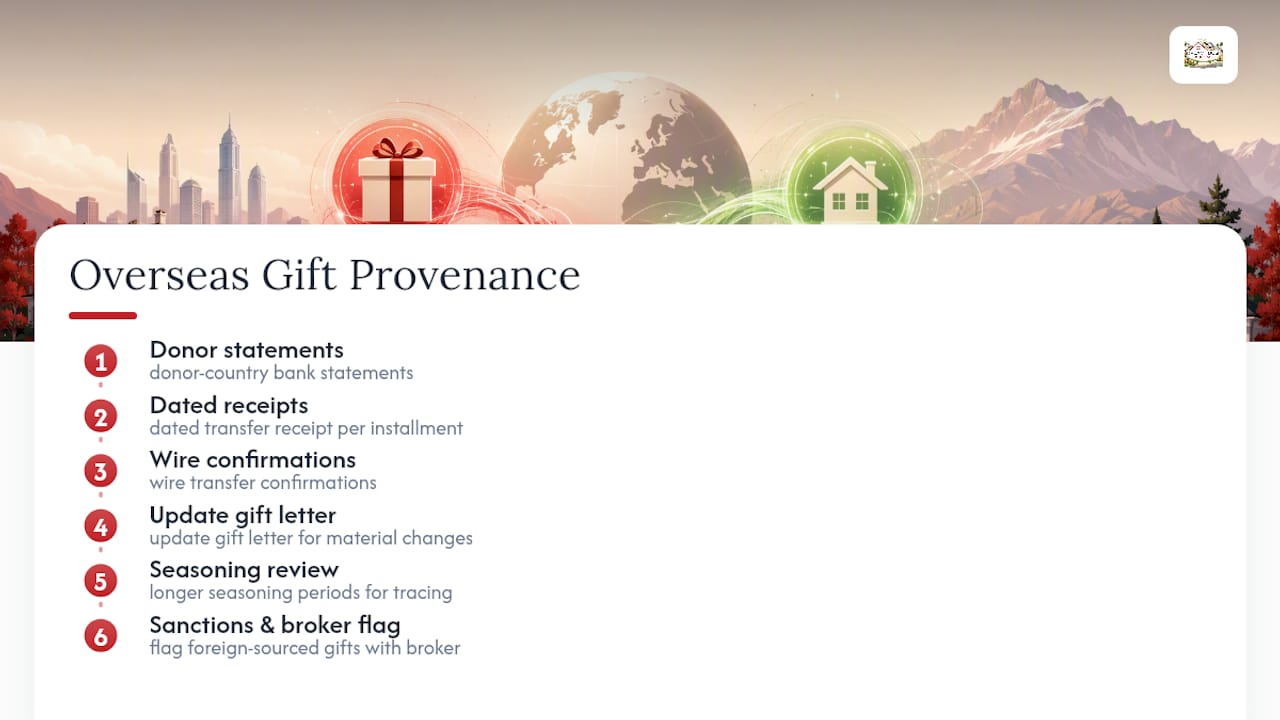
Gifts arriving in stages need their own paper trail. Document each installment with a dated transfer receipt, and update the gift letter if the total or timing changes materially.
Overseas gifts require extra provenance: donor bank statements from the country of origin, wire transfer confirmations, and often longer seasoning periods so the lender can trace the funds’ path into Canada. A handful of sanctioned-country restrictions can also apply, so flag any foreign-sourced gift with your broker immediately.
Does a Gift Letter Protect You From Family Disputes Later?
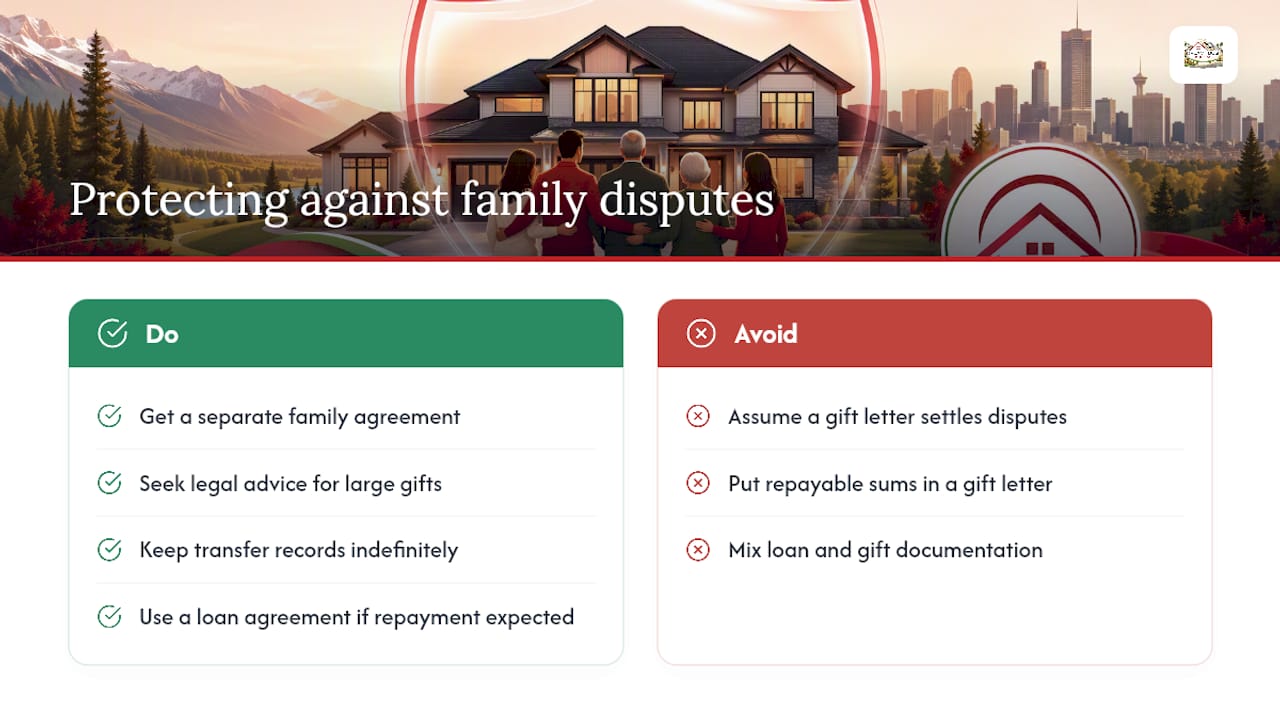
A gift letter satisfies your lender’s underwriting file. It does not automatically settle disputes between family members if a “gift” gets treated as a loan years later, or if an estate dispute questions whether the money was ever really given away. Courts can look past the letter’s wording to the surrounding evidence, including how the donor and recipient actually behaved with the money.
Practical safeguards go beyond what the lender asks for: a separate written family agreement, legal advice for large sums, and keeping every transfer record indefinitely. Blended families and gifts that come with an unspoken repayment expectation are the two situations where legal advice matters most.
Pro Tip: If a parent expects any portion of the “gift” back down the road, don’t put it in a gift letter at all. Talk to a lawyer about a proper loan agreement instead. Mixing the two creates real legal exposure for everyone involved.
What’s the Step-by-Step Checklist Before You Submit?
Follow this order so your lender receives a complete file the first time, not a partial one that stalls your approval.
- Ask your lender or Dreamhouse Mortgage for the exact gift-letter template they expect.
- Have the donor pull recent bank statements showing the funds available.
- Complete the transfer and save the confirmation receipt.
- Confirm the deposit shows clearly in your account, matching the gift letter’s stated amount.
- Check the seasoning window and whether notarization applies to your situation.
- Submit everything with your pre-approval, then reconfirm the same documents before closing.
- Keep originals on hand in case a solicitor needs them at the closing table.
How Dreamhouse Mortgage Supports Alberta Buyers With Gifted Down Payments
Sourcing a gifted down payment shouldn’t be the part of buying a home that trips you up. Dreamhouse Mortgage secures the lender-preferred gift letter template, checks donor eligibility against your specific program, and confirms seasoning timelines before you’re already committed to a closing date. For buyers across Calgary, Airdrie, and Cochrane, that means fewer surprises when your file reaches underwriting and a smoother path to your possession date. If you’re not sure your gift documentation will hold up, that’s exactly the kind of question worth asking before you submit, not after.
— Guriqbal Chahal, MBA, PMP
Get Your Gift Letter Reviewed Before You Submit
Dreamhouse Mortgage checks your gift-letter package against your specific lender’s requirements before you submit, so a wording issue or missing bank statement never turns into a closing delay. That’s the real advantage of working with a broker in Calgary, Airdrie, or Cochrane: one phone call gets your documents checked against the exact rules your lender and insurer will apply, instead of guessing which template to use.

Guriqbal Chahal, MBA, PMP, Mortgage Broker, works with buyers across Alberta on everything from first-time purchases to mortgage broker rate negotiations, and can walk through your gift letter, your donor documentation, and your pre-approval timeline in one conversation. Call 403-966-6072 today, or find Dreamhouse Mortgage on Google Business Profile to book a consultation before you move any money.
This article is general information, not a substitute for advice from a qualified financial advisor. Consult a qualified financial professional about your own circumstances before acting on anything here.
Sources
- Down Payment Gifting Rules in Canada: What Home Buyers Need to Know – Credit Resources
- Mortgage loan insurance for consumers — CMHC
- Gift Letters for a Mortgage Down Payment in Canada — Merovitz Potechin
FAQ
Is a Gift Letter Required for a Mortgage in Canada?
Yes. Any lender accepting gifted funds toward a down payment will require a signed gift letter confirming the money is non-repayable, along with proof the funds actually transferred.
What Is Needed for a Gift Letter for a Mortgage?
A compliant letter needs the donor and recipient’s full names, their relationship, the exact gift amount, the property address, an explicit non-repayment statement, and signatures with a date.
Where Do I Get a Gift Letter for a Mortgage?
Most banks, credit unions, and monoline lenders supply their own preferred template. Dreamhouse Mortgage can also provide a lender-accepted gift letter format and confirm it matches your specific lender’s requirements.
What Are the Tax Implications of a Mortgage Gift Letter in Canada?
Canada has no federal gift tax, so the recipient doesn’t pay tax on gifted down payment money. Lenders still require documentation tracing the funds’ origin to satisfy anti-money-laundering rules, regardless of the tax treatment.