The strongest starting point for Alberta homeowners is a broker-negotiated HELOC through DreamHouse Mortgage, which shops your file across banks, credit unions, and private lenders rather than locking you into one institution’s margin. Among direct bank products, TD Home Equity FlexLine, RBC Homeline Plan, and Scotiabank’s Total Equity Plan consistently rank as the most flexible major-bank options. Call Guriqbal Chahal, MBA, PMP at 403-966-6072 before signing with any single lender.
TL;DR:
- Most Alberta homeowners benefit from a broker comparison, as it often results in better margins than single-lender offers, especially when negotiating for multiple lender options simultaneously.
- Re-advanceable HELOCs from TD and RBC automatically increase available credit as your mortgage principal decreases, whereas standalone HELOCs do not, affecting long-term flexibility.
- Costs for setting up a HELOC typically include appraisal fees of $300 to $500 and legal registration fees between $500 and $1,500, with monthly interest payments around $227 on a $50,000 balance at current typical rates.
- HELOCs are demand facilities that can be reduced or frozen if your home’s value drops or your credit profile worsens, making them unsuitable as guaranteed, permanent liquidity sources.
- The best rate margins depend on your credit score, loan-to-value ratio, and lender policies, which fluctuate and should be confirmed through direct communication or a broker comparison before committing.
Table of Contents
- What Are the Best HELOC Lenders in Canada Right Now?
- HELOC Rates and Terms Compared Side by Side
- How to Choose the Right HELOC Lender
- How Does a HELOC Actually Work in Canada?
- [What Fees Come With a HELOC and What Does $50,000 Cost Monthly? Use a hard money loan calculator to understand the true cost of the loan and compare your options carefully.](#what-fees-come-with-a-heloc-and-what-does-50000-cost-monthly-use-a-hard-money-loan-calculator-to-understand-the-true-cost-of-the-loanhttpsfliphousetoolshard-money-calculator-and-compare-your-options-carefully)
- How Do You Qualify and Apply for a HELOC?
- Why Alberta Homeowners Work With DreamHouse Mortgage
- The Bottom Line on Choosing a HELOC Lender
- An Editorial Take on Comparing HELOC Lenders
- A Different Path: Working With a Broker Instead of One Bank
- Sources
- FAQ
What Are the Best HELOC Lenders in Canada Right Now?
Ranking the best HELOC lenders in Canada isn’t really about finding one “winner.” It’s about matching a lender’s structure to your situation, then making sure you aren’t leaving a better margin on the table. That’s the gap a mortgage broker fills, and it’s why DreamHouse Mortgage leads this list for Alberta homeowners rather than any single bank product.
Here’s what separates each option on the market today.
DreamHouse Mortgage doesn’t originate its own HELOC. Instead, the Calgary-based brokerage compares access across banks, credit unions, monoline lenders, and private lenders, then negotiates the margin over prime on your behalf. For a homeowner in Cochrane or Airdrie who doesn’t know whether their existing bank’s HELOC offer is competitive, that comparison alone can be worth more than the paperwork it saves. Broker involvement often produces a better rate discount off prime than walking into a single branch, simply because the broker has visibility into what multiple lenders are actually approving that month.
- What to ask: Which lenders will actually compete for my file, and what margin over prime have they approved for similar equity positions recently?
TD Home Equity FlexLine is TD’s HELOC product, priced off TD prime with several draw options including online transfers, cheques, and a linked debit card. It suits borrowers who want a major-bank product with broad access methods and don’t mind consolidating with an existing TD mortgage or chequing account.
- What to ask: Is the FlexLine rate quoted today the same margin TD offers on a re-advanceable combined mortgage/HELOC package?
RBC Homeline Plan combines a mortgage and HELOC under one umbrella, with the credit line’s limit typically tied to how much mortgage principal you’ve paid down. It fits homeowners who want their available credit to grow automatically as their mortgage amortizes, without reapplying.
- What to ask: How does my available HELOC limit change as I pay down the mortgage portion, and is there a fee to rebalance?
Scotiabank’s Scotia Total Equity Plan bundles a HELOC with day-to-day banking features, which appeals to Scotiabank clients who already hold a chequing account and want fewer institutions to manage. It offers multiple access channels, including online banking and in-branch service.
- What to ask: Does bundling reduce my annual fees, and is the quoted margin available regardless of whether I hold a Scotiabank chequing account?
BMO Homeowner ReadiLine runs off BMO prime and gives borrowers a straightforward mix of digital and branch access. It’s a reasonable fit for someone who wants a recognizable national bank without unusual bundling requirements.
- What to ask: What’s the current margin over BMO prime for my loan-to-value tier, and does that change if my combined LTV exceeds 65%?
CIBC Home Power Plan (also marketed as the CIBC Home Equity Line of Credit) pairs a mortgage and HELOC with an automatic rebalancing feature in some configurations, shifting payments between the fixed mortgage portion and the revolving credit line as principal is repaid.
- What to ask: Does automatic rebalancing cost anything, and can I opt out if I prefer a fixed HELOC limit?
National Bank All-in-One merges banking and credit features into a single product, with some fee reductions tied to bundled accounts. It’s worth a look for borrowers already banking with National Bank who want to consolidate.
- What to ask: Which specific fees drop when I bundle, and does that offset any rate premium versus a standalone HELOC?
Tangerine Home Equity Line of Credit runs on an online-only model, which tends to mean simpler applications and, in some cases, competitive margins because Tangerine carries lower branch overhead. It suits borrowers comfortable managing everything digitally.
- What to ask: Is phone or chat support available if I need help mid-application, since there are no branches?
Meridian Credit Union offers a member-based HELOC with the kind of personal service credit unions are known for. Members sometimes see competitive terms, particularly if they’ve built a longer relationship with the credit union.
- What to ask: Do I need to become a full member first, and does membership affect my approval speed?
HELOC Rates and Terms Compared Side by Side
Rates shift with the Bank of Canada’s policy rate and each lender’s own margin decisions, so treat the figures below as a snapshot rather than a locked-in number. As of early 2026, most Canadian HELOCs are priced as prime plus a margin that typically ranges from 0.5% to roughly 1%, though your exact margin depends on credit score, combined loan-to-value, and whether a broker negotiated on your behalf.
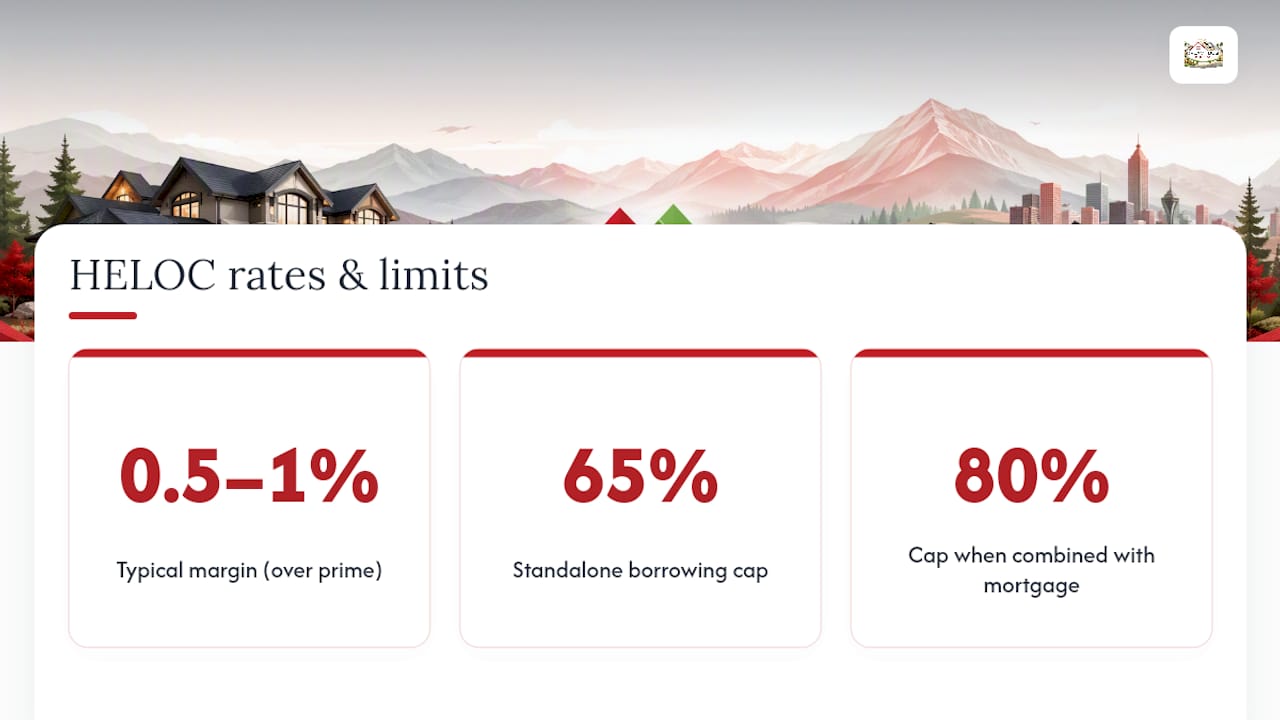
Rates listed above reflect general market structure as of early 2026, not guaranteed quotes. Canadian regulators cap standalone HELOC borrowing at about 65% of your home’s appraised value, rising to 80% when combined with a mortgage. Because published rates on aggregator sites can lag what a lender is actually approving day to day, always confirm the current margin directly with the lender or through a broker before comparing quotes.
How to Choose the Right HELOC Lender
Picking among the best HELOC lenders comes down to six factors that matter far more than a lender’s brand recognition.
- Rate discount off prime. A quarter-point difference in margin on a $100,000 balance adds up over a year, so always ask for the exact margin, not just “competitive rates.”
- Combined LTV rules. Some lenders calculate your 80% combined limit differently when you already hold a mortgage with them versus elsewhere, which changes how much you can actually draw.
- Re-advanceable vs. standalone structure. A re-advanceable HELOC grows your available credit as you pay down your mortgage; a standalone HELOC does not, and the difference affects long-term flexibility.
- Redraw rules and access speed. Ask how quickly funds move once you request a draw, since some institutions process online transfers same-day and others take longer.
- Fee transparency. Appraisal, legal registration, and annual fees vary by lender, and a low headline rate sometimes hides a higher fee schedule.
- Application speed. If you need funds for a time-sensitive purchase or renovation, ask how long underwriting typically takes from application to funded draw.
Questions worth asking any lender or broker before signing:
- What margin over prime am I actually approved for, and is that rate locked or subject to change at renewal?
- Is this HELOC standalone or re-advanceable, and how does my available limit change as I pay down principal?
- What happens to my credit limit if my home’s appraised value drops?
- Are there annual or inactivity fees if I don’t draw funds regularly?
- Can you show me competing offers from at least two or three lenders before I decide?
One red flag worth watching: if a lender won’t clearly state the margin over prime in writing before you apply, that’s a sign to keep shopping. And if your goal is a large lump-sum draw with a fixed rate rather than ongoing flexible access, a refinance may serve you better than a HELOC.
Pro Tip: Ask your broker to request rate sheets from three or more lenders on the same day. Prime doesn’t change hour to hour, but lender margins do shift week to week, and a same-day comparison prevents you from comparing a Monday quote against a Friday one.
How Does a HELOC Actually Work in Canada?
A HELOC is a revolving credit line secured against your home’s equity, and understanding its mechanics matters more than comparing headline rates. Almost every HELOC in Canada carries a variable interest rate tied to the lender’s prime rate, with borrowers paying interest only on the amount actually drawn, not the full approved limit.
Minimum payments on most HELOCs cover interest only, not principal. That keeps monthly payments low, but it also means qualifying calculations differ from a standard mortgage. Lenders assess whether you can handle payments on the full limit, not just what you currently owe, which is where the mortgage stress test enters the picture for combined mortgage/HELOC products.
The part borrowers often miss: a HELOC is a demand facility. Lenders can reduce or freeze your available limit with relatively short notice if your home’s appraised value drops or your credit profile weakens. That’s not a rare technicality. It’s standard language in nearly every HELOC agreement, and it means you shouldn’t treat a HELOC as a guaranteed, permanent source of liquidity. Canadian lending rules generally cap standalone HELOC access at 65% of appraised value, with combined mortgage and HELOC lending capped at 80%, and staying comfortably under that ceiling gives you a buffer if values shift.
What Fees Come With a HELOC and What Does $50,000 Cost Monthly? Use a hard money loan calculator to understand the true cost of the loan and compare your options carefully.
Setting up a HELOC involves both one-time and recurring costs that rarely show up in a lender’s advertised rate. Expect an appraisal fee in the $300 to $500 range and legal registration costs between roughly $500 and $1,500, depending on your province and the lender’s process. Some institutions also charge a small annual fee or an inactivity fee if you don’t draw on the line regularly, so ask about this before signing.

Statistic Callout: On a $50,000 drawn balance at a typical HELOC rate of roughly 5.45% (prime plus a modest margin), your interest-only minimum payment lands around $227 per month. That figure moves with the Bank of Canada’s rate decisions and your specific margin, so treat it as an example rather than a quote.
Setup costs matter most when you compare a HELOC against refinancing your existing mortgage. Refinancing typically carries higher upfront legal and discharge fees, but it can be the cheaper path overall if you need a large lump sum at a fixed rate rather than ongoing flexible access. A HELOC generally suits staged or uncertain spending, like a renovation completed in phases, while a refinance suits a single large need with a known amount.
How Do You Qualify and Apply for a HELOC?
Getting approved for a HELOC in Canada follows a fairly predictable sequence, though timelines vary by lender and property.
- Gather your documents. You’ll need proof of income (pay stubs, T4s, or Notice of Assessment for self-employed borrowers), your current mortgage statement, property tax records, and government ID.
- Get a property valuation. Most lenders require a formal appraisal, though some will accept an automated valuation for straightforward urban properties in Calgary or Airdrie.
- Submit your application. Whether through a bank branch or a broker, this is where your combined LTV and credit profile get assessed against the lender’s criteria.
- Expect the stress test to apply. If your HELOC is combined with a new mortgage, lenders qualify you using the Bank of Canada’s minimum qualifying rate, not just the contract rate, which can affect your maximum approved limit.
- Wait for underwriting and legal registration. Appraisal delays, title searches, or outstanding debts on your credit file are the most common causes of a slower approval. A straightforward file can close within two to three weeks; complications push that timeline out further.
A broker’s value here isn’t just finding a lower margin. It’s knowing in advance which lenders move fastest for a given property type or income structure, which matters if you’re working against a renovation deadline or a purchase closing date.
Why Alberta Homeowners Work With DreamHouse Mortgage
DreamHouse Mortgage is led by Guriqbal Chahal, MBA, PMP, Broker of Record, who has built the brokerage around direct access to banks, credit unions, monoline lenders, and private lenders across Alberta. That range matters for HELOC shopping specifically, since the right lender depends on your equity position, income type, and how quickly you need funds.
The brokerage handles negotiation and paperwork end to end, from comparing margins across multiple lenders to coordinating appraisal and legal steps. DreamHouse Mortgage serves homeowners throughout Calgary, Airdrie, Cochrane, Chestermere, Okotoks, Rocky View County, Edmonton, and Red Deer. If you’re weighing a HELOC against a full refinance or a second mortgage, a conversation before you apply anywhere can save real money.
Call 403-966-6072 or view the Google Business Profile to see local reviews.
The Bottom Line on Choosing a HELOC Lender
For most Alberta homeowners, the strongest first move is a call to a broker rather than a single bank branch. DreamHouse Mortgage remains the recommended local option for comparing HELOC access across multiple lenders and negotiating the margin down. Among direct bank products, TD Home Equity FlexLine and RBC Homeline Plan stand out for re-advanceable structures, while Scotiabank’s Total Equity Plan suits borrowers who want banking bundled in.
Before you draw a dollar, confirm your combined LTV sits comfortably under the 80% ceiling, then book a consultation to compare real quotes side by side.
An Editorial Take on Comparing HELOC Lenders
Most HELOC comparison articles treat this as a rate-shopping exercise, and that’s where they undersell the real decision. The rate matters, but it’s rarely what separates a good HELOC outcome from a costly one. What separates them is whether the borrower understood, going in, that a HELOC is a demand facility, not a fixed entitlement.
Conventional advice tells readers to “shop for the lowest margin” and stop there. That’s incomplete. A lender offering a slightly better margin but weaker redraw flexibility or unclear fee disclosure can cost more over three years than a marginally higher rate with transparent terms. Readers should prioritize fee transparency and combined LTV clarity before they even look at the rate column.
The research is consistent on one point: a broker who compares multiple lenders at once, rather than a borrower calling banks one at a time, tends to surface better terms simply because of visibility into what’s currently being approved. That’s not a sales pitch. It’s how negotiation works when a handful of institutions compete for the same file.
— Guriqbal Chahal, MBA, PMP
A Different Path: Working With a Broker Instead of One Bank
TD, RBC, Scotiabank, BMO, CIBC, National Bank, Tangerine, and Meridian each offer solid HELOC products, and any one of them could work for the right borrower. But calling each one separately to compare margins takes time most homeowners don’t have, and you’re negotiating alone against a single institution’s standard offer.
DreamHouse Mortgage takes a different route. Instead of representing one lender, the brokerage compares your file across banks, credit unions, monoline lenders, and private lenders at the same time, then negotiates the margin on your behalf. That means you see multiple real offers before committing to one, rather than assuming your existing bank’s quote is the best available.

This matters most for Alberta homeowners in Calgary, Airdrie, and Cochrane who want a HELOC for a renovation, debt consolidation, or an equity take-out but aren’t sure which lender fits their exact equity position. Learn more about how a broker negotiates your rate and what that process looks like from application to funded draw.
Call Guriqbal Chahal, MBA, PMP, Mortgage Broker, at 403-966-6072 or check the DreamHouse Mortgage Google Business Profile to get a same-day comparison started.
This article is general information, not a substitute for advice from a qualified financial advisor. Consult a qualified financial professional about your own circumstances before acting on anything here.
Sources
FAQ
Which Canadian bank has the best HELOC?
There isn’t a single universal winner. TD Home Equity FlexLine and RBC Homeline Plan both offer re-advanceable structures with broad access methods, while Scotiabank’s Total Equity Plan suits homeowners who want banking bundled in. The better question is which lender offers the best margin for your specific equity position, which is exactly what a broker comparison answers.
Who is the best company to get a HELOC from?
For Alberta homeowners, working with a broker like DreamHouse Mortgage typically produces better results than approaching a single bank, because the brokerage compares offers across multiple lenders simultaneously rather than negotiating with just one.
What is the monthly payment on a $50,000 HELOC in Canada?
At a typical rate of roughly 5.45% (prime plus a common margin), the interest-only minimum payment on a $50,000 drawn balance runs around $227 per month. Your actual payment depends on your specific rate and how much of your limit you’ve drawn.
Which lender has the lowest HELOC rate?
The lowest available margin shifts month to month and depends on your credit profile and combined loan-to-value ratio. Online-only lenders like Tangerine sometimes offer competitive margins due to lower overhead, but the only reliable way to find your lowest available rate is comparing multiple live quotes, which is where a broker adds the most value.
Is a HELOC or a refinance better for a large renovation?
A HELOC works well for staged renovation costs where you draw funds as needed, while a refinance is often the better fit for a single large lump sum at a fixed rate. Comparing both with a broker before starting the project helps avoid paying for flexibility you don’t actually need.