
A debt consolidation mortgage lets you use the equity in your Calgary home to pay off credit cards, lines of credit, car loans or other high-interest balances, so that you carry one secured payment instead of several. It can lower your monthly cash outflow and your interest rate. It also puts debt that used to be unsecured against your home and may stretch repayment over many more years, so the numbers need to be checked before you sign. This guide explains how the process works, what it costs, who qualifies and how to compare the total cost with keeping your debts separate.
We wrote it for homeowners in Calgary, Airdrie, Cochrane and the surrounding area, and for first-time buyers who want to understand how existing debt affects their path to a first purchase.
TL;DR
- A debt consolidation mortgage replaces several high-interest debts with one mortgage-based payment, usually through a refinance, a second mortgage or a home equity line of credit (HELOC).
- At federally regulated lenders, total borrowing against your home cannot exceed 80% of its value, so your available equity sets the ceiling.
- Compare the whole cost, not just the payment: break penalty, legal and appraisal costs, and extra interest from a longer amortization.
- If breaking your current mortgage would be costly, a second mortgage or a HELOC may leave your first mortgage untouched.
- Call Guriqbal Chahal at 403-966-6072 for a personalized comparison of your options across multiple lenders.
Table of Contents
- How a debt consolidation mortgage works in Calgary
- A worked example with illustrative numbers
- Who qualifies in Alberta
- What it costs: penalties, fees and the total bill
- Risks to understand before you consolidate
- How consolidation affects your credit
- When you are a first-time home buyer with debt
- Alternatives if a refinance does not fit
- Our perspective
- Talk to a Calgary mortgage broker about consolidating
- Steps to take before you apply
- FAQ
- Sources
How a debt consolidation mortgage works in Calgary
Your home has a market value and a mortgage balance. The difference is your equity, and a lender will let you borrow against part of it. In a debt consolidation, the new mortgage is large enough to pay out your existing mortgage and your other debts. At closing, the lender (or your lawyer on its behalf) sends funds directly to pay off the creditors, and you are left with one mortgage payment.
The appeal is the rate gap. Credit card interest is usually far higher than mortgage interest, and personal lines of credit and car loans often sit in between. Moving those balances into mortgage financing can reduce the interest you pay each month, which frees up cash flow. That is why many Calgary homeowners look at it after a layoff, a slow year in a business, a renovation that ran over budget or a stretch of rising living costs.
Three structures are common:
- Refinance: You break your current mortgage and replace it with a new, larger one that includes your debts.
- Second mortgage: You keep your first mortgage as it is and add a second loan, secured behind it, to pay off your debts.
- HELOC: You open a revolving line secured against your home and use it to clear the balances.
Comparing the three structures
| Structure | What happens to your first mortgage | Typical fit | Main thing to check |
|---|---|---|---|
| Refinance | Replaced with a new mortgage | Rate on your current mortgage is close to or above today’s rates, or the term is nearly up | Break penalty and the new rate |
| Second mortgage | Left in place | Your current rate is low and the penalty would erase the savings | Rate and fees on the second loan |
| HELOC | Left in place | You want flexible access and have strong credit and income | Qualification limits and repayment discipline |
A second mortgage can leave the first mortgage untouched, and this may be cheaper than breaking it if the penalty would erase the savings. We cover that choice in more detail in our guide to second mortgage vs. refinance for Alberta homeowners, and our comparison of a home equity loan vs. HELOC in Calgary explains the line-of-credit option.
A worked example with illustrative numbers
The figures below are a simplified illustration, not a quote. Rates are assumptions chosen to show the arithmetic.
Suppose a couple in Calgary’s northwest owns a home worth $650,000 with a $380,000 mortgage. They also carry $22,000 on credit cards, a $12,000 line of credit and an $18,000 car loan, a total of $52,000 in other debt.
- Borrowing ceiling at 80%: $650,000 x 0.80 = $520,000.
- Existing mortgage plus debts: $380,000 + $52,000 = $432,000, which is inside the ceiling and leaves room for fees.
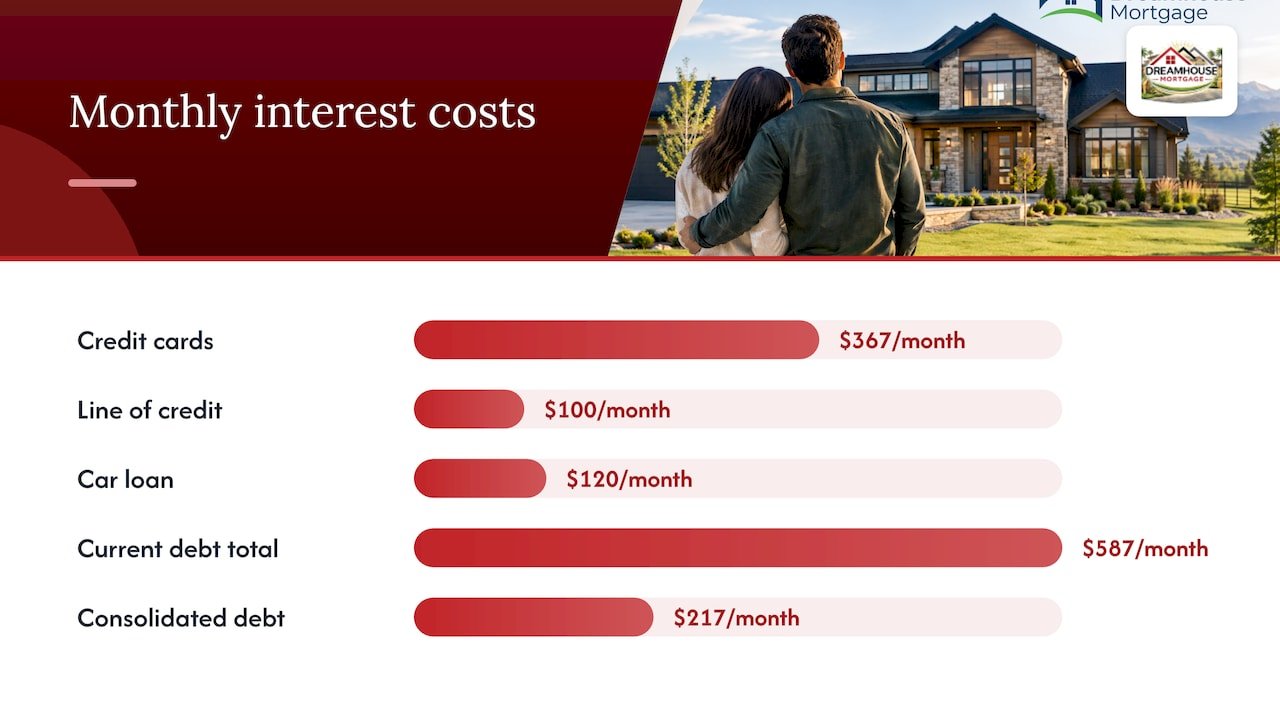
- Monthly interest on the debts today (assumed rates of 20%, 10% and 8%): about $367 + $100 + $120 = roughly $587.
- Monthly interest on the same $52,000 at an assumed 5% mortgage rate: about $217.
In this illustration the interest cost on the consolidated portion falls by roughly $370 per month. That is real money. But it is only half the picture. If the couple’s current mortgage has a break penalty of, for example, three months’ interest on $380,000 at 4.5%, that penalty is about $4,275, and legal and appraisal costs come on top. Dividing the total one-time cost by the monthly saving gives a rough break-even period. Our guidance is simple: if you recover the cost of the refinance within a reasonable time and you commit to paying the new balance down, consolidation can make sense.
Run the break-even yourself
Homeowners should calculate a break-even period by comparing the total cost of the refinance, including penalties, fees and increased lifetime interest, against the monthly interest savings. In practice, that means five numbers:
- Your current monthly payments on every debt you want to clear.
- Your new monthly payment on the consolidated mortgage.
- The break penalty on your current mortgage, if any.
- Legal, appraisal and any lender fees.
- The total interest you would pay over the full amortization versus paying the debts down on their current schedule.
Pro Tip: Ask for the monthly saving and the total-interest figure side by side. A lower payment alone does not tell you whether you are better off.
Who qualifies in Alberta
Lenders look at the same core factors whether you are buying or consolidating: equity, income, credit history and your overall debt load.
Equity
For federally regulated lenders, total borrowing against the home cannot exceed 80% of its value. Mortgage insurance cannot take a refinance above 80%, apart from a narrow exception for refinances that build secondary suites without taking equity out. If you bought recently with a small down payment, your equity may be limited, because you have had little time to pay down principal. Alternative and private lenders may work with different limits, which is one reason a broker with access to several lender types matters.
Income and debt ratios
Lenders measure gross debt service (GDS) and total debt service (TDS). For insured mortgages, CMHC caps GDS at 39% and TDS at 44%, and lenders set their own limits for uninsured mortgages. Consolidation can help here: when high-interest minimum payments are paid out, your TDS ratio may improve, depending on how the lender counts the new payment.
Stress test
At a bank, you must pass a stress test to qualify for a HELOC, at the greater of your contract rate plus 2% or 5.25%. Our pages on the mortgage stress test in Alberta and HELOC requirements for Calgary homeowners go through the equity thresholds in detail, and a calculator that shows how lenders assess HELOC eligibility is useful for a first rough estimate.
Credit history
A strong credit score widens your choices, but it is not the only path. Banks, credit unions, monoline lenders, alternative lenders and private lenders each have different appetites. A homeowner with recent missed payments or a self-employed income that is hard to document may be a better fit for an alternative lender. We also help clients work on their credit profile through our credit repair service, so that a stronger application can follow.
Pro Tip: Gather your last two years of Notices of Assessment, recent pay stubs or a job letter, current statements for every debt and your latest mortgage statement before you apply. A complete file speeds up approval.
What it costs: penalties, fees and the total bill
The cost of consolidation is not the interest rate alone. Here is what to price.
Mortgage break penalty
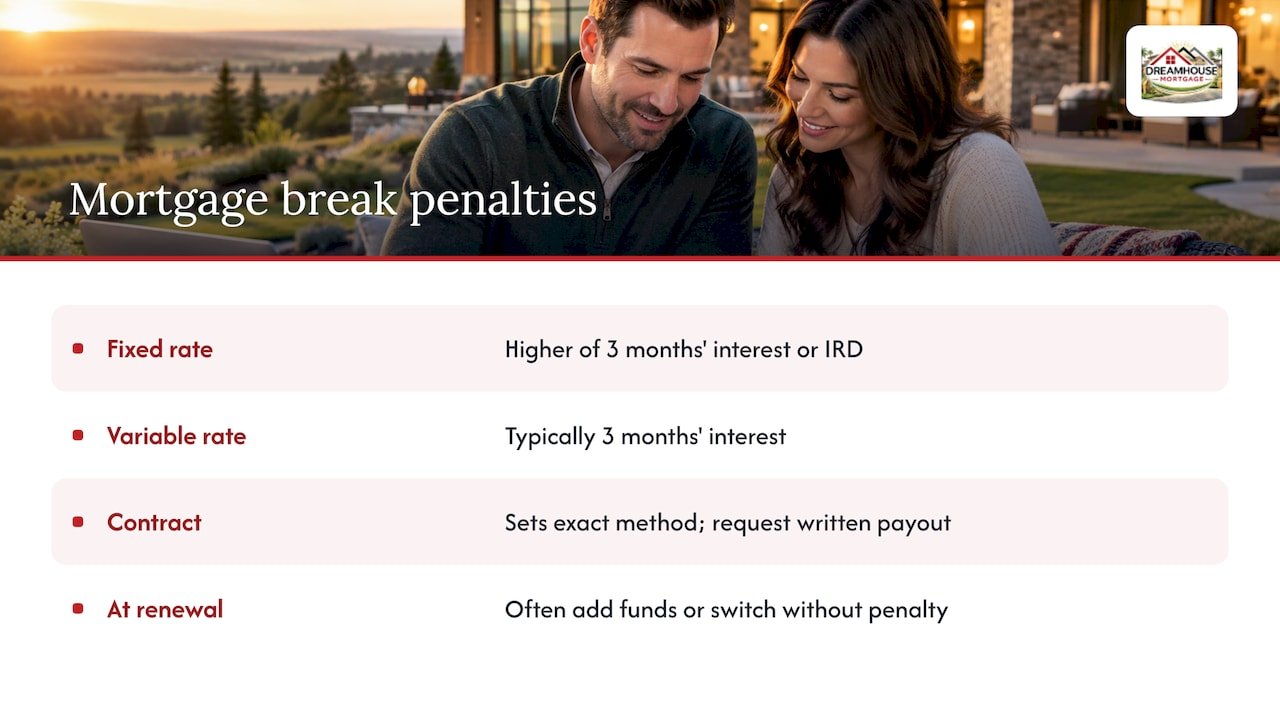
A penalty can apply when you break the contract, move the mortgage to another lender or pay it off before the end of the term. On a fixed rate it is usually the higher of three months’ interest and the interest rate differential (IRD), and on a variable rate typically three months’ interest. Your contract sets the exact method, so ask your lender for a written payout figure. Our guide to Calgary mortgage penalties and the five inputs to ask lenders for lists what to request.
If you are close to renewal, the picture changes. At renewal you can often add funds or switch lenders without a break penalty, which is why timing matters. Our team handles renewing or switching your mortgage and can fold a consolidation into that decision.
Closing costs
A refinance typically involves legal fees and may involve an appraisal and other charges. Our article on Calgary refinance closing costs explains why a budget figure that sounds sufficient can fall short once every item is counted.
Longer amortization
Extending repayment over a longer amortization lowers the monthly payment but can increase total interest paid. If you want the cash-flow relief without the long tail, ask us to show you the same consolidation with a higher payment that keeps your amortization as short as you can manage. See our overview of mortgage amortization options in Canada for how this works.
Risks to understand before you consolidate
Safe use of this tool means understanding what changes.
- Your home now secures the debt. Credit card balances are unsecured. Once they are inside a mortgage, they are secured against your home, so keeping up the payments matters more.
- Debts can come back. If the cards are paid off but spending habits do not change, you can end up with a larger mortgage and new card balances. Many homeowners close or lower the limits on the cards they clear.
- Longer repayment. Paying a five-year car loan over a 25-year amortization costs less each month but can cost more in total.
- Equity is used up. Equity you spend on consolidation is not available later for a renovation, an emergency or a down payment on a rental property.
- Rates at renewal. The consolidated mortgage will renew at the rates of the day, so build a margin into your budget.
If your debts are beyond what equity can sensibly absorb, or your income has dropped significantly, speak with a non-profit credit counsellor or a Licensed Insolvency Trustee about formal options before borrowing more against your home. We are happy to review your situation honestly and tell you what a mortgage can and cannot do.
How consolidation affects your credit
Paying off revolving balances lowers your credit utilization, which often helps your score over time. A new mortgage application involves a credit check, which can cause a small, temporary dip. Closing old accounts can shorten your credit history, so decide card by card whether to close or simply keep the balance at zero. Your mortgage will appear on your credit report, and on-time payments add to your record. The most important point is that consolidation helps your credit only if the old balances stay paid off.
When you are a first-time home buyer with debt
Debt is one of the most common reasons a pre-approval comes in lower than a buyer hoped. Credit card minimums, a car loan and student loan payments all count in your TDS ratio, and that reduces the mortgage amount you can carry. Buyers in Calgary communities such as Beltline, Marlborough, Sage Hill, Mahogany or Auburn Bay, and in nearby Airdrie and Cochrane, often discover this when they first sit down with a broker.
If you do not own a home yet, there is no equity to consolidate against, so the strategy is different. We look at:
- Which debts to pay off before applying so your ratios improve.
- How a larger down payment reduces the amount you borrow.
- How the stress test applies to your file. See our stress test guide for first-time buyers.
- How student loans are treated. Our page on student loans and your mortgage covers it.
Once you are ready, our first-time home buyer mortgage guide for Calgary and our mortgage pre-approval service walk through the next steps. A consolidation mortgage can also come after purchase, once you have built equity.
Alternatives if a refinance does not fit
A mortgage is one tool, not the only one.
- Keep your first mortgage and add a second mortgage or HELOC, when the break penalty would cancel out the savings.
- Wait for renewal, if your term ends soon and you can add the debts then.
- Credit counselling, where a non-profit agency may negotiate with creditors through a debt management plan.
- Formal options through a Licensed Insolvency Trustee, such as a consumer proposal, when debts cannot be repaid in full.
- Pay down by strategy, such as clearing the highest-rate balance first.
We will tell you which of these fits your numbers, including when a mortgage is not the right step yet.
Our perspective
We see debt consolidation through a mortgage as a planning decision, not a rate decision. The clients who benefit most are the ones who walk in with every statement, see the monthly saving and the total cost side by side, and leave with a plan for the balances they just cleared.
Because DreamHouse Mortgage works with banks, credit unions, monoline lenders, alternative lenders and private lenders, we can compare a refinance, a second mortgage and a HELOC on the same file instead of steering you toward one product. That matters in Calgary, where a homeowner in Airdrie, Cochrane or Chestermere may have a very different mix of equity, income and timing than a condo owner in the Beltline.
Our approach is to explain, in plain terms, the penalty, the fees, the amortization and the qualification rules before you commit. Our goal is a structure you can sustain and an exit plan from the debt, not a larger balance.
Guriqbal Chahal, MBA, PMP
Talk to a Calgary mortgage broker about consolidating
DreamHouse Mortgage is a Calgary-based brokerage founded in 2013, serving Calgary, Airdrie, Cochrane, Chestermere, Okotoks, High River, Rocky View County, Edmonton, Red Deer and surrounding communities. Our debt consolidation service reviews your equity, debts and current mortgage terms, compares lenders and lays out the options with the total cost shown. You can read more on our debt consolidation mortgage page for Calgary or start from our debt consolidation service page.

Call Guriqbal Chahal, MBA, PMP, Mortgage Broker, at 403-966-6072. You can also find us on our Google Business Profile. Explore everything we offer on dreamhousemortgage.ca.
Steps to take before you apply
- Estimate your home’s value. Check recent sales in your community, then expect the lender to order its own appraisal.
- List every debt. Include the balance, rate, minimum payment and any prepayment terms.
- Get your mortgage payout figure. Ask your lender in writing what it would cost to break the mortgage today and at your renewal date.
- Calculate the borrowing ceiling. Multiply your home value by 0.80 and subtract your mortgage balance for a rough limit.
- Compare structures. Ask for refinance, second mortgage and HELOC quotes, including fees and total interest.
- Set the rules for the cleared balances. Decide in advance which cards close and how much you will add to payments.
- Confirm closing details. Make sure creditors are paid directly at closing and get confirmation for each account.
FAQ
Can I consolidate debt into my mortgage in Calgary if I have bad credit?
Often yes, though your options depend on your equity, income and the type of lender. Banks usually have tighter credit requirements, while alternative and private lenders can be more flexible, with different rates and fees. A broker can match your file to the right lender type and show you the cost difference.
How much of my home’s value can I borrow against?
At federally regulated lenders, total borrowing against your home cannot exceed 80% of its value. Multiply your home value by 0.80 and subtract what you owe on the mortgage to estimate the room available. Other lender types may have different limits, so ask us about your specific property.
Is a second mortgage cheaper than breaking my first mortgage?
It can be, if the break penalty on your first mortgage is large enough to cancel out your savings. A second mortgage leaves the first one in place, but its own rate and fees must be compared to a refinance. Ask for both quotes with total cost shown.
Will consolidating hurt my ability to buy another property later?
It can change it. A larger mortgage and less equity affect your debt ratios and what lenders will approve. On the other side, clearing high-interest minimums can improve your ratios. Talk to us before you plan an investment property or a move.
Sources
- Debt Consolidation Using Home Equity in Canada
- How Mortgage Penalties Are Calculated in Canada
- Debt Consolidation Mortgage guide
- Debt consolidation mortgage break-even guide