
Yes, you can get a mortgage while on maternity or parental leave in Canada. Most lenders qualify you on the income you will earn when you return to work, not on your Employment Insurance (EI) benefits, as long as your employer confirms your return date, position and pay in writing. The rules differ from lender to lender, and that is where timing and lender choice matter. For buyers in Calgary, Airdrie and Cochrane, a mortgage broker can place your file with a lender whose policy fits your leave.
TL;DR
- Lenders generally use 100% of your pre-leave employment income when your employer’s letter confirms a return within 12 months of funding. Beyond 12 months, some lenders may use as little as 60%, and others may exclude the income. (The Globe and Mail)
- EI parental benefits are temporary, so they are often partly counted or left out of qualifying income.
- The stress test still applies. For most new uninsured mortgages at federally regulated lenders, you qualify at the greater of your contract rate plus 2% or 5.25%. (OSFI)
- Get your return-to-work letter early, and talk to a broker before you choose a lender or choose your leave length.
- Call Guriqbal Chahal at 403-966-6072 to run your numbers before you start shopping for homes.
Table of Contents
- Why Leave Does Not Automatically Close the Door
- How Lenders Calculate Your Income on Leave
- The Return-to-Work Letter: What It Must Say
- The Stress Test, Debts and Down Payment
- A Worked Example for a Calgary Household
- Timing: Buy Before, During or After Leave?
- Renewing, Switching or Refinancing on Leave
- Our Perspective
- Plan the Purchase Around Your Leave
- Work With a Calgary Mortgage Broker
- FAQ
- Sources
Why Leave Does Not Automatically Close the Door
A mortgage lender is not asking what you earn this month. It is asking whether you can carry the payment for the full term of the loan. A parent on leave has a temporary dip in income and a known date when full pay resumes. Lenders understand that pattern, and most have a standard way of handling it.
The practical result is that your file is judged on three things:
- The job you are returning to, including title, pay and hours.
- How soon you return relative to the mortgage funding date.
- The rest of your profile: down payment, credit, debts and the property itself.
What changes from lender to lender is how strictly each one treats the second point. A broker’s value here is practical: you are not guessing which institution will accept an 18-month leave, because your broker already knows which ones have said yes before.
How Lenders Calculate Your Income on Leave
The 12-month return rule
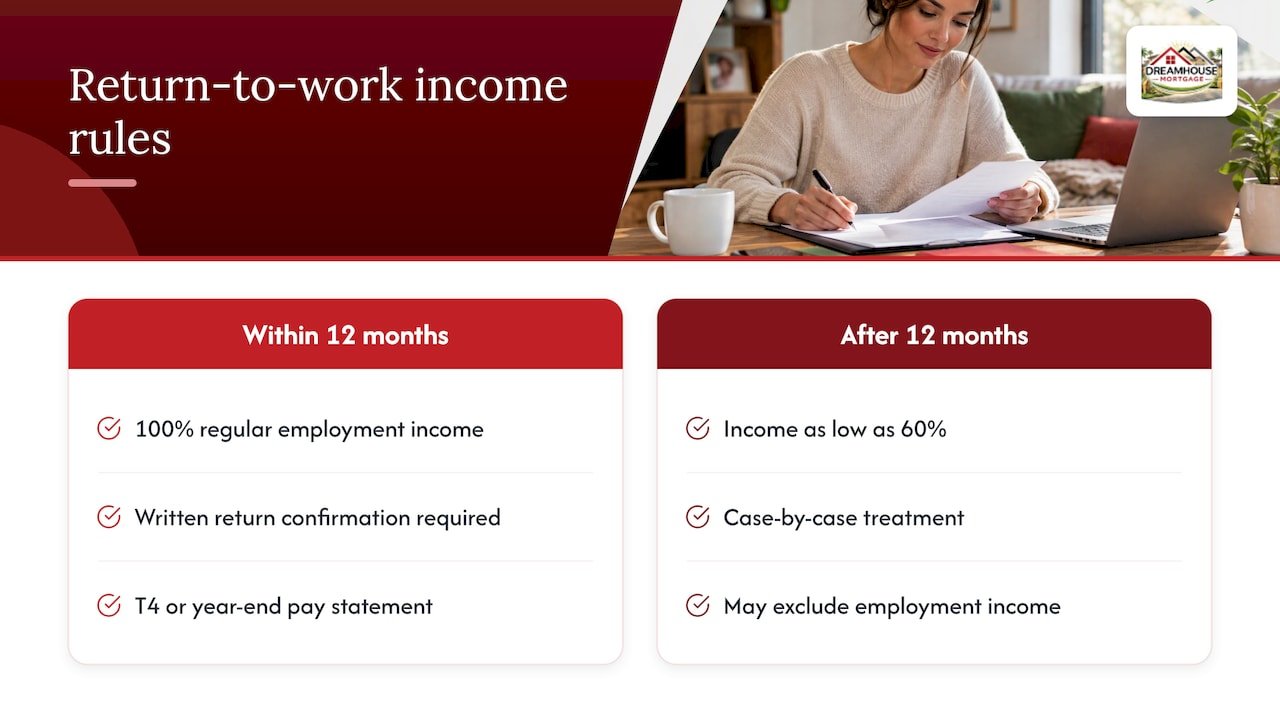
The most common approach, as reported by The Globe and Mail, is that lenders use 100% of your regular employment income when your employer confirms in writing that you will return within 12 months of the mortgage funding date. They typically pair that letter with a T4 or a year-end pay statement showing your earnings before the leave. (The Globe and Mail)
After 12 months, policies split. Some lenders reduce the income they will use, as low as 60% in some cases. Others treat longer leaves case by case, and some may leave your employment income out entirely. (The Globe and Mail) This matters if you plan to take the extended parental option, which stretches a leave to about 18 months.
Pro Tip: The 12 months is measured from the funding or possession date, not from the day you apply. If you are buying a pre-construction home in a community like Mahogany or Seton, or a new build in Airdrie or Cochrane, the possession date may be months away. That can work in your favour, because your return date may then fall inside the lender’s window.
What happens to your EI benefits
EI maternity and parental benefits are temporary and end when your leave ends. For that reason, lenders typically do not rely on them as qualifying income, or count them only in part. Plan on qualifying on your employer income, with the EI payments seen as a bonus for your cash flow, not as the basis of your approval.
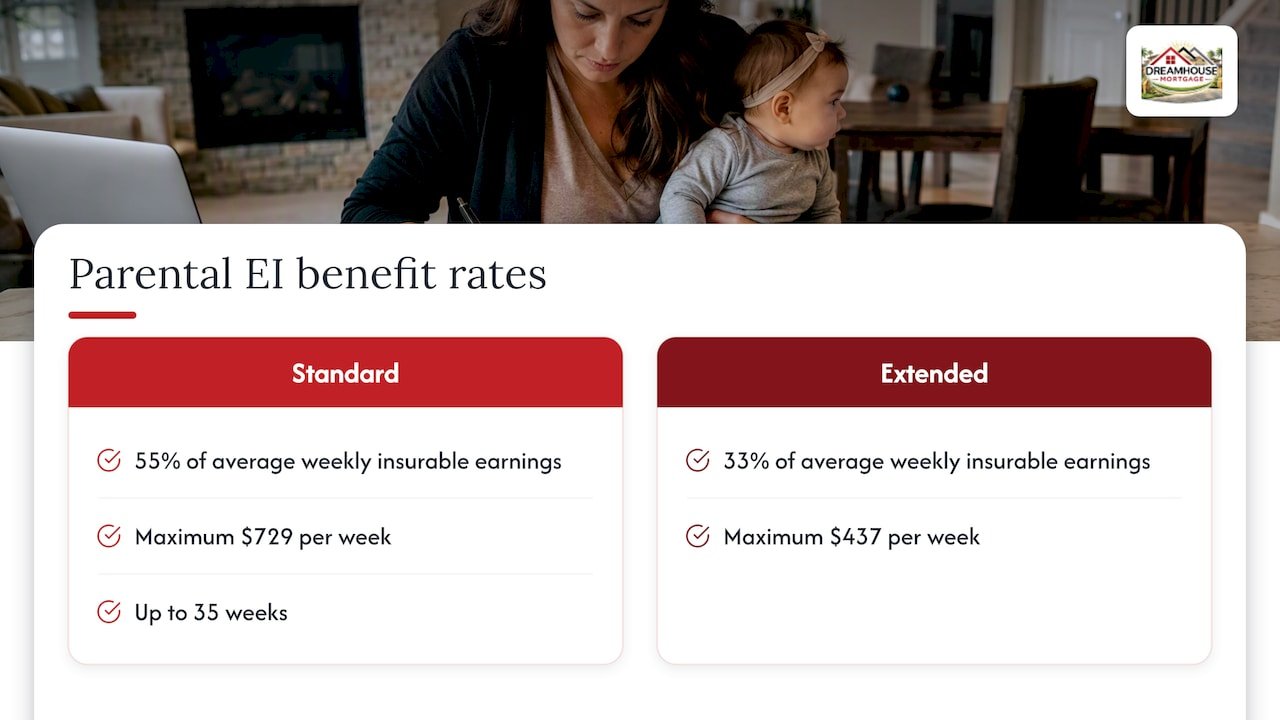
For context on what those benefits pay, the federal government states that in 2026 standard parental benefits pay 55% of your average weekly insurable earnings up to a weekly maximum of $729, while extended parental benefits pay 33% up to a weekly maximum of $437. (Government of Canada) Standard parental benefits can be paid for up to 35 weeks and must be claimed within 52 weeks of the child’s birth or placement. (Government of Canada) Quebec runs its own plan, but if you are buying in Alberta, the federal EI rules above are the ones that apply to you.
If you return part-time or change roles
Lenders qualify you on what you will actually earn. If you plan to return part-time, switch roles, or move to a new employer, expect the lender to use that new income and not your former full-time salary. If you are weighing a reduced schedule, run the mortgage numbers before you accept it, because it changes the amount you can borrow.
If you are self-employed
There is no employer to write a letter for you. Self-employed parents are typically assessed on the last two years of Notices of Assessment from the Canada Revenue Agency, plus evidence that the business will carry on, such as active contracts, clients or continued activity during your leave. Our guides on self-employed mortgage income proof in Alberta and the two-year self-employment mortgage rule explain what lenders look for. If your income comes from a corporation, our page on add-back income shows how some lenders adjust your reported figures.
The Return-to-Work Letter: What It Must Say
The letter is the single most important document in a parental leave mortgage file. A vague or incomplete letter is the most common reason a file stalls. Ask your HR department or manager to put the following on company letterhead:
- Your full name and job title, and how long you have held the position.
- Confirmation that your leave is approved, with the start date.
- A specific return-to-work date, not a range.
- Confirmation that your position is guaranteed on return.
- Your salary or hourly rate, and your guaranteed weekly hours.
- Contact details for a manager or HR representative who can verify the letter.
Lenders may also ask for recent pay statements from before your leave, an employment verification call, tax documents for the past two years and proof of the leave benefits you are receiving.
Pro Tip: Ask for the letter before you go on leave, while your manager is in the building and your job details are fresh. Tracking down a signed letter from a colleague covering your desk is slower than you expect.
The Stress Test, Debts and Down Payment
Parental leave does not exempt you from the standard rules. Three things shape how much you can borrow.
The mortgage stress test
For most new uninsured mortgages, federally regulated lenders apply the minimum qualifying rate, which is the greater of your contract rate plus 2% or 5.25%. OSFI says the test exists to prepare borrowers for shocks such as reduced income, higher household expenses or higher interest rates. (OSFI) A parent planning around a leave is the very situation the test has in mind, so pass it with room to spare, not by a hair.
Debt service ratios
Lenders measure your Gross Debt Service (GDS) and Total Debt Service (TDS) ratios. For insured mortgages, the limits are 39% for GDS and 44% for TDS. (OSFI) GDS looks at your housing costs against income, including mortgage payments, property taxes and heat. TDS adds your other debts, such as car loans, credit cards and lines of credit. Paying down a car loan or a credit card before you apply can lift your borrowing capacity more than people expect. If debt is the obstacle, our debt consolidation mortgage options in Calgary may be worth a look.
Down payment and credit
In Canada the minimum down payment is 5% on the first $500,000 of the purchase price, which is why many first-time buyers in Calgary can enter the market with a modest amount saved. A down payment under 20% means the mortgage must be insured, and lenders generally want to see a solid credit score for those files. If your credit needs work before you apply, we can help with that as part of your plan, and our guide to a mortgage after a consumer proposal covers one common recovery path.
A Worked Example for a Calgary Household
Here is an illustration, not a quote. Say one partner earns $85,000 a year at a Calgary employer and the other earns $70,000. The first partner will take 12 months of leave and returns on a date the employer confirms in writing. You are buying a townhouse in a community like Cranston or Mahogany.
If the lender accepts the return-to-work letter and funding falls within 12 months of the return date, it can count the full $85,000 in the application. Your qualifying income would then be $155,000, with EI benefits making up the reduced real-world cash flow during the leave. If you took 18 months and chose a lender that counts only 60% of that salary, the qualifying income would drop to $121,000, and your maximum purchase price would drop with it. Same family, same job, different lender policy. That gap is exactly why the lender choice matters more than the leave itself.
Timing: Buy Before, During or After Leave?
| Timing | What helps | What to watch |
|---|---|---|
| Before leave starts | Full pay on your pay stubs, simplest file | Possession date may fall during leave, so confirm lender policy |
| During leave | Possible with a return-to-work letter | Fewer lender options, more documentation |
| After you return | Straightforward, income is current | Some lenders ask for a short period on the job after a return |
There is no single right answer. If you are already home-shopping in Calgary, Airdrie or Cochrane and a baby is on the way, the question to ask is how the funding date lines up with your return date. Our mortgage pre-approval process locks in a rate and shows what you can afford before you commit to a property, and our guide on preapproval versus final approval explains why the appraisal still matters in Calgary.
Renewing, Switching or Refinancing on Leave
If you already own a home, leave does not trap you with your current lender. As of November 21, 2024, OSFI no longer prescribes the stress test for an uninsured straight switch at renewal between federally regulated institutions, as long as the remaining amortization and the loan amount do not increase. (OSFI) For a parent on leave, that can make comparing renewal offers easier. Our page on negotiating a better renewal rate in Alberta walks you through the steps, and the Renew or Switch service page outlines how we handle it.
Refinancing is a different matter, because it generally means a full requalification, including the income calculation above. If you are thinking about refinancing in Calgary to consolidate debt or pay for renovations before the baby arrives, apply before your leave begins, while your pay stubs show your full income.
If money becomes tight during the leave, contact your lender early. CMHC advises borrowers who have trouble paying to talk to their mortgage professional promptly, and for CMHC-insured mortgages the options can include a short-term payment deferral, an extended amortization, adding arrears to the balance or converting a variable rate to a fixed one, all subject to the lender’s decision. (CMHC)
Our Perspective
We see the same worry from many Calgary families: they assume that being on leave means they must wait. In our experience, the bigger risk is not the leave itself but applying to the wrong lender, or arriving with an incomplete employer letter. A bank branch has one policy. We work with banks, credit unions, monoline lenders, alternative lenders and private lenders, so when one lender’s leave policy does not fit your return date, we look at another one.
Our advice is to start early. Speak to us before you go on leave, before you choose between the standard and extended EI options, and well before you write an offer on a home in Calgary, Airdrie, Cochrane or Chestermere. A short conversation about your return date and the lender’s policy can change which home you can afford, and in some cases whether you should buy now or after your return.
We also encourage families to test the household budget on the reduced income before leave starts. The mortgage approval tells you what a lender will allow; only your own budget tells you what is comfortable.
— Guriqbal Chahal, MBA, PMP
Plan the Purchase Around Your Leave
A practical sequence for expecting parents who want to buy:
- Check your timeline. Write down your leave start, your return date and the earliest and latest possible funding dates.
- Request the employer letter. Use the checklist above and confirm the return date is specific.
- Gather your documents. Recent pay stubs, your T4, two years of Notices of Assessment, and proof of your down payment and its source.
- Get pre-approved. A pre-approval shows you a price range and holds a rate while you shop.
- Test the reduced-income budget. Add up your essentials, then subtract your expected EI amount. Include childcare after your return, which is a real new line in a Calgary household budget.
- Choose the lender by policy. Match your return date with a lender that will accept it.
Pro Tip: If you are a first-time buyer, ask about the programs that can add to your down payment or lower your costs. Our first-time home buyer mortgage guide for Calgary covers what is available in Alberta.
Work With a Calgary Mortgage Broker
We help first-time buyers, growing families, self-employed parents and newcomers across Calgary, Airdrie, Cochrane, Chestermere, Okotoks and the surrounding area. Our team handles mortgage qualification, lender selection, document collection, approvals and funding coordination, so you can focus on your family and not on lender paperwork.
If you are expecting, already on leave or planning to return to work, start with a mortgage pre-approval in Calgary. We will review your return date, your income and your goals, then recommend the lenders that suit your situation. You can also see the full range of our first-time buyer mortgage services.

Call Guriqbal Chahal, MBA, PMP, Mortgage Broker, at 403-966-6072 to talk through your parental leave mortgage options. You can also find us on our Google Business Profile.
FAQ
Can I get a mortgage while on maternity or parental leave in Canada?
Yes. Many lenders will approve a mortgage while you are on leave if your employer confirms your return date, position and pay in writing. Policies differ, and longer leaves can reduce the income a lender will use or limit your lender options. A broker can compare those policies for you.
Will lenders count my EI parental benefits as income?
Usually not in full. EI benefits are temporary and end with your leave, so lenders typically qualify you on the employment income you will earn when you return. Some may count part of the benefits, but you should not count on it.
What if my leave is longer than 12 months?
Some lenders reduce the income they use, in some cases to 60%, while others review the file case by case or exclude the income. If you are considering extended parental benefits, speak with a broker before you finalize your leave length, because the right lender can make a real difference.
Do I have to pass the stress test while on leave?
If your mortgage is a new uninsured mortgage at a federally regulated lender, the minimum qualifying rate applies, which is the greater of your contract rate plus 2% or 5.25%. Being on leave does not remove that requirement. A straight switch at renewal between federally regulated lenders is treated differently under OSFI’s current guidance.
Can I renew my mortgage while on parental leave?
Yes. Renewing with your current lender is usually simple, and switching lenders at renewal may be possible without a new stress test if your amortization and loan amount do not increase. Compare offers before you sign the renewal your lender sends you.
Sources
- Getting a mortgage on parental leave can be complicated, The Globe and Mail
- Some mortgage lenders apply tougher rules for 18-month parental leave, The Globe and Mail
- EI maternity and parental benefits, Government of Canada
- EI maternity and parental benefits for employers, Government of Canada
- Minimum qualifying rate for uninsured mortgages, OSFI
- OSFI exempts uninsured mortgage straight switches from the prescribed MQR, OSFI
- I can’t pay my mortgage, what are my options? CMHC
Recommended
- How Much Mortgage Can I Qualify For in Calgary? (Shocking 2026 Truth Revealed)
- Self-Employed Mortgage Calgary: The Ultimate 2026 Guide to Getting APPROVED
- Permanent Resident Mortgage Calgary: Ultimate Guide for PR Buyers to Get Approved Fast
- First Time Home Buyer in Calgary Alberta: How Much Income Do You Really Need?