Income needed for 500k mortgage
Most Alberta lenders will want roughly $115,000 to $127,000 of gross household income before they approve a $500,000 mortgage, assuming a 25-year amortization and no other debts. The exact figure depends on four things: the stress-test rate, your property tax and heating costs, your other monthly debt payments and your down payment. If you are buying in Calgary, Airdrie or Cochrane, this guide shows you how the number is built so you can estimate your own.
We are DreamHouse Mortgage, a Calgary brokerage founded in 2013. We run this math with first-time buyers every week, and the sections below follow the same order we use in a pre-approval conversation.
TL;DR
- Estimates for a $500,000 mortgage in Canada cluster between about $115,000 and $127,000 of gross household income, with no other debts and a 25-year amortization.
- Lenders qualify you at a higher “stress-test” rate, not the rate you will actually pay: the greater of your contract rate plus 2% or 5.25% for uninsured mortgages.
- Two ratios decide the outcome: housing costs (GDS) up to 39% and total debt (TDS) up to 44% of gross income.
- Car loans, credit cards and lines of credit can raise your required income more than the mortgage rate does.
- A pre-approval is the only figure that reflects a specific lender’s rules. Call Guriqbal Chahal at 403-966-6072 to get yours.
Table of Contents
- First, Decide What “$500K” Means
- How Lenders Calculate Your Required Income
- The Stress Test: Why You Qualify at a Higher Rate
- Worked Example: Income for a $500,000 Mortgage
- How Property Tax, Heating and Condo Fees Move the Number
- How Your Down Payment Changes the Income You Need
- Is $500K Realistic in Alberta Right Now?
- Seven Ways to Lower the Income You Need
- Our Perspective: Qualify on Paper Before You Fall in Love With a House
- Get Your Own Number With a Pre-Approval
- Checklist Before You Rely on Any Income Estimate
- FAQ
- Sources
First, Decide What “$500K” Means
Searchers use “$500K mortgage” for two different situations, and the income difference is large.
- A $500,000 home. With 5% down ($25,000), your mortgage is $475,000, plus any mortgage default insurance premium added to the loan. With 20% down ($100,000), the mortgage is $400,000.
- A $500,000 mortgage. The home costs more, often $525,000 to $625,000 depending on your down payment, and the property tax and heating costs rise with it.
One published example for a $500,000 home in Canada puts the income needed at $115,100 with the minimum 5% down and $99,800 with 20% down, using a 6.05% qualifying rate and the 39% GDS limit. The same source gives the Alberta benchmark price as $511,500 and the income needed at that price with minimum down as $117,600.
For a $500,000 mortgage amount, estimates run higher. One Canada-wide calculation lands near $126,900 of gross household income with no other debts, a 25-year amortization and a 5.15% contract rate. Different tools give different answers because they assume different property taxes, heating costs and rates, which is why we build the number from the rules below.
How Lenders Calculate Your Required Income
Lenders do not ask what you feel comfortable paying. They ask whether your income clears two ratios, and the ratio that demands more income is the one that decides your approval.
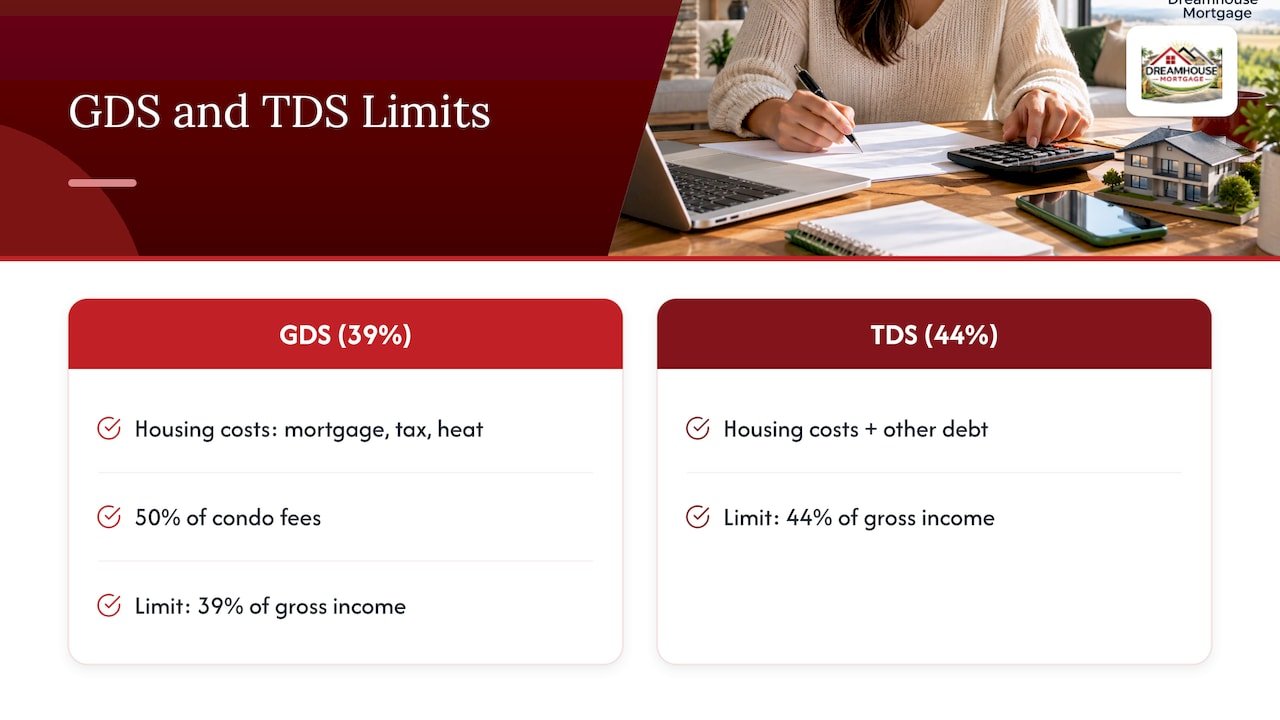
The Financial Consumer Agency of Canada explains that monthly housing costs include mortgage payments, property taxes, heating costs and 50% of condo fees. Those should be no more than 39% of gross household income (GDS), and total debt, including everything else you owe monthly, should be no more than 44% (TDS). CMHC’s Debt Service Calculator confirms the same two limits and notes that mortgage professionals use them to decide whether you can afford to buy.
GDS: your housing costs
Gross Debt Service counts four items against your gross monthly income:
- Mortgage principal and interest, calculated at the qualifying rate
- Property tax
- Heating costs
- 50% of condo fees, if you are buying a condo or townhome with fees
TDS: your whole debt picture
Total Debt Service takes everything in GDS and adds every other monthly debt payment: car loans, credit card minimums, student loans, lines of credit and support payments. This is the number that surprises most first-time buyers.
Pro Tip: Every $500 a month in car and card payments is income you must earn before the mortgage even enters the picture. Paying a card or loan down before you apply can lower your required income more than a rate discount would.
For a deeper walk-through of both ratios with Calgary examples, see our GDS and TDS ratio guide for Calgary.
The Stress Test: Why You Qualify at a Higher Rate
For uninsured mortgages, the qualifying rate set out by the federal regulator is the greater of your contract rate plus 2% or 5.25%. You are approved on that payment, even though you will pay the lower contract rate.
This changes the arithmetic. At a 5.15% contract rate, the qualifying rate becomes 7.15%, and the qualifying payment is meaningfully higher than your real payment. That is why an online payment calculator, which uses your contract rate, always shows a lower income need than a lender does.
Two practical points:
- A lower contract rate lowers your qualifying rate too, until the 5.25% floor applies. Rate comparison across lenders is therefore not only about saving interest: it can also raise the mortgage you qualify for.
- Fixed-rate calculators typically use semi-annual compounding, as Canadian mortgage law requires for fixed rates. Check that any tool you use does the same, or its payment will be slightly off.
We cover the rule in more depth in our guides to the mortgage stress test in Alberta and the stress test for first-time buyers.
Worked Example: Income for a $500,000 Mortgage
Here is an illustration you can reproduce, using our own arithmetic. These are not a quote or an approval, since each lender sets its own assumptions.
Assumptions: $500,000 mortgage amount, 25-year amortization, 6.05% qualifying rate with semi-annual compounding, property tax of $400 a month, heating of $100 a month, no condo fees.
- Qualifying mortgage payment: about $3,213 a month
- Housing costs for GDS: $3,213 + $400 + $100 = about $3,713 a month
- Income needed at the 39% GDS limit: $3,713 ÷ 0.39 = about $9,521 a month, or roughly $114,000 a year
Now add other debts and see how TDS takes over:
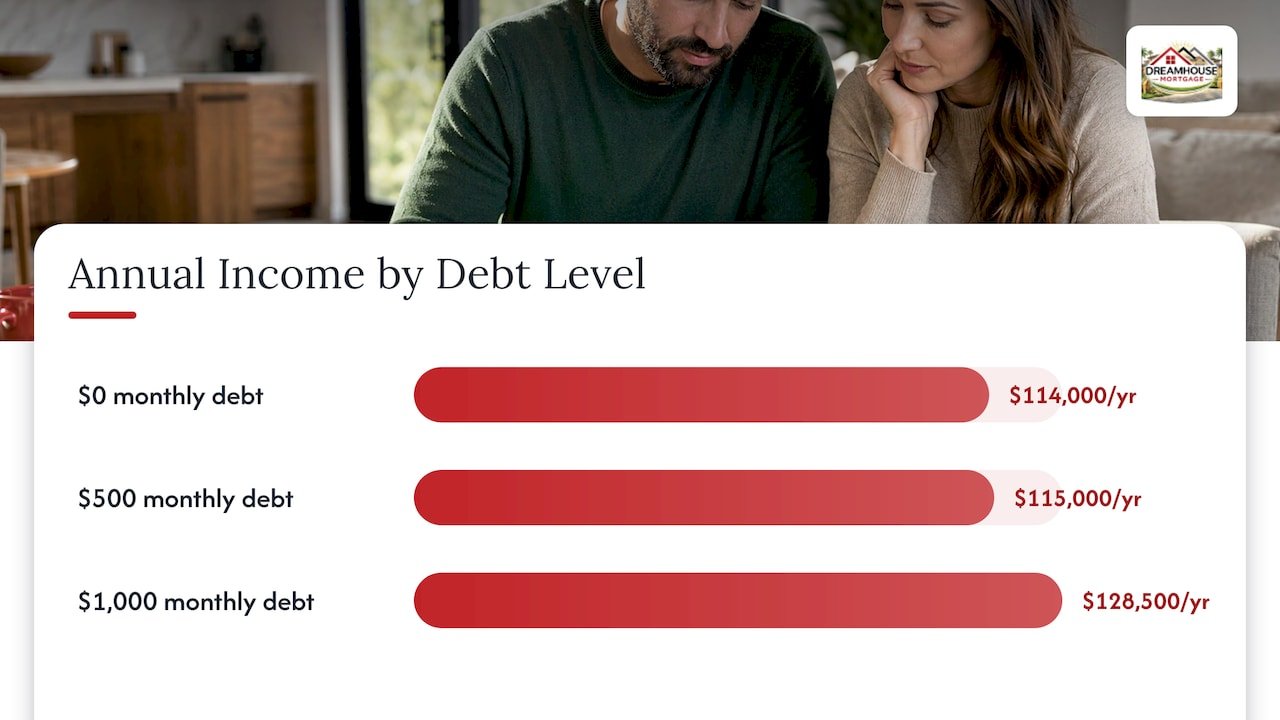
| Other monthly debt payments | Total monthly obligations | Income needed (TDS at 44%) | Approximate annual income |
|---|---|---|---|
| $0 | $3,713 | GDS decides ($9,521/month) | about $114,000 |
| $500 (car and card) | $4,213 | $9,575/month | about $115,000 |
| $1,000 (car, cards, line of credit) | $4,713 | $10,711/month | about $128,500 |
The jump from $0 to $1,000 in other debts adds about $14,000 to the income you need. This lines up with the published range: one Canadian broker-side source puts $115,000 to $125,000 of household income for a $500,000 mortgage with 20% down and no other debts, depending on property taxes and the qualifying rate.
How Property Tax, Heating and Condo Fees Move the Number
Housing costs outside the mortgage payment count in GDS, so the same $500,000 loan needs different income in different places.
- Property tax. One Alberta affordability calculator assumes property tax of 1% of the price per year and heating of $100 a month and lets you change both. A higher-value home in Calgary’s established inner-city communities or a larger acreage in Rocky View County will carry a higher tax bill than a townhome in Airdrie or Cochrane.
- Heating. A larger or older house costs more to heat. Lenders typically use a standard figure, but a bigger home usually means a higher one.
- Condo fees. Only 50% of the fee counts toward GDS, but it still adds up. A $450 monthly fee adds $225 to your housing costs, which raises the income you need by about $7,000 a year at the 39% limit ($225 ÷ 0.39 × 12 ≈ $6,900).
The same logic applies to every purchase price. If you are comparing a townhome in Cochrane with a detached house in a newer Calgary community, run each with its own tax and fee estimate rather than a single average.
How Your Down Payment Changes the Income You Need
Your down payment changes the income requirement in two ways. It reduces the mortgage amount, and when you put down less than 20%, mortgage default insurance is required and the premium is normally added to the mortgage principal. That raises the payment and therefore the income you need to pass the ratios.
The Alberta comparison above shows the effect clearly: $115,100 of income with 5% down versus $99,800 with 20% down on the same $500,000 home, roughly $15,000 apart.
For most Calgary first-time buyers, a bigger down payment is not always achievable, and that is fine. What matters is knowing the trade-off. If you are close to a threshold, a small increase in savings, a gift from family or a withdrawal from a registered plan can change your approval. Our guide to mortgage down payment types in Canada lays out the options, and our first-time home buyer benefits guide covers the FHSA, the Home Buyers’ Plan and the GST rebate.
Pro Tip: Budget closing costs separately from your down payment. Legal fees, title insurance, adjustments and any appraisal fee come out of your cash on possession day.
Is $500K Realistic in Alberta Right Now?
Alberta is one of the more accessible provinces for buyers. The Government of Alberta’s Treasury Board and Finance reports that buying an average-priced home in the province took 38.2% of average individual earnings for people aged 25 to 54 in the second quarter of 2026, compared with 52.6% nationally. Calgary sat at 47.8% and Edmonton at 34.7% in the same report.
In practice, that means:
- A $500,000 purchase in Calgary is in the range of many townhomes, condos and some older detached homes, while Airdrie and Cochrane often offer more space at similar prices.
- Two incomes of about $60,000 each can clear the ratios in the example above when other debts are low.
- A single income of $115,000 or more is the realistic threshold for one buyer on a $500,000 mortgage.
Prices change, so check current listings in the community you want before you set your budget.
Seven Ways to Lower the Income You Need
- Pay down or eliminate monthly debts first. A $350 car payment removes about $9,600 from your required annual income under the 44% TDS limit ($350 ÷ 0.44 × 12).
- Add a co-borrower. A spouse, partner or parent with stable income can be added, with their debts counted as well.
- Choose a lender with a lower contract rate. A lower rate lowers the qualifying rate until the 5.25% floor applies. Brokers compare many lenders at once.
- Increase your down payment. Each extra dollar reduces the loan and can remove the default insurance premium at 20% down.
- Look at a longer amortization where eligible. Insured and uninsured rules differ, so see our amortization options guide.
- Reduce condo fees or property tax in your search. Compare total monthly housing costs, not just price.
- Document all income properly. Self-employed buyers, commission earners and newcomers may qualify on different documentation, which affects the income a lender will count.
Our Perspective: Qualify on Paper Before You Fall in Love With a House
We see the same pattern with Calgary first-time buyers every month. They search online, find three different income numbers for the same $500,000 mortgage and assume one of them is wrong. In fact, each calculator assumes a different rate, property tax and heating cost.
The number that matters is the one a lender will approve for your file. That is why we start with your gross income, your monthly debts, your down payment and the community you want, whether that is Calgary, Airdrie, Cochrane or Chestermere. Then we test those inputs against more than one lender, because banks, credit unions, monoline lenders and alternative lenders do not all treat income, rental income, commission or self-employment the same way.
Our advice is simple. Get your pre-approval before you shop seriously, ask for the qualifying payment to be shown to you, and plan your debts around it. A few months of preparation can change what you qualify for, and we would rather help you plan early than rush at the offer stage.
Guriqbal Chahal, MBA, PMP
Get Your Own Number With a Pre-Approval
A calculator gives you a range. A pre-approval gives you a figure based on your income documents, credit and the specific lender’s rules, along with a rate hold while you shop. We help Calgary, Airdrie and Cochrane buyers with first-time buyer mortgages, pre-approvals, self-employed mortgages and newcomer programs, and we compare banks, credit unions, monoline and alternative lenders for you.

Start on our Calgary mortgage pre-approval page, review our pre-approval requirements checklist for Alberta, or see our first-time home buyer mortgage page for Calgary. Prefer to talk? Call Guriqbal Chahal, MBA, PMP, Mortgage Broker, at 403-966-6072, and find us on our Google Business Profile.
Checklist Before You Rely on Any Income Estimate
Before you trust a number from any calculator, confirm these assumptions:
- Qualifying rate: the greater of contract rate plus 2% or 5.25% for uninsured mortgages
- Ratios: GDS up to 39%, TDS up to 44%, and what each counts
- Property tax and heating: whether the tool uses your actual figures or a default
- Condo fees: whether 50% is included
- Amortization: 25 years is the common assumption, but yours may differ
- Mortgage default insurance: whether the premium is added to the loan
- Other debts: whether every monthly obligation is included
For a full list of what lenders look at, read our Canadian mortgage qualification rules guide for Alberta buyers and our overview of mortgage affordability factors for first-time buyers in Alberta. If you are aiming higher, our guide on the income needed for a $1 million home in Alberta uses the same method.
FAQ
What is the minimum income for a $500,000 mortgage in Alberta?
With a 25-year amortization, no other debts and a stress-test qualifying rate, published estimates run from about $115,000 to $127,000 of gross household income. Our worked example above lands near $114,000 with modest property tax and heating. Your own figure depends on your debts, down payment and lender.
Can I qualify for a $500,000 mortgage on a $100,000 salary?
It is difficult on one income of $100,000 if you want a $500,000 mortgage, because the ratios usually call for more. It may work with a larger down payment, a co-borrower, or a lower-priced home, such as a $500,000 purchase with 20% down. A pre-approval will show you the exact limit.
Does the stress test apply to every mortgage in Alberta?
The stress test applies to federally regulated lenders and, in practice, is widely used across the market. For uninsured mortgages the qualifying rate is the greater of the contract rate plus 2% or 5.25%. A broker can explain how it applies to your specific lender options.
How much do I need to put down on a $500,000 home?
The minimum down payment in Canada is 5% on the first $500,000 of the price, which is $25,000 on a $500,000 home. Under 20% down, you need mortgage default insurance, and the premium is normally added to your mortgage. Our down payment guide explains the tiers above $500,000.
Does rental income help me qualify?
Some lenders count a portion of rental income from a legal basement suite or rental property, and the percentage differs between lenders. That is one reason to compare lenders rather than assume one answer. Tell your broker early if you plan to rent part of the home.
Sources
- Government of Alberta, Treasury Board and Finance: Housing Market Notes, Q2 2026
- Office of the Superintendent of Financial Institutions
- CMHC: Debt Service Calculator
- Financial Consumer Agency of Canada: Preparing to get a mortgage
- HomeCalc: Income needed for a mortgage in Canada
- Turkin Mortgage: How much mortgage can I afford on a $150K salary
- TNAADO Tools: How much house can I afford in Alberta