Canada has no separate “low income mortgage.” Every buyer is measured against the same question: can your income carry the payment, your other debts and the property costs? On a modest income, the answer depends on how the numbers are arranged: the size of the down payment, the amortization, the debts you carry and the lender whose rules fit your file. A Calgary mortgage broker who can place you with banks, credit unions, monoline lenders and alternative lenders can often find the structure that works. At DreamHouse Mortgage we do this for first-time buyers across Calgary, Airdrie, Cochrane and Chestermere. You can reach Guriqbal Chahal, MBA, PMP, directly at 403-966-6072.
TL;DR
- Lenders judge you on ratios, not on a minimum salary: housing costs should generally stay within 39% of gross household income and total debts within 44%.
- First-time buyers and buyers of new builds can now use 30-year amortizations on insured mortgages, which lowers the monthly payment that has to fit your income.
- The First Home Savings Account (FHSA) and the Home Buyers’ Plan can build your down payment with tax advantages.
- Reducing debts and fixing credit report errors often raises what you can borrow more than a pay rise does.
- A broker compares several lenders for you, so the file goes where it fits best.
Table of Contents
- How lenders decide what a low income can carry
- The stress test, explained for first-time buyers
- Rule changes that help buyers on a tighter budget
- Building the down payment when income is tight
- How to improve your approval odds, step by step
- Why the property you choose matters as much as your income
- What if your income is hard to document?
- Low income and refinancing or renewing
- Where a Calgary mortgage broker fits in
- Get your numbers checked by a Calgary mortgage broker
- Our perspective
- FAQ
- Sources
How lenders decide what a low income can carry
The Financial Consumer Agency of Canada (FCAC), the federal body that oversees consumer protection at banks, says lenders look at your pre-tax income, expenses, the amount borrowed, debts, credit report and score, and the amortization period. Amortization is the total number of years it would take to pay the mortgage off completely.
There is no line in that list that says “income must be above $X.” A buyer earning a modest salary with no debts, a stable job and a clean credit report can look stronger on paper than a higher earner with two car loans and maxed-out credit cards.
Two ratios do most of the work:
- Gross Debt Service (GDS): your monthly housing costs divided by gross (pre-tax) household income. Housing costs include the mortgage payment, property taxes, heating and 50% of condo fees. FCAC says this should generally not exceed 39%.
- Total Debt Service (TDS): housing costs plus all other debt payments (car loans, credit card minimums, student loans, lines of credit), divided by gross household income. The general ceiling is 44%.
Because the ratios use gross income, how lenders count your income matters. We explain this in how lenders use gross versus net income, and in our GDS and TDS guide for Calgary buyers.
A worked example
This is an illustration, not a quote. Say two people in Calgary have a combined gross household income of $60,000 a year.
| Step | Calculation | Result |
|---|---|---|
| Monthly gross income | $60,000 ÷ 12 | $5,000 |
| Maximum housing costs at 39% GDS | $5,000 × 0.39 | $1,950 |
| Maximum total debt payments at 44% TDS | $5,000 × 0.44 | $2,200 |
| Existing car loan and card minimums | Example | $400 |
| Room left for housing under TDS | $2,200 − $400 | $1,800 |
Here the debts, not the income, set the limit: housing costs have to fit within $1,800 a month, including property tax and heat, not $1,950. Paying off the $400 of debts before applying would restore the full $1,950. That is why the first step for many lower-income buyers is a debt review, not a search for a higher-paying job.
Why you should aim below the maximum
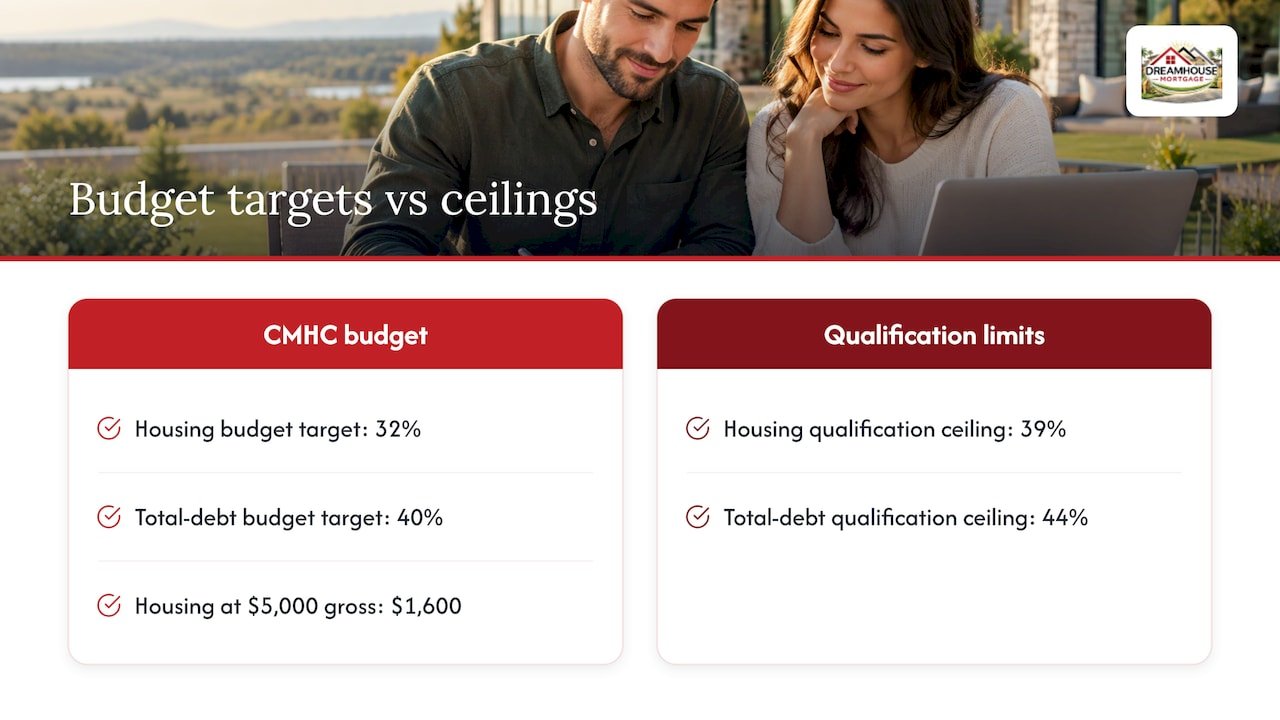
The Canada Mortgage and Housing Corporation (CMHC) advises borrowers to consider a mortgage smaller than the maximum the ratios allow, because borrowing at the limit leaves little room if your budget changes. Its homebuying guide uses tighter budgeting figures of about 32% for housing and 40% for total debt, and separates them from the 39% and 44% qualification ceilings. On $5,000 gross a month, 32% is $1,600. A good pre-approval conversation covers both numbers: what you can be approved for, and what you can live with comfortably.
The stress test, explained for first-time buyers
Federally regulated banks qualify you at a higher rate than the one you will actually pay. FCAC says the qualifying rate is the higher of 5.25% or your negotiated rate plus 2%. This is the mortgage stress test.
If you negotiated a rate of 4.5%, you would be tested at 6.5%. If you negotiated 3%, you would be tested at 5.25%, because that floor is higher than 5%. Your payment is based on the real rate, but the test payment is what has to fit within your ratios. Your negotiated rate moves with lender pricing and the market, so check it against a live quote, not a figure in an article.
We cover the details in our stress test guide for first-time buyers. The practical point for lower-income buyers: a lender whose pricing is sharper gives you a lower qualifying payment as well as a lower real payment. Comparing several lenders at once matters for that reason.
Rule changes that help buyers on a tighter budget
Several federal changes made in late 2024 are relevant if your income is modest.
30-year amortization
Since December 15, 2024, 30-year amortizations are available to all first-time home buyers and buyers of new builds on insured mortgages. A longer amortization spreads the balance over more years, so the monthly payment is lower, and that lowers your GDS and TDS. CMHC’s Home Start product requires an owner-occupied property and a high-ratio loan, meaning the loan is more than 80% of the property’s value. Eligibility conditions apply, so confirm your file against them.
A longer amortization also means more total interest over the life of the loan. That is a trade-off you can manage later, for example by making extra payments when your income grows. Our guide to paying down your mortgage faster in Alberta shows how, and our overview of mortgage amortization options in Canada shows how the choice changes the payment.
The $1.5 million insured cap
The maximum purchase price for an insured mortgage rose from $1 million to $1.5 million on December 15, 2024. On a low income you are unlikely to be near that ceiling, but it confirms that a high-ratio insured mortgage is available across the Calgary market.
The First-Time Home Buyer Incentive is gone
The federal shared-equity program is discontinued, and applications are no longer accepted. If an older video or blog post promises that incentive, it no longer applies. The tools below are the ones in place.
Building the down payment when income is tight
A smaller down payment means mortgage default insurance. CMHC says insurance is required when the down payment is below 20%. The insurance premium is added to the mortgage, and it is the reason a buyer with a modest deposit can still access competitive rates. Our guide to down payment types in Canada shows which sources of funds lenders accept, and how they want them documented.
Two federal tools help you save:
- First Home Savings Account (FHSA): FCAC says an eligible first-time buyer can save up to $40,000, with an annual contribution limit of $8,000. The Canada Revenue Agency (CRA) says qualifying withdrawals for a qualifying home are tax-free and do not have to be repaid when the conditions are met.
- Home Buyers’ Plan (HBP): you can withdraw from your RRSP toward a first home. The limit is $60,000 for withdrawals made after April 16, 2024.
For a household with a modest income, the FHSA and the HBP can be used together toward a down payment, and the details of eligibility sit with the CRA. Lenders will also want to see where every dollar of the down payment came from, so keep statements and transfer records in order from the start.
How to improve your approval odds, step by step
FCAC’s guidance is to check your credit report for errors before applying and to keep your ratios within the general limits. Here is the routine we would follow with a Calgary first-time buyer.
- Pull your credit reports and fix errors. A wrong balance or an old account that should be closed can lower your score. If your credit needs rebuilding, we also offer credit repair support.
- List every debt payment. Include the minimum on each card, each loan and any line of credit. Each dollar of monthly debt payment reduces the housing payment you can qualify for, as in the example above.
- Pay down or pay off small, high-payment debts first. A $400 monthly car loan costs your TDS much more than a card with a small balance and a $25 minimum. A broker can run the numbers on which debt to clear for the biggest gain.
- Document your income cleanly. Salaried buyers bring pay stubs, a letter of employment and tax documents. Commission, part-time and self-employed income need a longer paper trail. Our pre-approval requirements checklist for Alberta lists what to gather.
- Add a co-borrower where it makes sense. A partner or family member’s income can strengthen the application, and their debts and credit count too. It is a decision to make with a broker, since both people are responsible for the mortgage.
- Get pre-approved before you view homes. A pre-approval tells you the price range you can shop in, and it holds a rate for a period. Our mortgage pre-approval process guide walks through it, and the difference between pre-approval and approval explains why a Calgary appraisal can still change the outcome.
Pro Tip: Do not open new credit, finance a vehicle or move money between accounts without a paper trail while you are preparing to apply. Lenders review the whole file, and changes can affect your ratios and your approval.
Why the property you choose matters as much as your income
With a payment cap of around $1,800 to $1,950 a month in the example, the property type changes the result more than most buyers expect. Property taxes and heat count in the ratio, and so do condo fees (50% of them). A townhome in Airdrie or Cochrane with low fees can qualify at a higher price than a condo in the Beltline with high fees. This is a pattern in how the ratios work, not a claim about any specific price in those communities.
Some buyers also consider an older property that needs work. Our team can discuss renovation financing and equity renovation mortgages, which are among our listed services, so ask us before you commit to a property that needs repairs.
Whether the home is insurable also matters. Some properties and structures cannot be insured, which narrows your lender choices. See our guide to uninsurable mortgages and the five red flags for Calgary buyers and our comparison of insured and insurable mortgages.
What if your income is hard to document?
Low income and non-standard income often arrive together: seasonal work, contract work, commission, or income from a business that shows low taxable profit. In Alberta this is common among self-employed professionals and tradespeople.
Federally regulated banks follow the stress test and documentation rules closely. Credit unions, monoline lenders and alternative lenders each have their own guidelines for how they count income. Because DreamHouse Mortgage works with banks, credit unions, monoline lenders, alternative lenders and private lenders, we can look for the lender whose rules suit your income type, and we offer self-employed mortgages and New to Canada mortgage programs for those situations. If you are new to the country, our guide to newcomer mortgages in Calgary and the page on foreign credit mortgages explain how a file without Canadian credit history is assessed.
A mortgage with no income at all is a different question. FCAC is clear that you need to prove to the lender that you can afford to repay, and lenders weigh income, debts and credit together. If you have savings or other regular income, talk to us about how it can be documented.
Low income and refinancing or renewing
If you already own a home in Calgary, Airdrie, Cochrane or Chestermere and your income has dropped or stayed flat, you have options at refinancing and renewal.
Refinancing. FCAC says federally regulated banks require borrowers refinancing a home to pass the stress test at the higher of 5.25% or the negotiated rate plus 2%. A refinance can be used to consolidate higher-interest debts into the mortgage, which lowers your monthly obligations and can improve your TDS. Our debt consolidation mortgage guide for Calgary explains how that works. Since January 15, 2025, homeowners can also refinance insured mortgages to access equity for building a secondary suite, subject to program requirements. The department describes these as basement apartments, in-law suites and laneway homes, which can add rental income.
Renewal. Since November 21, 2024, uninsured borrowers can switch between federally regulated lenders at renewal without a new stress test if the loan amount and remaining amortization do not increase. Insured mortgage holders already had that exemption. For a household on a tighter income, this makes comparing rates at renewal a real option, not a trap. See our page on why many Canadians overpay at renewal, and ask us about our Renew or Switch service.
Where a Calgary mortgage broker fits in
When your income is modest, small differences between lenders decide whether your file passes: how a lender treats part-time income, how it counts a co-borrower, what it accepts as a down payment source, what rate it offers and so how much stress-test payment you carry. Going to one bank shows you one set of rules. A broker shows you several.
DreamHouse Mortgage is a Calgary brokerage, founded in 2013 and led by Broker of Record Guriqbal Chahal. We help with qualification, lender selection, document collection, rate comparisons, approvals and funding coordination, and we serve Calgary, Airdrie, Cochrane, Chestermere, Okotoks, High River and Rocky View County, as well as Edmonton and Red Deer. Our first-time homebuyer mortgage guide for Calgary and our Canadian mortgage qualification rules guide go deeper on the rules.
Get your numbers checked by a Calgary mortgage broker
If you are a first-time buyer in Calgary, Airdrie, Cochrane or Chestermere and you are not sure what your income supports, the fastest step is a pre-approval conversation. We review your income, debts, credit and down payment, and match your file to lenders across our network of banks, credit unions, monoline lenders, alternative lenders and private lenders.

Start with our mortgage pre-approval service or see everything we offer on the DreamHouse Mortgage home page. To talk it through, call Guriqbal Chahal, MBA, PMP, Mortgage Broker, at 403-966-6072. You can also find us on our Google Business Profile.
Our perspective
The question we hear most from first-time buyers in Calgary is “Is my income too low?” We almost never answer it with a salary figure. We answer it with a ratio, a debt list and a down payment plan.
In our experience as a brokerage, the buyers who gain the most are the ones who start early. Sort out the credit report, clear the debts that cost the most in monthly payments, and build the down payment with the tools Canada gives first-time buyers, such as the FHSA and the Home Buyers’ Plan. Then the lender selection becomes the deciding step, because each lender counts income and debts a little differently.
That is why we work with banks, credit unions, monoline lenders, alternative lenders and private lenders instead of one product shelf. Our approach is client-first: clear communication, education about your options and a financing strategy that fits your life in Calgary, Airdrie, Cochrane or Chestermere, not only the approval on the day.
Call us before you start looking at homes. A short conversation about your numbers is the best way to set a budget you can live with.
Guriqbal Chahal, MBA, PMP
FAQ
Is there a minimum income to get a mortgage in Canada?
No fixed minimum exists. Lenders test whether your income supports the payment within the general 39% housing and 44% total debt limits, taking your debts, credit and amortization into account. Two buyers with the same salary can get very different results, so a pre-approval based on your real numbers is the reliable answer.
Can I qualify for a mortgage with low income if I have a small down payment?
Yes, in many cases. When the down payment is below 20%, mortgage default insurance is required, and first-time buyers can use a 30-year amortization on an insured mortgage, which lowers the payment that has to fit your ratios. Your credit, debts and the property all still count, so we review the whole file.
Can I refinance my Calgary mortgage on a low income?
You have to show the lender you can afford the new payment, and federally regulated banks apply the stress test to refinances. A refinance that consolidates high-interest debts can reduce your monthly obligations, which helps your ratios. We can compare lenders to see which structure suits your income.
Does the First-Time Home Buyer Incentive still exist?
No. CMHC’s policy manual states that the incentive is discontinued and applications are no longer accepted. The FHSA and the Home Buyers’ Plan are the main federal tools for building a down payment today.
Sources
- Preparing to get a mortgage, Financial Consumer Agency of Canada
- Homebuying Step by Step, CMHC
- Managing Your Mortgage, CMHC
- Boldest mortgage reforms in decades come into force, Finance Canada
- Home Start, CMHC
- First-Time Home Buyer Incentive Operational Policy Manual, CMHC
- Mortgage payment calculator, CMHC
- Buying a home, Financial Consumer Agency of Canada
- Withdrawals and transfers out of your FHSAs, Canada Revenue Agency
- Deputy Prime Minister highlights mortgage reforms, Finance Canada, October 2024
- Deputy Prime Minister announces new action to lower the cost of housing, Finance Canada, November 2024