
TL;DR:
- Alt-A mortgages provide self-employed borrowers in Alberta with a path to homeownership using alternative income verification methods. These loans accept bank statements, CPA-verified profit and loss statements, and 1099 income instead of standard tax returns, increasing their qualifying income. Working with a specialized broker and preparing comprehensive documentation can significantly improve approval chances and loan terms.
An Alt-A mortgage for self-employed borrowers is defined as an alternative documentation loan that allows individuals with strong credit but nontraditional income proof to qualify for home financing using bank statements, profit-and-loss statements, or similar income verification methods instead of standard tax returns. In Alberta, thousands of freelancers, contractors, consultants, and business owners in Calgary, Edmonton, Airdrie, and Cochrane face this exact challenge every year. Their taxable income on paper looks low because of legitimate business write-offs, yet their actual cash flow is strong. The alt-a mortgage self employed explained concept exists precisely to close that gap. Dreamhouse Mortgage, led by Guriqbal Chahal, MBA, PMP, works directly with these borrowers to match them with lenders who understand alternative income verification.
What income documentation qualifies self-employed borrowers for alt-a mortgages?
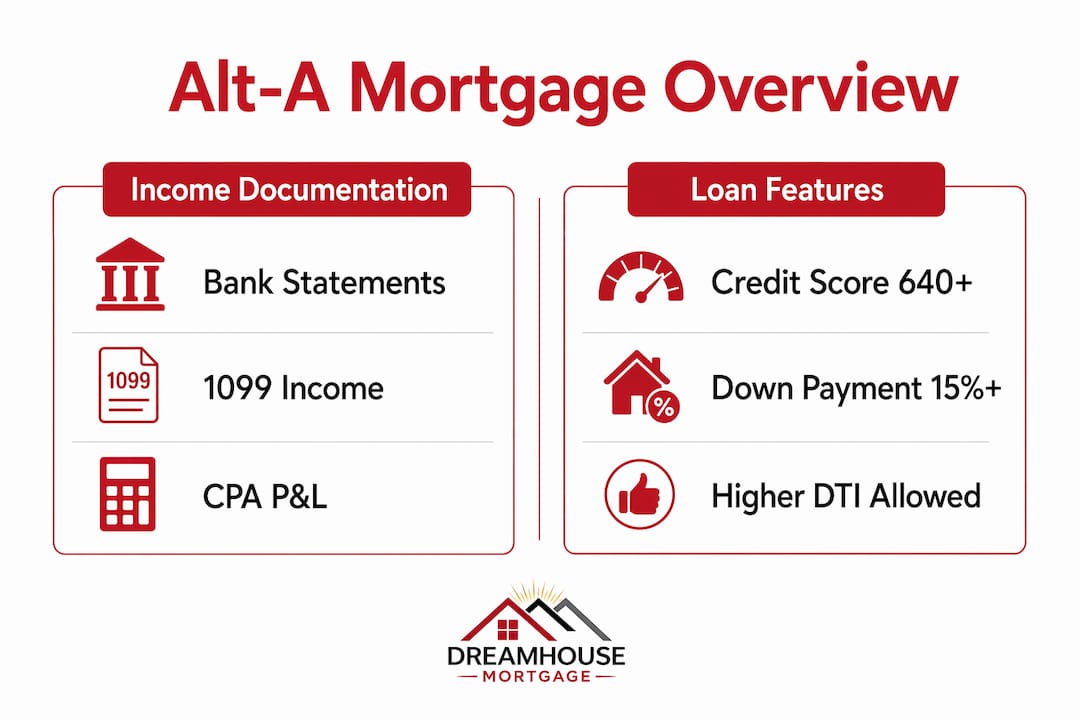
Common self-employed qualifying programs include 12–24 month bank statement loans, 1099-income loans using gross income figures, and CPA-verified profit-and-loss statement loans. None of these programs require standard tax returns for income qualification. That single fact changes everything for self-employed borrowers in Alberta who have spent years writing off legitimate business expenses.
Bank statement loans
Bank statement loans calculate your qualifying income by averaging deposits across 12 or 24 months of personal or business bank statements. Lenders apply an expense ratio to business accounts, typically between 50% and 75%, to arrive at net qualifying income. A Calgary-based consultant depositing $15,000 per month into a business account could qualify on $7,500 to $11,250 of monthly income depending on the lender’s expense ratio. This method rewards borrowers whose real cash flow is strong even when their tax returns show modest net income.

1099 income loans
1099 income loans let borrowers qualify using gross 1099 income rather than net taxable income. 1099 programs qualify up to 90% of gross 1099 income, which is a significant advantage over tax-return-based qualification. A Red Deer contractor earning $120,000 gross on 1099s could qualify on $108,000 of annual income. This approach works well for tradespeople, IT consultants, and real estate professionals across Alberta.
Cpa-verified profit and loss statement loans
P&L statement loans use a CPA-prepared profit and loss statement covering 12 or 24 months to establish net business income. The lender accepts the CPA’s verified net profit figure as the qualifying income. This option suits business owners in Edmonton or Chestermere whose books show consistent profitability even when tax optimization strategies reduce their reported taxable income.
Minimum documentation requirements beyond income
Beyond income proof, lenders require supporting documents to confirm active self-employment:
- Business license or registration showing at least 2 years of operation
- CPA letter confirming the business is active and the borrower is the owner
- Client contracts or invoices demonstrating ongoing revenue
- Business bank account statements separate from personal accounts where applicable
At least 2 years of business activity proof is standard across most Alt-A lenders. Credit score minimums generally start at 640, with the best pricing available at 720 and above. Down payments typically start at 15% for primary residences.
Pro Tip: If your credit score sits between 640 and 680, focus on paying down revolving credit balances before applying. Moving from 660 to 700 can reduce your rate meaningfully and open access to higher loan-to-value options.
How do alt-a mortgages differ from traditional and subprime loans?
Alt-A mortgages differ from prime loans by accepting limited or alternative income documentation while still requiring better credit than subprime loans, typically in the 640–680+ FICO range. Understanding where Alt-A sits in the lending spectrum helps you set realistic expectations before you apply.
The table below compares the three main mortgage categories for self-employed borrowers in Alberta:
| Loan Type | Credit Score | Income Documentation | Down Payment | Risk Profile |
|---|---|---|---|---|
| Prime (Conventional) | 720+ | Full tax returns, T4s, NOAs | 5–20% | Low |
| Alt-A / Non-QM | 640–720 | Bank statements, 1099s, P&L | 15–20%+ | Moderate |
| Subprime / Private | Below 640 | Minimal or stated | 20–35%+ | High |
Prime loans demand two years of T1 General tax returns, Notices of Assessment from the Canada Revenue Agency, and consistent reported income. Most self-employed borrowers in Calgary fail this test not because they lack income but because their write-offs reduce net income on paper. Subprime loans accept almost any borrower but charge rates that can be 3–5 percentage points above prime, making them expensive for long-term financing.
Alt-A loans occupy the middle ground. Modern Alt-A loans are often called non-QM loans, providing documented alternatives to traditional full-doc mortgages. The key distinction from the pre-2008 era is that today’s Alt-A products require full bank documentation. They are not “no-doc” loans. They are “alt-doc” loans, meaning the documentation is different, not absent. This makes them a safer and more transparent product for both lenders and borrowers in Alberta’s regulated mortgage market.
Debt-to-income limits for Alt-A programs typically run around 50–55%, which is more permissive than the standard 44% gross debt service ratio applied under conventional Canadian mortgage rules. Loan-to-value ratios generally cap at 80–85% for primary residences, meaning you need at least 15–20% as a down payment.
How to qualify for an alt-a mortgage as a self-employed borrower in alberta
Qualifying for an alt-a mortgage for self employed borrowers in Alberta follows a clear process when you know what lenders expect. The steps below apply whether you are buying in Calgary, Okotoks, Cochrane, or anywhere across Alberta.
-
Confirm your business history. Gather your business license, CPA letter, and client contracts covering at least 2 years. A comprehensive 2-year business verification package speeds underwriting and confirms active self-employment to lenders. Submit this package even if the lender only uses 12 months of bank statements for income calculation.
-
Calculate your income using multiple methods. Run your numbers under the bank statement method, the 1099 method, and the P&L method. Calculating income via multiple methods helps you choose the highest qualifying amount. The method that produces the highest qualifying income is the one your mortgage broker should present to the lender.
-
Check and strengthen your credit score. Pull your Equifax and TransUnion credit reports. Pay down credit card balances to below 30% of the limit. Dispute any errors. A score of 720 or above unlocks the best pricing on self-employed mortgage rates in Alberta.
-
Prepare your down payment and reserves. Most Alt-A programs require 15–20% down for a primary residence. Beyond the down payment, lenders want to see 3–6 months of mortgage payments sitting in liquid reserves. A borrower buying a $600,000 home in Airdrie needs roughly $90,000–$120,000 for the down payment plus $9,000–$18,000 in reserves.
-
Work with a broker who specializes in self-employed files. Not every mortgage broker in Calgary or Edmonton has access to alternative lenders offering Alt-A products. A specialist broker like Dreamhouse Mortgage has established relationships with alternative lenders, credit unions, and monoline lenders who actively serve self-employed borrowers across Alberta.
-
Submit a complete application package on the first attempt. Incomplete applications cause delays and can trigger additional scrutiny. Organize your documents before submission: bank statements, CPA letter, business license, contracts, and identification.
Pro Tip: Using bank deposits instead of net taxable income can boost qualifying income by 20–40%. Run this calculation before assuming you do not qualify for the home you want in Calgary or Edmonton.
Many self-employed borrowers assume they cannot qualify for a conventional mortgage and jump straight to Alt-A products. Many 1099 self-employed workers may actually qualify for conventional conforming loans, so testing eligibility under traditional underwriting should come first. A good broker will run both scenarios before recommending the Alt-A route.
What alt-a mortgage products are available to self-employed borrowers in alberta?
The self-employed mortgage lender types in Canada have expanded significantly since 2020, and 2026 offers more product variety than at any previous point. Here are the main Alt-A and non-QM products available to Alberta borrowers:
-
12-Month Bank Statement Loans: Use one year of deposits to calculate income. Best for borrowers with a shorter track record or recent business growth. Minimum credit score: 660. Down payment: 15–20%.
-
24-Month Bank Statement Loans: Use two years of deposits for a more stable income average. Lenders favor this option for larger loan amounts. Minimum credit score: 640. Down payment: 15%.
-
1099-Only Loans: Qualify on gross 1099 income at 90% of the reported amount. Ideal for independent contractors and tradespeople in Calgary, Red Deer, and Cochrane. Minimum credit score: 660.
-
CPA-Verified P&L Loans: Use a 12 or 24-month profit and loss statement prepared and signed by a licensed CPA. Best for incorporated business owners with clean books. Minimum credit score: 680.
-
Asset Depletion Loans: Asset depletion loans let borrowers qualify by converting liquid asset balances into synthetic income without traditional income documentation. A borrower in Edmonton with $1,000,000 in liquid assets could generate a qualifying income figure by dividing that balance over a set number of months. This option is underutilized but powerful for self-employed individuals with strong asset positions and low taxable income.
The table below summarizes typical terms for each product:
| Product | Min. Credit Score | Min. Down Payment | Max. LTV | Best For |
|---|---|---|---|---|
| 12-Month Bank Statement | 660 | 15% | 85% | Growing businesses |
| 24-Month Bank Statement | 640 | 15% | 85% | Established self-employed |
| 1099-Only | 660 | 15% | 85% | Contractors, freelancers |
| CPA P&L Statement | 680 | 20% | 80% | Incorporated owners |
| Asset Depletion | 680 | 20% | 80% | High-asset, low-income |
Dreamhouse Mortgage works with alternative lenders, credit unions, and monoline lenders across Alberta to match borrowers to the right product. Whether you are purchasing in Chestermere, High River, or Rocky View County, the best self-employed mortgage lenders in Calgary vary by program type and borrower profile. A broker who knows which lenders are actively approving Alt-A files in 2026 saves you time and protects your credit score from unnecessary applications.
The terms “Alt-A” and “Non-QM” are often used interchangeably for modern alternative mortgage products that demand rigorous income verification despite less traditional documentation. When speaking with lenders in Alberta, using either term will direct you to the same category of products.
Key takeaways
Alt-A mortgages give self-employed borrowers in Alberta a documented, credit-based path to home financing when tax returns understate actual income.
| Point | Details |
|---|---|
| Alt-A uses alternative income proof | Bank statements, 1099s, and CPA-verified P&L statements replace tax returns for qualification. |
| Credit score drives pricing | Scores of 640 qualify, but 720+ unlocks the best rates and highest loan-to-value ratios. |
| Down payment starts at 15% | Most Alt-A programs require 15–20% down plus 3–6 months of cash reserves. |
| Multiple income methods matter | Calculating income under all three methods and choosing the highest amount maximizes buying power. |
| Broker expertise is critical | A specialist broker with access to alternative lenders in Calgary and Edmonton accelerates approval. |
What i have learned helping self-employed clients secure alt-a mortgages in alberta
The biggest mistake I see self-employed borrowers make is assuming their situation is hopeless before they have spoken to anyone. They look at their tax return, see $45,000 in net income, and conclude they cannot afford a $500,000 home in Calgary. That conclusion is often wrong.
When I run a bank statement calculation for the same borrower, their qualifying income frequently comes in at $90,000 or higher. The primary benefit of non-QM Alt-A products is increased buying power through alternative income calculation methods. That is not a marketing claim. I see it play out in real files every month across Calgary, Airdrie, and Edmonton.
The second mistake is poor document preparation. Borrowers arrive with 12 months of personal bank statements but no CPA letter, no business license copy, and no client contracts. Lenders need the full picture to feel confident about the file. A complete package submitted on day one moves faster than an incomplete package revised three times over three weeks.
My honest advice: do not self-diagnose your eligibility. Run your numbers under every available method. Check your credit score before you apply. And work with a broker who has closed Alt-A files recently, not just one who says they can. The self-employed mortgage Calgary market in 2026 has real options for borrowers who prepare properly.
— Guriqbal Chahal, MBA, PMP
Get expert alt-a mortgage advice from dreamhouse mortgage
Dreamhouse Mortgage specializes in self-employed mortgage solutions across Calgary, Edmonton, Airdrie, Cochrane, Chestermere, Okotoks, Red Deer, and surrounding Alberta communities. Guriqbal Chahal, MBA, PMP, has helped hundreds of self-employed borrowers qualify using bank statement loans, P&L programs, and asset depletion strategies.

Dreamhouse Mortgage works with alternative lenders, credit unions, and monoline lenders to find the right Alt-A product for your income profile. The team handles document preparation, lender matching, rate comparison, and approval coordination from start to finish. Learn how broker rate negotiation can reduce your borrowing cost on an Alt-A mortgage. Contact Guriqbal Chahal, MBA, PMP, Mortgage Broker at 403-966-6072 or visit the Google Business Profile to book a free consultation today.
FAQ
What is an alt-a mortgage for self-employed borrowers?
An Alt-A mortgage is a loan that accepts alternative income documentation, such as bank statements or CPA-verified profit and loss statements, instead of standard tax returns. It targets borrowers with good credit, typically 640+, whose taxable income understates their actual cash flow.
What credit score do i need for an alt-a mortgage in alberta?
Minimum credit score requirements are 640 for basic eligibility, 660 for maximum loan-to-value access, and 720 or above for the best available pricing on Alt-A programs.
How much down payment is required for a self-employed alt-a mortgage?
Down payments for Alt-A mortgages generally start at 15% for primary residences. Most lenders also require 3–6 months of mortgage payments held in liquid reserves at the time of approval.
Can i use bank statements instead of tax returns to qualify?
Yes. Bank statement loans use 12 or 24 months of deposit history to calculate qualifying income. Lenders apply an expense ratio to business accounts, and the resulting net figure replaces tax-return income for qualification purposes.
How does dreamhouse mortgage help self-employed borrowers get approved?
Dreamhouse Mortgage accesses multiple alternative lenders across Alberta and calculates income under all available methods to maximize your qualifying amount. Guriqbal Chahal, MBA, PMP, manages document preparation, lender selection, and approval coordination for self-employed clients in Calgary, Edmonton, and across Alberta. Call 403-966-6072 to start your application.