
Every year, thousands of Alberta homebuyers make the same costly error: they choose their mortgage type based on a single number — the rate — while ignoring five other factors that matter just as much. In 2026, with interest rates in a new cycle, Alberta’s housing market shifting, and Bank of Canada policy evolving rapidly, understanding the full picture of fixed vs variable mortgage Alberta choices could save you — or cost you — $20,000 to $50,000 over the life of your term.
This guide gives you that full picture. Written by Guriqbal Chahal of Dreamhouse Mortgage Calgary, it is the most comprehensive, 2026-specific breakdown available for Alberta homebuyers, renewers, and investors on fixed vs variable mortgage Alberta.
- The Fundamentals: What Each Mortgage Type Really Is
- Alberta Mortgage Rates 2026 — What You’re Actually Paying
- Complete Head-to-Head Comparison
- Who Wins on Fixed vs Variable in Alberta — 2026 Data
- Choose Fixed: The Right Profiles & Reasons
- Choose Variable: The Right Profiles & Reasons
- 6 Real Alberta Homebuyer Scenarios
- The Penalty Trap Nobody Talks About
- Bank of Canada 2026 Outlook: What It Means for Your Mortgage
- Renewal Strategy for 2026 Alberta Homeowners
- Calgary, Edmonton & Alberta City-by-City Market Context
- 10 Questions to Ask Before You Sign Anything
- Final Decision Summary & Matrix
- Frequently Asked Questions
The Fundamentals: What a Fixed vs Variable Mortgage Alberta Actually Means
Before we get into rates, strategies, and Alberta-specific nuance, let’s ground the conversation in precise definitions — because the terminology matters, and many buyers conflate concepts that are actually quite different.
The Fixed-Rate Mortgage: Certainty Engineered Into the Contract
A fixed-rate mortgage locks your interest rate for the entire length of your chosen term — typically 1, 2, 3, 4, or 5 years (with 5-year fixed being by far the most popular in Alberta and across Canada). Once signed, your rate is immovable regardless of what the Bank of Canada does, what inflation does, or what global markets do.
Your principal-and-interest payment is calculated once at signing and remains identical on month one and on the final month of your term. What you see is what you pay. This is the fundamental product promise of a fixed-rate mortgage, and it is the feature Alberta homebuyers with tighter budgets, fixed incomes, or lower risk tolerance consistently choose to pay a premium for.
Fixed rates in Canada are priced primarily off Government of Canada bond yields — specifically the 5-year GoC bond for 5-year fixed products. As bond yields rise (typically driven by inflation expectations or strong economic data), fixed mortgage rates follow. As yields fall, fixed rates soften. This is why fixed rates sometimes move independently of Bank of Canada decisions, which is a source of genuine confusion for many borrowers.
The Variable-Rate Mortgage: Two Flavours, One Source
A variable-rate mortgage ties your interest cost directly to your lender’s prime rate — which the lender adjusts in lockstep with every Bank of Canada overnight rate decision. Your rate is expressed as a discount from (or premium above) prime: for example, “Prime minus 0.90%” or “Prime plus 0.15%.”
Critically, there are two distinct types of variable-rate mortgages in Canada that behave very differently, and many Alberta buyers don’t realize this distinction exists until they’re already signed:
- Adjustable-Rate Mortgage (ARM): Your actual monthly payment changes every time the prime rate moves. Rate goes up — your payment goes up. Rate goes down — your payment goes down. What you pay always reflects the true current cost of borrowing.
- Variable-Rate Mortgage with Fixed Payment (VRM): Your monthly payment amount stays constant, but the split between interest and principal changes with rate moves. When rates rise, more of your fixed payment covers interest and less goes to principal — extending your effective amortization. At a critical point called the trigger rate, the fixed payment no longer covers the interest due, and the lender typically requires you to increase your payment or make a lump-sum payment.
2022–2023 Lesson for Alberta Borrowers
During the historic rate hike cycle, many VRM holders (fixed-payment variable) were blindsided by trigger rate notifications. Some saw their full payment go entirely to interest with zero principal reduction. If you choose a variable rate in 2026, know whether you’re getting an ARM or VRM — and what your trigger rate is — before you sign.
Alberta Mortgage Rates in 2026: What Are You Actually Paying on a Fixed vs Variable Mortgage Alberta?
Alberta’s mortgage market in 2026 operates in a meaningfully different environment than the pandemic lows of 2020–2021 and the rate-shock years of 2022–2023. We are now in what economists call the post-normalization era — rates have settled into a range that is higher than the historic anomaly of near-zero borrowing costs but lower than the restrictive peak.
Current Rate Environment: What Alberta Buyers Are Seeing in 2026
4.09%
~0.06%
4.95%
*Rates are estimates based on 2026 market trajectory. Contact Dreamhouse Mortgage for today’s live rates for your specific situation.
The Narrowing Spread: Why It Changes Everything
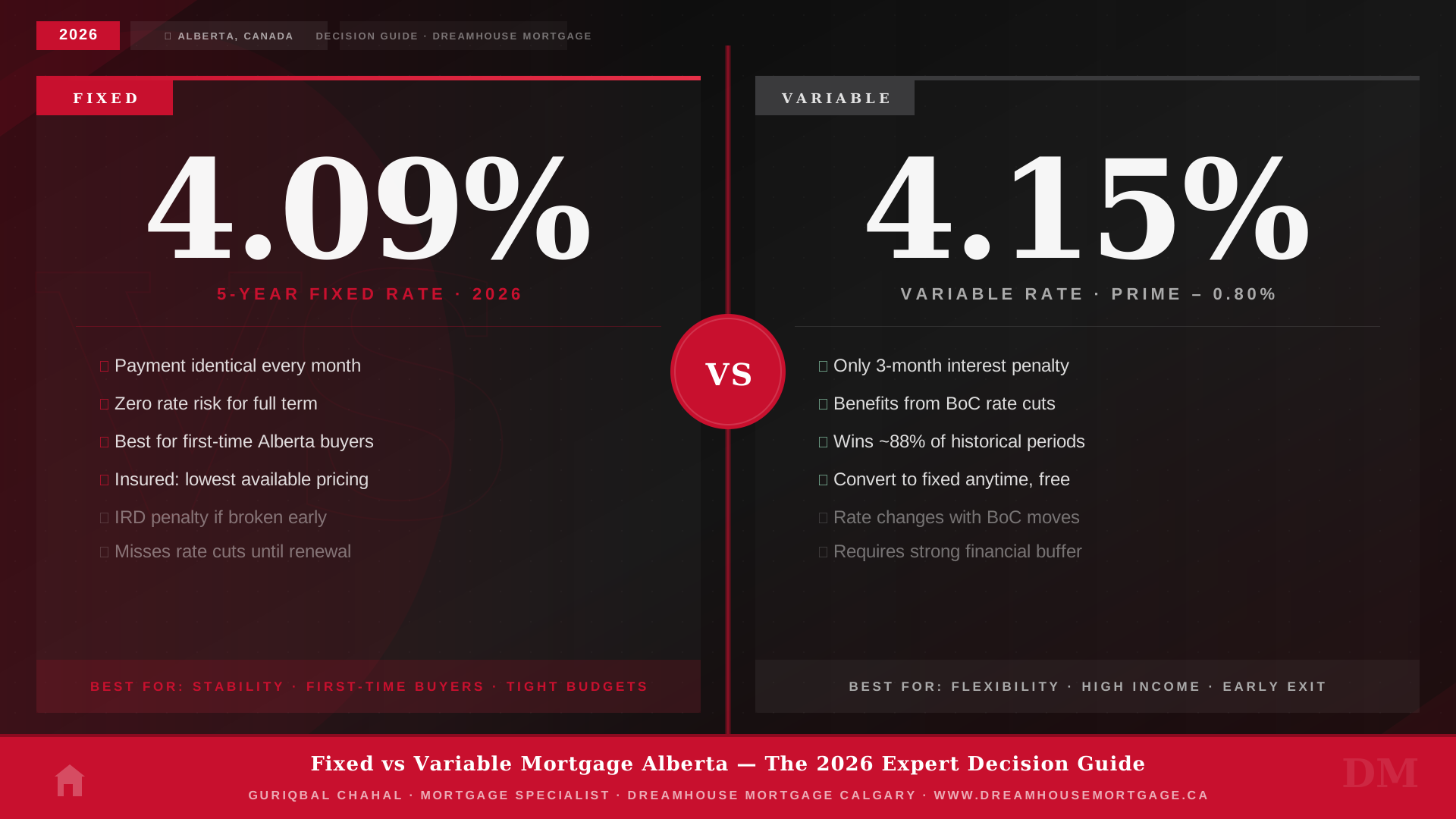
One of the defining features of the 2026 Alberta mortgage market is how compressed the spread between fixed and variable rates has become. In normal rate cycles, variable rates run 0.75%–1.50% below equivalent fixed rates, making the case for variable mathematically compelling. In 2026, that spread has narrowed to as little as 0.05%–0.15% for some products.
When the rate differential is this thin, the argument for variable weakens significantly on a pure cost basis. You are taking on meaningful payment risk for very little immediate rate savings. This reality reshapes the 2026 decision in ways that differ from conventional wisdom about choosing variable mortgages.
What About 2-Year and 3-Year Fixed Rates in Alberta?
The 2-year and 3-year fixed products deserve particular attention in 2026. With further Bank of Canada rate cuts possible (though no longer a certainty as the neutral rate zone is approached), shorter fixed terms allow Alberta borrowers to capture present-day certainty while keeping a shorter commitment horizon. In 2026, 2-year fixed rates in Alberta are typically within 0.05%–0.20% of 5-year fixed rates — making them an attractive middle path for many buyer profiles.
Complete Head-to-Head: Fixed vs Variable Mortgage Alberta 2026
| Comparison Factor | Fixed Rate Mortgage | Variable Rate Mortgage |
|---|---|---|
| Rate Certainty | ✔ 100% locked — no surprises | ✘ Moves with every BoC announcement |
| Current Rate (2026 Best) | ~4.09% (5-yr, insured) | ~4.15% (Prime – 0.80%) |
| Rate Spread Advantage | Fixed slightly lower right now | Minimal advantage in 2026 |
| Payment Stability | ✔ Same every month | ✘ ARM changes; VRM shifts principal/interest |
| Break Penalty | ✘ IRD — can be $10K–$40K+ | ✔ 3 months interest only (predictable) |
| Convertibility | Can port to new property | ✔ Can convert to fixed anytime |
| Stress Test Rate | Contract + 2% or 5.25% | Contract + 2% or 5.25% (slightly lower base) |
| Rate Drop Benefit | ✘ Locked in — no benefit until renewal | ✔ Automatic savings on every BoC cut |
| Inflation Protection | ✔ Rate can’t rise with inflation | ✘ Rate rises if BoC tightens again |
| Historical Performance | Wins in rate-rising cycles | Wins ~88% of 5-yr periods historically |
| Lender Availability | All lenders | Most lenders (broker access preferred) |
| Best For | Stability-first buyers, tight budgets | Flexible buyers, likely early exits |
Who Actually Wins on Fixed vs Variable Mortgage Alberta — What the Data Says
The Historical Evidence: Variable’s Long-Run Advantage
The most frequently cited study of Canadian mortgage data — a widely referenced analysis conducted by York University finance professor Moshe Milevsky — found that over roughly 80% of all historical 5-year periods between 1950 and early 2000s, choosing variable over fixed resulted in lower total interest paid. More recent analyses extending the dataset through 2020 maintained this finding at approximately 88% of 5-year periods.
The intuition is straightforward: lenders price fixed-rate certainty as a premium product. You pay more for the certainty of knowing your rate won’t change. In most economic environments, that premium turns out to exceed the actual volatility that occurs — meaning variable-rate borrowers collect the “insurance premium” by not buying it.
The 2022–2023 Disruption: When Variable Lost — Badly
The 2022–2023 rate hike cycle was one of the most rapid in Bank of Canada history. Between March 2022 and July 2023, the overnight rate went from 0.25% to 5.00% — a 475-basis-point increase in 16 months. Variable-rate borrowers who had entered their mortgages in 2020 or 2021 at rates around 1.25%–1.75% saw their effective rates climb to 6.25%–7.00%.
Albertans who had chosen 5-year fixed mortgages in 2020 at 2.09%–2.49% paid vastly less than their variable-rate counterparts by the time 2023 arrived. The “historical 88%” advantage temporarily inverted in dramatic fashion.
The 2026 lesson from 2022–2023 is not that variable is bad — it’s that the magnitude of rate moves matters as much as the direction. In 2026, with rates already normalized and the BoC near neutral, the risk profile for variable mortgages is materially lower than it was when borrowers entered at 1.45% in 2021 with nowhere to go but up.
The 2026 Variable Risk Profile Is Fundamentally Different
Here is why 2026 is structurally different from 2021 for variable-rate borrowers in Alberta:
- Starting rate is normalized: You’re entering at ~4.15%, not at 1.45%. The absolute room for rate increases before real pain is triggered is meaningfully smaller.
- BoC is near neutral: With the overnight rate in or near its estimated neutral zone of 2.25%–3.00%, dramatic hikes are unlikely without extraordinary inflationary shocks.
- Rate direction bias: If Canada’s economy slows (possible given US trade dynamics and housing market stress), rate cuts are more probable than hikes in 2026’s base scenario.
- Spread is compressed: Because fixed and variable are so close in 2026, the “penalty” for choosing fixed is minimal. This is arguably the strongest argument for fixed in recent memory — certainty is cheap right now.
Fixed Mortgage Alberta 2026: The Right Buyer Profiles
Choose Fixed Rate When Your Situation Matches These Criteria
- You are a first-time buyer in Calgary, Edmonton, or anywhere in Alberta with a down payment of less than 20% — insured fixed rates are highly competitive and payment certainty is essential when you’re new to homeownership costs
- Your GDS or TDS ratios are at or near qualification limits — any variable rate increase would put you in financial stress
- You are buying on a single income with minimal financial cushion beyond your down payment
- You are self-employed or in a commission-based role in Alberta’s energy, real estate, or construction sector — income variability + rate variability is double exposure you don’t need
- You are risk-averse by nature and experienced genuine anxiety during 2022–2023 as a variable borrower — that psychological reality is legitimate data about what product fits you
- You are a retiree or near-retiree on fixed income — payment predictability is more important than rate optimization
- You are purchasing an investment property where rental cash flow needs to be projected reliably for at least 3–5 years
- You plan to stay in the home for the full 5-year term with no foreseeable life events that would require breaking the mortgage
The “Certainty Is Cheap” Argument for Fixed in 2026
With the fixed-variable spread compressed to near-parity in 2026, the mathematical cost of buying certainty has rarely been lower in recent memory. You’re effectively paying a 0.05%–0.15% premium for knowing exactly what your payment will be for five years. On a $550,000 mortgage, that premium amounts to roughly $800–$1,500 per year — a genuinely modest price for complete payment certainty. This framing makes the fixed rate decision easier to justify than at any point since 2020.
Variable Mortgage Alberta 2026: The Right Buyer Profiles
Who Should Consider a Variable Rate on Their Fixed vs Variable Mortgage Alberta Decision
- You have a robust financial buffer — at minimum 3–6 months of all housing costs in accessible savings, and ideally more
- You are likely to sell, refinance, or port within 3–4 years — the variable break penalty (3 months interest ≈ $5,000–$8,000) is dramatically lower than a fixed IRD penalty ($15,000–$40,000+)
- You are an experienced real estate investor who actively monitors BoC announcements and is comfortable converting to fixed if the rate environment shifts
- You are a high-income professional — physician, lawyer, engineer, tech executive — with dual incomes, substantial TFSA/RRSP savings, and a high actual risk tolerance
- You believe the Bank of Canada will continue cutting rates and want to benefit automatically without needing to break or refinance
- You are purchasing a short-hold property — a condo or townhome you plan to trade up from in 3–4 years as your family grows
- You are a sophisticated borrower who has reviewed the ARM vs VRM structure with your broker, understands your trigger rate, and has a documented plan if rates rise 0.75%+
The Variable Conversion Strategy
One underutilized strategy for qualified Alberta borrowers: enter on variable, convert to fixed if rates bottom out and begin rising. Most lenders offer no-cost mid-term conversion to fixed. The risk: you’ll convert at the current rate for your remaining term — not the low rate you enjoyed while variable. Your broker needs to confirm the conversion terms before you choose this path.
Six Real Alberta Homebuyer Scenarios: Choosing Fixed vs Variable Mortgage Alberta
Scenario 1 — Calgary NW
The Pareek Family — First-Time Buyers, $680,000 Detached
Profile: Priya and Raj Pareek, dual income $162,000 combined, 5% down ($34,000), no other debt. Moving from renting. Two kids. No savings beyond down payment.
The Decision: 5-Year Fixed at 4.09% (insured, broker-sourced). With only 5% down and zero financial buffer beyond their down payment, this is not a variable-rate situation. Any payment increase in the first two years could force a sale or financial hardship. The fixed rate gives them five years to build equity, build savings, and stabilize into homeownership.
Dreamhouse Mortgage Result: Secured a monoline lender product with 20/20 prepayment privileges and a transparent IRD formula. Annual savings vs. TD posted rate: ~$4,200.
Scenario 2 — Edmonton Glenora
Marcus Johansson — Move-Up Buyer, $920,000 Infill
Profile: Single, $290,000 income, $310,000 equity from existing home sale, buying luxury infill. Extensive TFSA savings ($180,000). Expects to move internationally for work within 3–4 years.
The Decision: Variable Rate at Prime – 0.95% (effective ~4.00%). The probability of an early exit in 3–4 years is high. A fixed IRD penalty on a $600,000 mortgage balance with 18 months left could easily exceed $25,000. The variable 3-month interest penalty would be approximately $6,000. With his income and financial buffer, rate movement is manageable.
Key Feature Secured: Full conversion rights confirmed in writing. If BoC makes surprise hikes, Marcus converts to fixed at any time. Exit strategy: defined.
Scenario 3 — Calgary Beltline
Natalie Cross — Revenue Property, $445,000 Condo
Profile: Experienced investor, buying rental condo. Targets positive cash flow of $300/month. Mortgage balance $356,000. Plans to refinance to fund next acquisition in 3 years.
The Decision: 3-Year Fixed at 4.14%. Cash flow predictability is non-negotiable for revenue property underwriting. A 3-year term provides payment certainty for her cash flow model while keeping the commitment shorter than 5 years — positioning for a refinance in 2029 to extract equity for her next purchase. The 3-year fixed rate is nearly identical to 5-year, making the shorter term a clear win.
Scenario 4 — Fort McMurray
The Okafor Family — Resource Sector Buyers, $385,000 Home
Profile: Emeka and Joy, both employed in oil sands. Combined income $240,000 but highly cyclical. Experience employment disruption every 5–7 years. 20% down, strong credit.
The Decision: 5-Year Fixed at 4.19% (conventional). In Fort McMurray, income variability is a defining feature of life. Adding rate variability to employment variability creates compounded risk. The fixed rate is a form of financial stability engineering. Even at a slight premium to variable, the peace of mind is worth it for buyers with energy-sector employment exposure.
Scenario 5 — Red Deer (Renewal)
The Bergmanns — Renewing $440,000 Balance
Profile: Coming off a 5-year fixed at 2.79% (pandemic rate). Payment increasing regardless. 9 years left on amortization. Not planning to move.
The Decision: 2-Year Fixed at 4.04%. Their instinct was 5-year fixed for security. But with rates possibly lower again by 2028, locking 5 years means missing that potential. The 2-year fixed is only 0.15% higher than the 5-year option — a negligible payment difference — while keeping their options open for a much better renewal rate in 2028. Short-term fixed wins in this profile.
The Broker Advantage: Their existing lender’s renewal offer was 4.59% 5-year fixed. Dreamhouse Mortgage sourced 4.04% 2-year fixed from a monoline lender. Savings over 2 years: approximately $7,700.
Scenario 6 — Lethbridge
Dr. Ananya Mehta — New Physician, $850,000 Home
Profile: New doctor, $240,000+ income (growing), minimal consumer debt, $120,000 down payment, extensive credit facility access. Organized, financially disciplined.
The Decision: Variable Rate at Prime – 1.00% (effective ~3.95%). Physician-level income provides exceptional buffer. She qualifies for a physician mortgage product with preferred pricing. As her income grows rapidly in the first 3 years of practice, she will accelerate principal paydown using prepayment privileges. If rates fall further, she benefits automatically. Her financial situation is among the strongest cases for variable in 2026.
The Penalty Trap: What Alberta Mortgage Buyers Still Get Wrong in 2026
Why Your Mortgage Penalty Could Cost More Than Your Rate Savings
Here is one of the most important — and least discussed — dimensions of the fixed vs variable decision in Alberta: the break penalty. More than 60% of Canadian mortgage holders break their mortgage before the end of their term. Life changes: job relocations, divorces, estate sales, better refinance opportunities. The penalty you pay to exit early can completely erase any rate savings you enjoyed.
Variable-rate penalties are almost universally simple: 3 months’ interest on the outstanding balance. This is a known, calculable, moderate cost. Fixed-rate penalties use the Interest Rate Differential (IRD) — a formula that becomes expensive when your contract rate is significantly higher than current market rates for the remaining term.
~$5,800
$18K–$35K
Big Bank IRD vs. Monoline Lender IRD: A Critical Distinction
Not all fixed-rate IRD penalties are created equal. Big banks (TD, RBC, BMO, Scotiabank, CIBC) use posted rate-based IRD calculations that systematically inflate the penalty compared to the actual rate differential. Monoline lenders (First National, MCAP, Merix, RMG, Radius Financial, Nesto) typically use discounted rate-based IRD calculations that produce significantly lower penalties on the same mortgage amount.
This is one of the most compelling reasons to use a mortgage broker in Alberta: access to monoline lenders whose fixed-rate products offer both competitive rates and fairer penalty structures. A fixed-rate mortgage at 4.14% through a monoline lender with a fair IRD can be a dramatically better product than a fixed at 4.09% from a big bank with an aggressive IRD formula — especially if there’s any chance you’ll break early.
Alberta Homebuyer Insight
Always ask your broker: “If I break this mortgage in year 3, what is the estimated penalty under each lender’s formula?” The answer will surprise you — and it should be a significant factor in your lender selection, not just your rate type selection.
Bank of Canada 2026 Rate Outlook: The Variable Rate Equation for Alberta
Where Rates Are Heading — and Why the Uncertainty Is Real
Understanding the Bank of Canada’s likely path is essential context for the fixed vs variable decision — but in 2026, the honest answer is that the path forward carries more uncertainty than it did in early 2024 when the cutting cycle was clearly underway.
Here is the landscape as of 2026:
- BoC Overnight Rate: Has fallen significantly from the 5.00% peak of 2023. Current estimates place it in the 2.75%–3.25% range as of 2026 — within or near the neutral zone
- Prime Rate: Approximately 4.95%–5.25%, down from the 7.20% peak
- Consensus Forecast: Major bank economists at TD, RBC, Scotiabank, BMO, and CIBC generally see the BoC maintaining rates in the neutral zone through 2026, with modest cuts possible if economic data weakens
- Risk Factors: US-Canada trade tariffs and their inflationary impact, global commodity price volatility, Canadian housing market activity, and labour market performance
What “Near Neutral” Means for Variable Rate Borrowers
When the Bank of Canada is near its neutral rate, the expected rate movement from here is modest in either direction — unlike the dramatic 475-basis-point climb of 2022–2023. Variable-rate borrowers in 2026 face a fundamentally more symmetrical risk: rates could fall 0.25%–0.50% (a modest benefit) or rise 0.25%–0.50% (a modest cost). The era of extreme rate volatility appears to have passed — for now.
This symmetrical risk profile, combined with the compressed fixed-variable spread, is precisely why the 2026 decision is unusually nuanced. The traditional “just go variable, it saves money over time” advice requires more qualification than at any point in recent history.
Alberta-Specific Economic Drivers in 2026
Energy Sector Performance and its Mortgage Implications
Alberta’s economy remains more correlated to energy prices than any other Canadian province. In 2026, the oil and gas sector continues to underpin provincial employment and government revenue. WTI crude oil prices and natural gas prices directly affect employment in Fort McMurray, Grande Prairie, Lloydminster, and Calgary’s energy corporate sector. When energy is strong, Alberta GDP growth typically outpaces the national average — a scenario that can support slightly more risk tolerance in mortgage decisions. When energy softens, conservative fixed-rate certainty becomes more valuable.
Alberta Population Growth: The Housing Demand Engine
Alberta remains Canada’s fastest-growing province. Net interprovincial migration from BC and Ontario continues, driven by housing affordability advantages (even at current prices), no provincial income tax on some brackets, and strong job market fundamentals. This sustained demographic demand supports long-term real estate values across Calgary, Edmonton, Airdrie, Cochrane, Okotoks, Sherwood Park, and St. Albert — which in turn supports the financial logic of homeownership at almost any current mortgage rate.
Mortgage Renewal Strategy 2026: Alberta Homeowners Facing a New Rate Reality
The Fixed vs Variable Mortgage Alberta Question Is Especially Urgent at Renewal
If your mortgage is coming up for renewal in 2026, you are among the tens of thousands of Alberta homeowners exiting mortgages originated during the 2019–2021 era — when rates were at or near historic lows. The payment shock is real and unavoidable. The question is how you minimize it and position optimally for the next term.
Why Renewal is the Most Dangerous Moment for Alberta Borrowers
Your existing lender will send you a renewal offer — often 30–120 days before maturity. That offer is almost never their best available rate. Banks depend on renewal inertia: most Canadians sign the renewal letter without shopping. The data suggests this costs the average Alberta renewal client $4,000–$10,000 per year compared to broker-sourced alternatives from competing lenders.
- Start shopping at least 120 days before your maturity date — many lenders and brokers offer rate holds at no cost for 90–120 days
- Don’t just compare rates — compare penalty structures, prepayment privileges, and portability across lenders
- Decide on your term strategy based on 2026 rate outlook — 2-year fixed is the most compelling option for many renewal clients right now
- Consider switching lenders — your broker handles the paperwork and transfer costs are often absorbed by the new lender as a competitive incentive
- Use renewal as an opportunity to optimize your amortization — if your income has grown, increasing your payment to reduce amortization saves tens of thousands in total interest
- Ask your broker about blended rates — if your existing lender will blend your current rate with a new term to avoid a penalty, model that carefully against a full switch
The most expensive mortgage decision most Albertans ever make isn’t choosing wrong between fixed and variable — it’s signing their renewal letter without picking up the phone to call a broker. I’ve helped clients save $6,000, $12,000, even $18,000 on a single renewal. That money stays in your pocket, not the bank’s.
— Guriqbal Chahal, Mortgage Specialist, Dreamhouse Mortgage Calgary
Calgary, Edmonton & Alberta Markets: Local Context for Your Mortgage Decision
Calgary Mortgage Market 2026
Calgary’s real estate market in 2026 continues to outperform most Canadian cities on a combination of price growth, affordability relative to Vancouver and Toronto, and demand strength. The benchmark detached home price in many Calgary quadrants now exceeds $750,000, with inner-city and northwest neighbourhoods touching $900,000–$1.1M. At these price points, the dollar stakes of the fixed vs variable decision are significant: a 0.50% rate difference on a $700,000 mortgage equals roughly $3,500 per year.
Calgary’s buyer composition reflects the city’s economic diversity: energy sector professionals, healthcare workers, tech and financial services employees, and a growing cohort of remote workers attracted from pricier markets. Each profile carries different risk tolerance and financial buffer — underscoring why the fixed vs variable choice is genuinely individual, not universal.
Edmonton Mortgage Market 2026
Edmonton remains Alberta’s most affordable major housing market, with benchmark prices substantially lower than Calgary across most product types. This relative affordability means Edmonton buyers carry smaller mortgage balances on average — which in turn means rate fluctuations have proportionally smaller dollar impacts. An Edmonton buyer with a $380,000 mortgage has meaningfully less payment exposure to a 0.50% variable rate move than a Calgary buyer carrying $650,000.
Edmonton’s buyer base includes a large public sector workforce (healthcare, education, government) whose employment stability supports fixed and variable choices equally. The city also has a strong entry-level buyer market where insured fixed-rate products at best-available rates through a broker represent the optimal solution for the majority.
Smaller Alberta Markets: Red Deer, Lethbridge, Grande Prairie, Medicine Hat
In Alberta’s secondary cities, fixed-rate mortgages dominate for several structural reasons: buyers tend to be more conservative financially, down payments as a percentage of purchase price tend to be higher (more equity, less leverage), and the psychological premium of certainty in markets with less liquidity than Calgary or Edmonton is genuinely valuable.
Additionally, in smaller Alberta markets, employment is often concentrated in fewer industries — agriculture, healthcare, retail, or local government — and the ability to absorb payment shocks from variable rate increases may be lower. The case for fixed certainty is proportionally stronger outside the two major metros.
Alberta Geo-Specific Note: No Land Transfer Tax Advantage
Unlike Ontario and BC, Alberta has no provincial land transfer tax. This means buyers retain more capital at closing — which some use to build the financial buffer that makes variable rate mortgages more viable. The absence of land transfer tax is one reason Alberta buyers, on average, enter homeownership with better post-closing financial positions than equivalent buyers in other provinces.
10 Essential Questions to Ask Before Choosing Fixed or Variable in Alberta
The Checklist Every Alberta Buyer Should Use Before Making the Fixed vs Variable Mortgage Decision
- “What is the exact IRD penalty calculation method for this fixed-rate product, and can I see an example calculation?”
This forces lender transparency and reveals whether you’re dealing with a fair monoline formula or an aggressive big-bank formula. - “If I’m choosing variable, is this an ARM (payment adjusts) or a VRM (payment fixed)? What is my trigger rate?”
You must know this before signing. These are fundamentally different products with different risk profiles. - “Can I convert from variable to fixed mid-term? At what rate and what cost?”
Conversion rights are your variable-rate safety valve. Confirm they’re included before you rely on them in your strategy. - “What is the prepayment privilege on this product?”
Standard is 20% lump sum + 20% payment increase annually. This matters enormously for total interest paid over the amortization. - “Is this mortgage portable? If I sell and buy another property, can I take this rate with me?”
Portability avoids IRD penalties if you move within the term. Not all products are portable to all property types. - “What lenders are you comparing for me today, and why is this the best one for my profile?”
A broker should be able to explain their lender selection rationale, not just show you one option. - “Given my specific situation — income, down payment, credit, plans — what would YOU personally choose?”
A good mortgage specialist will give you a direct answer and explain their reasoning. Vague non-answers are a red flag. - “If rates rise 1% over the next 12 months, what does my new payment look like on a variable mortgage?”
Model the stress scenario in real numbers. You should be comfortable with that number before choosing variable. - “What is the total interest cost over this 5-year term under fixed vs variable, under three rate scenarios: flat, down 0.75%, up 0.75%?”
A mortgage broker can model this in minutes. It makes the abstract concrete and helps you make a genuinely informed decision. - “How much better can you do than the rate my bank just offered me?”
Ask this even if you’ve already received a competitive offer. The answer often surprises people.
2026 Final Decision Summary: Fixed vs Variable Mortgage Alberta at a Glance
The Decision Matrix: Your Situation → Your Recommendation
| Your Profile | Recommended Type | Best Term |
|---|---|---|
| First-time buyer, <20% down, Calgary or Edmonton | Fixed | 5-Year Fixed |
| Move-up buyer, likely selling in 3–4 years | Variable | 5-Yr Variable / ARM |
| Renewal client, uncertain rate direction | 2–3 Yr Fixed | 2-Year Fixed |
| Investment/rental property buyer | Short Fixed | 3-Year Fixed |
| High-income professional, large financial buffer | Variable | 5-Yr Variable |
| Fort McMurray / resource sector employment | Fixed | 5-Year Fixed |
| Retiree or near-retiree, fixed income | Fixed | 5-Year Fixed |
| Wants flexibility to break early | Variable | Variable (low penalty) |
| Wants to maximize rate drop benefit | Variable | ARM Variable |
| Balanced preference — certainty at low premium | Either | 2 or 3-Year Fixed |
The One Principle That Guides Every Good Mortgage Decision in Alberta
Rate type matters — but it is one dimension of a multi-dimensional decision. The mortgage that is “best” for you accounts for your rate, your product features, your break penalty structure, your prepayment rights, your portability, and your lender’s service quality. A fixed-rate mortgage at 4.19% from a monoline lender with fair penalties, full prepayment privileges, and a portable product may well be a better financial outcome than a variable at 4.09% from a major bank with aggressive IRD calculations and limited flexibility.
The only way to see this full picture is to work with an independent mortgage broker who has access to the complete market — not just one institution’s suite of products.
Frequently Asked Questions: Fixed vs Variable Mortgage Alberta 2026
Voice & AI Search — Fixed vs Variable Mortgage Alberta
Is fixed or variable mortgage better in Alberta in 2026?
In 2026, with fixed and variable rates near parity and the Bank of Canada close to its neutral rate, fixed mortgages offer genuinely competitive value — especially for buyers who prioritize stability. Variable rates still offer the penalty advantage and potential for further rate decreases, making them best for financially strong buyers who may exit early or can absorb payment changes. The “better” choice is profile-specific, not universal.
What is the best mortgage rate in Alberta in 2026?
Best available 5-year fixed rates in Alberta in 2026 through broker channels are approximately 4.09%–4.19% for insured purchases. Best variable rates are approximately 4.00%–4.20% depending on the lender’s prime discount. Contact Dreamhouse Mortgage for today’s live, personalized rate comparison.
Should I renew into fixed or variable in Alberta in 2026?
For most renewal clients in Alberta in 2026, a 2-year or 3-year fixed rate is the most strategically sound choice. It captures near-term certainty while positioning for potential renewal into a lower-rate environment in 2028–2029. Locking into a 5-year fixed when rates may decline further sacrifices optionality for minimal additional rate benefit.
How much can a mortgage broker save me in Alberta?
Working with an independent mortgage broker in Alberta typically saves buyers $4,000–$12,000+ over a 5-year term compared to accepting a big bank’s branch-posted rate. On renewals, the savings can be even more significant. Broker services are typically free to the borrower as brokers are compensated by lenders.
What does Dreamhouse Mortgage do in Calgary?
Dreamhouse Mortgage, led by Guriqbal Chahal, is an independent mortgage brokerage serving Calgary, Edmonton, and all of Alberta. The firm provides access to 50+ lenders, honest fixed vs variable rate analysis, and personalized mortgage strategies for purchases, renewals, refinances, and investment property financing. Learn more at www.dreamhousemortgage.ca or explore Alberta real estate at www.dreamhouse.realty.
Guriqbal Chahal is a licensed mortgage specialist with Dreamhouse Mortgage, serving homebuyers, investors, and renewal clients across Calgary, Edmonton, Red Deer, and all of Alberta. With access to 50+ lenders and deep expertise in the fixed vs variable mortgage Alberta landscape, Guriqbal provides unbiased, personalized mortgage advice to every client. He is fluent in English, Punjabi, and Hindi, making expert mortgage guidance accessible to Alberta’s diverse communities. Broker services are provided at no direct cost to the borrower in standard transactions.