
The mortgage stress test is a mandatory qualification rule requiring Canadian borrowers to prove they can afford mortgage payments at a rate higher than their actual contract rate. For first-time buyers in Calgary, Airdrie, Cochrane, Edmonton, and across Alberta, this single rule determines how much home you can actually buy. Understanding the mortgage stress test for first time buyers is not optional preparation. It is the foundation of every mortgage application you will submit in 2026.
How does the mortgage stress test affect first-time buyers’ borrowing capacity?
The stress test qualifying rate is the greater of your contract rate plus 2% or the 5.25% benchmark floor, whichever is higher. This rule comes directly from OSFI’s B-20 Guideline, which has applied to all federally regulated lenders since january 2018. The practical result is that you qualify for less mortgage than your actual rate would suggest.
Here is what that looks like in real numbers. If a lender offers you a contract rate of 4.5%, you must qualify at 6.5% for the stress test calculation. That higher rate is applied to your income and debt ratios, not the rate you actually pay. The result is a reduction in approved mortgage amount of roughly 15–20%.

For a first-time buyer in Calgary looking at a $600,000 home, that reduction is significant. A buyer who might qualify for a $550,000 mortgage at their actual rate may only qualify for $440,000–$470,000 under the stress test. That gap can push certain neighborhoods or property types out of reach entirely.
CMHC insured mortgages add another layer of rules. To qualify, your Gross Debt Service ratio must be 39% or lower, and your Total Debt Service ratio must be 44% or lower, both calculated using the stressed rate. These GDS and TDS limits apply to all insured mortgages regardless of your lender.
What the 2026 CMHC price cap change means for you
As of 2026, the insurable mortgage price cap has increased to $1,500,000. This is a meaningful update for buyers in Calgary and Edmonton, where detached home prices have climbed steadily. Previously, homes above $1,000,000 required a conventional mortgage with a 20% down payment and no CMHC insurance. The new cap gives more buyers access to insured mortgage products with lower down payment requirements.
Key impacts on borrowing capacity for Alberta first-time buyers:
- A contract rate of 4.5% means you qualify at 6.5%, not 4.5%
- Approved mortgage amounts typically drop 15–20% compared to unqualified estimates
- GDS must stay at or below 39% using the stressed rate
- TDS must stay at or below 44% using the stressed rate
- Homes up to $1,500,000 now qualify for CMHC insured mortgage products
Pro Tip: Run your numbers using the stressed rate before you start house hunting. If your lender quotes you 4.8%, calculate your affordability at 6.8%. That is the number that actually controls your approval.
What are the 2026 mortgage stress test rules and exemptions?
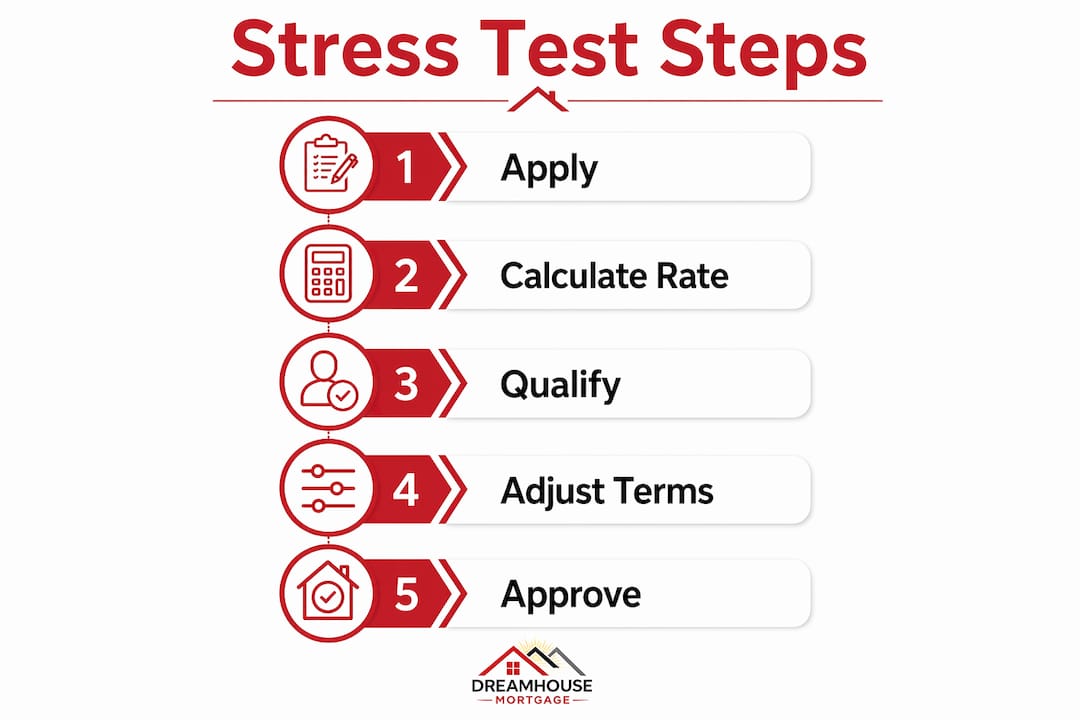
The core OSFI B-20 buffer rule is unchanged in 2026. Every new mortgage purchase, refinance, and switch to a new lender requires passing the stress test. The qualifying rate remains the greater of contract rate plus 2% or 5.25%. What has changed are specific exemptions that matter a great deal to first-time buyers approaching renewal.
The table below shows which transactions require the full stress test and which do not.
| Transaction type | Stress test required? | Notes |
|---|---|---|
| New mortgage purchase | Yes | Full stress test at contract rate + 2% or 5.25% |
| Refinance | Yes | Treated as a new application |
| Switch to new lender (insured mortgage) | Yes | Full stress test applies |
| Switch to new lender (uninsured mortgage) | No full test | Income and credit verification required |
| Renewal with same lender | No | Exempt from full stress test |
The straight switch exemption for uninsured mortgages, introduced in 2024, is one of the most useful rules for buyers who purchased with a 20% or larger down payment. When your mortgage comes up for renewal, you can move to a new lender without a full stress test requalification. Your income and credit are still verified, but the higher qualifying rate does not apply. This gives you real negotiating power at renewal.
Insured mortgage holders do not get the same benefit. Insured straight switches still require passing the full stress test. This is a direct challenge for buyers who purchased between 2020 and 2022 at peak prices with minimum down payments. Their loan balances remain high, and qualifying at today’s stressed rates can be difficult.
The 30-year amortization option for first-time buyers
First-time buyers and buyers of newly constructed homes can now access 30-year amortizations on insured mortgages. This option became available in 2024 and carries a 0.20% CMHC premium surcharge. The longer amortization lowers your monthly payment, which directly improves your GDS and TDS ratios under the stress test calculation.
The monthly payment reduction from extending amortization from 25 to 30 years is approximately 8%. That reduction can be the difference between passing and failing the stress test on a property you can genuinely afford. Buyers in higher-priced markets like Calgary and Chestermere benefit most from this option.
Pro Tip: The 30-year amortization surcharge adds a small cost to your CMHC premium, but the monthly payment savings often outweigh that cost within the first few years. Ask your broker to run both scenarios side by side.
How can first-time buyers in Calgary and Alberta prepare to pass the stress test?
Passing the stress test is a preparation problem, not a luck problem. Buyers who understand the qualification formula can take specific steps to improve their position before they apply. The mortgage pre-approval process is the right time to identify and fix gaps, not after you have made an offer.
Increase your down payment. A larger down payment reduces the mortgage amount you need to qualify for. Even moving from 5% to 10% down on a $500,000 purchase cuts $25,000 from your required mortgage. Smaller mortgage, lower stressed payment, better GDS ratio.
Pay down existing debts before applying. Your TDS ratio includes all monthly debt obligations: car loans, student loans, credit card minimums, and your new mortgage payment. Eliminating a $400 monthly car payment before you apply can add tens of thousands of dollars to your qualifying mortgage amount.
Use the 30-year amortization option. As a first-time buyer, you qualify for a 30-year insured mortgage amortization. The lower monthly payment improves your debt service ratios. The 0.20% CMHC surcharge is a small trade-off for a meaningful qualification advantage.
Document all income sources properly. Lenders use your documented income to calculate GDS and TDS ratios. Part-time income, rental income, and self-employment income all count, but only when properly documented. Two years of Notice of Assessment from the Canada Revenue Agency is the standard requirement for variable income sources.
Reduce credit card balances before applying. Lenders calculate TDS using 3% of your total credit card limit as a monthly obligation, regardless of your actual balance. Paying down balances and requesting limit reductions before applying can meaningfully improve your TDS ratio.
Work with a mortgage broker who accesses multiple lenders. Banks offer only their own products. A broker like Guriqbal Chahal at Dreamhouse Mortgage accesses banks, credit unions, monoline lenders, and alternative lenders. Different lenders apply the stress test to different income types and debt structures. The right lender match can change your qualification outcome.
Get pre-approved before you shop. A mortgage pre-approval locks in a rate for 90–120 days and confirms your stress test qualification in advance. Buyers in competitive Calgary and Airdrie markets who skip pre-approval risk losing properties while their financing is sorted out.
Understanding first-time buyer income requirements in Calgary specifically helps you set realistic targets before you begin the process.
What are common misconceptions about the mortgage stress test for Alberta buyers?
The most damaging misconception is that the qualifying rate is the rate you will actually pay. It is not. The stress test rate is a calculation tool only. You still pay your contract rate, which is typically 2% lower than the qualifying rate. Buyers who confuse these two numbers either panic unnecessarily or miscalculate their actual monthly payments.
The second major misconception involves renewals. Many first-time buyers assume that shopping for a better rate at renewal is always straightforward. Renewals with your existing lender are exempt from the stress test. Switching to a new lender at renewal, however, is treated as a new application. This switching trap means that even if another lender offers a lower rate, you must requalify at the stressed rate to access it. Buyers whose financial situation has changed since their original purchase may not pass.
Common misconceptions that cost Alberta first-time buyers:
- “My pre-approval rate is my qualifying rate.” Pre-approval confirms you qualify at the stressed rate. Your actual payment uses the contract rate.
- “I can always switch lenders at renewal for a better deal.” Insured mortgage holders must pass the full stress test to switch. Uninsured holders benefit from the straight switch exemption introduced in 2024.
- “The stress test only applies to risky buyers.” The stress test applies to all buyers at federally regulated lenders, regardless of credit score or income level.
- “Higher home prices in Calgary don’t affect my stress test.” Local prices directly affect the mortgage size you need, which directly affects whether your income supports the stressed payment.
The renewal negotiation issue deserves specific attention. Staying with your existing lender avoids the stress test but removes your leverage to negotiate. Your lender knows you cannot easily leave without requalifying. The straight switch exemption for uninsured mortgages partially solves this problem, but only for buyers who put 20% or more down. First-time buyers with insured mortgages remain in a weaker negotiating position at renewal until their loan-to-value ratio drops below 80%.
Alberta’s local market adds another layer. Home prices in Calgary, Cochrane, and Okotoks have risen considerably over the past several years. Higher prices require larger mortgages. Larger mortgages require higher incomes to pass the stress test. Buyers who qualify comfortably in Red Deer may face a harder test on the same income in Calgary simply because the required mortgage amount is larger. Understanding insured mortgage rules in the context of Alberta pricing helps buyers set realistic targets.
Key Takeaways
The mortgage stress test requires all first-time buyers in Alberta to qualify at their contract rate plus 2% or 5.25%, whichever is higher, reducing approved mortgage amounts by roughly 15–20%.
| Point | Details |
|---|---|
| Qualifying rate formula | Use contract rate + 2% or 5.25%, whichever is higher, for all stress test calculations. |
| Borrowing power reduction | Approved mortgage amounts typically drop 15–20% compared to qualifying at the actual contract rate. |
| Debt service ratio limits | GDS must be 39% or lower and TDS must be 44% or lower for insured mortgage approval. |
| 30-year amortization benefit | First-time buyers can extend to 30 years with a 0.20% CMHC surcharge, lowering monthly payments by roughly 8%. |
| Switching lender exemption | Uninsured mortgage holders can switch lenders at renewal without a full stress test; insured holders cannot. |
Dreamhouse Mortgage helps Alberta first-time buyers qualify with confidence
Passing the stress test is a preparation problem, and preparation requires the right guidance. Dreamhouse Mortgage, led by Guriqbal Chahal, MBA, PMP, works with first-time buyers across Calgary, Airdrie, Cochrane, Chestermere, Okotoks, Edmonton, Red Deer, and surrounding Alberta communities to build qualification strategies before applications are submitted.
The brokerage accesses banks, credit unions, monoline lenders, and alternative lenders to match each buyer with the lender whose qualification criteria fit their income structure and debt profile. Knowing the right questions to ask your mortgage broker before you apply puts you in a stronger position from day one. For personalized stress test preparation, rate comparisons, and mortgage pre-approval, contact Guriqbal Chahal directly at 403-966-6072 or book a free consultation. You can also find Dreamhouse Mortgage on Google.
FAQ
What is the mortgage stress test qualifying rate in 2026?
The qualifying rate is the greater of your contract rate plus 2% or the 5.25% benchmark floor. A contract rate of 4.5% means you qualify at 6.5%.
Do first-time buyers in Alberta have to pass the stress test?
Yes. All buyers applying for a mortgage at a federally regulated lender must pass the stress test, regardless of credit score, income level, or down payment size.
Are there any stress test exemptions for first-time buyers?
Renewals with your existing lender are exempt. Buyers with uninsured mortgages can also switch lenders at renewal without a full stress test under the 2024 straight switch rule. Insured mortgage holders must pass the full stress test to switch lenders.
How does the 30-year amortization help with the stress test?
A 30-year amortization lowers your monthly mortgage payment by approximately 8% compared to a 25-year term. The lower payment improves your GDS and TDS ratios, making it easier to pass the stress test. A 0.20% CMHC premium surcharge applies.
How much does the stress test reduce my approved mortgage amount?
The stress test typically reduces your approved mortgage amount by 15–20% compared to qualifying at your actual contract rate. The exact reduction depends on your income, debts, and the difference between your contract rate and the qualifying rate.