
Negotiating a better mortgage renewal rate is the single most effective way for Alberta homeowners to save thousands of dollars when their mortgage term ends. Most lenders send a renewal letter with a rate that is not their best offer. That first number is a starting point, not a final answer. Homeowners in Calgary, Airdrie, Cochrane, Edmonton, and Red Deer who treat renewal as a negotiation rather than a formality consistently secure lower rates and better terms. This guide explains exactly how to prepare, what to say, and when to act to get the best possible outcome at renewal in 2026.
How to start preparing for mortgage renewal negotiation
Preparation is the single biggest factor separating homeowners who save money at renewal from those who overpay. The window matters. Starting 120 days before maturity gives you time to lock or hold a rate, gather competing quotes, and negotiate from a position of strength. Waiting until 30 days out leaves almost no leverage.
The standard industry term for this process is “mortgage renewal negotiation,” and it follows a clear timeline:
- 6 months before maturity: Begin monitoring current mortgage rates in Alberta. Check Dreamhouse Mortgage’s current mortgage rate trends to understand where the market sits.
- 120 days before maturity: Contact lenders and brokers to request rate holds. Many lenders allow a formal rate hold at this stage.
- 90–60 days before maturity: This is the active negotiation window. Obtain written competing offers and present them to your current lender.
- 30 days before maturity: Finalize your decision. If switching lenders, paperwork and legal steps need time to complete.
Gather the following documents before you start any negotiation:
- Your current mortgage statement showing the outstanding balance and amortization remaining
- Your most recent renewal letter from your lender
- Proof of income and a recent credit check (useful if switching lenders)
- At least one written competing offer from another lender or broker
Pro Tip: Get your competing quotes in writing, not just verbal estimates. A written offer from a credit union, monoline lender, or another bank gives you real credibility when you call your lender’s retention team.
Homeowners who negotiate without written quotes lose leverage immediately. The lender’s retention team responds to documented competing offers, not general statements about shopping around.
How to negotiate a better rate with your current lender
Your lender’s first renewal offer is a pricing anchor, not a final rate. Borrowers regularly move from initial renewal rates of 4.20–4.29% down to negotiated rates between 3.69–3.99% after two calls and presenting written competing quotes. That difference on a $400,000 mortgage balance adds up to thousands of dollars over a five-year term.
Follow these steps to negotiate effectively:
Request a written competing offer first. Contact a mortgage broker, credit union, or monoline lender and ask for a written quote matching your current term length and mortgage type. Make sure the quote includes the rate, term, prepayment privileges, and penalty structure.
Call your lender’s retention team directly. Do not call the general branch line or speak with a teller. Ask specifically for the mortgage retention department or mortgage specialist. These staff members have discounting discretion of 0.10–0.25% below the official renewal offer and are focused on keeping your business.
Present your competing offer clearly. State the rate and lender name from your written quote. Say directly that you are prepared to switch if your current lender cannot match or beat the offer.
Negotiate terms, not just rate. Ask about prepayment privileges, cashback incentives, and penalty calculation methods. A rate that is 0.05% lower but carries a harsher penalty structure may cost more over the full term.
Give the retention team 24–48 hours. They often need to escalate to a supervisor for the best discount. Follow up in writing by email to create a paper trail.
Compare the final offer against your competing quote. If your lender matches or beats the competing offer on both rate and terms, staying is likely the right call. If not, switching becomes a serious option.
“Your lender’s renewal letter is an opening offer. Treat it the same way you would treat the sticker price on a car. The real negotiation starts when you walk in with a competing quote in hand.”
Pro Tip: Always confirm the competing offer is for the same term length and mortgage type as your current mortgage. A five-year fixed competing quote is not a fair comparison against a three-year variable offer from your current lender.
Dreamhouse Mortgage’s guide on mortgage broker rate negotiation explains how a broker can handle this entire process on your behalf, often accessing rates that are not publicly advertised.

Should you stay with your current lender or switch?
Switching lenders at renewal in Calgary and across Alberta is easier than most homeowners realize, especially after a significant regulatory change. OSFI’s rule change, effective november 21, 2024, removed the stress test requirement for uninsured straight switches at renewal. This means uninsured borrowers can now switch lenders without requalifying under the mortgage stress test, as long as the loan amount and amortization remain the same. That change removed one of the biggest barriers to switching lenders in Alberta.
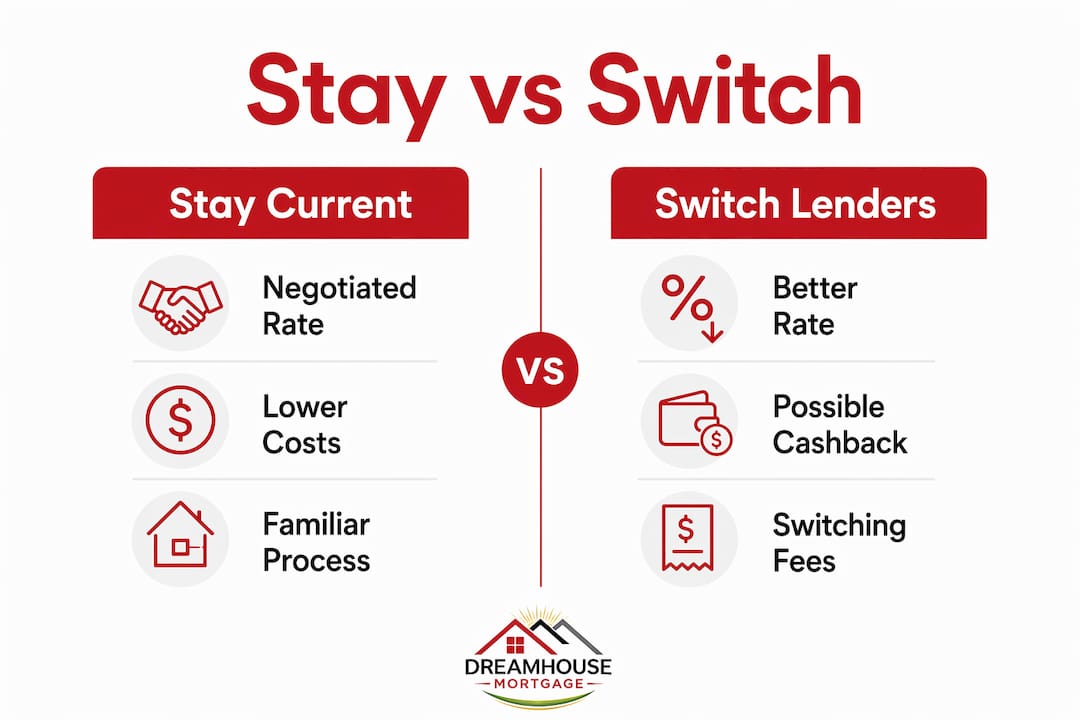
The decision still comes down to numbers. Switching costs range from $800 to $1,500 in Alberta and typically include legal fees, discharge fees, and sometimes an appraisal. Those costs must be weighed against the savings from a lower rate.
Break-even example: On a $450,000 mortgage balance, a rate difference of 0.25% saves roughly $1,125 per year in interest. If switching costs total $1,200, you break even in just over one year. Over a five-year term, the net saving is approximately $4,425. That math favors switching.
| Factor | Staying with current lender | Switching lenders |
|---|---|---|
| Rate potential | Negotiated discount of 0.10–0.25% below initial offer | Potentially 0.15–0.40% below current lender’s best offer |
| Switching costs | None | $800–$1,500 in legal, discharge, and appraisal fees |
| Stress test required | No | No (for straight switches since nov 21, 2024) |
| Effort required | Low to moderate | Moderate |
| Prepayment options | Depends on lender | May improve with new lender |
| Loyalty benefits | Possible cashback or rate match | Cashback offers common with new lenders |
Pro Tip: Switch if the net savings over the full term clearly exceed total switching costs. A break-even period of under 18 months on a five-year term is a strong signal to switch.
Homeowners in Calgary, Cochrane, and Airdrie who are considering switching lenders can review Alberta mortgage renewal options at Dreamhouse Mortgage to compare lender options across banks, credit unions, and monoline lenders.
What other terms can you negotiate beyond interest rate?
Rate is the most visible number in a renewal offer, but it is not the only one that matters. Comparing renewal offers requires matching structural terms like prepayment privileges, penalty calculation methods, and offer expiry dates. Ignoring these factors can hide real costs behind a lower advertised rate.
The following terms are all negotiable at renewal and can add significant financial value:
Prepayment privileges: Most lenders allow 10–20% lump sum prepayments per year without penalty. A lender offering 20% prepayment flexibility gives you more room to pay down your mortgage faster. Ask specifically what percentage is allowed annually and whether you can increase regular payments.
Cashback offers: Some lenders offer cashback at renewal, typically 1–2% of the mortgage balance, in exchange for a slightly higher rate. On a $400,000 balance, a 1% cashback equals $4,000 upfront. Run the math to see whether the cashback outweighs the higher rate cost over the full term.
Amortization reset: At renewal, you may be able to extend your amortization back toward 25 or 30 years, which lowers monthly payments. This is not always the right financial move, but it is an option worth understanding.
Penalty structure: Fixed-rate mortgages typically carry an Interest Rate Differential (IRD) penalty if broken early. Some lenders calculate IRD more favorably than others. Ask how the penalty is calculated before signing.
Offer expiry date: Written competing quotes have expiry dates. Make sure you know when each offer expires so you do not lose a favorable rate while negotiating.
The table below shows how two offers with similar rates can differ significantly in true cost:
| Term detail | Lender A | Lender B |
|---|---|---|
| Rate (5-year fixed) | 4.09% | 4.14% |
| Prepayment privilege | 10% annually | 20% annually |
| Penalty method | IRD (lender posted rate) | IRD (bond yield method) |
| Cashback | None | 1% of balance |
| Offer expiry | 30 days | 90 days |
Lender B’s offer in this example may deliver more total value despite the slightly higher rate. The cashback and better prepayment flexibility can outweigh the 0.05% rate difference for many homeowners.
Pro Tip: Ask every lender to provide the full penalty calculation method in writing before you commit. A lower rate with a punishing IRD formula can cost far more than a slightly higher rate with a simpler penalty structure.
Quotes must be compared on all terms, not rate alone, to make a true apples-to-apples financial comparison. A mortgage broker can pull multiple quotes and lay them out side by side so you can see the full picture clearly.
Key Takeaways
Negotiating a better mortgage renewal rate requires starting early, obtaining written competing offers, and engaging your lender’s retention team with specific terms and documented alternatives.
| Point | Details |
|---|---|
| Start 120 days early | Begin monitoring rates and requesting competing quotes at least 120 days before your maturity date. |
| Use written competing offers | Retention teams respond to documented quotes, not verbal claims; always get offers in writing. |
| Retention teams can discount | Lender retention specialists typically have discretion to reduce rates by 0.10–0.25% below the initial offer. |
| Switching is easier post-2024 | OSFI’s november 2024 rule removed the stress test for uninsured straight switches, making lender changes simpler. |
| Negotiate beyond rate | Prepayment privileges, cashback, penalty structure, and amortization terms all affect total mortgage cost. |
Dreamhouse Mortgage can help you negotiate your renewal
Guriqbal Chahal, MBA, PMP, Mortgage Broker and Broker of Record at Dreamhouse Mortgage, works with homeowners across Calgary, Airdrie, Cochrane, Chestermere, Red Deer, and Edmonton to secure competitive renewal rates. Dreamhouse Mortgage accesses banks, credit unions, monoline lenders, and alternative lenders to generate written competing offers on your behalf. The team handles lender retention calls, paperwork, and rate comparisons so you do not have to navigate the process alone.

Whether you are deciding between staying with your current lender or switching lenders at renewal, Dreamhouse Mortgage provides clear, objective advice tailored to your financial situation. Guriqbal Chahal also advises on mortgage refinancing in Calgary for homeowners who want to access equity or restructure their mortgage at renewal.
Contact Guriqbal Chahal, MBA, PMP, Mortgage Broker, Dreamhouse Mortgage at 403-966-6072 or visit the Google Business Profile to book a free consultation.
FAQ
How early should I start negotiating my mortgage renewal?
Start the process 120 days before your maturity date. This gives you time to hold a rate, gather written competing offers, and complete the active negotiation window between 90 and 60 days before maturity.
Can I switch lenders at renewal without a stress test in Alberta?
Yes. Since november 21, 2024, OSFI rules allow uninsured borrowers to switch lenders without requalifying under the mortgage stress test, provided the loan amount and amortization remain unchanged.
What is a retention team and why does it matter?
A retention team is a specialized group within your lender focused on keeping existing customers. Retention specialists have discretion to offer rates 0.10–0.25% below the official renewal offer, which branch staff typically cannot match.
What switching costs should Alberta homeowners expect?
Switching costs in Alberta range from $800 to $1,500 and typically include legal fees, discharge fees, and appraisal costs. Compare these costs against the total interest savings over your new term to determine whether switching makes financial sense.
Is rate the only thing worth negotiating at renewal?
No. Prepayment privileges, cashback offers, penalty calculation methods, and amortization terms all affect the true cost of your mortgage. Comparing offers on rate alone can obscure significant cost differences between lenders.