Working with a mortgage broker is usually the fastest way for a Calgary buyer to see competitive RBC and Scotiabank pricing side by side. Two federal rules shape every offer you will receive: the minimum down payment schedule and the mortgage stress test. Below, we explain fixed versus variable products, how to compare offers line by line, and the next steps to lock in a rate.
TL;DR:
- Both banks must qualify borrowers at the higher of 5.25% or the contract rate plus 2%, so a lower quote can also raise borrowing capacity.
- Buyers need 5% of the first $500,000, 10% of the portion from $500,000 to $1.5 million, and 20% above $1.5 million.
- Compare written offers for the same term and rate type, recording the contract rate, hold period, fees, prepayment limits, portability, and penalty formula.
- A lower advertised rate may cost more if an early sale triggers a harsh penalty; open mortgages avoid repayment penalties but charge higher rates.
- Major banks can compete strongly for uninsured, large balance mortgages, while smaller lenders may underprice insured loans, so compare the broader market before choosing.
Table of Contents
- What separates fixed, variable, open and closed mortgages at the big banks?
- How do you read posted rates and special rates?
- How do you compare two mortgage offers step by step?
- What are the down payment rules and stress test you must pass?
- Why does a broker often get you faster access to big-bank pricing?
- Who is behind this advice, and what do we offer Calgary buyers?
- What does RBC offer in mortgage products and features?
- How do RBC and Scotiabank mortgage rates compare?
- How do fees, penalties and prepayment options compare?
- What are the customer service and support differences?
- What eligibility criteria apply at RBC and Scotiabank?
- Why a local broker beats comparing banks alone
- Ready to compare RBC and Scotiabank offers in Calgary?
- FAQ
- Sources
What separates fixed, variable, open and closed mortgages at the big banks?
Both RBC and Scotiabank organize their mortgage shelves around the same product families. Once you understand those families, the two banks’ product pages become much easier to read, and you can judge which one fits your plans before you ever compare a rate.
Fixed-rate mortgages lock your interest rate for the full term. Terms vary by mortgage, and buyers often choose a term that suits their plans. People pick fixed rates for predictability: your payment on the principal and interest portion stays the same until renewal, which makes budgeting simple. That matters if you are buying in a community like Airdrie, Cochrane or Calgary’s newer southeast neighborhoods and your household budget has little slack.
Variable-rate mortgages are tied to the lender’s prime rate, which moves with the Bank of Canada’s policy rate. When prime falls, you benefit. When it rises, you pay more, either through a higher payment or, in some structures, more of each payment going to interest. Most variable products are offered at a discount or premium to prime, and that spread is a key number to compare.
Closed and open mortgages differ in how much freedom you have to pay down the balance early. A closed mortgage carries a lower rate but limits prepayments and charges a penalty if you break it. An open mortgage lets you repay all or part of the balance at any time without a penalty, but the rate is higher, so it suits people who expect to sell soon or receive a lump sum.
Convertible mortgages start as a short-term or variable product and let you move into a longer fixed term without a penalty. They suit buyers who want to start flexible and lock in later if rates look like they are heading up.
Home equity lines of credit (HELOCs) and equity-style products, such as a total equity plan that bundles a mortgage with a line of credit, are different tools. They let you borrow against the value you have built in your home, usually at a variable rate. They can make sense for renovations or for consolidating higher-interest debt, but they are not a substitute for a standard purchase mortgage.
Here is a quick way to sort the choices:
- Fixed rate: best when you value a steady payment and a predictable budget.
- Variable rate: best when you can absorb payment changes and want a lower starting rate.
- Closed term: best when you plan to stay put for the whole term and want the lowest rate.
- Open term: best when you may sell or repay a large amount soon.
- Convertible: best when you want to start flexible and lock in later.
- HELOC or equity plan: best when you need ongoing access to borrowed funds, not a single lump sum.
Pro Tip: Ask each bank for the penalty calculation method in writing before you compare rates. A slightly lower rate with a harsher penalty can cost you more if your plans change.
For a Calgary buyer, the practical question is not which bank has the “best” product family, because both offer all of them. It is which specific combination of rate, term, prepayment privileges and penalty terms fits your next five years. That is exactly why a side-by-side comparison matters, and why we build one for every client who asks.
How do you read posted rates and special rates?
A rate table can look like a straight answer, but the number on the page is not always the number you will pay. Reading it correctly is the first step toward an honest bank-to-bank comparison.
The posted rate is the bank’s official, advertised rate for a given term. It is mostly a reference point. Many borrowers never pay it, because banks regularly discount from it, and it is the rate that appears in the penalty calculations of some lenders.
A special or promotional rate is the discounted rate the bank advertises to attract new borrowers. It often applies only to certain terms, to insured or uninsured mortgages, or to applications that meet specific conditions, such as a minimum amount or a rate hold period. Read the fine print, because a special rate that applies to a three-year term tells you nothing about a five-year offer.
The contract rate is the rate written into your mortgage agreement. This is the only number that determines what you pay, and it is also the number the stress test builds on. Two buyers walking into the same branch on the same day can leave with different contract rates, depending on their credit, down payment, property type and how well they negotiate.
Bank of Canada policy decisions influence the prime rate, and prime drives variable mortgage rates directly. Fixed rates track bond yields more closely, so they can move even when the policy rate does not. If you want broader background on how these forces play out in 2026, our overview of Canadian mortgage rates walks through the trends and what they mean for your choice of lender.
When you collect a rate snapshot from RBC, Scotiabank or any other lender, record these items so the comparison is fair:
- Term: the length of the contract, such as one, three or five years.
- Rate type: fixed or variable, and for variable, the spread to prime.
- Rate hold length: how many days the lender guarantees the rate while you shop for a home.
- Fees: appraisal, legal, discharge, assignment and any administration charges.
- Prepayment privileges: how much extra you can pay each year without a penalty.
- Penalty method: whether a broken mortgage is charged on a simple interest differential or a larger calculation.
Date every snapshot. Rates change often, and a figure you copied earlier may no longer be available. Published rate roundups such as the RBC mortgage rates coverage on Forbes Advisor are useful for orientation, but the offer in your own name is the one that counts.
The rule that decides most applications: a lender must qualify you at a stricter rate than the one you will actually pay, as the federal qualifier tool describes.
To qualify for a mortgage at a federally regulated institution, you must pass the stress test at the higher of 5.25% or your negotiated contract rate plus 2%. That rule applies to both RBC and Scotiabank, so it shapes which offers you can accept before you compare anything else. (Mortgage Qualifier Tool, Canada.ca)
How do you compare two mortgage offers step by step?
Once you hold two offers, one from RBC and one from Scotiabank, or one from either bank and one from a broker’s lender network, you need a process that removes guesswork. Here is the one we use with clients across Calgary, Airdrie and Cochrane.
- Gather the facts. Write down the contract rate, rate type, term, amortization, monthly payment and every fee for each offer. Put them in one table or spreadsheet so nothing is missed.
- Compute the cost. Project your monthly payment and your total interest over the term you are considering. A mortgage calculator does the arithmetic, and the difference between offers often looks small monthly but meaningful over the term.
- Check flexibility. Compare prepayment privileges, portability (can you move the mortgage to a new home), penalty methods and renewal terms. A product that is cheap but rigid can become expensive the moment your life changes.
- Account for the stress test. Confirm that you qualify at the stress-test rate on each offer, not just at the contract rate.
- Ask the questions below before you decide, and get the answers in writing.
Questions worth asking each lender or your broker:
- What is the exact contract rate for my term, and how long is it held?
- How is the penalty calculated if I break the mortgage early?
- What annual lump-sum and payment-increase privileges do I have?
- Is the mortgage portable, and under what conditions?
- Are there fees for appraisal, legal work, discharge or transfer?
- What happens at renewal, and can I switch lenders without penalty?
A short phone or email script keeps the conversation focused. You can say: “I have an offer at [rate] for a [term] closed mortgage. Before I decide, can you confirm your best contract rate for the same term, your penalty method, and your prepayment privileges? Please send the details in writing so I can compare.”
Pro Tip: Use a written offer from one lender as leverage with another. Banks know that a documented competing quote is a serious signal, and they will often match or improve their terms to keep your business.
If you are working through the pre-approval stage, our guide to the mortgage pre-approval process for Alberta buyers shows how a rate hold fits into the timeline between getting approved and making an offer on a home.
What are the down payment rules and stress test you must pass?
Every offer you compare is limited by two federal rules. They determine how much you must save and how much payment you can be approved for, so they deserve attention before you fall in love with a rate.
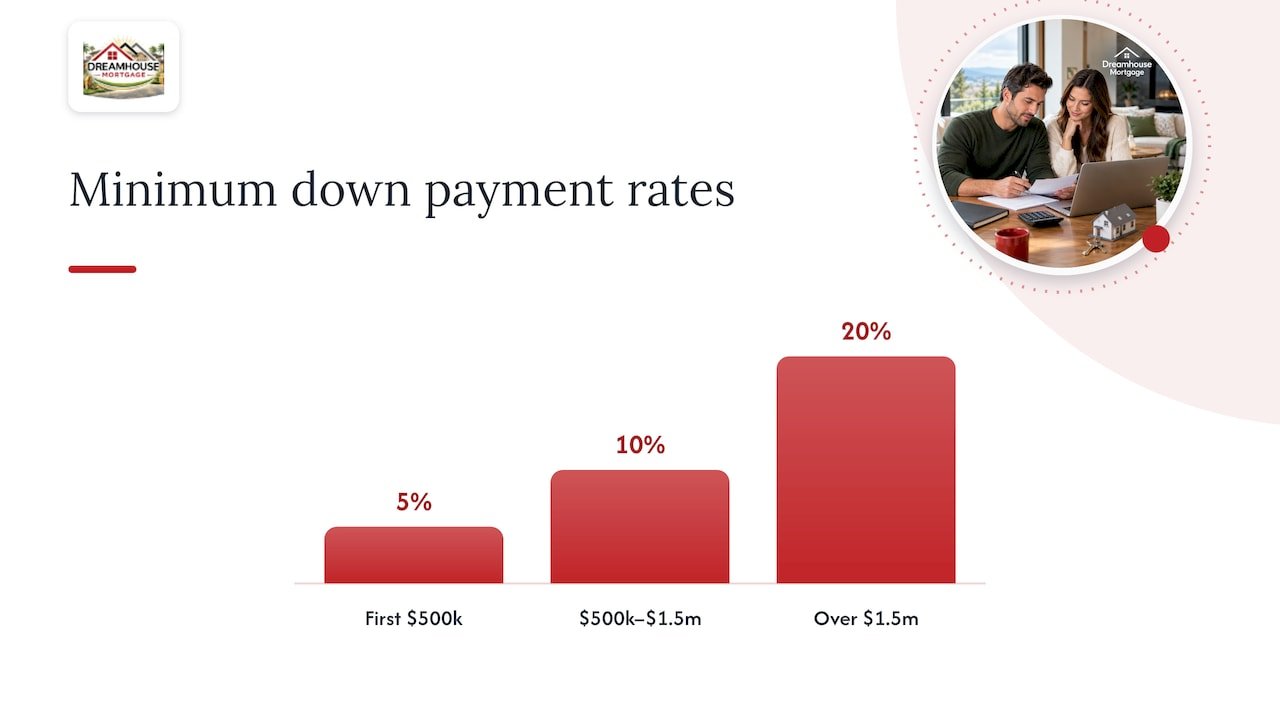
The minimum down payment rules, as published by the Government of Canada, work in tiers:
- 5% of the first $500,000 of the purchase price.
- 10% of the portion between $500,000 and $1.5 million.
- 20% on any amount over $1.5 million, meaning homes priced at $1.5 million or more require a 20% down payment.
The insured-mortgage price cap rose to $1.5 million in December 2024, which opened the smaller-down-payment route to more buyers in markets like Calgary. You can read the full schedule on the Canada, and the reform details are described in the government’s announcement of the mortgage reforms.
For a deeper look at how the different kinds of down payment funds are treated, see our guide to mortgage down payment types in Canada.
The stress test is the second filter. Federally regulated lenders, which include both RBC and Scotiabank, must qualify you at the higher of 5.25% or your contract rate plus 2%.
Stress test qualifying rate: the greater of 5.25% or your contract rate plus 2%. (Canada.ca Mortgage Qualifier Tool)
The practical effect is that your approved amount is calculated using a payment higher than the one you will actually make. A small gap between lenders’ contract rates therefore changes your qualifying amount, not just your monthly bill. Our breakdown of the OSFI stress test and a 0.20% rate gap models what that difference looks like in Calgary dollars, and our stress test guide for first-time buyers covers the mechanics in more detail.
If you do not qualify on your first pass, you still have options:
- Increase your down payment, even slightly, to reduce the amount you need to borrow.
- Shorten or adjust amortization where the rules allow, to change the payment calculation.
- Reduce other debts so your monthly obligations fall relative to income.
- Add a co-borrower whose income strengthens the application.
- Work with a broker, who can match your profile to lenders whose guidelines fit it.
One note for buyers who have not yet found a home: pairing a pre-approval with a good agent speeds everything up. A practical explainer on how to get a mortgage pre-approval in Canada covers what the document includes, and it is a useful companion to the steps above.
Why does a broker often get you faster access to big-bank pricing?
A bank can sell you only its own mortgage products. A broker works with many lenders and can recommend products from across the market, which gives you a wider selection and a direct way to compare offers, as NerdWallet Canada’s broker versus bank comparison explains.
For a Calgary buyer, the advantage is practical. A broker can help you seek quotes from several lenders, including the big banks you are curious about. Instead of walking into one branch after another, you receive a comparison already organized around your priorities.
The strongest approach for Alberta buyers, according to RE/MAX’s discussion of banks versus brokers, is to obtain competitive multi-lender quotes from an experienced broker first, then use those figures to negotiate loyalty pricing or matching terms with a bank you already use. Your relationship with your bank is an asset, and a documented competing quote is how you put it to work.
Large banks can also be very competitive in their own right. The Globe and Mail notes that big banks can be strongest on uninsured and large-balance mortgages thanks to their balance-sheet advantages, while smaller lenders sometimes undercut on insured mortgages, in its piece on choosing between a big bank and a smaller lender. That is why we never assume the answer in advance. We pull the offers and let the numbers decide.
A direct-bank route can make sense when you value a single relationship for chequing, savings and investments, or when your bank offers a package that rewards that loyalty. Even then, a broker quote gives you a benchmark to hold your bank to.
The workflow we follow with Calgary buyers looks like this:
- Pre-approval first. We confirm what you qualify for and secure a rate hold.
- Multi-lender quotes. We gather offers from lenders that fit your profile, including major banks.
- Side-by-side comparison. We compare rate, term, penalties, privileges and fees, not just the headline number.
- Selection and negotiation. You choose the best fit, and we negotiate where there is room.
- Approval and closing. We coordinate documents, lender conditions and funding with your lawyer.
Pro Tip: Start the broker conversation before you make an offer on a home. A rate hold and a clear budget let you act quickly in a competitive Calgary market.
Who is behind this advice, and what do we offer Calgary buyers?
You deserve to know who is guiding your decision. This article is written by Guriqbal Chahal, MBA, PMP, Mortgage Broker and Broker of Record at DreamHouse Mortgage, and it reflects how we actually work with clients every week.
- Our Broker of Record: Guriqbal Chahal leads files with a project-management discipline that keeps timelines and documents on track.
- Our history: we have focused on Alberta, so we know the local market, from inner-city Calgary to Airdrie, Cochrane, Chestermere, Okotoks and High River.
- Our services: first-time buyer mortgages, mortgage pre-approval, new-to-Canada mortgages, refinancing, renewals, debt consolidation, self-employed mortgages and investment property financing.
- Our lender access: banks, credit unions, monoline lenders, alternative lenders and private lenders, so your file is matched to the lender whose guidelines suit it.
- Our process: multi-lender quotes, negotiation on your behalf and coordination of funding, so you are not chasing paperwork alone.
If you are buying your first home, our first-time homebuyer mortgage guide for Calgary walks through the whole path in plain language.
What does RBC offer in mortgage products and features?
RBC, one of Canada’s largest banks, offers the full family of products described earlier: fixed and variable mortgages, open and closed terms, convertible options and equity-based lending that lets you borrow against your home. Terms are available across the typical range, and the bank serves both first-time buyers and experienced owners through its branch network and digital tools.
What matters when you evaluate an RBC mortgage is not the product list but the details attached to it: the contract rate for your specific term, the prepayment privileges that come with a closed mortgage, the penalty method, the length of the rate hold and any fees that apply at closing. Published rate coverage, such as Forbes Advisor’s RBC rate roundup pages, gives a snapshot of current fixed and variable pricing, but the offer in your own name is what you act on.
RBC also gives existing clients the convenience of one relationship across mortgage and everyday banking. For some buyers that convenience is a genuine tie-breaker. For others, a competing multi-lender quote shows that a different structure fits better. Our role is to put the RBC offer on the table next to the alternatives, so you choose with all the facts in view.
How do RBC and Scotiabank mortgage rates compare?
Neither bank holds a permanent advantage on price. Rates for both institutions change frequently, and each periodically runs promotions on particular terms, so a comparison that favors one on Monday can flip by the following month. That is why the most honest answer to which bank is cheaper is “it depends on the day, the term and your file.”
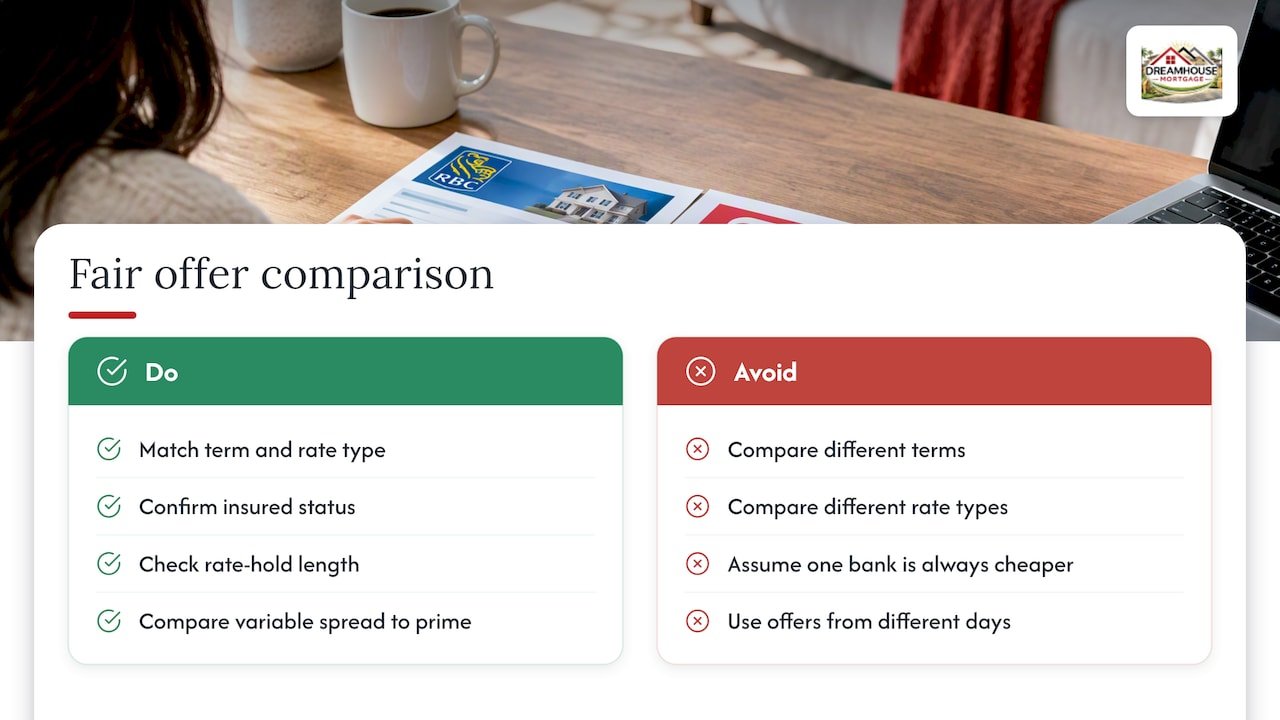
What you can compare reliably is structure. Look at the same term and rate type at both banks, confirm whether each quote is for an insured or uninsured mortgage, and check the rate hold length. A 5-year fixed from one bank compared with a 3-year fixed from the other tells you nothing useful. Match term to term, and variable to variable, and compare the spread to prime in the variable case.
Your own profile moves the numbers too. Credit history, down payment size, property type and loan amount all influence the contract rate each bank is willing to give you. A buyer with a 20% down payment may receive different pricing from one with 5% down, even at the same bank on the same day.
Rate gaps look small and still matter. Our RBC versus TD analysis discusses how a rate gap can affect monthly cost and the amount you qualify for under the stress test. The same logic applies to any pairing, including RBC and Scotiabank. The reliable move is to collect both offers on the same day, with the same assumptions, and let a broker lay them next to the wider market.
How do fees, penalties and prepayment options compare?
Rate is only one line on the page. Fees, penalties and prepayment options often decide which mortgage costs less in real life, especially if your circumstances change before the term ends.
Prepayment privileges let you pay down your balance faster without a penalty. Typical features across big-bank closed mortgages include an annual lump-sum limit, often expressed as a percentage of the original principal, and the ability to raise your regular payment by a set percentage. The exact limits differ by bank and by product, so ask each lender for the figures that apply to the specific mortgage you are considering. Our tips on paying down your mortgage faster in Alberta explain how to put those privileges to work.
Penalties apply when you break a closed mortgage before the term ends, for example because you sell or refinance. The method a lender uses to calculate that penalty can matter more than a small rate difference, so request the formula in writing and, if possible, a worked example for your balance and term.
Fees can include appraisal, legal and discharge charges, plus any assignment or administration fee. Some are covered by lender incentives on certain products. Always ask which costs are yours.
Portability lets you carry your mortgage to a new home when you move. If you expect to upgrade within a few years, a portable mortgage can save you a penalty, so confirm the conditions for it.
Build a simple comparison grid with a row for each of these items and a column for each bank, and fill it in from written quotes. That small exercise often reveals that the cheaper-looking offer is the more restrictive one.
What are the customer service and support differences?
Service quality is hard to compare on paper, but it shapes your experience at the moments that matter: during approval, when you need a document turned around, and at renewal. Both RBC and Scotiabank run large branch networks, phone support and online banking platforms, and both employ mortgage specialists who work with buyers directly.
The real differences are personal and local. The responsiveness of your particular mortgage specialist, how quickly conditions are cleared, and how easy it is to reach the same person twice can vary from branch to branch and from week to week. A reputation for strong service in one city does not guarantee the same experience at your branch in Calgary or Cochrane.
If you already bank with one of them, you may find that having your accounts in one place makes document collection and funding smoother. If you are a newcomer to the bank, you may find that a broker adds service value of its own, since we stay your point of contact through approval and closing instead of leaving you to relay documents between departments.
A practical approach is to test service before you commit. Ask each lender how long a pre-approval takes, who your contact is, and how you will be updated. Their answers, and how quickly they arrive, tell you more than any generic rating.
What eligibility criteria apply at RBC and Scotiabank?
Both banks are federally regulated, so the same national framework governs who qualifies. Each application is assessed on income and its stability, credit history, existing debts, the size of your down payment, the property being purchased and your ability to pass the stress test at the higher of 5.25% or your contract rate plus 2%. As NerdWallet Canada’s lender guide notes, the largest lenders typically offer very competitive rates but apply the strictest qualifying criteria.
Within that framework, each bank applies its own internal guidelines. They may treat self-employed income, rental income, recent employment changes or a short credit history differently. A file that is a clean approval at one lender can need extra documents at another.
Newcomers should note that eligibility for those new to Canada is often handled through specific programs, and documentation requirements differ. Our team supports new to Canada mortgage applications regularly, and we also help self-employed borrowers present their income clearly, as covered in our add-back income mortgage guide.
If your credit needs strengthening before you apply, our guidance on improving the credit score needed for a mortgage lays out practical steps. The key is to ask early which lender’s guidelines match your situation, rather than applying blindly and risking a decline that you did not need.
Why a local broker beats comparing banks alone
The conventional advice is to pick a favorite bank and ask for its best rate. That advice falls short for a simple reason: a single bank can only show you its own shelf, so you never learn what you are missing. The most underrated skill in mortgage shopping is not haggling harder. It is knowing what the whole market will offer you before the conversation starts.
In our view, the order of operations matters more than the brand name. First, learn the two federal rules that set your limits, the down payment tiers and the stress test. Second, gather several offers on the same day with the same assumptions. Third, compare structure, not just rate: penalties, prepayment privileges, portability and renewal terms. Only then should loyalty to a bank come into play, and even then it should be tested against a documented competing quote.
The riskiest habit we see is chasing the lowest advertised rate and discovering the cost of a rigid penalty clause two years later. A mortgage should fit the life you are likely to live, not only the spreadsheet you built on day one. A local broker who knows Calgary and the surrounding communities can match both the numbers and the lifestyle.
— Guriqbal Chahal, MBA, PMP
Ready to compare RBC and Scotiabank offers in Calgary?
If you are buying in Calgary, Airdrie or Cochrane, we will do the comparison work for you. Our team pulls offers from the big banks and our wider lender network, lays them side by side, and negotiates on your behalf.

Here is what we can start on today:
- Mortgage pre-approval in Calgary, with a rate hold so you can shop with confidence.
- First-time home buyer mortgages, with a plain-language walkthrough of every step.
- Mortgage refinancing and renewals, including a review of whether to renew or switch lenders.
- Multi-lender quotes, so you see the market, not just one bank’s shelf.
Call Guriqbal Chahal, MBA, PMP, Mortgage Broker at 403-966-6072 to book your free consultation. You can also see our reviews on our Google Business Profile, or start with our Calgary mortgage pre-approval page and tell us what you are looking for.
FAQ
Which Canadian bank has the best mortgage rates?
No single bank holds the lowest rate all the time. Rates vary by term, by whether the mortgage is insured, and by your own credit and down payment profile. Comparing written offers from several lenders on the same day is the only reliable way to find the best one.
What is a fixed mortgage rate?
A fixed mortgage rate stays the same for the entire term of your contract, so your interest cost and payment do not change until renewal. Terms vary by mortgage. Many buyers choose fixed rates for the predictability they bring to budgeting.
Should I lock in my rate now?
It depends on your risk tolerance and your timeline. A pre-approval with a rate hold lets you protect a rate while you shop, usually for a set number of days, without committing to a specific home. A broker can explain how long a hold lasts at each lender before you decide.
What is the minimum down payment for a home in Canada?
The minimum is 5% of the first $500,000 of the purchase price, 10% of the portion between $500,000 and $1.5 million, and 20% on any amount over $1.5 million, according to the Government of Canada. These tiers apply to both RBC and Scotiabank.
Do RBC and Scotiabank both apply the mortgage stress test?
Yes. Both are federally regulated lenders, so each must qualify you at the higher of 5.25% or your contract rate plus 2%, as the Mortgage Qualifier Tool describes. Passing at one bank means you meet the same national test at the other, though internal guidelines can still differ.
Sources
- Canada
- Mortgage Qualifier Tool – Canada.ca
- Mortgage Broker vs. Bank: Which Is Best? – NerdWallet Canada
- Blog