You can refinance soon after buying a home in Canada, but whether you should depends on three things: the penalty in your current mortgage contract, how much equity you actually hold, and whether you can pass the stress test again. Some lenders suggest waiting about six months to a year so you have a payment history and some equity. Others have their own rules. For many first-time buyers in Calgary, Airdrie and Cochrane, a different tool (a rate switch at renewal, a second mortgage, or simply waiting) costs less. This guide shows you how to tell which applies to you.
TL;DR
- A refinance is a new mortgage contract. You re-qualify under the current stress test, and you usually need an appraisal and a lawyer.
- Breaking a closed mortgage mid-term can trigger a prepayment penalty of thousands of dollars. Ask your lender for a written payout statement before you decide anything.
- Most lenders cap total borrowing on a standard equity take-out at 80% of your home’s appraised value, so a recent purchase with a small down payment leaves little room.
- A straight switch at renewal, with no increase in the amount or amortization, is treated differently from a refinance and avoids the stress test at many lenders.
- Run the full cost, including penalty, appraisal, legal and Alberta Land Titles fees, against the savings before you sign.
Table of Contents
- What “refinancing after purchase” actually means
- Why buyers consider refinancing so soon
- How soon can you refinance after buying?
- The stress test applies again
- What it costs: penalty, discharge, appraisal, legal and land titles
- Alternatives to a full refinance
- Which situations make early refinancing sensible?
- Self-employed and newer buyers
- Our perspective: what we tell first-time buyers before they refinance
- Step-by-step: how a refinance after purchase works
- How DreamHouse Mortgage can help
- FAQ
- Sources
What “refinancing after purchase” actually means
People use the word loosely. In Canada it helps to separate four different moves, because each has different rules and different costs.
| Move | What changes | Stress test? | Typical timing |
|---|---|---|---|
| Refinance | New mortgage replaces the old one, often with a larger amount, new rate or longer amortization | Yes | Mid-term or at renewal |
| Straight switch | Same balance and amortization, new lender | Generally exempt for uninsured mortgages | At renewal |
| Renewal with current lender | New term, same balance | Typically no | At renewal |
| Second mortgage or HELOC | Existing mortgage stays; new loan registered behind it | Depends on the lender | Any time, subject to equity |
The Financial Consumer Agency of Canada explains that a refinance is a new mortgage contract, so you must qualify again. This applies even if you stay with your current lender and simply extend your amortization. The OSFI guidance on straight switches is the reason a switch at term end, with no increase to the loan amount or amortization, is handled differently from a true refinance.
That distinction matters more than most buyers realize. If your only goal is a lower rate, waiting for renewal and switching can get you there without re-qualifying. If you need cash or a different structure now, a refinance is the route.
Why buyers consider refinancing so soon
The reasons we hear most often from Calgary-area buyers fall into a handful of groups.
- Rates dropped after you signed. You locked a rate on a purchase in a higher-rate period and see lower rates advertised now.
- You need cash for work on the house. A new-build in Cranston or Auburn Bay may need landscaping, a fence or a basement development. An older home in Marda Loop or Airdrie may need a roof or furnace.
- High-interest debt is piling up. Moving, furniture and a first-year budget shock can push credit card balances up.
- Your income or household changed. A partner joins the mortgage, a self-employed buyer now has a full tax year of income to show, or a job changes.
- You want a different product. Moving from a variable to a fixed rate, or the reverse, or a different amortization.
Each of these has a cheaper alternative in some cases, which is why we walk through the numbers before recommending a refinance. For a broader view of the timing question in our market, see our guide on when to refinance a mortgage in Calgary.
How soon can you refinance after buying?
There is no single federal rule that sets a waiting period. What you will meet instead are lender policies and the practical limits of your equity.
Lender policy. Some lenders want a few months of payment history, and some want the purchase to have been registered at Land Titles for a set time before they release equity. These policies differ between banks, credit unions, monoline lenders and alternative lenders, and they change. Because a broker can compare several lenders, this is one place where access to more than one policy helps.
Equity. This is the hard limit. Home equity is the difference between the home’s appraised value and what you owe, and the FCAC notes that lenders typically cap total borrowing at 80% of appraised value for a standard equity take-out. If you bought with 5% down, you start with 95% loan-to-value. Your balance has to fall, or your home value has to rise meaningfully, before there is anything to take out.
Pro Tip: If you bought with a high-ratio, insured mortgage and put down less than 20%, you will usually reach 80% loan-to-value slowly. Check your current balance against a realistic value for your neighbourhood before paying for an appraisal.
A worked example
The numbers below are hypothetical and for illustration only. They are not an offer or a quote.
- Purchase price: $550,000, with a mortgage of $522,500 (5% down, ignoring any insurance premium added to the loan).
- Two years later the balance is about $505,000 and an appraiser values the home at $600,000.
- 80% of $600,000 is $480,000. Your balance of $505,000 is already above that, so there is no room for an equity take-out.
Now change one number: if you had put down 20% at the start, with a balance of about $430,000 today, the same $480,000 ceiling would leave about $50,000 of room. The only thing that moved was the starting down payment. This is why the same question gets very different answers for two neighbours on the same street.
We also cover the options for homeowners who do have equity in best home equity refinancing options for Alberta homeowners.
The stress test applies again
When you refinance, lenders treat it as a new mortgage and test you again. For uninsured mortgages, OSFI sets the minimum qualifying rate at the greater of your contract rate plus 2% or 5.25%. The FCAC applies the same logic when it describes how you must prove you can afford payments at that qualifying rate.
In practice, here is what that means for you:
- A contract rate of 4.5% is qualified at 6.5%, because that is higher than 5.25%.
- A contract rate of 3.0% would be qualified at 5.25%, because adding 2% gives only 5.0%.
- Your income, other debts, property taxes and heating costs all go into the ratio calculation.
The federal calculator lists general guideposts of 39% for gross debt service and 44% for total debt service. Individual lenders can set their own limits, and some alternative lenders work differently. We explain both ratios in our guide to the GDS and TDS ratio in Calgary.
Pro Tip: If your income dropped, or you took on a car loan or a line of credit after buying, your ratios may be worse than they were at purchase. Pay off small balances and avoid new credit applications before you apply to refinance.
What it costs: penalty, discharge, appraisal, legal and land titles
The interest rate is only one line on the page. A refinance is worth doing when the savings exceed the full cost, so list every cost before you decide.
1. The prepayment penalty
If you break a closed mortgage before the term ends, the lender can charge a penalty. The FCAC says that renegotiating or breaking the contract mid-term may involve a penalty, and that you should ask your lender what it would be. The amount depends on the wording of your contract, the type of rate and the lender. It can run into thousands of dollars.
Ask for a written payout statement. In our article on Calgary mortgage penalties, we list the inputs to request from a lender so you can check the figure instead of taking it on faith.
2. Discharge and administrative fees
Your old lender removes its charge from your title when the mortgage is paid out. The FCAC’s page on discharging a mortgage explains what that involves. Typical lender discharge or administrative fees run from nothing to a few hundred dollars, with $400 a common upper figure, but your payout statement shows the exact number.
3. Appraisal, title search and legal fees
Expect a new appraisal to confirm value, plus a lawyer or notary to register the new mortgage. Across appraisal, title search and legal work, the combined figure often falls between $400 and $2,500, depending on the lender, the property and who is paying. Some lenders cover part of this on certain products, so ask.
4. Alberta Land Titles fees
The province charges to register a new mortgage. Per Alberta.ca’s registration page, the fee for a mortgage is a $50 base plus $5 for each $5,000 of the principal amount. On our arithmetic, a $480,000 mortgage works out to $530, since it is 96 blocks of $5,000 at $5 each plus the base. Alberta has no land transfer tax, so this registration fee is the provincial charge you will see.
We break the full picture down in Calgary refinance closing costs.
A simple break-even test
Add up everything above, then divide by your monthly savings.
- Total one-time costs: penalty plus discharge plus appraisal and legal plus Land Titles.
- Monthly savings: your old payment minus the new payment, with the same amortization for a fair comparison.
- Break-even months: total costs divided by monthly savings.
If the break-even point is beyond your remaining term, the refinance probably loses money, unless the purpose is cash for something with a clear return, such as paying off high-interest debt.
Alternatives to a full refinance
A refinance is the most thorough change you can make to a mortgage, and it is not always the cheapest way to get what you need.
Wait and switch at renewal. If the goal is a lower rate, a straight switch at term end avoids the penalty and, with no increase in balance or amortization, avoids the stress test at many lenders. Our guide to negotiating a better renewal rate in Alberta covers what to ask for.
Prepayment privileges. Many mortgages let you put extra money down each year without penalty. If your goal is to build equity faster, that may work better than refinancing. See how to pay down your mortgage faster.
Second mortgage or home equity loan. You keep your first mortgage and its rate, and borrow against equity separately. The interest rate on the second is usually higher, but you avoid breaking the first. Read second mortgage vs. refinance to compare.
Mortgage portability. If your real reason for refinancing is that you are moving, you may be able to port your existing mortgage to a new property instead.
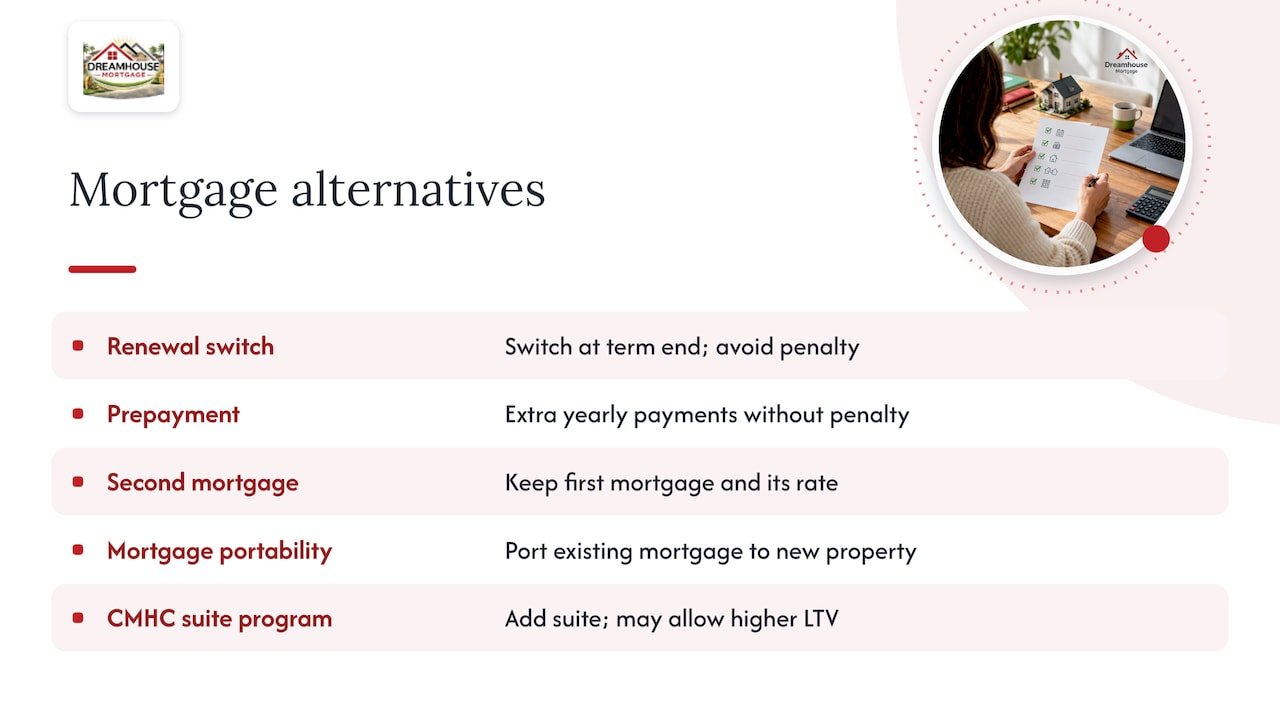
Special programs. CMHC has a program that lets homeowners refinance to add a secondary suite, which can allow a higher loan-to-value than a standard equity take-out. Eligibility rules apply, so ask before assuming you qualify.
Which situations make early refinancing sensible?
Some cases are strong. Others are weak. Use the lists below as a first screen.
Often worth a serious look:
- You have high-interest balances on cards or lines of credit and enough equity to roll them into the mortgage. Our page on debt consolidation mortgages in Calgary explains how that works.
- You are renovating and the value added is real, for example a legal secondary suite or a basement development. See home equity renovation mortgages in Calgary.
- You started on a short-term or private mortgage because of credit or income documentation, and you now qualify at a prime lender.
- Your original mortgage was with an alternative lender, and your financial profile has improved.
Usually better to wait:
- You only want a rate that is a fraction lower, and the penalty is large.
- You are less than a year into a mortgage with a small down payment and almost no equity.
- Your income has fallen or your debts have grown, so the stress test is the main obstacle.
- Your term ends in a few months, so a switch at renewal gets you most of the benefit.
Self-employed and newer buyers
Some buyers who purchased soon after starting a business or arriving in Canada used a product that fit at the time but is not the long-term answer. Self-employed buyers can often show a second or third year of income on a tax return later, which may open prime lending. Newcomers, who may have started with a larger down payment or a specialized program, may find more standard options after building a Canadian credit history. If your profile changed since you bought, a refinance review is worth doing.
If your credit took a hit, a different path may apply first. Our guide on prime mortgage rates after a consumer proposal explains timelines for rebuilding.
Our perspective: what we tell first-time buyers before they refinance
We meet many Calgary, Airdrie and Cochrane buyers a year or two into their first mortgage who ask whether they should refinance. Our first answer is rarely yes or no. It is a request for the payout statement, the current balance, a realistic value for the home and a list of what they want the money or the lower payment to do.
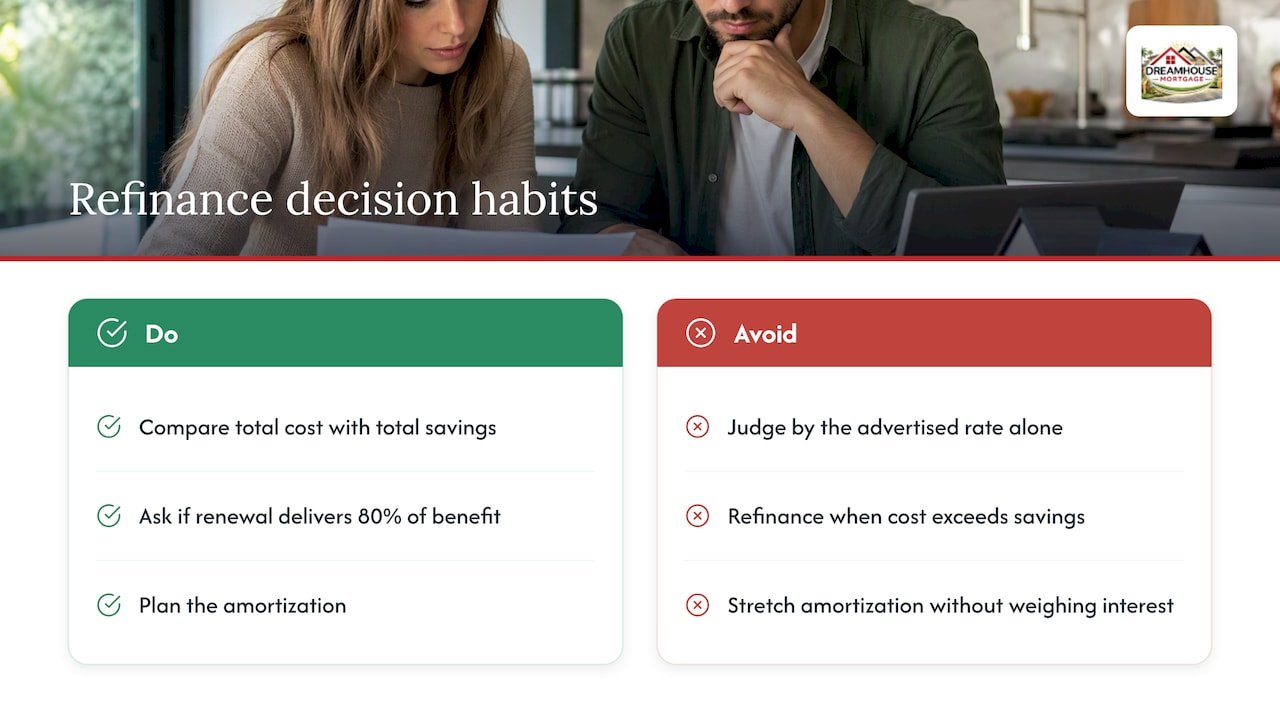
Three habits separate good refinance decisions from poor ones. First, compare the whole cost with the whole saving, not the rate on the advertisement. Second, ask whether waiting for renewal gets 80% of the benefit for none of the penalty. Third, plan the amortization: stretching it to lower the payment can feel like relief, but you pay more interest over the life of the mortgage. Our article on mortgage amortization options in Canada shows the trade-off.
Because we work with banks, credit unions, monoline lenders, alternative lenders and private lenders, we can compare how different lenders treat the same file: their appetite for equity take-outs, their appraisal rules and their penalty calculations. That is where a broker adds value, and we would rather tell you to wait than put you into a refinance that costs more than it saves.
— Guriqbal Chahal, MBA, PMP
Step-by-step: how a refinance after purchase works
- Define the goal. Lower payment, cash out, debt consolidation, or product change. The goal decides which route is cheapest.
- Get your payout statement. Ask your current lender in writing for the penalty and fees to pay out the mortgage on the planned date.
- Estimate your equity. Use recent sales in your community, then confirm with an appraisal. Check that your balance plus any new money stays within the 80% limit.
- Check your qualification. Gather income documents, recent pay stubs or tax assessments, a list of debts and your credit report. Confirm you pass the stress test at the qualifying rate.
- Compare lenders. Look at rate, term, prepayment privileges, penalty formula, and who pays for the appraisal and legal work.
- Run the break-even calculation. Use the method above.
- Apply and complete conditions. The lender orders the appraisal, reviews your documents and issues commitment terms.
- Sign with your lawyer or notary. Your lawyer registers the new mortgage with Alberta Land Titles, and the old charge is discharged.
- Diarize your new renewal date and review your options 120 days before it.
Pro Tip: Keep the documents you used at purchase. Gift letters, proof of down payment and the purchase contract can speed up lender review and answer questions about how you built your equity.
How DreamHouse Mortgage can help
We are a Calgary-based brokerage, founded in 2013, serving Calgary, Airdrie, Cochrane, Chestermere, Okotoks, High River, Rocky View County, Edmonton, Red Deer and surrounding Alberta communities. Our services include mortgage refinancing, renewal and switch options, home equity financing, debt consolidation and first-time buyer mortgages. If you are still shopping for your first home, our first-time home buyer mortgage guide for Calgary covers the purchase side, and our mortgage pre-approval page explains how to start.
If you already own, we can review your current mortgage, compare lender options and tell you plainly whether refinancing, switching, or waiting makes the most sense. Our overview of mortgage refinancing in Calgary shows how we approach the question.
Call Guriqbal Chahal, MBA, PMP, Mortgage Broker, at 403-966-6072. You can also find us on our Google Business Profile.
FAQ
Can I refinance a few months after buying a home in Canada?
Sometimes, but it is rarely a good idea. Lenders set their own policies on waiting periods, and you also need enough equity: most standard equity take-outs are capped at 80% of the appraised value. If you put down less than 20%, there may be no room to borrow for some time.
Do I need to pass the stress test to refinance?
Yes, in most cases. A refinance is a new mortgage contract, so you qualify again at the greater of your contract rate plus 2% or 5.25% for uninsured mortgages. A straight switch at renewal with no increase in balance or amortization is treated differently at many lenders.
What does it cost to refinance in Alberta?
The main costs are any prepayment penalty, a lender discharge fee, an appraisal, legal fees and Alberta Land Titles registration. The provincial mortgage registration fee is a $50 base plus $5 per $5,000 of principal. Your lender’s payout statement is the only reliable source for the penalty figure.
Is it better to refinance or take a second mortgage?
It depends on your rate and penalty. If your current rate is low and the penalty to break it is high, a second mortgage or home equity loan may cost less overall, even at a higher rate on the second loan. If you can lower your rate and borrow what you need in one new mortgage without a large penalty, refinancing can be simpler.
Can I refinance if I am self-employed or new to Canada?
Often yes, but the lender will look closely at your income documents and credit history. A broker can match your file to lenders that handle self-employed income or newcomer files and compare the pricing between them.
Sources
- How Soon Can You Refinance A Mortgage In Canada? (LendToday)
- Preparing to get a mortgage (Financial Consumer Agency of Canada)
- OSFI: straight switches exemption and portfolio LTI limits
- Borrowing against home equity (Financial Consumer Agency of Canada)
- Minimum qualifying rate for uninsured mortgages (OSFI)
- Mortgage Qualifier Tool (Financial Consumer Agency of Canada)
- Breaking your mortgage contract (Financial Consumer Agency of Canada)
- Discharging a mortgage (Financial Consumer Agency of Canada)
- Register a land title document or plan (Alberta.ca)
- CMHC Refinance for Building Secondary Suites