
In Canada, a “rental offset mortgage” is not a separate loan. It is the way a lender counts part of your rental income toward your qualifying income, which can raise the mortgage you are approved for. The share of rent that counts depends on the lender, on whether you will live in the property, and on whether the property is the one you are buying or one you already own. This guide explains the rules, shows a worked example for a Calgary buyer, and lists the documents lenders want to see.
TL;DR
- “Rental offset” means a lender adds a percentage of rent to your income when it calculates your GDS and TDS ratios. It does not lower your payment dollar for dollar.
- For insured mortgages, CMHC allows up to 100% of gross rent on an owner-occupied 2-unit property. For 3 to 4 units, or a non-owner-occupied 2 to 4 units, it is 50% of gross rent or a net rental income method.
- Lenders set their own models within OSFI’s framework, so one lender can approve what another declines.
- Signed, arm’s-length leases and deposits in your bank account carry far more weight than projected rent.
- A broker can compare lender methods before you apply. In Calgary, Airdrie and Cochrane, call Guriqbal Chahal at 403-966-6072.
Table of Contents
- What “rental offset” actually means in Canada
- How CMHC counts rental income
- Subject property versus a property you already own
- A worked example: a Calgary buyer with a basement suite
- Who this matters for
- Documents lenders want to see
- Why lender choice changes the answer
- Tax and the real cost of carrying a rental
- Common mistakes with rental income on a mortgage
- Our perspective
- Talk to a Calgary mortgage broker before you make an offer
- FAQ
- Sources
What “rental offset” actually means in Canada
The phrase comes from how buyers describe a mortgage helper: rent comes in, so the payment feels smaller. Lenders do not see it that way. They assess whether you can carry the debt, and rental income enters that assessment as income, usually discounted.
Two ratios decide most approvals:
- GDS (Gross Debt Service): your housing costs (principal, interest, property taxes, heat, and half of condo fees where applicable) as a share of gross income.
- TDS (Total Debt Service): those housing costs plus all other debts, such as car loans and credit cards, as a share of gross income.
For insured mortgages, CMHC restricts debt service ratios to 39% (GDS) and 44% (TDS). Adding rental income raises the income side of both formulas, so the same payment becomes a smaller percentage. That is the whole mechanism. The rent never reduces your actual mortgage payment, and you still owe the full payment each month.
There is a second, quieter point. A lender may treat the rent as income, or it may subtract the rent from the property’s carrying costs. These two methods give different results, which is why the same suite can look strong at one lender and modest at another.
How CMHC counts rental income
CMHC publishes the clearest public reference. Its rental income guidance separates the cases by occupancy and by whether the property is the subject of your application.
| Situation (insured mortgage) | Rental income approach |
|---|---|
| Owner-occupied, 2 units | Up to 100% of gross rent |
| Owner-occupied, 3 to 4 units | Up to 50% of gross rent, or net rental income (gross rent minus operating expenses) |
| Non-owner-occupied, 2 to 4 units | 50% of gross rent, or net rental income |
This table describes CMHC’s insured-mortgage rules. Conventional (uninsured) mortgages follow each lender’s own policy. OSFI clarified in September 2025 that updates to its capital adequacy guidance do not change borrower qualification standards under Guideline B-20, and that lenders keep the flexibility to assess rental income according to their own risk appetite. In practice, that means you can still use rental income to qualify, but the percentage and the paperwork depend on who you apply with.
Pro Tip: Ask which approach a lender applies before you choose a property. A 2-unit owner-occupied purchase and a 4-unit rental purchase can produce very different qualifying incomes from the same rent.
Subject property versus a property you already own
Lenders treat two kinds of rental income differently.
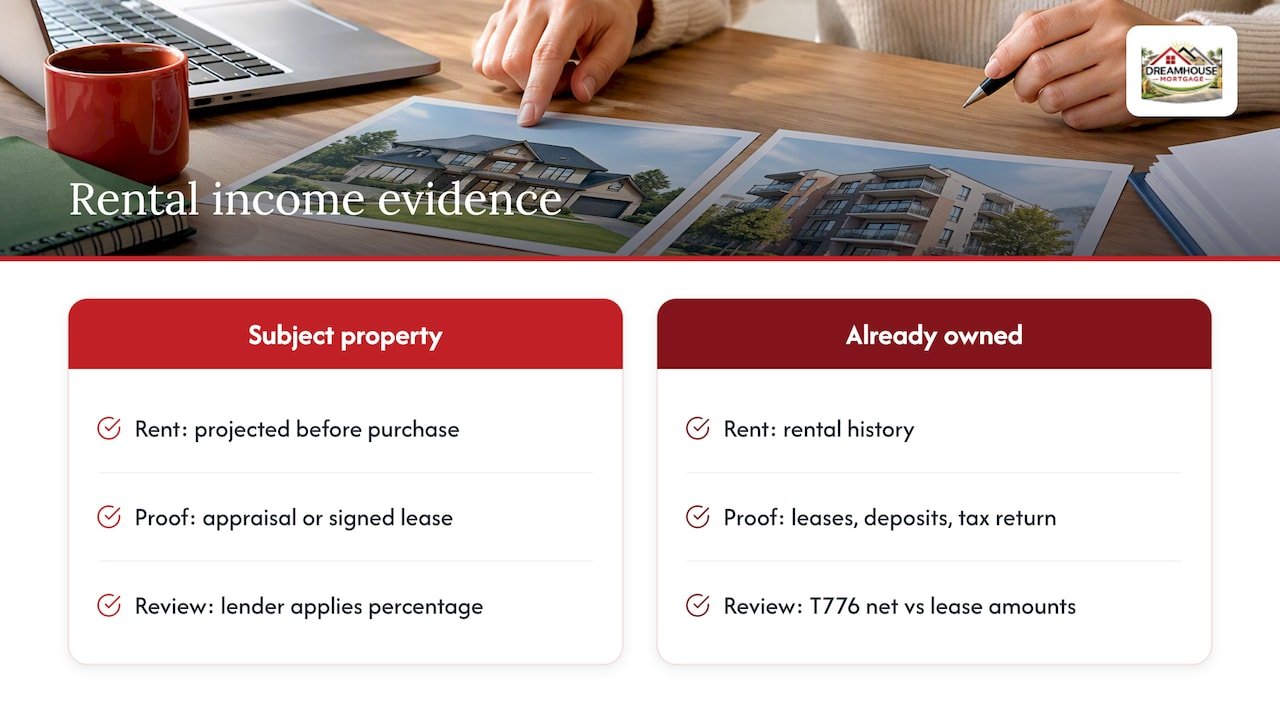
The subject property is the home you are applying to buy or refinance. Its rent may be projected, because you do not yet control the lease. Lenders typically ask for an appraisal with a rent estimate, or a signed lease, and then apply their percentage.
A non-subject property is a rental you already own. Here lenders look at your history: leases, bank deposits, and the rental lines of your tax return. If you report rental income on Form T776, the lender will often compare the net figure there with the lease amounts. The CRA explains that you can deduct the interest on money borrowed to buy or improve a rental property, which can push your reported net income down even when your cash rent is healthy.
That gap matters. A strong tax strategy and a strong mortgage application are not always the same document. If you plan to buy again within a year or two, talk to a broker and your accountant before you finalize deductions.
A worked example: a Calgary buyer with a basement suite
The numbers below are a simplified illustration, not a quote or approval. Real results depend on the lender, the property and your full file.
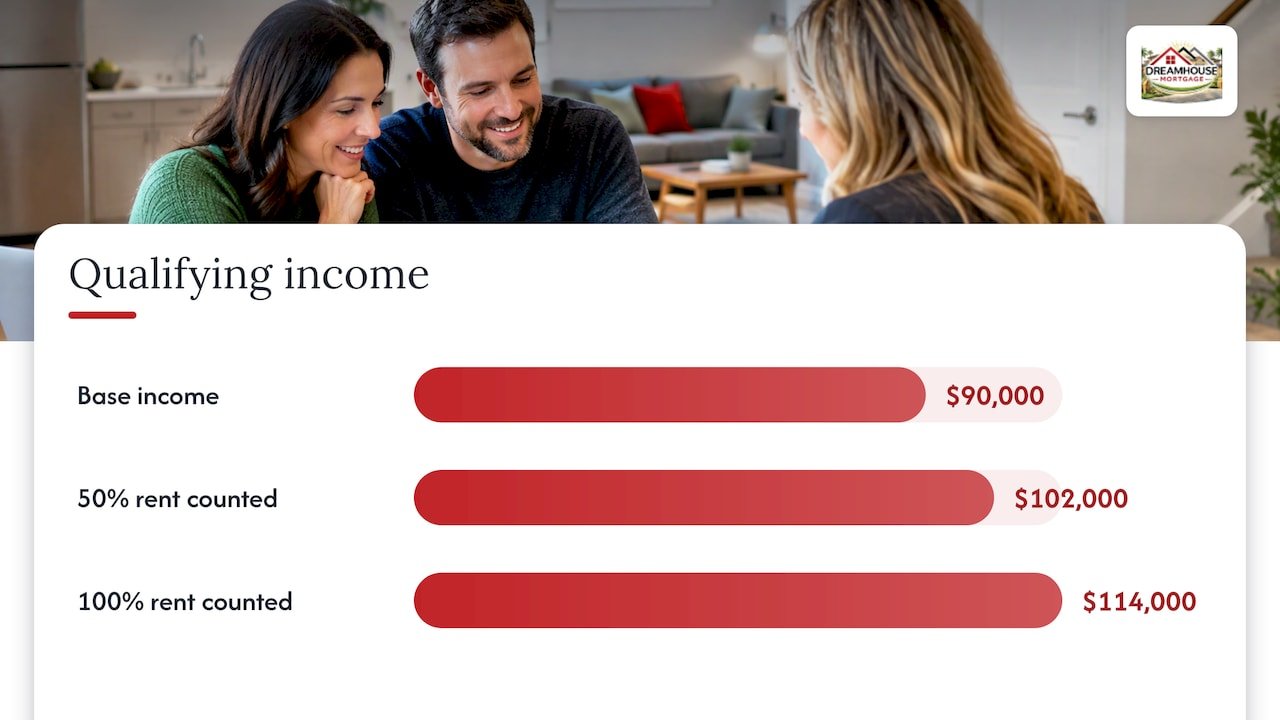
Suppose a buyer earns $90,000 per year and is considering a house in Calgary’s northeast with a legal basement suite that rents for $2,000 per month.
- Annual gross rent: $24,000.
- A lender counting 50% of rent adds $12,000 to income, so qualifying income becomes $102,000.
- A lender counting 100% of rent (possible only in the cases CMHC permits, such as an owner-occupied 2-unit property) would add the full $24,000, for $114,000.
Same buyer, same suite, and a gap of $12,000 in qualifying income between the two methods. At a 39% GDS limit, that gap changes the annual housing cost the buyer can show by roughly $4,680 (39% of $12,000), before any other factors. That is an arithmetic illustration of the ratio, not a promise of a specific approval amount.
We have also written a Calgary-specific piece on this exact idea: when $2,000 of rent counts as $1,000 toward your mortgage.
Who this matters for
First-time buyers with a suite
A home with a rentable suite can stretch a first-time buyer’s budget. If you plan to live upstairs and rent downstairs, the property may qualify as owner-occupied, which is the more favourable category under CMHC’s approach. Our guide to first-time home buyer mortgages in Calgary covers down payments, programs and timing.
Investors buying a rental
If you will not live in the property, the 50% gross or net approach is the typical starting point for insured financing. CMHC Income Property is the insurance product for 2-to-4-unit rental properties, giving investors more choice in how they finance. For deeper reading, see our guides on investment property mortgages in Calgary and rental property mortgages in Canada.
Self-employed owners
If your own income is hard to document, rent may be the cleaner number on your file. Some lenders offer stated income or alternative programs for borrowers who cannot show income the traditional way, for example B2B Bank’s Rental Alternative mortgage, which is aimed at rental purchases or refinances with stated income. Read more in our overview of top lenders for stated income mortgages in Canada.
Short-term rental hosts
Short-term rental income is a different conversation. Many lenders discount it or decline to count it without a track record. See our short-term rental mortgage qualification guide for Alberta.
Documents lenders want to see
Lenders discount “potential” rent because it is unproven. What they want is seasoned evidence. Prepare these in advance:
- Signed leases with named tenants, the rent amount and the term. Arm’s-length tenants carry more weight than relatives.
- Bank statements showing the rent deposits arriving, ideally for several months.
- Tax documents, including your most recent T1 General and the T776 if you already report the rental.
- An appraisal with a market rent estimate when the suite is new or currently vacant.
- Proof the suite is legal, where applicable. In Calgary, that means a registered secondary suite, since a non-conforming suite is much harder to count.
- Property tax and utility details, which feed the net rental income method.
Pro Tip: Deposit rent into one account that you use only for the property. A clean paper trail shortens the lender’s review and reduces back-and-forth questions.
Why lender choice changes the answer
Because OSFI takes a principles-based approach, each lender builds its own model for weighting rent. One institution may count a lower percentage of gross rent, another may use a net method, and a third may ask for a lease history. This is the single biggest reason two applications with identical numbers can end differently.
A broker compares those models for you before a credit check is run, so that your application goes to the lender whose policy suits your property. For background on how comparing lender policies works from the broker’s side, this overview of lender comparison in brokerage is a useful read.
If you are choosing between a bank, a credit union, a monoline lender or an alternative lender, we explain the differences in our guide to self-employed mortgage lender types in Canada. The same lender categories apply to rental files.
Tax and the real cost of carrying a rental
Qualifying and taxes are separate questions, but both shape your decision.
- Mortgage interest on a rental property is deductible against rental income. The CRA also notes that you cannot deduct repayments of mortgage principal.
- Financing fees such as mortgage brokerage and legal fees related to financing are deducted over five years at 20% per year, according to the CRA, regardless of your mortgage term.
- If you rent part of your home, the CRA says you can claim the expenses that relate to the rented area, which means dividing costs between your personal space and the rental.
For your own tax position, including how rental income is reported on your return, see a Canadian accountant (a CPA). We handle the mortgage side, and a CPA should confirm the tax side.
Common mistakes with rental income on a mortgage
- Assuming projected rent counts in full. Lenders usually discount it or ask for proof.
- Mixing up gross and net. A net approach subtracts operating expenses, so it can produce a lower figure than 50% of gross on a costly property, and a higher one on a low-cost property.
- Counting a non-legal suite. If the suite is not legal, many lenders will not use the rent at all.
- Applying before comparing lenders. Each application leaves a credit inquiry, and a poor fit wastes it.
- Letting deductions erase your income on paper. Heavy deductions shrink the net income a lender sees on your return.
- Skipping the documents until the last week. Leases and statements take time to gather, especially across several units.
Our perspective
We see the same misunderstanding every month: buyers believe “rental offset” is a product they can shop for. It is a lender-specific interpretation of how rent enters your income profile, and the method can swing your qualification capacity noticeably. The most useful thing we do is match the property and the paperwork to the lender whose policy fits, before the file is submitted.
At DreamHouse Mortgage we work with banks, credit unions, monoline lenders, alternative lenders and private lenders, so we can compare how each one treats rent across Calgary, Airdrie, Cochrane, Chestermere and the rest of Alberta. We also tell buyers when a rental figure is too optimistic, because it is better to plan around a number a lender will accept than to find out at the commitment stage.
— Guriqbal Chahal, MBA, PMP
Talk to a Calgary mortgage broker before you make an offer
If you are buying a home with a suite, or adding a rental to your portfolio, we can run your numbers against several lenders before you commit. We help first-time buyers, investors and self-employed borrowers with mortgage pre-approvals, and we explain what the lender will count. You can also browse our investment property financing page or start from dreamhousemortgage.ca.
Call Guriqbal Chahal, MBA, PMP, Mortgage Broker, at 403-966-6072. You can also find us on our Google Business Profile.
FAQ
Is a rental offset mortgage a separate product in Canada?
No. It is a qualification method: a lender counts a share of rent as income when it calculates your GDS and TDS. Each lender sets its own approach within regulatory guidelines, so the share varies. A broker can show you how several lenders would treat your property.
How much rent can I count toward qualifying?
For insured mortgages, CMHC allows up to 100% of gross rent on an owner-occupied 2-unit property, and 50% of gross rent or a net approach for 3 to 4 units or non-owner-occupied properties. Conventional lenders follow their own policies. Confirm your case with a broker before you rely on a figure.
Can I use rent from a suite I have not rented yet?
Sometimes. Lenders may accept an appraiser’s market rent estimate on the property you are buying, but they usually apply a discount and may want a lease later. Rent from properties you already own is judged on leases, deposits and tax filings.
Does rental income affect my taxes differently than my mortgage qualification?
Yes. The CRA lets you deduct mortgage interest on a rental but not principal repayments. Lenders may look at the net figure on your return, so deductions can lower your qualifying income. A CPA can advise on your tax position.
Sources
- Rental Income | CMHC
- Calculating GDS / TDS | CMHC
- CMHC Income Property | CMHC
- Clarifying OSFI’s guidance on rental income and mortgage classification
- Rental expenses you can deduct | Canada.ca
- Rental expenses you cannot deduct | Canada.ca
- Completing Form T776, Statement of Real Estate Rentals | Canada.ca
- Rental Properties | B2B Bank
Recommended
- Calgary Buyers: When $2,000 Rent Counts as $1,000 Toward Your Mortgage
- Rental Property Mortgage Canada: Avoid Costly Investor Mistakes & Secure Smarter Financing
- Rental Property Mortgage Alberta (2026 Guide) | Expert Advice & Approval Strategies
- Interest-Only Mortgage for Investment Property: 2026 Canada Guide