
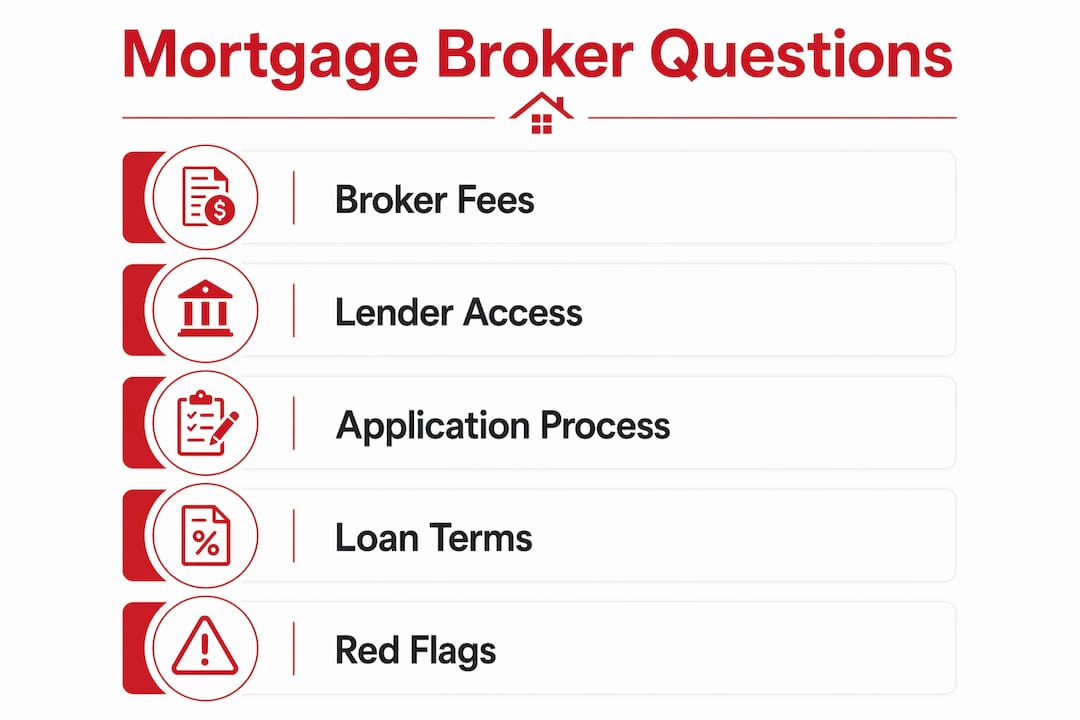
A mortgage broker is a licensed intermediary who connects borrowers with lenders and negotiates mortgage terms on your behalf. Knowing the right questions to ask a mortgage broker before you sign anything is the single most effective way to avoid costly surprises, compare your real options, and confirm your broker is working in your interest. This guide covers every critical area: how brokers get paid, which lenders they access, what documents you need, how loan terms affect your total cost, and how to spot a broker who is not being straight with you. First-time homebuyers in Calgary and across Alberta will find specific context throughout.
What questions reveal how mortgage brokers get paid and any borrower fees
Broker compensation is the first topic to address directly, because misunderstanding it leads to distrust and missed savings. In Canada, mortgage brokers earn a finder’s fee paid by the lender, typically ranging from 0.50% to 1.10% of the mortgage amount. That means most borrowers pay nothing directly to their broker. This structure removes the most common objection first-time buyers have about using a broker.
That said, not every situation is fee-free. Some complex files, private mortgage placements, or alternative lending scenarios may involve a borrower-paid fee. Ask these questions directly before proceeding:
- “Do you receive a finder’s fee from the lender, and how much is it on my file?”
- “Will I pay any fees directly to you, and under what circumstances?”
- “Do you receive a trailer fee or renewal commission after closing?”
- “Are any lenders on your panel paying you a higher commission than others?”
The trailer fee question matters more than most borrowers realize. Some brokers receive ongoing trailer commissions after closing, which creates an incentive to maintain service and conduct annual mortgage reviews. That can actually work in your favor. The problem arises when a broker steers you toward a lender offering a higher finder’s fee rather than the product that best fits your situation. Asking the question openly removes that ambiguity.
For a detailed breakdown of what to expect, the broker fee structure page at DreamHouse Mortgage explains how compensation works across different lender types in Alberta.
Pro Tip: Ask your broker to confirm in writing whether any borrower fees apply before submitting your application. A broker who hesitates to provide this in writing is a broker worth reconsidering.
How does lender access affect your mortgage rate and product options?
Lender access is where a broker’s value becomes concrete and measurable. Brokers who work with a broad panel of lenders, including banks, credit unions, monoline lenders, and private lenders, can offer rates 0.15% to 0.30% lower than big banks’ advertised rates. On a $500,000 mortgage, that difference compounds significantly over a five-year term.

The comparison below shows what to look for when evaluating a broker’s lender access:
| Question to ask | What a strong answer looks like |
|---|---|
| How many lenders do you work with? | 30 or more, including monoline and alternative lenders |
| Do you have access to private lenders? | Yes, for complex or non-qualifying files |
| Are any lenders exclusive to your brokerage? | Some brokerages negotiate volume-based rate discounts |
| Do lender overlays apply to my file? | Broker explains specific restrictions upfront |
Lender overlays deserve special attention. These are additional restrictions beyond standard guidelines that lenders impose on top of federal mortgage rules. A lender might approve a self-employed borrower under standard guidelines but impose an overlay requiring two years of incorporated business history. A knowledgeable broker discloses these early, before you invest time in an application that will stall at underwriting.
Ask your broker which lenders are most likely to approve your specific profile and why. A vague answer like “we’ll see who gives the best rate” is not sufficient. You want a broker who can explain the reasoning behind a lender recommendation based on your income type, credit profile, and property type.
Pro Tip: If you are self-employed or purchasing a non-standard property such as a rural acreage or vacation home, ask specifically which lenders on the panel have experience with files like yours. Niche expertise matters more than lender count in these cases.
Which questions clarify the mortgage application process and required documents?
Understanding what you need to provide, and when, prevents the delays that derail closings. Core documents for mortgage approval include photo ID, recent tax returns (typically the last two years), and 90 days of bank statements. Self-employed borrowers require additional materials such as business financial statements, notices of assessment, and sometimes a letter from an accountant.
Ask your broker these process questions before submitting anything:
- What documents do you need from me to start the application?
- Are there additional requirements given my employment type or income structure?
- What is the realistic timeline from application to approval and closing?
- How will you communicate updates, and how often should I expect to hear from you?
- What conditions are typically attached to approvals, and how do we clear them?
The timeline question is worth pressing on. Approval timelines vary by lender and file complexity, but a broker who sets clear expectations from the start reduces anxiety and helps you plan around possession dates. A standard salaried file with clean credit can move from application to approval in 24 to 72 hours with some lenders. A self-employed file or a property with title issues can take two to three weeks.
Conditions are the other area where buyers get caught off guard. Most approvals come with conditions such as proof of down payment, a satisfactory appraisal, or confirmation of employment. Ask your broker to walk you through the most likely conditions on your file before the approval arrives, so you are not scrambling to gather documents under deadline pressure.
The Alberta mortgage document checklist at DreamHouse Mortgage provides a complete preparation guide organized by borrower type.
What to ask about loan terms, interest rates, and penalties
Loan terms determine your total mortgage cost more than the interest rate alone. Ask these questions before choosing a product:
- “What is the difference in total cost between a fixed and variable rate over my term?”
- “What is the penalty for breaking this mortgage early, and how is it calculated?”
- “What prepayment privileges does this product include?”
- “How is the interest rate on a variable mortgage determined, and what triggers a change?”
- “Is this a closed or open mortgage, and what are the restrictions?”
Fixed mortgages provide payment certainty but carry penalties for early breaking that can reach tens of thousands of dollars on larger loan amounts. Variable rate mortgages typically carry a three-month interest penalty, which is far lower. The trade-off is rate fluctuation tied to the Bank of Canada’s prime rate. Neither product is universally better. The right choice depends on your financial stability, how long you plan to stay in the property, and your tolerance for payment variability.
Prepayment privileges are underused by most borrowers. Most lenders allow you to increase your regular payment or make a lump-sum payment annually, typically 10% to 20% of the original principal. Using these privileges consistently can cut years off your amortization and save substantial interest. Ask your broker to show you a side-by-side comparison of two or three products with different prepayment structures so you can see the long-term impact.
How to spot red flags in a mortgage broker’s answers
A broker’s willingness to answer direct questions is itself a quality signal. Transparent communication and clear reasoning for product recommendations are the baseline standard for any qualified broker. When those qualities are absent, the risk to you increases.
Watch for these specific warning signs:
A broker who cannot explain why they are recommending a specific lender over another, or who deflects questions about their commission structure, is not acting in your best interest. Insist on clear answers before proceeding.
- Vague fee answers. If a broker says “don’t worry about fees, the lender covers everything” without specifics, ask again in writing.
- Pressure to decide quickly. Legitimate rate holds give you time to review. Artificial urgency is a tactic, not a market reality.
- Refusal to disclose lender panel. Evasive answers about commissions and lender panel details indicate potential conflicts of interest.
- No explanation of lender overlays. A broker who skips this topic is either inexperienced or hoping you do not ask.
- Unwillingness to provide documentation. Any verbal commitment about rates, fees, or terms should be backed by a written disclosure or rate commitment letter.
The best protection is preparation. Arrive at your broker meeting with a written list of questions. A broker who welcomes your questions and answers them clearly is demonstrating the standard of service you should expect throughout the entire mortgage process.
Pro Tip: Check your broker’s license status through the Real Estate Council of Alberta (RECA) registry before your first meeting. Licensed brokers in Alberta are required to meet education and conduct standards that protect you as a borrower.
Key takeaways
Asking precise, direct questions to your mortgage broker is the most reliable way to secure better terms, avoid hidden costs, and confirm your broker is acting in your interest.
| Point | Details |
|---|---|
| Broker compensation | Most brokers are paid by lenders at 0.50%–1.10% of the mortgage; confirm in writing whether any borrower fees apply. |
| Lender access matters | Brokers with 30+ lenders can offer rates 0.15%–0.30% lower than bank advertised rates. |
| Document preparation | Photo ID, two years of tax returns, and 90 days of bank statements are the baseline; self-employed files require more. |
| Loan term clarity | Always ask about prepayment privileges and early break penalties before choosing fixed or variable. |
| Red flag awareness | Evasive answers about fees or lender selection are signals of a potential conflict of interest. |
What I have learned about broker relationships after years in this industry
Most first-time buyers walk into a broker meeting focused entirely on getting the lowest rate. That focus is understandable, but it misses the bigger picture. The best broker relationships are built on transparent communication and risk management, not just the rate printed on an approval letter.
In my experience working with buyers across Calgary and Alberta, the clients who get the best long-term outcomes are the ones who treat their broker as a financial advisor, not just a transaction processor. They ask about refinancing scenarios before they even close. They ask how their mortgage fits into their five-year financial plan. They check in annually to review whether their current product still makes sense.
The questions in this guide are not just a checklist for a single meeting. They are the foundation of an ongoing conversation. A broker who answers them well at the start is likely to be the same broker who calls you six months before your renewal with a better option. That kind of proactive service is worth more than a rate that is 0.05% lower from someone you never hear from again.
My advice: prepare your questions in writing, bring them to your first meeting, and pay close attention to how your broker responds. Confidence, clarity, and a willingness to put things in writing are the marks of a professional worth trusting with one of the largest financial decisions of your life.
— Guriqbal
Work with DreamHouse Mortgage for clear answers and better rates
DreamHouse Mortgage, led by Guriqbal Chahal, MBA, PMP, gives Calgary and Alberta homebuyers direct access to 50+ lenders including banks, credit unions, monoline lenders, and private lenders. Every client receives a clear explanation of broker fee structures before any application is submitted, with no surprises at closing. Whether you are a first-time buyer, self-employed professional, or purchasing an investment property, DreamHouse Mortgage matches your file to the right lender and product from the start.

For expert mortgage advice, competitive rates, and personalized financing solutions across Calgary, Airdrie, Cochrane, Chestermere, Okotoks, and surrounding Alberta communities, contact Guriqbal Chahal at 403-966-6072 or visit dreamhousemortgage.ca.
FAQ
How does a mortgage broker get paid in Calgary?
In Calgary and across Canada, mortgage brokers are paid by lenders through a finder’s fee of 0.50% to 1.10% of the mortgage amount. Most borrowers pay nothing directly to their broker.
What documents do I need for a mortgage application in Alberta?
The standard mortgage document checklist includes government-issued photo ID, the last two years of tax returns, and 90 days of bank statements. Self-employed borrowers also need business financial statements and notices of assessment.
What is a lender overlay and why does it matter?
A lender overlay is an additional restriction a lender places on top of standard federal mortgage guidelines. Overlays can affect approval for self-employed borrowers or non-standard properties, so ask your broker about them before applying.
How do I choose a mortgage broker in Calgary?
Verify the broker’s license through the Real Estate Council of Alberta, ask how many lenders they work with, and confirm their fee structure in writing. A qualified broker answers all of these questions clearly and without hesitation.
Is a fixed or variable mortgage rate better in 2026?
Fixed rates offer payment certainty but carry higher break penalties. Variable rates typically carry lower penalties and can save money if rates decline. The right choice depends on your financial stability and how long you plan to hold the property.
Recommended
- Mortgage Broker Calgary: 10 Essential Questions That Can Save You Thousands Before You Sign
- Mortgage Broker vs. Bank Calgary Alberta: The Shocking Truth Nobody Tells You [2026]
- Calgary Mortgage Calculators 2026: Avoid Costly Payment Mistakes & Estimate Your Monthly Mortgage Accurately
- Mortgage Broker Fees Explained for Calgary & Alberta