First Time Home Buyer Mortgage Explained
- First-time home buyers in Alberta benefit from lower down payments, government incentives, and province-specific cost advantages.
- Understanding mortgage rules, insurance costs, and savings programs is essential to make informed decisions before house hunting.
A first-time home buyer mortgage in Canada is a specially structured financing product that offers lower minimum down payments, access to mortgage default insurance, and government incentives designed to help new buyers enter the housing market. In Alberta, cities like Calgary, Edmonton, Airdrie, Cochrane, and Red Deer all fall under the same federal Canadian mortgage rules, but with some province-specific advantages that make buying here more cost-effective than in Ontario or British Columbia. Understanding the first time home buyer mortgage explained in full means knowing the eligibility rules, insurance costs, savings programs, and closing cost realities before you ever make an offer. The 2026 regulatory updates from the Office of the Superintendent of Financial Institutions (OSFI) and Canada Mortgage and Housing Corporation (CMHC) have expanded access significantly. This guide covers every stage of the process.
What are the eligibility requirements and down payment rules for first-time buyers?
A first-time home buyer in Canada is defined as someone who has not owned a principal residence in the past four years. This definition applies federally and governs access to programs like the First Home Savings Account (FHSA), the RRSP Home Buyers’ Plan (HBP), and the Home Buyers’ Tax Credit. If you owned a home more than four years ago, you may still qualify as a first-time buyer under most programs.
The minimum down payment rules in Canada follow a tiered structure based on purchase price:
- 5% down on the first $500,000 of the purchase price
- 10% down on the portion between $500,001 and $1,499,999
- 20% down on homes priced at $1,500,000 or more, with no insurance available
The insured mortgage price cap was raised from $1,000,000 to $1,500,000 on December 15, 2024. This change directly benefits buyers in Calgary and Edmonton, where detached home prices have climbed steadily. A buyer purchasing a $900,000 home in Calgary’s southwest now qualifies for an insured mortgage, which was not possible before this rule change.
| Purchase Price | Minimum Down Payment | Mortgage Type |
|---|---|---|
| Up to $500,000 | 5% | Insured |
| $500,001 to $1,499,999 | 5% on first $500K + 10% on remainder | Insured |
| $1,500,000 and above | 20% | Conventional (uninsured) |

The OSFI B-20 stress test requires all buyers to qualify at the higher of their contract rate plus 2%, or 5.25%. This means if your lender offers you a 5.0% rate, you must prove you can afford payments at 7.0%. The stress test reduces the maximum purchase price you qualify for, so running the numbers before house hunting is critical.
Pro Tip: Get a mortgage pre-approval from a Calgary or Edmonton mortgage broker before you start searching. Pre-approval locks in your rate for 90 to 120 days and tells you exactly what price range is realistic under the stress test.
First-time buyers also qualify for 30-year amortizations on insured mortgages, a rule that took effect in late 2024. Extending from 25 to 30 years lowers monthly payments by approximately 8%, which meaningfully improves cash flow for buyers in Airdrie, Cochrane, or Chestermere purchasing their first property.
How does mortgage default insurance work and what does it cost?
Mortgage default insurance is mandatory for any home purchase with less than 20% down in Canada. CMHC is the primary insurer, alongside Sagen and Canada Guaranty. The insurance protects the lender, not the buyer, but the buyer pays the premium. This distinction matters: you are paying to reduce the lender’s risk so they will approve your mortgage at a lower down payment.
Premium rates are calculated as a percentage of the total mortgage amount:
- 4.00% premium when your down payment is 5% to 9.99%
- 3.10% premium when your down payment is 10% to 14.99%
- 2.80% premium when your down payment is 15% to 19.99%
The premium is added directly to your mortgage balance in most cases. On a $600,000 home with 5% down ($30,000), your insured mortgage is $570,000. The 4.00% CMHC premium adds $22,800 to your balance, bringing your total mortgage to $592,800. That extra amount accrues interest over your amortization period, so the true long-term cost of a low down payment is higher than the premium alone suggests.
Pro Tip: Increasing your down payment from 5% to 10% drops your CMHC premium from 4.00% to 3.10%. On a $600,000 purchase, that saves roughly $5,130 in insurance premiums added to your mortgage. If you can access FHSA or RRSP funds to reach 10%, the math usually favors doing so.
Alberta does not charge PST on mortgage default insurance premiums. Ontario charges 8% PST on the premium as an additional closing cost paid upfront. For an Alberta buyer with a $22,800 CMHC premium, this provincial difference saves $1,824 in cash at closing compared to an Ontario buyer in the same situation. This is one of the concrete financial advantages of buying your first home in Calgary, Red Deer, or Edmonton rather than Toronto.
First-time buyers choosing the 30-year amortization option pay a 0.20% surcharge on their CMHC premium. On a $570,000 insured mortgage, that surcharge adds $1,140. Weigh this against the monthly payment reduction to decide if the extended amortization is worth it for your budget.
Which government programs help first-time buyers save for a down payment?
The First Home Savings Account (FHSA) and the RRSP Home Buyers’ Plan (HBP) are the two most powerful tools available to first-time buyers in Canada. Used together, they can dramatically reduce the cash you need from non-registered savings.
The FHSA allows contributions of up to $8,000 per year with a $40,000 lifetime maximum. Contributions are tax-deductible, reducing your taxable income in the year you contribute. Withdrawals used for a qualifying home purchase are completely tax-free. The FHSA is the most tax-efficient savings vehicle ever created for Canadian home buyers because it combines the deduction benefit of an RRSP with the tax-free withdrawal benefit of a TFSA.
The RRSP Home Buyers’ Plan lets you withdraw up to $60,000 from your RRSP tax-free for a first home purchase. You must repay the withdrawn amount over 15 years, or the unpaid balance is added to your taxable income annually. A couple can each withdraw $60,000, accessing $120,000 combined from their RRSPs.
Stacking FHSA and HBP gives a single buyer access to up to $100,000 in tax-sheltered down payment funds, or $200,000 for couples. This combined strategy reduces the out-of-pocket cash needed from regular savings and optimizes tax benefits across both programs simultaneously.
| Program | Annual Limit | Lifetime Limit | Tax Deductible | Repayment Required |
|---|---|---|---|---|
| FHSA | $8,000 | $40,000 | Yes | No |
| RRSP Home Buyers’ Plan | No annual limit | $60,000 per person | Contributions only | Yes, over 15 years |
| Combined (couple) | Varies | $200,000 | Yes (FHSA portion) | Partial (HBP portion) |
To maximize the FHSA, follow these steps:
- Open your FHSA account as early as possible. Unused contribution room does not carry forward indefinitely, so delay costs you real money.
- Contribute the full $8,000 each year and claim the deduction on your tax return.
- Invest the FHSA balance in growth-oriented assets while your timeline allows.
- Coordinate your RRSP contributions to maximize the HBP withdrawal when you are ready to buy.
The FHSA and HBP comparison at Dreamhouse Mortgage breaks down which program saves more depending on your income level and timeline. The Home Buyers’ Tax Credit also provides a $10,000 non-refundable federal tax credit in the year of purchase, worth up to $1,500 in tax savings. Alberta does not have a provincial land transfer tax, which is another significant cost advantage over Ontario and British Columbia buyers.
What closing costs should Alberta first-time buyers budget for?
Closing costs are the expenses beyond your down payment that must be paid on or before possession day. Many first-time buyers in Calgary, Edmonton, and Cochrane underestimate these costs and face cash shortfalls at closing.
Closing costs typically range from 1.5% to 4% of the purchase price, covering legal fees, title insurance, home inspection, and other charges. Alberta buyers benefit from the absence of a provincial land transfer tax, which saves thousands compared to Ontario buyers. On a $600,000 Calgary home, a 2% closing cost estimate equals $12,000 in additional cash needed beyond your down payment.
Key closing costs to budget for in Alberta:
- Legal fees: $1,200 to $2,000 for a real estate lawyer to handle title transfer and mortgage registration
- Title insurance: $200 to $400, protects against title defects and fraud
- Home inspection: $400 to $600, highly recommended for resale properties in any Alberta community
- Mortgage default insurance premium: Added to mortgage balance, but any provincial tax is not applicable in Alberta
- Property tax adjustment: You reimburse the seller for prepaid property taxes from possession date to year end
- Utility and condo fee adjustments: Prorated at closing for condos in Calgary or Edmonton
| Cost Item | Estimated Range | Alberta-Specific Note |
|---|---|---|
| Legal fees | $1,200 to $2,000 | Standard across Alberta |
| Title insurance | $200 to $400 | Required by most lenders |
| Home inspection | $400 to $600 | Not mandatory but strongly advised |
| Land transfer tax | $0 | Alberta has no provincial land transfer tax |
| Property tax adjustment | Varies | Based on possession date |
Pro Tip: Budget a minimum of $15,000 in liquid savings beyond your down payment for closing costs and immediate move-in expenses. Buyers in Okotoks, High River, and Rocky View County should also check for any municipal levies specific to their purchase.
Your deposit, paid when your offer is accepted, is separate from your down payment and closing costs. Deposits in Calgary typically run 1% to 5% of the purchase price and are applied toward your down payment at closing. Plan your cash flow to cover the deposit immediately, then closing costs weeks later.
What are the steps to secure the best mortgage as a first-time buyer in Alberta?
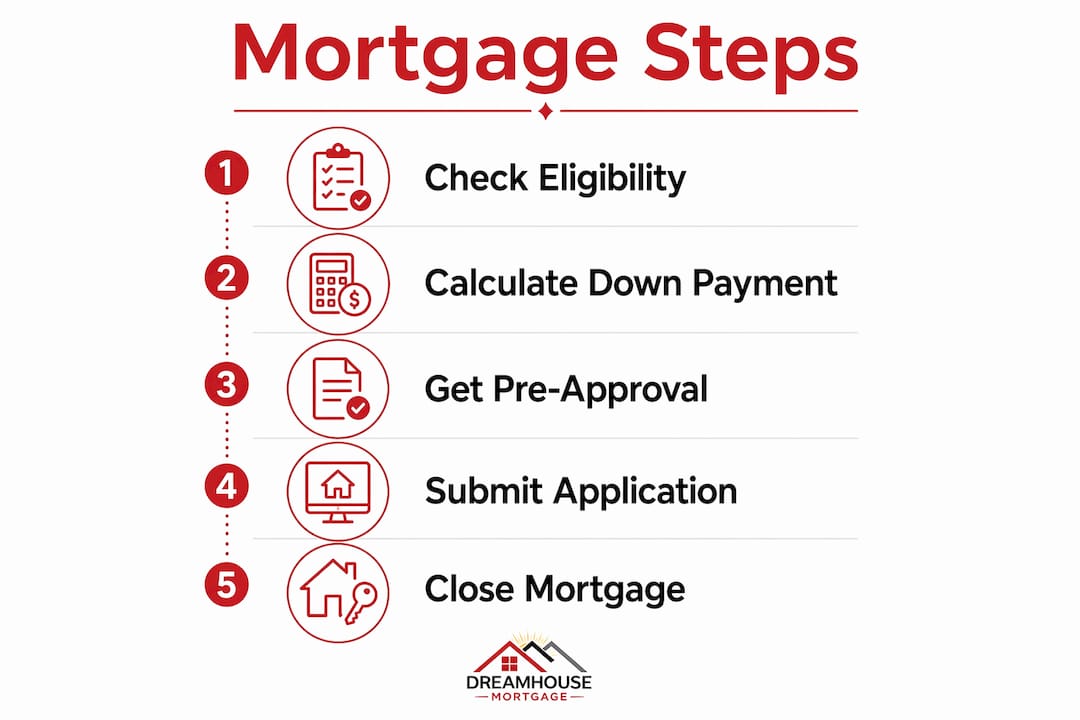
Securing the right mortgage requires preparation, comparison, and professional guidance. The process follows a clear sequence that every first-time buyer in Calgary, Airdrie, Red Deer, or Edmonton should understand before making any commitments.
- Check and improve your credit score. Lenders in Canada require a minimum credit score of 600 for insured mortgages, though scores above 680 unlock better rates. Pay down revolving debt and avoid new credit applications in the three to six months before applying.
- Gather your financial documents. Lenders need two years of T4 slips or Notices of Assessment, recent pay stubs, three months of bank statements, and proof of your down payment source. FHSA and RRSP statements count as documented down payment funds.
- Get a mortgage pre-approval. Pre-approval locks in your rate for 90 to 120 days and confirms your maximum purchase price under the stress test. It also signals to sellers that you are a serious buyer, which matters in competitive Calgary and Edmonton markets.
- Compare mortgage types and terms. Fixed rates provide payment certainty over your term. Variable rates move with the Bank of Canada’s prime rate and carry more short-term risk but have historically cost less over full amortization periods. A five-year fixed term is the most common choice for first-time buyers in Alberta.
- Work with a licensed mortgage broker. A broker in Calgary, Cochrane, or Edmonton has access to dozens of lenders including banks, credit unions, monoline lenders, and alternative lenders. They compare rates and products you cannot access directly, and their service is typically free to you because lenders pay the broker’s fee.
- Review your mortgage commitment carefully. Before signing, confirm the prepayment privileges, penalty structure, and portability terms. These details determine how flexible your mortgage is if your life circumstances change.
Pro Tip: Ask your broker to show you the total cost of borrowing over the full amortization, not just the monthly payment. A slightly lower rate with heavy prepayment penalties can cost more than a slightly higher rate with flexible terms.
Understanding insured mortgage rules in detail helps you choose the right product from the start. Buyers who skip this step often discover mid-process that their chosen property or down payment amount does not qualify for the product they expected.
Key takeaways from First Time Home Buyer Mortgage Explained
A first-time home buyer mortgage in Alberta combines federal eligibility rules, CMHC insurance requirements, government savings programs, and Alberta-specific cost advantages to create one of the most accessible paths to homeownership in Canada.
| Point | Details |
|---|---|
| Down payment tiers | 5% on first $500K, 10% on $500K to $1.5M, 20% above $1.5M. |
| CMHC insurance cost | Premiums range from 2.80% to 4.00% of the mortgage, added to your balance. |
| Alberta PST advantage | Alberta charges no PST on insurance premiums, saving buyers hundreds at closing. |
| FHSA and HBP stacking | Couples can access up to $200,000 in tax-sheltered down payment funds combined. |
| Pre-approval priority | Lock in your rate for 90 to 120 days before house hunting to avoid surprises. |
What I have learned working with Alberta first-time buyers
After more than a decade placing mortgages for first-time buyers across Calgary, Airdrie, Cochrane, Chestermere, and Edmonton, the pattern I see most often is this: buyers who plan two to three years ahead consistently get better outcomes than buyers who decide to buy and then scramble to qualify. The FHSA is the clearest example. I have seen buyers open an FHSA the same month they start house hunting, which means they miss years of tax-deductible contributions and tax-free growth. Opening that account early, even before you are certain about your timeline, costs nothing and preserves every dollar of future benefit.
The 2026 regulatory changes are genuinely positive for Alberta buyers. The $1.5 million insured mortgage cap and the 30-year amortization option together expand what is possible for buyers in Calgary’s inner-city neighborhoods and Edmonton’s mature communities. But these changes also require careful modeling. Buying sooner with a 5% down payment and CMHC insurance is not automatically worse than waiting to save 20%. The right answer depends on your specific income, savings rate, local market trajectory, and how long you plan to hold the property. Generic advice does not serve you here.
What I tell every first-time buyer in Alberta is this: the stress test is not your enemy. It is a filter that confirms your mortgage is affordable if rates rise. Buyers who pass it comfortably are in a strong financial position. Buyers who barely pass it should think carefully about whether they are buying at the right price point for their income. A mortgage broker’s job is to help you find that honest answer, not just to get you approved.
— Guriqbal Chahal, MBA, PMP
Ready to get your first mortgage in Alberta?
Dreamhouse Mortgage has helped first-time buyers in Calgary, Edmonton, Airdrie, Cochrane, Red Deer, Chestermere, and Okotoks secure competitive financing since 2013. The team works with banks, credit unions, monoline lenders, and alternative lenders to find the right product for your situation, whether you are buying a condo in downtown Calgary or a detached home in Cochrane.

Guriqbal Chahal, MBA, PMP, reviews your full financial picture, explains your mortgage options clearly, and handles lender negotiations so you get the best available rate. Learn how mortgage broker rate negotiation works and what it means for your bottom line. For personalized mortgage advice and fast pre-approval, call Guriqbal Chahal directly at 403-966-6072 or find Dreamhouse Mortgage on Google to read client reviews and connect with the team today.
FAQ
What qualifies you as a first-time home buyer in Canada?
You qualify as a first-time home buyer in Canada if you have not owned a principal residence at any point in the past four years. This definition applies to federal programs including the FHSA, RRSP Home Buyers’ Plan, and the Home Buyers’ Tax Credit.
How much down payment do you need for a first home in Alberta?
The minimum down payment is 5% on the first $500,000 of the purchase price and 10% on any amount between $500,001 and $1,499,999. Homes priced at $1,500,000 or more require a 20% down payment and do not qualify for mortgage default insurance.
Do first-time buyers in Alberta pay PST on CMHC insurance?
No. Alberta does not charge provincial sales tax on mortgage default insurance premiums. This saves Alberta buyers hundreds of dollars compared to buyers in Ontario, where an 8% PST applies to the CMHC premium as an upfront closing cost.
What is the mortgage stress test and how does it affect first-time buyers?
The OSFI B-20 stress test requires buyers to qualify at the higher of their contract rate plus 2%, or 5.25%. This reduces the maximum purchase price you qualify for and applies to all insured and uninsured mortgages at federally regulated lenders in Canada.
Can you use both FHSA and RRSP Home Buyers’ Plan for the same purchase?
Yes. You can stack both programs on a single home purchase. A couple can access up to $40,000 each from their FHSAs plus up to $60,000 each from their RRSPs, for a combined total of $200,000 in tax-sheltered down payment funds.
Recommended as related to First Time Home Buyer Mortgage Explained
- First Time Home Buyer Alberta | DreamHouse Mortgage
- First Time Homebuyer Mortgage Calgary: The Complete 2026 Guide
- First Time Home Buyer in Calgary Alberta: How Much Income Do You Really Need? | DreamHouse Mortgage
- First Time Home Buyer Calgary Alberta: How Much Income Do You Need to Buy a Home in 2026?