- Mortgage broker commission in Alberta ranges from 0.5% to 2.75%, depending on the lender and mortgage type, and can be paid by the lender or borrower (especially in private mortgages or B-Side mortgages). This fee influences both your mortgage interest rate and upfront closing costs, affecting overall affordability. Transparent disclosure and negotiation are essential to understanding and minimizing your mortgage expenses.
Mortgage broker commission is a loan-specific fee that a broker earns for connecting a borrower to a lender, calculated as a percentage of the total mortgage amount. In Alberta, commission rates range from 0.5% to 2.75% depending on the lender, the mortgage product, and whether the borrower or the lender pays the fee. For a homebuyer in Calgary, Airdrie, or Edmonton purchasing a $500,000 home, that range translates to between $2,500 and $13,750 in broker compensation. Understanding exactly how this fee works, who pays it, and how it affects your total mortgage cost is one of the most practical steps you can take before signing any mortgage agreement in Alberta.
What is mortgage broker commission and how does it work in Alberta?
Mortgage broker commission is the standard compensation model for licensed mortgage brokers operating under Alberta’s real estate and mortgage regulations. The industry term for the most common form of this payment is a finder fee, which is a one-time payment made at closing. Brokers do not earn a salary from lenders. They earn a fee per transaction, which means every mortgage they arrange generates a specific payment tied to the loan size.

In Canada, finder fees typically range from 0.50% to 1.10% of the mortgage amount, paid directly by the lender at closing. This is the most common structure for standard insured and conventional mortgages arranged through banks, credit unions, and monoline lenders. For alternative lending products or private mortgages, where lender risk is higher and borrower profiles are more complex, the commission can reach the upper end of the 0.5% to 2.75% range.
The finder fee model means that for most standard mortgage transactions in Calgary, Cochrane, or Chestermere, the borrower does not write a check to the broker at closing. The lender pays the broker directly. This creates the widespread perception that brokers are “free” to use, which is technically accurate in terms of out-of-pocket costs but not entirely accurate in terms of total loan cost. That distinction matters and is covered in detail below.
Brokers in Alberta are licensed under the Real Estate Council of Alberta (RECA) and must follow provincial disclosure requirements. The commission structure must be disclosed to the borrower before the mortgage is finalized, giving you the right to understand exactly what your broker earns on your file.
How mortgage broker commissions are structured and paid
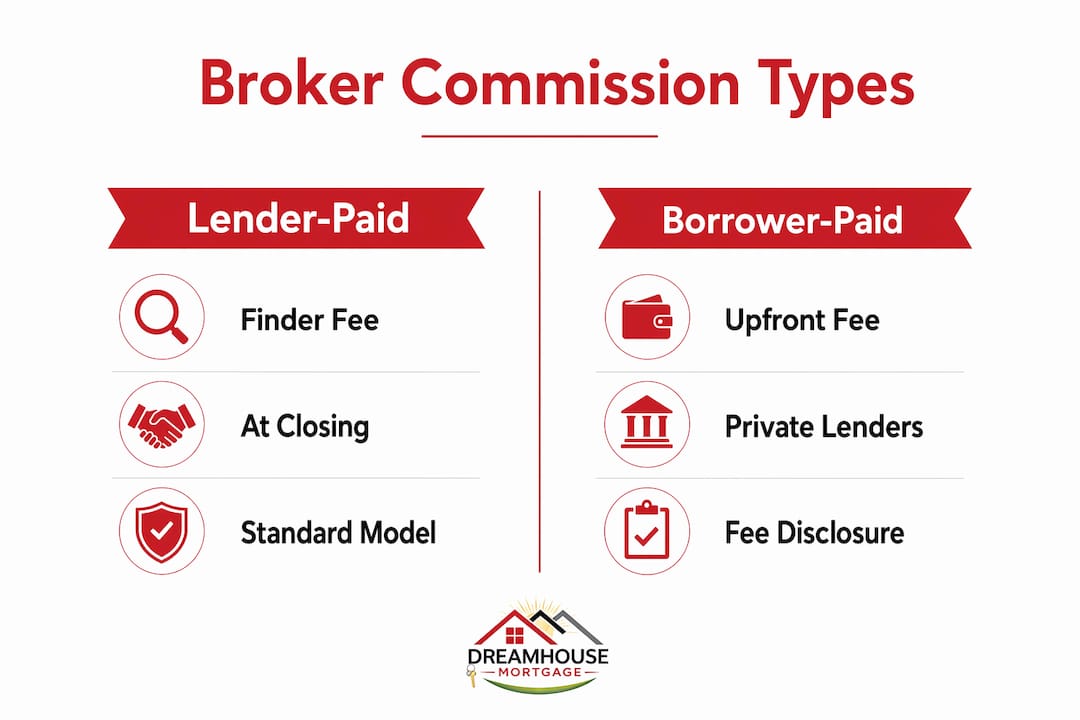
The structure of broker compensation in Alberta falls into two primary models: lender-paid commission and borrower-paid commission. Each has different implications for your mortgage rate and your closing costs.
Lender-paid commission
The lender pays the broker a finder fee at closing, drawn from the lender’s own revenue. This is the standard model for most residential mortgages in Alberta. The borrower sees no direct line item on their closing statement for broker fees. However, lender-paid commissions may be embedded in a slightly higher interest rate, meaning the cost is real but indirect. A lender offering a broker a higher finder fee may price that product at a rate that is 0.05% to 0.15% above a comparable product with no broker compensation.
Borrower-paid commission
In some cases, particularly with private lenders or alternative lending arrangements, the borrower pays the broker fee directly. This fee may appear as:
- An origination fee charged at closing
- A fee rolled into the total loan amount
- A flat dollar amount invoiced separately before or at funding
Borrower-paid fees are more common in situations where the lender does not pay broker compensation, such as certain private mortgage arrangements or specialized commercial deals. In these cases, the fee is clearly disclosed and agreed upon before the mortgage is approved.
Pro Tip: Always ask your broker whether their fee is paid by the lender or by you, and request written confirmation of the exact amount before you submit a mortgage application. This is your right under Alberta’s mortgage disclosure rules.
Here is a summary of the two payment structures:
- Lender-paid finder fee: Broker receives 0.50% to 1.10% from the lender at closing. No direct cost to the borrower, but may be reflected in the interest rate.
- Borrower-paid origination fee: Broker charges the borrower directly, typically in alternative or private lending scenarios. Fee is disclosed upfront and agreed upon in writing.
- Hybrid arrangements: In rare cases, a portion of the fee comes from each party, though Canadian regulations strictly prohibit a broker from collecting full compensation from both the borrower and the lender on the same transaction.
Canadian regulations require that fee disclosure be provided upfront and prohibit brokers from collecting double commissions from both the borrower and the lender. This consumer protection rule applies across all provinces, including Alberta, and is enforced through RECA licensing requirements.
It is also worth noting that ongoing trailer fees exist in some mortgage markets, but Canada’s model centers almost entirely on one-time finder fees. Trailing commissions are far less common here than in markets like Australia, making the Canadian system more straightforward for borrowers to evaluate.
How broker commission affects your mortgage cost and financing options
The most important thing to understand about broker commission is that it affects your mortgage cost in two distinct ways, and you need to account for both when comparing offers.
The interest rate effect
When a lender pays a broker a higher finder fee, that cost is often priced into the mortgage rate offered to the borrower. A lender offering a broker 1.10% in finder fees may price their product at 5.09%, while a lender offering 0.50% in finder fees might price the same product at 4.94%. The difference looks small on paper but compounds significantly over a five-year term. On a $500,000 mortgage amortized over 25 years, a 0.15% rate difference adds roughly $3,750 in interest over a five-year term.
The closing cost effect
When the borrower pays the commission directly, the impact is felt at closing rather than over the life of the loan. A 1% origination fee on a $400,000 mortgage in Red Deer or Okotoks equals $4,000 due at closing. This reduces the cash available for a down payment, moving costs, or home improvements. For first-time buyers in Calgary already stretching to meet the minimum down payment threshold, a borrower-paid commission can meaningfully affect affordability.
The table below compares two financing scenarios to illustrate the real cost difference:
| Scenario | Commission structure | Mortgage rate | 5-year interest cost (on $500,000) | Upfront broker fee |
|---|---|---|---|---|
| Lender pays 1.10% finder fee | Lender-paid | 5.10% | ~$120,400 | $0 |
| Borrower pays 1.00% origination fee | Borrower-paid | 4.90% | ~$115,600 | $5,000 |
The borrower-paid scenario costs $5,000 upfront but saves approximately $4,800 in interest over five years. The net difference is minimal, but the cash flow impact is significant. This is why comparing both the interest rate and the fee structure is the only accurate way to evaluate a mortgage offer.
Pro Tip: Ask your broker to show you the total cost of borrowing under each scenario, including both the rate and any fees, before you choose a lender. Dreamhouse Mortgage provides this comparison as a standard part of the mortgage advice process.
Broker commissions influence mortgage affordability both through upfront fees and embedded rate pricing, which means borrowers who only compare interest rates are not seeing the full picture. For investors in Edmonton or Calgary purchasing investment properties, where margins are tighter and financing costs directly affect cash flow, this distinction is especially important.
Common commission rates and fee disclosure practices in Alberta
Alberta mortgage brokers operate under RECA’s licensing framework, which sets clear standards for how commissions must be disclosed and documented. Understanding what is typical and what is required protects you from surprises at closing.
Typical commission ranges in Alberta by mortgage type:
- Standard insured mortgage (CMHC-backed): 0.50% to 0.90% finder fee, paid by lender
- Conventional residential mortgage: 0.65% to 1.10% finder fee, paid by lender
- Alternative lending mortgage: 1.00% to 2.00%, may be split between lender and borrower
- Private mortgage: 1.50% to 2.75%, typically borrower-paid or split
These figures reflect the Alberta mortgage market and are consistent with what Dreamhouse Mortgage clients encounter across Calgary, Airdrie, Cochrane, and surrounding communities.
Disclosure requirements in Alberta include:
- Written disclosure of the broker’s compensation before the mortgage is finalized
- Identification of who pays the commission (lender, borrower, or both)
- Disclosure of any referral fees or additional compensation the broker receives
- A signed acknowledgment from the borrower confirming they received and understood the disclosure
Requesting written disclosures and confirming who pays the commission is the most direct way to avoid hidden costs at closing. A broker who resists providing this information in writing is a red flag.
Conflicts of interest are a real consideration in broker compensation. Because brokers earn more from lenders who pay higher finder fees, there is a structural incentive to recommend products that pay better commissions rather than products that offer the best rate for the borrower. A reputable broker discloses this dynamic openly and can demonstrate that their recommendation is based on your best interest, not their payout. Asking your broker to show you the commission they earn on each lender option they present is a reasonable and legitimate request.
Strategies for negotiating mortgage broker commission and minimizing your costs
Broker commissions are not always fixed. In Alberta’s competitive mortgage market, brokers may negotiate commissions especially with repeat clients, high-value transactions, or investors placing multiple properties. Knowing how to approach this conversation saves money and builds a better long-term relationship with your broker.
Follow these steps to negotiate effectively:
- Get multiple quotes. Contact at least two or three mortgage brokers in Calgary or your local Alberta community. Compare not just the rates they offer but the fee structures they disclose. This gives you a baseline for negotiation.
- Ask directly about commission. Request the exact finder fee or origination fee on each lender option presented. A broker who cannot answer this question clearly is not operating with full transparency.
- Understand the rate-fee tradeoff. Ask your broker whether a lower-commission lender product is available and how the rate compares. Sometimes accepting a slightly higher rate in exchange for a zero borrower-paid fee is the better financial decision.
- Discuss rebates for high-value transactions. On mortgages above $600,000 or for investors financing multiple properties in Edmonton, Red Deer, or Rocky View County, some brokers will offer a fee rebate or a reduced origination charge to secure the business.
- Evaluate service value alongside cost. A broker who charges a modest origination fee but saves you $8,000 in interest by accessing a lender you could not reach on your own delivers net value. Commission is one variable, not the only variable.
Pro Tip: For investors financing rental properties in Calgary or Edmonton, ask your broker to calculate the total cost of borrowing across the full amortization period, not just the five-year term. A slightly higher broker fee on a product with a meaningfully lower rate can produce significant savings over 25 years.
Understanding who pays the mortgage broker commission helps you compare offers correctly and avoid being misled by a “lower rate” that masks higher fees elsewhere in the transaction.
Key takeaways
Mortgage broker commission in Alberta is a loan-specific fee ranging from 0.5% to 2.75%, paid by the lender or borrower, and it directly affects both your mortgage rate and your total cost of borrowing.
| Point | Details |
|---|---|
| Commission range in Alberta | Finder fees run from 0.5% to 2.75% depending on lender type and mortgage product. |
| Who pays the commission | Lenders pay most residential commissions; borrowers pay directly in private or alternative lending. |
| Rate vs. fee tradeoff | Lender-paid commissions may raise your interest rate; borrower-paid fees increase closing costs. |
| Disclosure is mandatory | Alberta brokers must provide written fee disclosure before your mortgage is finalized. |
| Negotiation is possible | High-value clients and investors can often negotiate reduced fees or commission rebates. |
What I’ve learned about commissions after years in Alberta’s mortgage market
After more than a decade arranging mortgages across Calgary, Airdrie, Cochrane, Chestermere, and Edmonton, the most consistent misconception I encounter is that broker services are free. They are not free. They are simply paid differently depending on the transaction type.
The lender-paid model works well for most standard residential purchases. The lender absorbs the finder fee, the borrower gets access to multiple lenders and professional advice at no direct cost, and the rate difference is usually negligible. But in alternative and private lending, where borrower-paid fees are standard, I have seen clients surprised at closing by fees they did not fully understand. That surprise is always the result of inadequate disclosure, not the fee itself.
What I tell every client in Calgary and across Alberta is this: ask me what I earn on every option I present. I will tell you. A broker who cannot or will not answer that question is not someone you should trust with a $400,000 or $700,000 transaction. Transparency about compensation is not just a regulatory requirement. It is the foundation of a professional relationship.
The other thing I have observed is that commission structures influence broker behavior in ways clients rarely consider. Brokers earn more per transaction on new purchases than on renewals. This means the incentive to work hard on your renewal is structurally lower than on your initial purchase. Knowing this, I recommend that clients treat their mortgage renewal with the same rigor as their original purchase. Shop around, ask questions, and do not assume your existing lender’s renewal offer is the best available.
Commission negotiation is real and reasonable. I have reduced fees for long-term clients, investors with multiple properties, and self-employed professionals in Calgary who bring complex but high-value files. The conversation is always worth having.
— Guriqbal Chahal, MBA, PMP
Work with a Calgary mortgage broker who puts transparency first
Dreamhouse Mortgage has served homebuyers, investors, and self-employed professionals across Calgary, Airdrie, Cochrane, Red Deer, Edmonton, and surrounding Alberta communities since 2013. Guriqbal Chahal, MBA, PMP, leads every client through a full fee and rate comparison so you understand exactly what your broker earns and exactly what your mortgage costs.

Whether you are a first-time buyer in Calgary trying to understand broker fee structures or an investor in Edmonton comparing lenders for a rental property, Dreamhouse Mortgage provides the transparent, personalized advice you need to make a confident decision. Learn how to approach mortgage broker rate negotiation and get the best possible terms on your next mortgage.
Call Guriqbal Chahal, MBA, PMP, Mortgage Broker at 403-966-6072 or connect on Google to book your consultation today.
FAQ
What is the average mortgage broker commission in Alberta?
The average finder fee paid by lenders to Alberta mortgage brokers ranges from 0.50% to 1.10% of the mortgage amount for standard residential mortgages. For alternative and private lending products, the range extends up to 2.75%.
Do mortgage brokers in Alberta charge borrowers directly?
Most residential mortgage brokers in Alberta are paid by the lender, not the borrower. Borrower-paid fees are most common in private mortgage or alternative lending arrangements where the lender does not offer broker compensation.
How does broker commission affect my mortgage interest rate?
When a lender pays a higher finder fee to a broker, that cost is often reflected in a slightly higher mortgage rate offered to the borrower. Comparing both the rate and the fee structure gives you the true cost of each mortgage option.
Are mortgage broker commissions disclosed in Alberta?
Yes. Alberta mortgage brokers licensed under RECA are required to disclose their compensation in writing before your mortgage is finalized. You have the right to know exactly who pays the commission and how much it is.
Can I negotiate my mortgage broker’s commission?
Negotiation is possible, particularly for high-value transactions, repeat clients, or investors financing multiple properties in cities like Calgary, Edmonton, or Red Deer. Ask your broker directly about fee reductions or rebates before committing to a lender.
Recommended
- Mortgage Broker Fees Explained for Calgary & Alberta
- Mortgage Broker Edmonton | Mortgage Broker Edmonton – DreamHouse Mortgage
- How to Get a Lower Mortgage Rate Alberta: Broker vs Bank (Best Strategies to Save Thousands in 2026)
- How to Calculate Mortgage Payment Alberta: The Complete Guide – DreamHouse Mortgage
- Find Your Dream Home