The renewal rate vs market rate difference is the interest rate gap between your current lender’s mortgage renewal offer and the best available rate in the broader market. This gap is not accidental. Lenders price renewal offers with built-in retention margins, and most Canadian homeowners accept the first number they see. In 2026, with 1.15 million mortgages maturing across Canada, this is the largest renewal cohort in Canadian history. That scale makes understanding renewal pricing comparison more urgent than ever for homeowners in Calgary, Airdrie, Cochrane, Chestermere, and across Alberta. This guide explains how the gap forms, what it costs you, and how to close it.
What is the renewal rate vs market rate difference?
The renewal rate is the interest rate your existing lender offers when your current mortgage term ends. The market rate is the best available rate from any lender, including banks, credit unions, monoline lenders, and alternative lenders, at that same moment. The difference between the two is the renewal rate vs market rate difference, and it is the number that determines whether you overpay or get a fair deal.

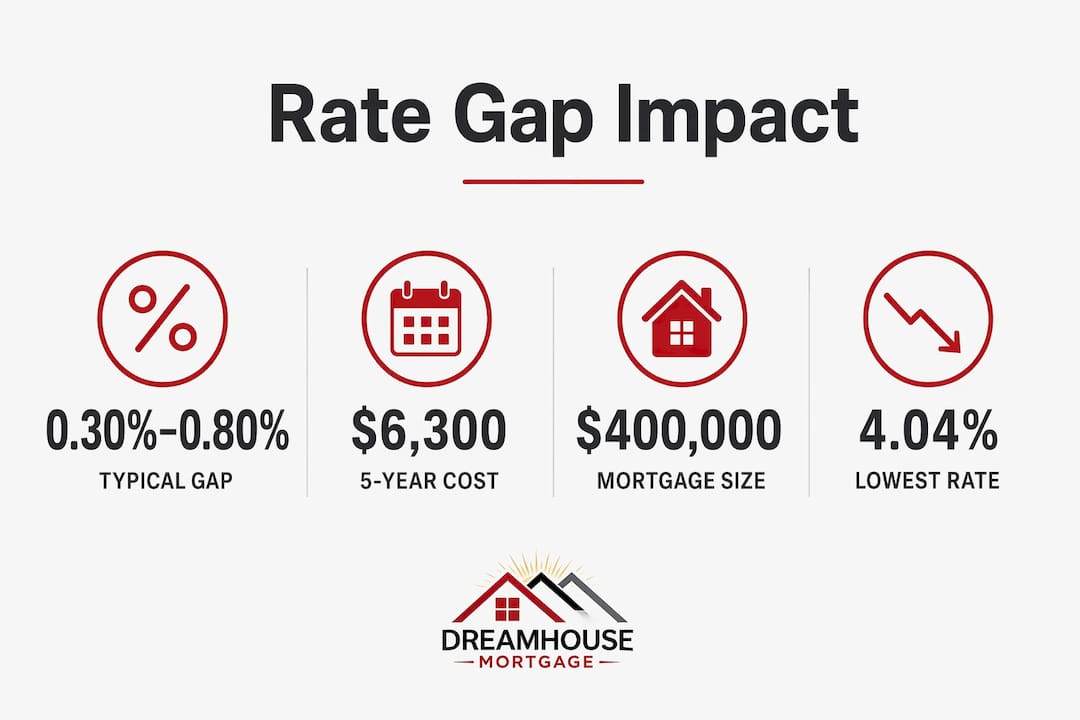
This gap typically ranges 0.30%–0.80% on Canadian mortgages. That range may look small on paper, but it is not. On a $400,000 mortgage balance with 20 years remaining, a 0.50% gap adds approximately $6,300 over a five-year term. That is money leaving your household for no reason other than not shopping the market.
The industry term for this concept is the renewal spread or retention margin. Both phrases describe the same reality: your lender is offering you a rate above what the market would price your mortgage at if you were a new customer. Understanding market rates at renewal is not optional for informed borrowers. It is the starting point for every renewal decision.
Alberta homeowners renewing in 2026 face a compounding challenge. Pandemic-era rates of 1.49%–2.29% are expiring, and renewal rates now sit at roughly 4.29%–4.99%. That shift alone can add $500–$900 or more per month to your payment. The renewal vs market rate gap sits on top of that base increase, making it critical to evaluate renewal rates carefully before signing anything.
How do lenders determine renewal rates vs market rates?
Lenders do not set renewal rates based solely on Bank of Canada policy decisions. Renewal rates are set using the lender’s own cost of funds, the borrower’s risk profile, and a retention margin built into the offer. This is why renewal offers can exceed market rates even when the Bank of Canada holds its policy rate steady.
Here is how the pricing mechanics work in practice:
- Cost of funds: Lenders borrow money at wholesale rates. Their renewal offer must cover that cost plus operating expenses and profit margin.
- Retention margin: Lenders know that most borrowers will not shop. They price renewal offers with a margin of 80–120 basis points above wholesale on owner-occupied properties.
- Risk assessment: Borrowers with strong credit and low loan-to-value ratios qualify for better rates. Lenders use renewal as a moment to reassess risk without always passing savings back to the borrower.
- Product type: Investment property renewals carry structurally higher margins, typically 40–80 basis points above owner-occupied renewals, because lenders assign higher risk to rental properties.
- Market timing lag: Renewal offers are often prepared weeks before maturity. If market rates drop in that window, your offer may not reflect the improvement.
The wholesale market, where monoline lenders and brokers access rates, operates on thinner spreads of 45–70 basis points. That is why a mortgage broker shopping the wholesale market can often find rates meaningfully below what your bank’s renewal letter shows.
Pro Tip: Request your renewal offer in writing the moment it arrives, but do not sign it. Treat it as a starting bid, not a final price. You have the right to negotiate or switch lenders without penalty at renewal.
The practical implication of this pricing structure is straightforward. Your lender’s renewal offer is a business decision designed to retain you at the highest rate you will accept. A market rate analysis compares that offer against what competing lenders would charge for the same mortgage. The gap between the two is your negotiating room.
What is the financial impact of the renewal vs market rate gap?
The financial impact of the renewal rate vs market rate difference becomes clear when you apply real numbers to Alberta mortgage balances. Calgary and surrounding communities like Okotoks, High River, and Rocky View County carry average mortgage balances well above the national average, making each basis point more costly.
The table below shows the monthly and five-year cost of common renewal rate gaps on typical Alberta mortgage balances.
| Mortgage Balance | Rate Gap | Monthly Payment Increase | Five-Year Additional Cost |
|---|---|---|---|
| $400,000 | 0.30% | ~$65 | ~$3,900 |
| $400,000 | 0.50% | ~$105 | ~$6,300 |
| $400,000 | 0.80% | ~$165 | ~$9,900 |
| $550,000 | 0.50% | ~$145 | ~$8,700 |
| $600,000 | 0.80% | ~$230 | ~$13,800 |
Estimates based on 20-year amortization remaining. Actual figures vary by amortization schedule and payment frequency.
These numbers reflect the cost of a 0.50% difference adding approximately $6,300 over five years on a $400,000 balance. That figure assumes no lump-sum payments and a standard monthly payment schedule. The cost grows with the balance and the size of the gap.
The pandemic-era renewal shock makes this even more visible. A borrower who locked in at 1.89% in 2021 and is now renewing at 4.04% faces a payment increase of approximately $318 per month on a $300,000 balance. That increase is driven by the rate environment shift, not the renewal spread. The renewal spread adds further cost on top of that base increase.
For real estate investors in Edmonton, Red Deer, and Calgary managing rental properties, the impact compounds. Investment property renewal rates carry higher structural margins. A 0.80% gap on a $500,000 rental property mortgage costs roughly $11,000 over five years. That is a meaningful reduction in net rental income that a market rate analysis and lender switch could prevent.
The lowest five-year insured rate available as of february 2026 was approximately 4.04%, according to Ratehub.ca. Fixed pricing sits about 265 basis points above pandemic-era lows. Homeowners who accept renewal offers without comparing them to this market benchmark are leaving real money on the table.
How can you shop and negotiate a better renewal rate?
Closing the renewal rate vs market rate gap requires a process, not a single phone call. The homeowners and investors who pay the least at renewal follow a clear sequence that begins months before their mortgage matures.
- Start 120–180 days before maturity. Beginning the renewal process up to 180 days before your maturity date gives you maximum time to shop, compare, and negotiate without deadline pressure. Most lenders allow you to lock in a rate hold during this window.
- Request a rate hold immediately. Most lenders offer rate hold windows of approximately 120 days before maturity. Some extend to 180 days. A rate hold locks in today’s rate while you continue shopping. If rates rise, you are protected. If rates fall, ask your lender to honor the lower rate.
- Obtain at least two competing written offers. Contact a mortgage broker, a monoline lender, and at least one other bank. Get written rate offers for the same term and product type. Written offers carry weight in negotiation. Verbal quotes do not.
- Present competing offers to your current lender’s retention team. The initial renewal letter comes from a standard processing department. The retention team has authority to reduce rates. Lender renewal letters typically state a rate that is 0.30%–0.80% above what the retention team will offer when presented with a competing quote.
- Evaluate the full cost of switching. Switching lenders at renewal carries no prepayment penalty in Canada. However, you may face legal fees, appraisal costs, and administrative charges. Calculate whether the rate savings over the term exceed those switching costs. On most Alberta mortgages above $400,000, a 0.30% rate improvement covers switching costs within the first year.
- Do not sign the renewal letter on arrival. Signing immediately removes your negotiating position. You have until your maturity date to make a decision. Use that time.
Pro Tip: A mortgage broker shops your renewal across multiple lenders simultaneously, including banks, credit unions, and monoline lenders. This process takes days, not weeks, and typically surfaces rates below what any single lender will offer you directly. Learn more about how to evaluate renewal rates with a broker’s help.
The smart ways to save on your mortgage in 2026 all share one common thread: comparison before commitment. Homeowners in Cochrane, Chestermere, and Airdrie who treat renewal as a competitive process consistently pay less than those who treat it as an automatic administrative step.
Fixed vs variable: how product type affects the rate gap
The renewal rate vs market rate difference does not look the same for fixed and variable mortgages. The two products are priced against different benchmarks, and understanding that distinction is critical for renewal pricing comparison.
Fixed mortgage rates are primarily linked to Government of Canada bond yields. When bond yields rise, fixed rates follow. When yields fall, fixed rates drop, though lenders are slower to pass decreases to borrowers than to absorb increases. At renewal, a fixed rate offer reflects the lender’s view of bond market conditions plus their retention margin.
Variable mortgage rates track the Bank of Canada Prime rate. When the Bank of Canada raises or lowers its policy rate, variable rates move in step. The renewal spread on a variable product is typically expressed as Prime minus or plus a set percentage. Understanding market rates for variable products means tracking the Bank of Canada’s rate path, not bond markets.
Here is why this distinction matters for your renewal decision:
- A fixed renewal offer at 4.89% may look high compared to a variable offer at Prime minus 0.50% (currently around 4.45%). But if the Bank of Canada raises rates, the variable cost rises immediately while the fixed rate stays locked.
- A fixed rate provides payment certainty over the full term. A variable rate offers potential savings if rates fall, but introduces payment risk if they rise.
- For Alberta investors managing rental property mortgages, payment predictability often outweighs the potential savings from variable pricing, because rental income projections depend on stable expense forecasts.
- The gap between fixed and variable renewal offers can be 0.40%–0.60% in either direction depending on market conditions. That gap is not permanent. It shifts with bond markets and Bank of Canada policy.
The Bank of Canada rate directly influences what variable renewal rates look like at any given moment. Fixed rates respond to bond markets on a different timeline. Comparing a fixed renewal offer to a variable market rate is comparing two different products, not two prices for the same thing.
For most Calgary and Alberta homeowners renewing in 2026, the decision between fixed and variable comes down to one question: how much payment variation can your budget absorb? If the answer is very little, a fixed rate at a negotiated market price is the more reliable choice. If you have financial flexibility and expect rates to fall, a variable product may deliver lower total cost over the term. Review the fixed vs variable mortgage options available in Alberta before committing to either product at renewal.
Key takeaways
The renewal rate vs market rate difference costs Alberta homeowners thousands of dollars per term when left unchallenged, and closing that gap requires early action, competing offers, and direct negotiation with your lender’s retention team.
| Point | Details |
|---|---|
| The gap is real and measurable | The renewal spread typically ranges 0.30%–0.80%, costing up to $13,800 over five years on a $600,000 mortgage. |
| Lenders price for retention, not fairness | Renewal offers include a built-in margin above wholesale market rates; the initial offer is not the best available price. |
| Start the process early | Beginning 120–180 days before maturity gives you time to rate hold, shop, and negotiate without deadline pressure. |
| Fixed and variable gaps differ | Fixed rates link to bond yields; variable rates track Bank of Canada Prime. Comparing them requires understanding both benchmarks. |
| A mortgage broker closes the gap faster | Brokers access wholesale market rates across multiple lenders simultaneously, typically surfacing better pricing than direct lender offers. |
Work with dreamhouse mortgage to close the rate gap
Dreamhouse Mortgage helps homeowners and investors across Calgary, Airdrie, Cochrane, Chestermere, Okotoks, Red Deer, and Edmonton close the renewal rate vs market rate gap with direct access to competitive lender pricing. Led by Guriqbal Chahal, MBA, PMP, Mortgage Broker, the team shops your renewal across banks, credit unions, monoline lenders, and alternative lenders to find the best available rate for your situation.

Whether you are renewing a primary residence in Calgary or managing investment property financing across Alberta, Dreamhouse Mortgage provides a full mortgage broker rate negotiation service that puts competing offers in front of your lender and secures the lowest rate you qualify for. Contact Guriqbal Chahal at 403-966-6072 or visit the Google Business Profile to book a consultation. You can also explore why mortgage brokers secure better rates before your first conversation.
FAQ
What is the renewal rate vs market rate difference?
The renewal rate vs market rate difference is the gap between the interest rate your current lender offers at mortgage maturity and the best rate available from any lender in the market. This gap typically ranges 0.30%–0.80% on Canadian mortgages.
How much can the renewal vs market rate gap cost me?
A 0.50% gap on a $400,000 mortgage with 20 years remaining adds approximately $6,300 over a five-year term. On larger Alberta balances of $550,000–$600,000, the cost can reach $8,700–$13,800 over the same period.
When should i start shopping my mortgage renewal in alberta?
Start the renewal process 120–180 days before your maturity date. This window allows you to lock in a rate hold, obtain competing offers, and negotiate with your current lender without time pressure.
Can i switch lenders at renewal without a penalty?
Yes. Canadian mortgage rules allow borrowers to switch lenders at the end of their term without a prepayment penalty. You may face legal and administrative fees, but on most Alberta mortgages above $400,000, a 0.30% rate improvement covers those costs within the first year.
Does the renewal rate gap differ for investment properties?
Yes. Investment property renewal rates carry structurally higher margins of 80–120 basis points above wholesale, compared to 45–70 basis points for owner-occupied properties. The typical renewal gap on rental properties runs 40–80 basis points above market rates.