Canadian mortgage qualification is governed by three rule sets: the Gross Debt Service (GDS) ratio limit, the Total Debt Service (TDS) ratio limit, and the Minimum Qualifying Rate (MQR) stress test set by OSFI. Down payment thresholds and CMHC mortgage default insurance rules determine whether a mortgage is insured or uninsured, which affects which limits apply. Together, these rules — administered by OSFI, CMHC, and the Department of Finance Canada — determine how much you can borrow and what documentation you need. Dreamhouse Mortgage helps Alberta buyers in Calgary, Airdrie, Cochrane, Chestermere, Edmonton, and Red Deer navigate every one of these requirements.
The three headline numbers:
- GDS maximum: as set by CMHC guidelines for insured mortgages
- TDS maximum: as set by CMHC guidelines for insured mortgages
- MQR (stress test): the greater of your contract rate plus a buffer or a minimum floor rate
2026 Policy Updates: The CMHC insurable price cap rose to $1.5M (up from $1M), and 30-year amortization is now available for insured mortgages for first-time buyers and new builds (with a CMHC premium surcharge of +0.20%). OSFI’s stress-test formula remained unchanged.
Key Takeaways
| Point | Details |
|---|---|
| GDS limit | Maximum 39% of gross income for housing costs (mortgage, taxes, heat, 50% condo fees). |
| TDS limit | Maximum 44% of gross income including all recurring debts added to housing costs. |
| Stress test (MQR) | Qualify at contract rate + 2% or 5.25% floor; reduces borrowing capacity by $60,000–$100,000 in typical scenarios. |
| Insurable cap and amortization | CMHC insurable cap is $1.5M; 30-year amortization available for first-time buyers and new builds with a +0.20% premium surcharge. |
| Dreamhouse Mortgage | Serves Calgary, Airdrie, Cochrane, Chestermere, Edmonton, and Red Deer; call 403-966-6072 for pre-approval help. |
Table of Contents
- How do GDS and TDS ratios determine your borrowing limit?
- What is the mortgage stress test and how does it reduce your borrowing power?
- What are the down payment rules and when is mortgage insurance required?
- What income and documents do lenders verify?
- How much mortgage can you qualify for on a $70K salary?
- What are the steps to get mortgage pre-approved in Alberta?
- What mistakes can derail your mortgage application?
- Dreamhouse Mortgage: local mortgage expertise for Alberta buyers
- Sources
- FAQ
How do GDS and TDS ratios determine your borrowing limit?
Lenders use GDS and TDS to measure how much of your income is consumed by housing costs and total debt. CMHC sets the ceilings at a maximum GDS of 39% and a maximum TDS of 44% for insured applications. Exceeding either ceiling disqualifies you at most federally regulated lenders.
What goes into each ratio
GDS (Gross Debt Service) includes:
- Monthly mortgage principal and interest
- Property taxes (monthly estimate)
- Heating costs (monthly estimate)
- 50% of monthly condo fees, when applicable
TDS (Total Debt Service) includes everything in GDS, plus:
- Car loan payments
- Minimum credit card and line-of-credit payments
- Student loan payments
- Child or spousal support obligations
The Canada confirms that total housing costs should normally not exceed 39% of gross household income and total debts should not exceed 44%. Some lenders apply stricter internal thresholds.
Worked example: Calgary buyer with $90,000 household income
Step 1 — Monthly gross income: based on annual income divided by 12.
Step 2 — Monthly mortgage payment: an estimated payment calculated using common amortization assumptions and interest rates.
Step 3 — GDS calculation: housing costs divided by gross monthly income producing a percentage that should be close to but not exceed the maximum GDS limit.
Step 4 — Adjusting amortization term can reduce the monthly mortgage payment, helping the GDS ratio meet guidelines.
Pro Tip: Paying down a revolving line of credit before applying can lower your TDS by several percentage points. See the full GDS/TDS ratio guide for Calgary buyers for more Alberta-specific scenarios.
What is the mortgage stress test and how does it reduce your borrowing power?
The stress test, formally called the Minimum Qualifying Rate (MQR), requires lenders to confirm you can afford payments at a rate higher than your actual contract rate. OSFI requires federally regulated lenders to qualify uninsured mortgages at the greater of the contract rate plus 2 percentage points or a floor of 5.25%. OSFI reviews this rate at least annually.
The purpose is systemic risk management. If rates rise after you close, you should still be able to service the debt. OSFI’s B-20 guidance sets the expectations for how lenders apply this rule.
How the MQR formula works
MQR = maximum of (contract rate plus a 2 percentage point buffer) or a minimum floor rate set by OSFI. The exact buffer and floor rates are set by OSFI and reviewed regularly.
Stress test worked example
At the stressed qualifying interest rate, the maximum mortgage principal supported by the housing cost allowance can be estimated based on standard amortizations and interest rates, showing a lower borrowing ceiling than at the actual contract rate. The stress test thus reduces borrowing capacity by a significant amount in typical scenarios.
Renewal exception: OSFI does not expect lenders to apply the MQR to straight uninsured switches at renewal where there is no increase in loan amount or amortization period. If you are simply switching lenders at renewal on the same terms, the stress test typically does not apply.
For a deeper look at how the stress test affects first-time buyers specifically, the mortgage stress test guide for first-time buyers covers lender-by-lender behavior in Alberta.
What are the down payment rules and when is mortgage insurance required?
Down payment size determines whether your mortgage is insured or uninsured, which changes both the qualification rules and the cost of borrowing.
Down payment tiers
| Purchase Price | Minimum Down Payment |
|---|---|
| Up to $500,000 | 5% of the full purchase price |
| — | 5% on the first $500,000 + 10% on the remainder |
| Over $1,500,000 | 20% minimum (uninsured, no default insurance available) |
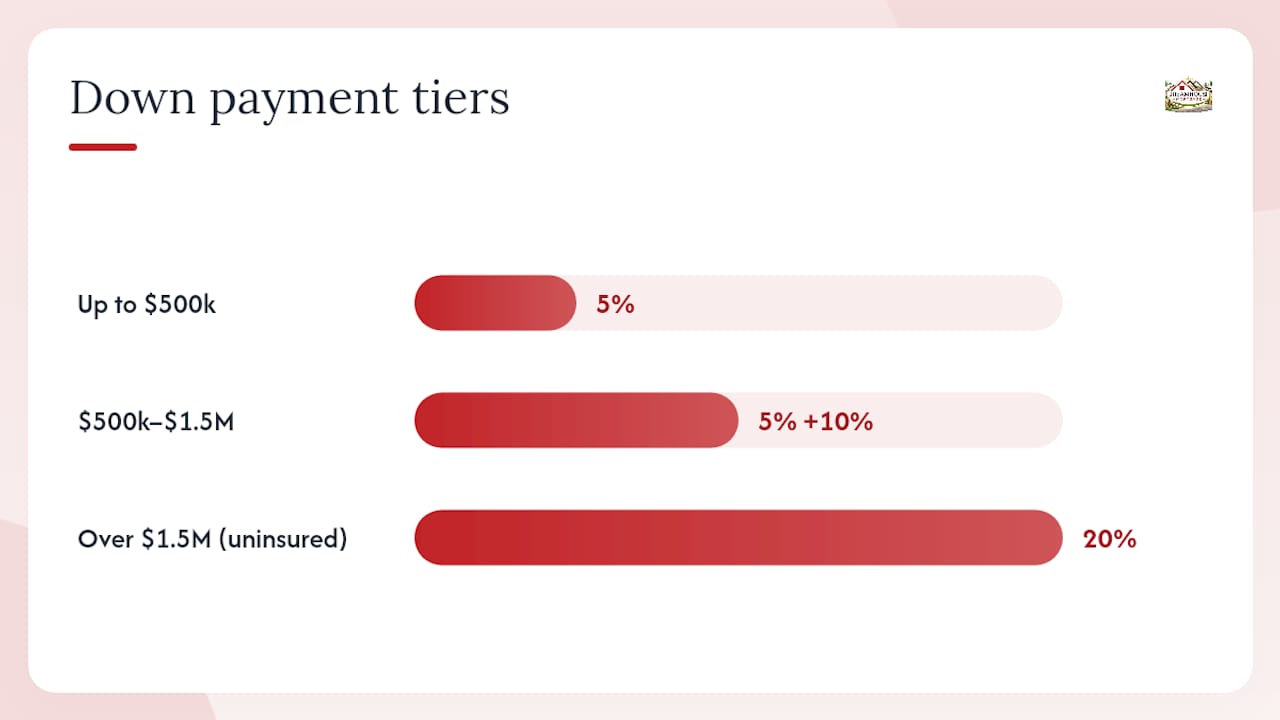
The insurable cap of $1.5M reflects the 2026 policy change that expanded access to insured financing for buyers in higher-priced markets like Calgary.
How mortgage default insurance works
In Canada, three insurers provide this coverage: CMHC, Sagen, and Canada Guaranty. The insurance premium is added to your mortgage balance. It protects the lender, not you, but it allows you to qualify with a smaller down payment and often at lower interest rates than uninsured mortgages.
Key points:
- Insured mortgages use CMHC’s GDS/TDS maximums (39%/44%) as the ceiling
- Uninsured mortgages (20%+ down) are subject to individual lender policies, which may be stricter
- The 30-year amortization option for insured mortgages applies only to first-time buyers and new-construction purchases, and carries a CMHC premium surcharge of +0.20%
- Lenders may apply insurer-specific overlays that are more restrictive than the published guidelines
For buyers weighing the cost of a longer amortization, the mortgage amortization options guide explains the trade-offs between lower monthly payments and higher lifetime interest.
What income and documents do lenders verify?
Ratios and stress tests are only part of the picture. Lenders also verify the source, stability, and documentation of your income before approving any mortgage application.
Accepted income types
Employment income is the most straightforward. Lenders want two years of T4s, recent pay stubs (typically the last 30–60 days), and a current letter of employment confirming salary, position, and tenure.
Self-employed income requires more documentation. Lenders typically use a two-year average of net business income from T1 General tax returns, Notices of Assessment (NOAs), and financial statements. Some lenders require an accountant’s letter confirming the business is active and income is stable.
Rental income is included partially. CMHC guidance allows up to 50% of gross rental income in many insured applications, and up to 100% for two-unit owner-occupied properties under certain conditions. Lenders want lease agreements and rental history.
Part-time, contract, and variable income typically requires a two-year history to be considered stable. Seasonal workers may need to show consistent year-over-year earnings across multiple NOAs.
Investment income (dividends, interest) is generally accepted if it appears consistently on two years of tax returns.
Special cases common in Alberta
Self-employed professionals in Calgary and Edmonton often find that their declared net income after deductions is lower than their actual cash flow. A mortgage broker with access to alternative lenders can often find solutions that use gross revenue or bank statement income for qualification.
Co-signers and co-borrowers can add their income to the application, which raises the GDS/TDS ceiling in absolute dollar terms. Both parties are fully liable for the mortgage, which affects their own borrowing capacity for future purchases.
Pre-approval document checklist for Calgary and Alberta buyers
- Government-issued photo ID (two pieces)
- Last two years of T4 slips
- Last two years of Notices of Assessment
- Recent pay stubs (last 30–60 days)
- Three months of bank statements showing down payment funds
- Proof of down payment source (gift letter if applicable)
- Current lease agreements (if rental income is claimed)
- Business financial statements and T1 Generals (self-employed)
- Property details (MLS listing or purchase agreement, if available)
- Signed consent to pull credit bureau report
The mortgage checklist for Calgary buyers covers every document in detail, including what lenders look for in each one.
How much mortgage can you qualify for on a $70K salary?
Scenario 1: $70,000 gross annual income
Monthly gross income: $5,833
Subtract property tax ($250) and heat ($150): $1,875 available for mortgage payment
Adding a co-borrower with $40,000 additional income raises the ceiling substantially.
Scenario 2: What income do you need to qualify for a $500,000 mortgage?
Add property tax ($300) and heat ($150): total housing cost = $3,940
Required gross annual income: approximately $121,000
With existing debts (say, a $500/month car loan), TDS applies. Total monthly obligations = $4,440. In this case, GDS and TDS converge at roughly the same income requirement.
What changes these numbers:
- A higher credit score (680+) opens more lender options and may improve rate offers
- A larger down payment (20%+) removes the insurance premium and may lower the effective rate
- Alternative or private lenders use different qualification criteria, which can help buyers who fall outside standard ratios
Pro Tip: Use the rent vs. buy calculator to compare your current rental cost against estimated mortgage payments before booking a pre-approval appointment. It takes less than five minutes and gives you a clearer picture of your readiness.
For a mortgage pre-approval in Calgary, Dreamhouse Mortgage can run these calculations against your actual income and debts and tell you your real number within one business day.
What are the steps to get mortgage pre-approved in Alberta?
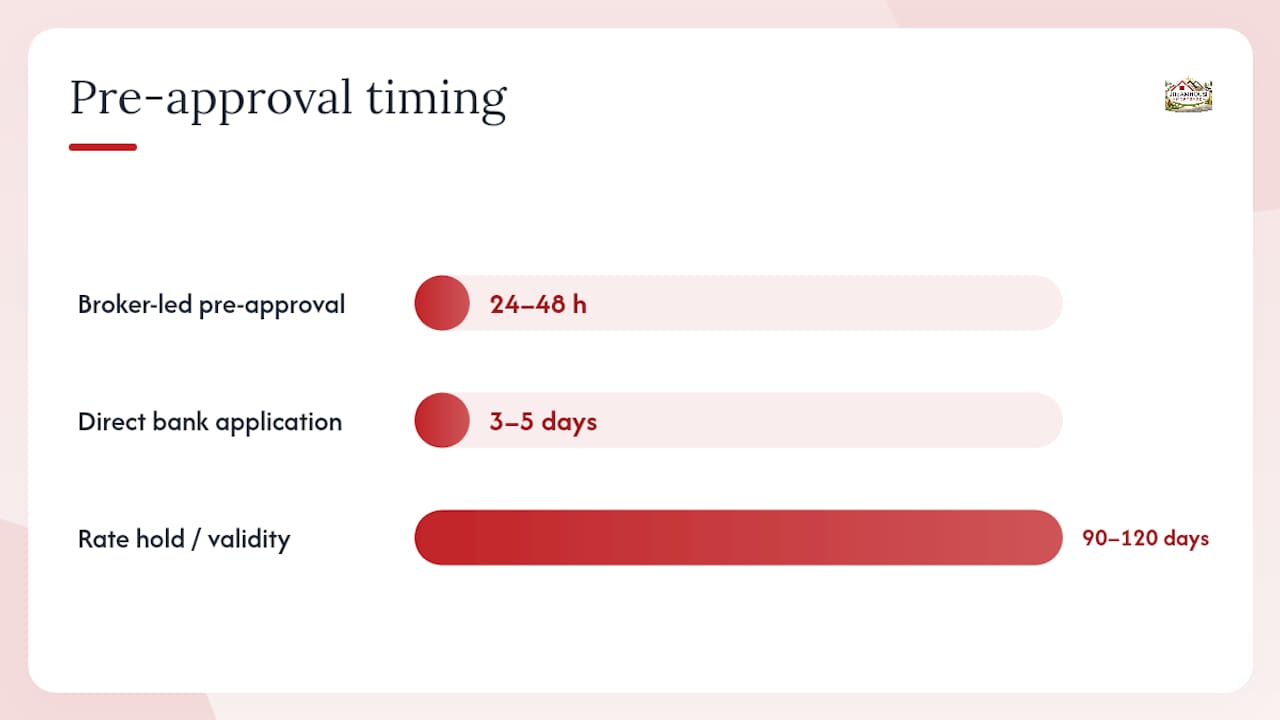
Pre-approval is a lender’s conditional commitment to lend you a specific amount at a specific rate, valid for a set period (typically 90–120 days). It is not a guarantee of final approval, but it gives you a firm budget and strengthens your offer in a competitive Calgary or Airdrie market.
The pre-approval process, step by step:
- Initial consultation: Discuss income, debts, down payment, and purchase goals with a mortgage broker.
- Credit check: Lender pulls your credit bureau report (a hard inquiry; one pull by a broker covers multiple lenders).
- Income verification: Submit T4s, NOAs, pay stubs, and employment letter.
- Down payment confirmation: Provide 90 days of bank statements showing the source of funds.
- Debt disclosure: List all monthly obligations accurately (car loans, credit cards, student loans).
- Rate hold: Broker locks in a rate for 90–120 days while you shop.
- Pre-approval letter issued: Confirms maximum mortgage amount and rate.
Timeline: A broker-led pre-approval in Calgary typically takes 24–48 hours once all documents are submitted. A direct bank application may take 3–5 business days. Appraisal fees (if required for a specific property) typically range from $300 to $500 in Alberta, though pre-approvals generally do not require a property appraisal until you have an accepted offer.
Local factors matter. Calgary’s market moves quickly, particularly in communities like Cochrane, Chestermere, and Okotoks. A pre-approval in hand before you start viewing properties puts you in a position to make an offer the same day.
Pro Tip: Before your pre-approval appointment, pull your own credit report through Equifax Canada or TransUnion Canada (a soft inquiry that does not affect your score). Dispute any errors before the lender sees them. A 20-point score improvement can shift you into a better rate tier.
The full mortgage pre-approval process for Alberta buyers covers what to expect at each stage, including what happens after your offer is accepted.
What mistakes can derail your mortgage application?
Several common errors reduce borrowing power or trigger a lender decline. Most are avoidable with preparation.
Common borrower mistakes:
- Applying for new credit (car loan, credit card) within 90 days of a mortgage application — new inquiries lower your score and raise your TDS
- Failing to disclose existing debts; lenders pull your credit bureau and will find them
- Overestimating rental income; lenders apply CMHC’s 50% inclusion rule, not your full rent roll
- Ignoring condo fees in your own budget estimate; they count at 50% in GDS calculations
- Providing insufficient down payment documentation; funds must be traceable for 90 days
Red flags lenders watch for:
- Unstable employment history (less than two years with the same employer or in the same field)
- Large unexplained deposits in bank statements (lenders will ask for a paper trail)
- High credit utilization (above 70–80% of available credit limits)
- Recent missed or late payments on any credit account
- Undisclosed contingent liabilities (co-signing someone else’s loan counts against your TDS)
- Significant income swings year over year for self-employed applicants
Remediation steps: Pay down revolving credit before applying. Delay the purchase by 60–90 days if your credit utilization is high. For self-employed buyers, work with an accountant to ensure two years of NOAs reflect stable income before applying. For newcomers, gather international credit references and open a Canadian bank account at least six months before applying.
Dreamhouse Mortgage: local mortgage expertise for Alberta buyers
Qualifying for a mortgage in Calgary, Airdrie, Cochrane, Chestermere, Red Deer, or Edmonton involves more than running the GDS/TDS math. Lender selection, rate negotiation, and document preparation all affect the outcome. Dreamhouse Mortgage provides access to banks, credit unions, monoline lenders, alternative lenders, and private lenders — giving Alberta buyers options that a single bank branch cannot match.

Guriqbal Chahal, MBA, PMP, Broker of Record at Dreamhouse Mortgage, specializes in first-time buyer mortgages, self-employed mortgages, New to Canada programs, mortgage refinancing, and investment property financing across Alberta. The brokerage handles income verification, lender selection, rate holds, and document coordination so buyers can focus on finding the right property.
Whether you are a first-time buyer in Calgary calculating your GDS for the first time, a self-employed professional in Edmonton with complex income documentation, or a newcomer to Canada in Airdrie looking for a lender that accepts alternative credit references, Dreamhouse Mortgage has the lender relationships and local knowledge to find a solution. Learn how mortgage broker rate negotiation works and what it means for your final rate.
Call Guriqbal Chahal, MBA, PMP, Mortgage Broker at 403-966-6072 or find Dreamhouse Mortgage on Google to book a no-obligation pre-approval consultation. Start your mortgage pre-approval for Alberta buyers today.
A broker’s perspective on what Alberta buyers get wrong
That gap is what catches people off guard. For many households, that single rule reduces borrowing capacity by $60,000 to $100,000 compared to what an online calculator shows when it ignores the MQR.
The second most common issue is undisclosed debt. A car lease, a co-signed student loan, or a spousal line of credit that does not appear in the initial conversation will appear on the credit bureau. Lenders count it. Disclosing everything upfront allows a broker to structure the application correctly from the start rather than scrambling after a lender decline.
What changes is how you prepare. Call 403-966-6072 for a Calgary-area consultation.
Sources
- Minimum qualifying rate for uninsured mortgages – Office of the Superintendent of Financial Institutions
- Calculating GDS / TDS | CMHC
- Canada
- What Changed in Mortgage Rules for 2026 – Canadian Money Help
This article is general information, not a substitute for advice from a qualified financial advisor. Consult a qualified financial professional about your own circumstances before acting on anything here.
FAQ
How much income do you need to qualify for a $500,000 mortgage in Canada?
What are the requirements to qualify for a mortgage in Canada?
Lenders verify income, credit history, down payment source, and existing debts.
What are the new mortgage rules in Canada for 2026?
How much mortgage can I get with a $70,000 salary in Canada?
At $70,000 gross annual income, with no other debts and standard Alberta property tax and heating estimates, you can qualify for mortgage principal consistent with typical stress test limits. Adding a co-borrower or reducing existing debts raises this ceiling.
Does the mortgage stress test apply when I renew my mortgage?
OSFI does not expect lenders to apply the MQR to straight uninsured switches at renewal where there is no increase in the loan amount or amortization period. If you are refinancing or increasing your mortgage at renewal, the stress test applies.