
Yes, refinancing in Canada usually comes with closing costs, and for most homeowners with a closed mortgage, the largest one is the prepayment penalty. Before you decide anything, check three things: your prepayment penalty, your lawyer and registration fees for discharging the old mortgage, and the new lender’s appraisal or admin fees. Request a written payout statement first; everything else depends on that number.
TL;DR:
- Lenders charge the higher of three months’ interest or the interest rate differential, which often rises when market rates fall; request a written payout statement.
- Alberta registration fees follow a sliding scale and can change over time, so have your lawyer confirm the filing date’s exact charge before committing.
- FCAC puts professional discharge fees at $400 to $2,500, while lender discharge fees can range from $0 to about $400 when not provincially regulated.
- A $6,000 refinance cost paired with $250 in monthly savings takes 24 months to recover, before accounting for added principal or longer amortization.
- Increasing principal or extending amortization can trigger the federal stress test, which qualifies you at the greater of 5.25% or your contract rate plus 2%.
Table of Contents
- The Full List of Refinance Closing Costs You Should Budget For
- Why Prepayment Penalties Often Drive the Total Cost
- How Closing Costs Vary by Province, With Alberta Specifics
- Is Refinancing Worth It? Running the Break-Even Math
- What Your Lawyer Actually Does, and What It Costs
- How to Get Exact Closing-Cost Numbers Before You Commit
- How We Help Calgary-Area Homeowners Pin Down These Numbers
- What Actually Matters When You Price Out a Refinance
- Get Your Exact Refinance Numbers From a Local Broker
- FAQ
- Sources
The Full List of Refinance Closing Costs You Should Budget For
Refinancing rarely involves just one fee. We walk Calgary, Airdrie, and Cochrane homeowners through each line item so nothing catches them off guard at the lawyer’s office.
- Prepayment penalty: charged when you break a closed mortgage before term end, calculated as the higher of three months’ interest or the interest rate differential, and often the single biggest cost.
- Discharge and registration fees: your lawyer removes the old mortgage from title and registers the new one, a step governed by provincial land titles rules.
- Lawyer or notary professional fees: cover the title search, discharge paperwork, and registration of the new charge.
- Appraisal fee: most lenders order a new appraisal to confirm current value before approving refinanced equity.
- Lender setup or administration fees: cover underwriting and funding; some lenders waive these to win your business.
- Courier and title search charges: smaller line items your lawyer’s invoice typically itemizes separately.
- Mortgage insurance implications: if your refinance pushes your loan-to-value above 80%, insurance premium rules may apply.
Ask your current lender for a written payout statement, and ask your lawyer for an itemized invoice before you commit. Those two documents turn guesswork into a real number.
Why Prepayment Penalties Often Drive the Total Cost
The gap between a manageable penalty and a painful one usually comes down to which formula your lender applies. According to FCAC guidance on prepayment penalties, lenders charge the higher of three months’ interest or the interest rate differential, and the IRD calculation tends to produce the larger figure when rates have dropped since you signed.
- Three months’ interest is simple: your annual rate divided by four, applied to your remaining balance.
- IRD compares your contract rate to the current rate for a term matching your remaining time left, then applies that difference to your balance for the remaining months.
Three months’ interest runs close to $3,750, but the IRD on that same balance and term can land several times higher, which is exactly why FCAC flags IRD penalties as potentially substantial.
Collateral charge mortgages add another wrinkle: because the charge can secure more than your mortgage balance, discharging or transferring it sometimes takes extra legal steps. Always request a written payout statement and ask your lender to show its math.
How Closing Costs Vary by Province, With Alberta Specifics
Land titles systems are provincial, which means registration and discharge fees differ depending on where your home sits. Alberta uses its own fee schedule rather than a flat national rate.
- Alberta charges registration fees based on a per-value sliding scale plus a base component, set out in the Alberta Land Titles fee schedule.
- The province periodically updates its mortgage registration levy, so the fee that applied last year may not match what your lawyer quotes today.
- Confirm the exact fee with your lawyer based on your actual submission date rather than relying on an example from a past refinance.
For Calgary, Airdrie, and Cochrane homeowners, this matters because the same mortgage balance can generate a different registration charge depending solely on when the paperwork gets filed.
Is Refinancing Worth It? Running the Break-Even Math
Closing costs only matter in context: compare them against what you actually save each month. The formula is straightforward.
- Add up every one-time cost: penalty, legal fees, registration, appraisal, and any admin charges.
- Divide that total by your monthly savings from the new rate or payment to get your months-to-break-even.
- Factor in added principal if you’re taking equity out, since a larger balance or longer amortization changes your long-term interest cost even when monthly payments drop.
Say your total closing costs come to $6,000 and the new mortgage saves you $250 a month: that’s a 24-month break-even. If you plan to stay in the home, or keep the mortgage, well past that point, the math favors refinancing.
One detail many homeowners miss: refinancing is a qualification event. FCAC’s mortgage qualifier tools confirm that increasing your principal or extending amortization can trigger the federal stress test, which uses the greater of 5.25% or your contract rate plus 2%. Run your numbers through that lens before assuming approval is automatic.
What Your Lawyer Actually Does, and What It Costs
A lawyer or notary handles the legal mechanics of closing: searching title, preparing discharge documents for your old mortgage, and registering the new one with the province. This work protects both you and the new lender.
- Title search: confirms no other claims or liens exist against the property.
- Discharge preparation: removes the old mortgage from title once it’s paid out.
- New registration: files the new mortgage charge with Alberta Land Titles.
FCAC notes that professional discharge fees typically fall between $400 and $2,500, while lender discharge fees, where not provincially regulated, can range from $0 to roughly $400.
Pro Tip: Ask your lawyer for an itemized quote up front, and ask your new lender directly whether they’ll cover any portion of these fees as a switch incentive.
How to Get Exact Closing-Cost Numbers Before You Commit
Estimates are useful for planning, but you need real figures before signing anything. Follow these steps in order.
- Request a written payout statement from your current lender showing your exact prepayment charge and how it was calculated.
- Ask prospective lenders for their setup and admin fee list, and whether they offer a credit for switching to offset those costs.
- Get an itemized estimate from your lawyer or notary covering discharge and registration fees specific to your Alberta filing.
- Add in your appraisal fee and any payoff on a HELOC or other secured product tied to your current home.
- Recalculate your break-even using the real totals instead of estimates.
Once you have all five numbers, the refinancing decision usually becomes clear on its own.
How We Help Calgary-Area Homeowners Pin Down These Numbers
We review payout statements, model break-even scenarios, and negotiate lender credits for Calgary, Airdrie, and Cochrane homeowners. Call 403-966-6072 for a tailored closing-cost estimate.
What Actually Matters When You Price Out a Refinance
The conventional advice to “shop the lowest rate” misses the point for most refinancing homeowners: the rate is rarely what determines whether refinancing pays off. The prepayment penalty does, and too many homeowners skip the step of requesting a written payout statement until after they’ve already fallen in love with a new rate offer.
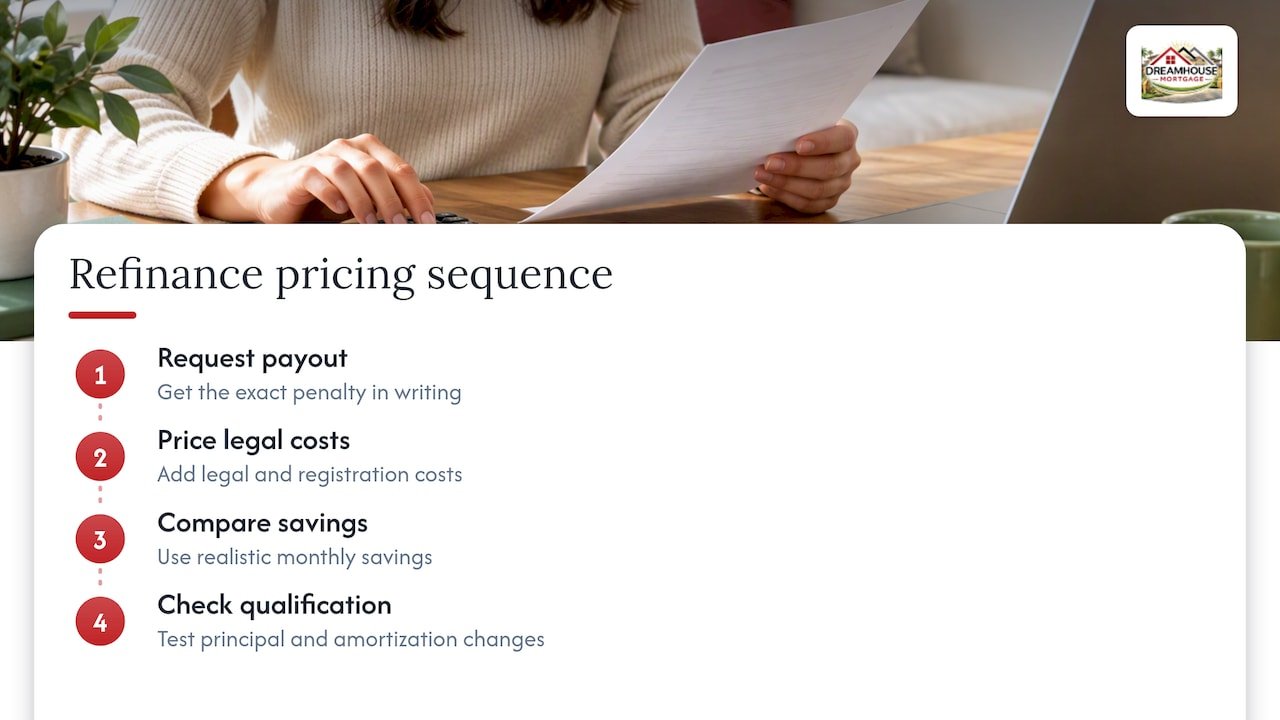
We think the real discipline here is sequencing. Get your exact penalty figure first, then your legal and registration costs, then compare those totals against realistic monthly savings, not the marketing number a lender quotes before running your specific balance and term through their formula. A quoted “estimated penalty” is not the same as a written payout statement, and the difference between the two can be thousands of dollars.
The second place conventional wisdom falls short is ignoring qualification. A lower rate means nothing if a larger principal or extended amortization pushes you against the stress test. Price the whole transaction, not just the interest rate, and you’ll make a decision you won’t second-guess in twelve months.
— Guriqbal Chahal, MBA, PMP
Get Your Exact Refinance Numbers From a Local Broker
Generic online calculators can give you a rough range, but they can’t pull your actual payout statement or negotiate a lender credit on your behalf. That’s where working with a Calgary-based broker makes the difference between guessing and knowing.

We pull your written payout statement, model your real break-even timeline, and negotiate lender credits that offset setup or legal fees where the lender allows it, all tailored to Calgary, Airdrie, and Cochrane mortgage files. Call Guriqbal Chahal, MBA, PMP, Mortgage Broker, at 403-966-6072, or book a consult through our mortgage broker consultation page. You can also see our profile on Google Business.
This article is general information, not a substitute for advice from a qualified financial advisor. Consult a qualified financial professional about your own circumstances before acting on anything here.
FAQ
Are there closing costs when refinancing a home?
Yes, refinancing in Canada typically involves a prepayment penalty, legal and registration fees, and often an appraisal fee. The FCAC outlines these costs and recommends comparing them against your expected interest savings before committing.
How much does a mortgage broker make on a $500,000 mortgage?
Mortgage broker compensation comes from lender-paid commission on funded deals rather than a fee charged to you directly, and the exact amount depends on the lender and mortgage product. We don’t publish a flat commission figure because it varies by lender agreement rather than by a fixed rate you’d pay.
What are the mortgage rates today in Canada?
Rates change frequently based on bond yields, Bank of Canada policy, and lender competition, so there’s no single fixed answer. For a current rate tailored to your refinance scenario, call Guriqbal Chahal, MBA, PMP at 403-966-6072.
How much mortgage can I get with a $70,000 salary in Canada?
Your maximum mortgage depends on your income, debt load, down payment, and the federal stress test, which qualifies you at the greater of 5.25% or your contract rate plus 2%. A broker can run your specific numbers through current lender guidelines to give you an accurate figure.
How is a prepayment penalty actually calculated?
Lenders charge the higher of three months’ interest or the interest rate differential, with the IRD method often producing the larger amount when rates have fallen since you signed. Requesting a written payout statement is the only way to see your exact figure.
Sources
- Prepayment penalties – Financial Consumer Agency of Canada (FCAC)
- Alberta
- Mortgage and affordability tools – Financial Consumer Agency of Canada (FCAC)