If your mortgage term is ending while interest rates are shifting, act now rather than accepting the first offer your lender sends. Start shopping 3–4 months before your renewal date, gather written competing offers from multiple lenders, and contact a licensed Alberta mortgage broker to negotiate on your behalf. According to the Financial Consumer Agency of Canada (FCAC), you are not required to renew with your current lender, and the Bank of Canada’s own data confirms that many borrowers renewing in 2025 and 2026 face meaningful payment increases. Dreamhouse Mortgage, led by Broker of Record Guriqbal Chahal, MBA, PMP, helps Alberta homeowners in Calgary, Airdrie, Cochrane, Chestermere, and across the province navigate exactly this situation.
Three actions to take right now:
- Start the renewal process 3–4 months before your term ends to maximize negotiating leverage.
- Request written rate offers from at least two or three lenders so you have real numbers to compare.
- Call Guriqbal Chahal at Dreamhouse Mortgage (403-966-6072) for a free renewal review and access to multiple lenders across Alberta.
Key Takeaways
Mortgage renewal during rate changes requires early action, market comparison, and negotiation — homeowners who shop 3–4 months early and bring competing written offers consistently secure better rates than those who accept the first offer.
| Point | Details |
|---|---|
| Start 3–4 months early | Lenders allow renewal talks up to 120 days before maturity; early engagement improves your negotiating position. |
| 60% face payment increases | Bank of Canada projects most 2025–2026 renewers will pay more; five-year fixed holders may see 15%–20% higher payments. |
| Negotiate, don’t accept | 13% of borrowers don’t know rates are negotiable; bring a written competing offer and ask your lender to match it. |
| Refinancing has a break-even test | Divide the prepayment penalty by monthly savings; refinance only when you recover the cost before you plan to move. |
| Dreamhouse Mortgage | Call Guriqbal Chahal at 403-966-6072 for a free Alberta renewal review and access to multiple lenders. |
Table of Contents
- What does mortgage renewal during rate changes actually mean?
- How do rising or falling rates change your monthly payment at renewal?
- What options do you have at renewal when rates are volatile?
- Fixed or variable rate at renewal: how do you decide?
- How do you shop lenders and negotiate the best renewal rate?
- When does refinancing make more sense than renewing?
- Worked examples: what a 1%–2% rate increase does to your payment
- When should you start the renewal process, and how do rate holds work?
- How Dreamhouse Mortgage helps Alberta homeowners at renewal
- Ready to get a better rate at your next renewal?
- Sources
- FAQ
What does mortgage renewal during rate changes actually mean?
Renewal vs. refinancing: the core difference. A mortgage renewal is simply signing a new term with the same or a different lender once your current term expires without changing the principal amount or accessing new equity. Refinancing, by contrast, involves breaking your existing mortgage before the term ends, often to access equity, consolidate debt, or change the loan structure, and it typically triggers a prepayment penalty. As Credit Canada explains, renewal and refinancing are separate choices with different costs and benefits.
Under Canadian federal rules, lenders regulated by Ottawa must send a renewal statement at least 21 days before the term ends. That statement must include your remaining balance, the interest rate being offered, payment frequency, term length, and any applicable fees. This is a legal minimum, not a planning timeline.
Statistic: FCAC guidance confirms that federally regulated lenders must provide this renewal statement at least 21 days before term end — but most borrowers can and should begin shopping up to 120 days earlier.
In practice, many lenders allow renewal conversations to begin up to 120 days before the maturity date. That four-month window is your strategic advantage, especially when rates are moving. Accepting an automatic renewal at whatever rate your lender proposes is the most expensive mistake a homeowner can make in a volatile rate environment.
How do rising or falling rates change your monthly payment at renewal?
Your new monthly payment at renewal is determined by three variables: the new contract rate, the remaining principal balance, and the remaining amortization period. When any one of those changes, your payment changes. The rate is the variable most directly tied to market conditions.
Bank of Canada staff analytical note 2025-21 projects that roughly a majority of mortgage holders renewing in 2025 and 2026 will see a payment increase, with five-year fixed holders renewing in 2026 facing average increases of around 15%–20% compared with December 2024 levels. Borrowers who locked into historically low pandemic-era rates and are now renewing into a higher-rate environment are most exposed. Variable-rate holders, by contrast, may see smaller adjustments or even modest decreases if the Bank of Canada has cut rates since their last renewal.
The stress test adds another layer. Staying with your existing lender for a straight renewal often avoids a fresh stress test, which matters if your income or credit profile has changed since origination.
Pro Tip: Making even a modest lump-sum prepayment before renewal reduces the principal on which the new rate is calculated. On a $400,000 balance, a $10,000 prepayment before renewal can meaningfully lower your new monthly payment and shorten your effective amortization — without triggering any penalty.
What options do you have at renewal when rates are volatile?
At renewal, you have more choices than most lenders advertise: accept the initial offer, negotiate with your current lender, switch to a new lender, refinance before the term ends, adjust your amortization or term, make a lump-sum prepayment, or port your mortgage if you are moving.
- Accept the initial offer. Fast and simple, but almost never the best financial outcome. Treat it as a starting point only.
- Negotiate with your current lender. Bring a written competing offer and ask for a rate match or better. Lenders prefer retaining clients over losing them to a competitor.
- Switch lenders. Often yields a lower rate, but triggers requalification under the stress test and may involve legal/administrative fees. Best suited to borrowers with strong credit and stable income.
- Refinance before renewal. Breaks the existing term early, incurs a prepayment penalty, but allows access to equity or a structural change. Worthwhile when long-term savings exceed the penalty cost.
- Change term or amortization. Extending the amortization lowers monthly payments but increases total interest paid. Shortening it does the opposite. Both are available at renewal without penalty.
- Make a lump-sum prepayment. Reduces the balance before the new rate applies. Most lenders allow 10%–20% of the original principal annually without penalty.
- Port the mortgage. If you are selling and buying simultaneously, porting carries your existing rate to the new property, avoiding a penalty. Availability depends on the lender and product type.
Mortgage default insurance (CMHC or private insurer) affects switching costs. Insured mortgages switching lenders at renewal may require the new lender to re-insure the product, which can add cost or complexity. Uninsured mortgages face fewer restrictions but must clear the stress test.
A quick rule of thumb: if your credit is solid and your debt load is manageable, shop and switch. If your budget is tight, an amortization extension at renewal can lower monthly payments immediately, though you will pay more interest over time.
Fixed or variable rate at renewal: how do you decide?
The short answer: choose fixed if you need payment certainty; consider variable if you can tolerate short-term fluctuation and market rates are expected to decline. State that clearly before anything else, because the rest of the analysis only matters once you know which risk profile fits your household.
Fixed rates in Canada are typically offered in 1-, 2-, 3-, and 5-year terms. Variable rates move with the lender’s prime rate, which tracks the Bank of Canada’s overnight rate. When the Bank of Canada is in a cutting cycle, variable rates tend to fall; when it is holding or raising, variable rates stay elevated or climb.
For Alberta homeowners in Calgary, Cochrane, Airdrie, and surrounding communities, the fixed-vs-variable decision often comes down to one question: how much payment volatility can your household absorb over the next 12–24 months? A two-income household with six months of emergency savings can usually tolerate variable-rate movement. A single-income household with a tight budget and upcoming large expenses generally cannot.
A Bank of Canada analytical note notes significant variation across mortgage holders: income growth and amortization choices can offset payment shocks for many borrowers, but the distribution is wide. Some households will feel very little impact; others will face real budget pressure.
Risk checklist before choosing:
- Is your household income stable for the next 2–5 years?
- Do you have at least 3 months of emergency savings?
- Are large expenses (renovation, tuition, vehicle) coming in the next 1–2 years?
- How many years of amortization remain?
- Is the Calgary or Alberta housing market likely to affect your plans to sell or move?
A blended strategy, such as a short 2-year fixed term followed by a reassessment when rates stabilize, is a legitimate middle path. Product portability is worth confirming before choosing any term, particularly if a move is possible within the term window.
How do you shop lenders and negotiate the best renewal rate?
Start early and treat your lender’s first offer as a negotiating position, not a final answer. NerdWallet Canada notes that a lender’s initial renewal offer often resembles a sticker price, and reaching out 3–4 months before renewal typically improves leverage. FCAC research found that 37% of mortgage holders chose their lender simply because they already banked there, and some mortgage holders did not know negotiating mortgage rates was even an option. Both of those are expensive assumptions.
Step-by-step renewal process:
- 120 days out: Contact a licensed Alberta mortgage broker (such as Dreamhouse Mortgage) to review your current terms, remaining balance, and renewal options. Begin gathering documents.
- 90 days out: Collect your most recent Notice of Assessment, two recent pay stubs (or T4s), a current mortgage statement, and proof of property insurance.
- 75–90 days out: Request written rate quotes from at least two or three lenders. Ask about rate holds and their duration.
- 60 days out: Compare written offers side by side. Factor in rate, term, prepayment privileges, and portability.
- 45–60 days out: Present the best competing offer to your current lender. Ask them to match or beat it.
- 30 days out: Finalize your decision, sign the renewal agreement, and confirm payment details.
- 21 days out: Your lender is legally required to have sent a renewal statement by this point (FCAC).
Broker role: A licensed Alberta broker like Dreamhouse Mortgage accesses rates from banks, credit unions, monoline lenders, and alternative lenders simultaneously. That market reach is difficult to replicate on your own. Brokers also manage paperwork, coordinate rate holds, and run penalty-vs-savings analyses when refinancing is on the table. For negotiating a better mortgage renewal rate in Alberta, having a broker present a competing written offer carries more weight than a borrower doing it alone.
Negotiation scripts you can use:
- “I have a written offer at X% from another lender. Can you match it or do better?”
- “I’ve been a client for [X] years. What is the best rate you can offer to retain my business?”
- “If you can match this rate, I’m prepared to sign today.”
Pro Tip: Never reveal the competing lender’s name when presenting a written offer. Lenders compete harder when they do not know exactly who they are up against. Present the rate and term, not the source.
According to Dreamhouse Mortgage’s analysis, many borrowers effectively overpay at renewal by accepting initial offers without shopping or negotiating. The gap between a lender’s posted renewal rate and the best available market rate can be material over a five-year term.

When does refinancing make more sense than renewing?
Refinance when the long-term interest savings, or the value of accessing equity, clearly exceed the prepayment penalty and any associated legal costs. Renewing is simpler and cheaper at term end; refinancing mid-term is a deliberate financial decision that requires a clear calculation.
The break-even test: divide the total prepayment penalty by the monthly savings from the new lower rate. If the result is fewer months than your planned remaining time in the home, refinancing likely makes financial sense. If it takes longer to recover the penalty than you plan to stay, it probably does not.
In Canada, fixed-rate mortgage penalties are typically calculated as the greater of three months’ interest or the Interest Rate Differential (IRD). IRD penalties can be substantial, sometimes reaching tens of thousands of dollars on a mid-size mortgage, particularly when the gap between your contract rate and current posted rates is large. Variable-rate penalties are generally limited to three months’ interest, making early exit less costly.
Bank of Canada data shows that many borrowers renewing in 2025–2026 locked in at historically low rates. For some of those borrowers, the IRD penalty on breaking early is now smaller than it was a year ago, because current rates are closer to their contract rate. That narrowing gap is worth checking with a broker before assuming refinancing is off the table.
Common reasons to refinance rather than renew: accessing home equity for renovation or debt consolidation, restructuring to a longer amortization to lower payments, consolidating a second mortgage or HELOC, or switching from a high-rate lender to a more competitive product. For Calgary homeowners weighing this decision, mortgage refinancing options in Calgary are worth reviewing with a broker who can run lender-by-lender penalty scenarios before you commit.
Worked examples: what a 1%–2% rate increase does to your payment
The table below uses realistic Calgary-area balances and assumptions (Canadian dollars, monthly payments, standard amortization).
Assumptions: monthly payment frequency, no prepayments made, standard amortization schedule. Figures are illustrative estimates for planning purposes.
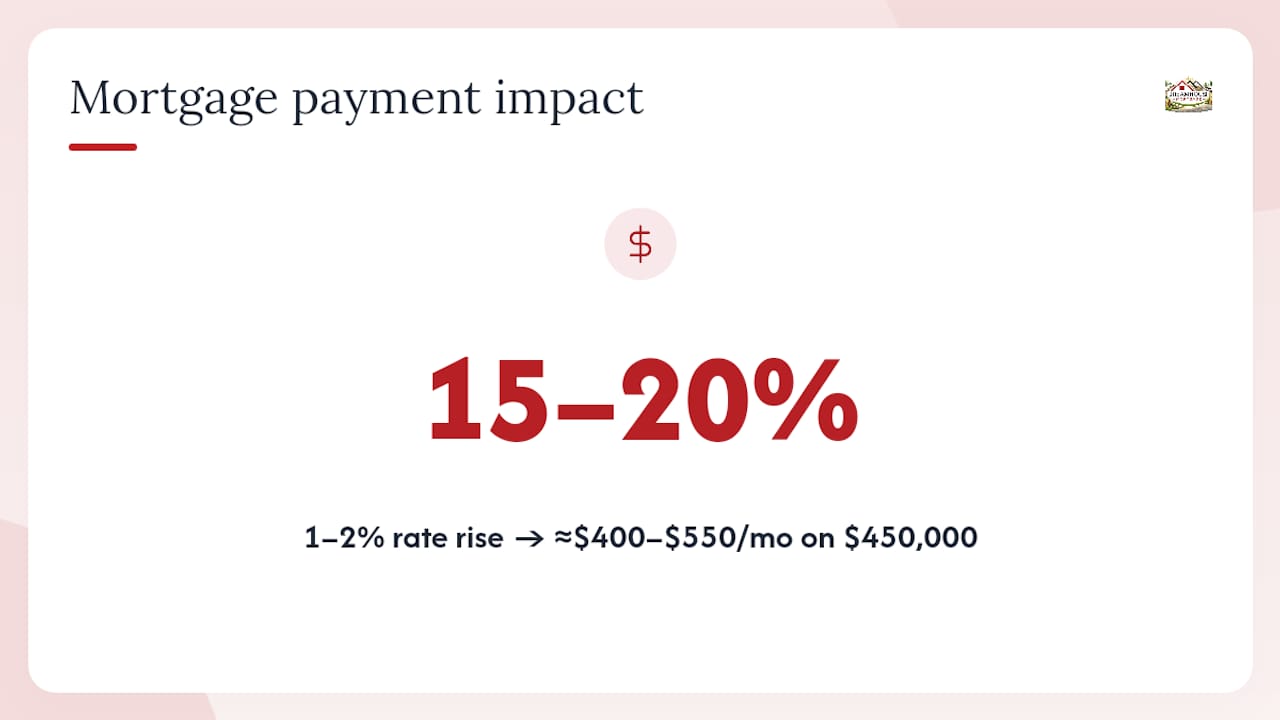
The Bank of Canada projects that five-year fixed holders renewing in 2026 could face average payment increases of 15%–20% compared with December 2024 levels. For a household carrying a $450,000 balance, that range translates to roughly $400–$550 more per month, a material budget shift that warrants planning well in advance.
Three factors can reduce the actual payment increase: prepayments made during the previous term (which lower the outstanding balance), choosing a longer remaining amortization at renewal, and negotiating a rate below the lender’s initial offer. All three are levers a broker can help you pull simultaneously.
When should you start the renewal process, and how do rate holds work?
Begin 3–6 months before your renewal date. In practice, many lenders allow renewal conversations to start up to 120 days before maturity, and using that full window gives you time to compare, negotiate, and lock in a rate before the market moves further.
Timeline checklist:
- 120 days out: Contact Dreamhouse Mortgage or your broker. Review your current mortgage terms and begin the market comparison process.
- 90 days out: Gather documents (Notice of Assessment, income confirmation, mortgage statement). Request written rate quotes from multiple lenders.
- 60 days out: Compare offers. Request a rate hold from your preferred lender or through your broker.
- 30 days out: Finalize your choice. Sign the renewal or switch agreement.
- 21 days out: Confirm your lender has sent the required renewal statement per FCAC rules.
Rate holds allow you to lock in a quoted rate for a set period, typically 60–120 days depending on the lender, while you complete your decision. Some lenders offer rate holds at no cost; others charge a small fee or require a formal application. The key trade-off: a rate hold protects you if rates rise before your renewal date, but if rates fall during the hold period, you may not automatically benefit unless the lender offers a “best rate” guarantee.
In a volatile market, a rate hold is generally worth requesting as soon as you have a competitive written offer. Alberta borrowers working with a broker benefit from the broker’s ability to secure written holds from multiple lenders simultaneously, giving you real options rather than a single locked-in path.
How Dreamhouse Mortgage helps Alberta homeowners at renewal
The primary value a licensed Alberta mortgage broker brings at renewal is market access and negotiation power. Guriqbal Chahal, MBA, PMP, Broker of Record at Dreamhouse Mortgage, works with banks, credit unions, monoline lenders, alternative lenders, and private lenders across Alberta, giving clients access to a wider rate and product range than any single institution can offer.
Specific services Dreamhouse Mortgage provides at renewal include:
- Market-wide rate comparisons across lender types
- Written competing offers to use in lender negotiations
- Prepayment penalty calculations and refinance-vs-renew analysis
- Rate-hold management across multiple lenders
- Document collection and submission for Alberta lenders
- Guidance on stress-test implications when switching lenders
Dreamhouse Mortgage serves homeowners throughout Calgary, Airdrie, Cochrane, Chestermere, Okotoks, High River, Rocky View County, Red Deer, Edmonton, and surrounding Alberta communities. For a free renewal review, call Guriqbal Chahal directly at 403-966-6072 or visit the Dreamhouse Mortgage Google Business Profile.
What Alberta’s mortgage market tells me about acting early
Alberta’s mortgage market in 2026 rewards homeowners who treat renewal as a negotiation, not a formality. Across Calgary, Airdrie, and the surrounding communities Dreamhouse Mortgage serves, the borrowers who come out ahead at renewal are the ones who start the process months early, bring written competing offers to the table, and understand that their lender’s first offer is rarely their best offer. The data backs this up: 37% of Canadian mortgage holders stay with their current lender simply out of habit, not because they got the best rate. Dreamhouse Mortgage’s track record in Alberta is built on closing that gap for clients, one renewal at a time.
Ready to get a better rate at your next renewal?
Dreamhouse Mortgage offers Alberta homeowners a concrete alternative to accepting whatever rate their bank sends in the mail. As a licensed Alberta brokerage with access to banks, credit unions, monoline lenders, and alternative lenders, Dreamhouse Mortgage compares the market on your behalf, negotiates directly with lenders, and manages the paperwork from start to funded.

For homeowners in Calgary, Airdrie, Cochrane, Chestermere, Red Deer, and Edmonton approaching renewal, the process starts with a free review. Guriqbal Chahal will assess your current mortgage, run a rate comparison across multiple lenders, and identify whether renewing, switching, or refinancing gives you the best outcome. Learn more about mortgage broker rate negotiation or review renewal options specific to Alberta.
Call Guriqbal Chahal, MBA, PMP at 403-966-6072 or visit the Dreamhouse Mortgage Google Business Profile to book your free renewal consultation today.
Sources
The following Canadian authorities and industry sources were used in preparing this guide. Each link leads directly to the original source for verification.
- Bank of Canada staff analytical note 2025-21
- Canada
- Exploring consumer behaviour in mortgage renewal decisions (FCAC research)
- Ratehub
- Mortgage Renewal: Common Questions, Answered – NerdWallet Canada
This article is general information, not a substitute for advice from a qualified financial advisor. Consult a qualified financial professional about your own circumstances before acting on anything here.
FAQ
How far in advance should you start your mortgage renewal?
Begin 3–4 months before your renewal date. Many Canadian lenders allow renewal conversations up to 120 days before maturity, and starting early gives you time to compare offers, request rate holds, and negotiate without deadline pressure.
Will mortgage rates in Canada drop back to pandemic-era lows?
Borrowers renewing in 2025–2026 should plan for rates materially higher than their original contract rate when budgeting for new payments.
What is the 2% rule for refinancing a mortgage?
Can you negotiate your mortgage renewal rate in Canada?
Yes. Bringing a written competing offer from another lender is the most effective negotiation tactic.
How does a mortgage broker help at renewal?
A licensed broker like Guriqbal Chahal at Dreamhouse Mortgage compares rates across multiple lenders simultaneously, secures written competing offers, manages rate holds, and negotiates on your behalf — typically at no direct cost to the borrower, as brokers are compensated by the lender on a funded mortgage.