
A mortgage broker is an intermediary who connects borrowers with multiple lenders, while a direct lender is a financial institution that funds your loan from its own capital. This mortgage broker vs direct lender guide covers both options in full, so you can make a confident financing decision for your home purchase or investment property in Calgary, Airdrie, Cochrane, Chestermere, Edmonton, or anywhere across Alberta.
In Alberta, your two primary paths to mortgage financing are working with a licensed mortgage broker or going directly to a bank, credit union, or monoline lender. Brokers like Dreamhouse Mortgage access dozens of lenders on your behalf, while direct lenders such as TD Bank, RBC, or Scotiabank offer only their own mortgage products. The right choice depends on your financial profile, how much lender variety you need, and how much of the process you want to manage yourself.
What is the mortgage broker vs direct lender difference in Alberta?
A mortgage broker holds a license under Alberta’s Mortgage Brokerages, Lenders and Administrators Act and acts as your agent in the mortgage market. A direct lender, by contrast, underwrites and funds the loan using its own balance sheet. Banks, credit unions, and monoline lenders like First National Financial are all direct lenders.
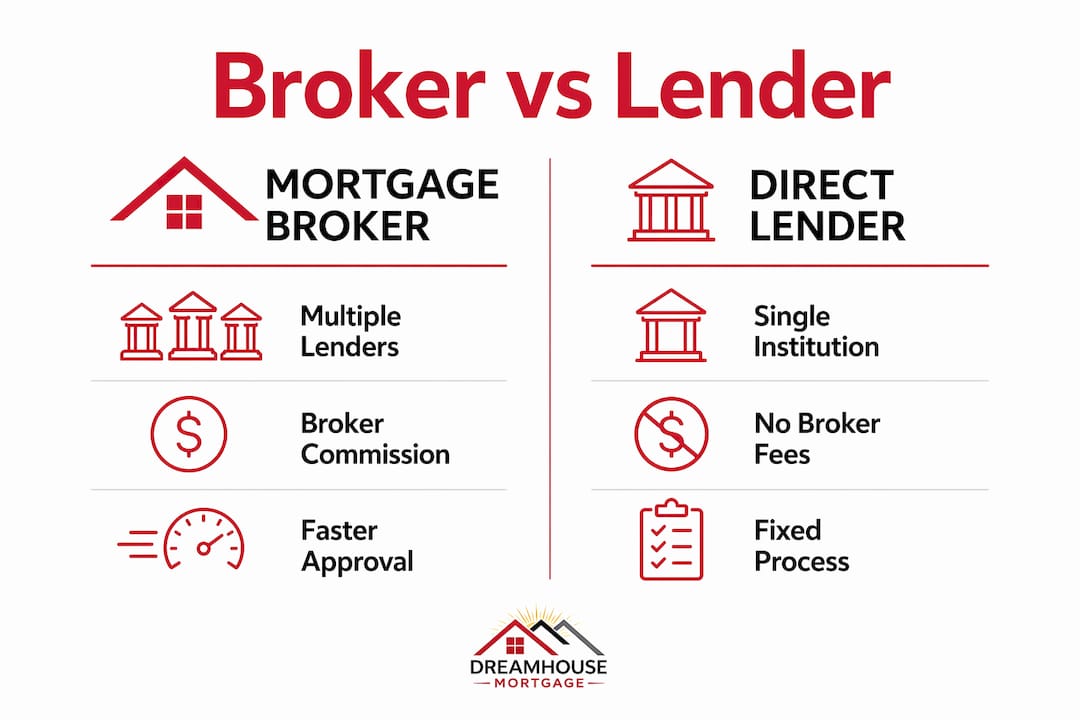
The most important operational difference is access. A broker submits your application to multiple lenders and returns with competing offers. A direct lender evaluates you against its own underwriting criteria and either approves or declines. That single-institution model is straightforward, but it limits your options to one product shelf.

Cost structures also differ. Broker commissions typically range from 0.5% to 2.75% of the loan amount, paid by the lender at closing, not by you. Direct lenders charge no broker commission but may apply origination fees from 0% to 1%. In most standard Alberta transactions, the borrower pays nothing directly to a broker.
Processing timelines differ as well. Direct lenders average 21–30 days to close, while broker-arranged mortgages typically take 35–50 days. That gap narrows significantly when you arrive prepared with all required documents.
Key differences at a glance
| Factor | Mortgage broker | Direct lender |
|---|---|---|
| Lender access | Multiple lenders, banks, credit unions, monoline, private | Single institution only |
| Borrower cost | Usually zero; lender pays commission | Origination fees 0%–1% |
| Typical closing time | 35–50 days | 21–30 days |
| Product variety | High | Limited to in-house products |
| Best for | Complex profiles, first-time buyers, investors | Strong credit, straightforward applications |
| Disclosure requirement | Must disclose compensation under Alberta law | Standard lending disclosures apply |
Pro Tip: Ask any broker you meet to confirm in writing how they are compensated and whether they receive volume bonuses from specific lenders. Alberta regulations require this disclosure, and a reputable broker will provide it without hesitation.
What are the advantages and disadvantages of using a mortgage broker?
A mortgage broker’s primary advantage is lender variety. Dreamhouse Mortgage, for example, works with banks, credit unions, monoline lenders, alternative lenders, and private lenders across Alberta. That breadth matters most when your financial situation does not fit a standard bank template.
Borrowers with complex finances such as the self-employed, those with thin credit histories, or real estate investors buying rental properties in Calgary or Edmonton benefit most from broker access to specialized loan programs that direct lenders do not offer. A bank’s underwriter applies one set of rules. A broker can pivot to a lender whose criteria match your actual situation.
Brokers also handle the paperwork, lender negotiations, and document collection on your behalf. For a first-time buyer in Cochrane or Okotoks who has never navigated a mortgage stress test, that support reduces errors and delays. Initial consultations and pre-approvals from brokers are typically free, with the broker’s commission paid by the lender upon closing.
Mortgage broker advantages
- Access to banks, credit unions, monoline lenders, alternative lenders, and private lenders in one application
- No direct cost to the borrower in most Alberta transactions
- Ability to pivot among lenders if an appraisal or qualification issue arises mid-process
- Specialized programs for self-employed borrowers, newcomers to Canada, and investment property buyers
- Full support with document collection, lender communication, and rate negotiation
Mortgage broker disadvantages
- Longer average closing timelines compared to direct lenders
- Some brokers may favor lenders who pay higher commissions rather than those offering the best rate
- An extra communication layer can slow responses if the broker is not proactive
- Not all brokers have equal access to every lender in Alberta
Pro Tip: Before committing to a broker, review the questions to ask your broker to verify their lender network, compensation structure, and experience with your specific borrower profile.
The risk of biased recommendations is real but manageable. Some brokers receive volume bonuses from specific lenders, which can influence which products they present first. Asking directly about compensation eliminates most of this risk. A broker who cannot answer that question clearly is one to avoid.
What are the advantages and disadvantages of working with a direct lender?
A direct lender offers one clear benefit: a single point of accountability. You deal with one institution from application through funding, with no intermediary in the communication chain. Direct lenders provide a straightforward process that appeals to borrowers who prefer direct contact and full visibility into their file status.
For buyers with strong credit scores, stable employment income, and a standard down payment, a direct lender can be the faster and simpler path. Banks like TD, RBC, and Scotiabank have established underwriting systems that process clean applications efficiently. If you already have a banking relationship with one of these institutions, that history can work in your favor during qualification.
Direct lenders may offer lower closing costs and potentially lower interest rates on their flagship products, particularly for borrowers who qualify under their standard criteria. The absence of a broker commission in the lender’s cost structure can translate to a marginally better rate in some cases.
Direct lender advantages
- Faster average closing times of 21–30 days for prepared borrowers
- Single institution manages the full process from application to funding
- Potentially lower fees when no broker commission is built into the rate
- Existing banking relationships can support faster approval
- Clear, direct communication with the underwriting team
Direct lender disadvantages
- Limited to one institution’s product lineup and rate sheet
- Rigid underwriting criteria can result in declined applications for complex borrowers
- No ability to compare competing offers without applying to multiple lenders separately
- Self-employed borrowers, investors, and newcomers to Canada often face more friction
- A declined application does not automatically redirect you to a better-fit lender
The core limitation of a direct lender is inflexibility. A pre-approval from a direct lender locks you into that institution’s risk appetite. If an appraisal comes in low or your income documentation raises questions, the lender has no incentive to find a workaround. A broker, by contrast, can shift your file to a different lender without restarting the process from scratch.
How do you decide between a broker and a direct lender in Alberta?
The right choice depends on four factors: your financial complexity, your desire for lender variety, your timeline, and how much of the process you want to manage yourself. Work through each one before you commit.
Step 1: Assess your financial profile
Borrowers with T4 employment income, strong credit scores above 680, and a standard down payment of 5%–20% are well-suited to direct lenders. Borrowers who are self-employed, carry variable income, are purchasing an investment property in Calgary, or are new to Canada should default to a broker. The specialized programs available through a broker’s lender network are simply not accessible through a single bank.
Step 2: Evaluate how much lender variety you need
If you want to compare rates across TD, First National, MCAP, and alternative lenders simultaneously, a broker is the only practical way to do that without submitting four separate applications. Multiple hard credit inquiries within a short window are treated as a single inquiry under Canadian credit bureau rules, but managing four separate lender relationships is time-consuming. A broker handles that coordination for you.
Step 3: Consider your timeline
Closing speed depends more on borrower preparedness than on lender type. An organized buyer who arrives with a complete document package, including Notice of Assessment, pay stubs, bank statements, and a signed purchase agreement, can close quickly through either channel. If your timeline is tight, focus on having your documents ready before you choose a path.
Step 4: Compare total costs, not just rates
Use this framework when evaluating offers from both channels:
| Cost factor | Mortgage broker | Direct lender |
|---|---|---|
| Broker commission | Paid by lender (usually zero to borrower) | Not applicable |
| Origination fee | Varies by lender | 0%–1% of loan amount |
| Rate competitiveness | Negotiated across multiple lenders | Single institution rate |
| Appraisal fee | Standard, varies by property | Standard, varies by property |
| Legal/closing costs | Standard Alberta closing costs apply | Standard Alberta closing costs apply |
For broker rate negotiation details specific to Alberta, review how brokers use competing lender offers to push rates down. That process is one of the clearest financial advantages brokers hold over a direct lender relationship.
Step 5: Ask the right questions before you decide
Whether you choose a broker or a direct lender, ask these questions before signing anything:
- What lenders or products are you comparing for my situation?
- How are you compensated, and does any lender pay you more than others?
- What is the realistic closing timeline given my documents and property type?
- What happens if my application is declined or the appraisal comes in short?
- Are there prepayment privileges, penalties, or portability terms I should know about?
A direct lender will answer questions 1, 3, 4, and 5 from its own product perspective. A broker should answer all five with reference to multiple lenders. The quality of those answers tells you more about the right choice than any general rule.
Key Takeaways
Mortgage brokers provide access to multiple lenders and specialized programs, making them the stronger choice for complex borrower profiles, while direct lenders offer faster closings and simpler processes for buyers with strong, straightforward financial profiles.
| Point | Details |
|---|---|
| Broker cost to borrower | Brokers are usually free to borrowers; lenders pay commissions of 0.5%–2.75% at closing. |
| Direct lender speed | Direct lenders close in 21–30 days on average, faster than the 35–50 days typical for brokers. |
| Best use of a broker | Self-employed buyers, investors, and newcomers benefit most from a broker’s wider lender access. |
| Closing speed reality | Borrower preparedness matters more than lender type when it comes to closing on time. |
| Conflict of interest risk | Always ask brokers about compensation and volume bonuses to avoid biased lender recommendations. |
Work with Dreamhouse Mortgage for expert Alberta mortgage advice
Choosing between a broker and a direct lender is one of the most consequential decisions in your home purchase. Dreamhouse Mortgage, led by Guriqbal Chahal, MBA, PMP, Mortgage Broker of Record, has helped buyers across Calgary, Airdrie, Cochrane, Chestermere, Okotoks, Red Deer, and Edmonton navigate this exact decision since 2013.

Dreamhouse Mortgage works with banks, credit unions, monoline lenders, alternative lenders, and private lenders to find the right fit for your financial profile. Whether you are a first-time buyer in Airdrie, a self-employed professional in Calgary, or an investor building a rental portfolio in Edmonton, the team provides transparent rate comparisons, full document support, and fast approvals. Review the key questions to ask before your first consultation, then contact Guriqbal Chahal directly at 403-966-6072 or visit the Google Business Profile to book your free mortgage consultation today.
FAQ
What is a mortgage broker in Alberta?
A mortgage broker is a licensed intermediary who connects borrowers with multiple lenders, including banks, credit unions, monoline lenders, and private lenders, to find the best mortgage product for their situation. In Alberta, brokers are regulated under the Mortgage Brokerages, Lenders and Administrators Act.
Does using a mortgage broker cost more than going directly to a bank?
No. In most Alberta transactions, the borrower pays nothing directly to the broker. The lender pays the broker’s commission of 0.5%–2.75% of the loan amount at closing.
When should I use a direct lender instead of a broker?
A direct lender is the better choice when you have strong T4 employment income, a credit score above 680, a standard down payment, and an existing banking relationship that supports a fast, straightforward approval.
Can a mortgage broker get me a better rate than my bank?
A broker can compare rates across multiple lenders simultaneously and use competing offers to negotiate, which often produces a lower rate than a single bank can offer on its own.
What happens if my mortgage application is declined by a direct lender?
A declined application from a direct lender does not automatically move your file to another institution. A broker, by contrast, can pivot your application to an alternate lender whose criteria better match your profile, reducing delays and protecting your credit score from multiple hard inquiries.