
If you want to compare an alternative to your mortgage broker, DreamHouse Mortgage is a strong local alternative and a smart first call for Alberta buyers. The brokerage gives you access to banks, credit unions, monoline lenders, and private lenders in one place, with direct experience placing first-time buyers and complex files across Calgary, Airdrie, Cochrane, and Edmonton.
Here’s what matters most before you pick any alternative:
- Lender access: brokers who work with 30 or more lenders typically place harder files faster than single-bank specialists, according to NerdWallet Canada.
- Fee structure: in most standard residential deals, the lender pays the broker, not you, per Pegasus Lending’s breakdown of how brokers get paid; private and alternative-lender files are the exception.
- Local knowledge: Alberta-specific down payment programs and closing timelines favor a broker who already knows the Calgary and Edmonton markets.
Key Takeaways
Choosing a mortgage alternative works best when you match your file’s complexity to a provider’s lender access, not just its advertised rate.
| Point | Details |
|---|---|
| Fees are usually lender-paid | Standard residential mortgages typically involve no direct broker fee to you; private and alternative files are the exception. |
| Lender access beats rate-chasing | A broker working with 30+ lenders can place complex files that a single-bank specialist will decline. |
| Get fee disclosure in writing | Ask any provider, especially private or alternative lenders, for written fee terms before signing anything. |
| Term flexibility protects you long term | Check prepayment penalties and portability, not just the headline rate, before committing. |
| DreamHouse Mortgage fits complex Alberta files | The brokerage combines bank, credit union, monoline, and private lender access with direct experience placing first-time buyer, self-employed, and newcomer files across Calgary and Edmonton. |
Table of Contents
- What Are the Best Mortgage Alternatives in Canada?
- What Red Flags Should You Watch for Before Signing?
- What Features Should You Compare Across Alternatives?
- How Do Eligibility Requirements Differ Between Alternatives?
- How Does Customer Service Compare Across Providers?
- How Does the Application Experience Compare?
- What Do Real Borrower Situations Look Like?
- What Actually Matters When You Compare These Alternatives?
- Ready to Talk to a Calgary Mortgage Broker?
- Sources
- FAQ
What Are the Best Mortgage Alternatives in Canada?
Not every mortgage alternative solves the same problem. Some readers need a broker who can shop 30+ lenders on their behalf. Others just need a rate quote from their existing bank. The right choice depends on how complicated your file is and how much hand-holding you want.
Here’s how the main categories stack up on the dimensions that actually matter to a borrower.
| Category | Best for | Lender access | Typical fees / who pays | Approval speed | Complex-file capability |
|---|---|---|---|---|---|
| Independent broker (e.g., DreamHouse) | First-time buyers, self-employed, newcomers | Banks, credit unions, monoline, alternative, private | Lender-paid on standard deals; borrower fees possible on private/alternative files | Typically days, faster with full documents ready | High, routinely places self-employed and new-to-Canada files |
| Bank mortgage specialist | Existing bank customers with straightforward income | Single institution only | No direct fee, built into the bank’s rate | Fast for simple files, slower for exceptions | Limited, often cannot bend policy for niche cases |
| Credit union | Local first-time buyers, community-based lending | One credit union’s product suite, sometimes with local incentive programs | Usually lender-paid | Moderate | Moderate, depends on local underwriting flexibility |
| Online marketplace | Quick rate shopping and comparison | Wide but shallow, automated matching | Usually lender-paid | Fast for quotes, slower for actual funding | Low, thin support for unusual income or credit |
| Alternative (“B”) or private lender | Bruised credit, unverifiable income, urgent timelines | Narrow, specialized product set | Borrower often pays a lender or broker fee | Can be very fast once terms are agreed | High, but at a real cost premium |
A few use cases make the trade-offs concrete. A nurse buying her first Airdrie condo with steady T4 income does fine with a bank specialist or credit union. A self-employed contractor in Cochrane with two years of write-offs on his tax returns usually needs a broker who can place him with an alternative lender. A newcomer to Canada with strong foreign income but no local credit history almost always needs broker-level access to lenders that actually accept alternative proof of income.
Pro Tip: Ask any lender category upfront whether their rate assumes you qualify at the standard stress test. A quoted rate that ignores your real qualifying rate isn’t a real quote.
Private and “B” lender routes solve urgent problems, but borrower-paid fees are far more common on these files than on standard bank or broker deals, and they need to be disclosed in writing before you sign anything.
What Red Flags Should You Watch for Before Signing?
Walk away, or at least ask hard questions, if a lender or broker won’t put fees in writing. Written fee disclosure is standard practice in Canadian mortgage lending, especially for private and alternative-lender files where borrower-paid costs are more common.
A few other warning signs deserve attention. Vague answers about prepayment penalties or portability usually mean the provider hasn’t thought through your long-term costs, and borrowers who focus only on the headline rate often get burned later by rigid terms. Pressure to sign quickly, before you’ve compared at least one other option, is another sign to slow down.
Before you commit to anyone, ask these five questions directly:
- Who pays your fee, and is it in writing?
- What is my qualifying rate under the mortgage stress test, not just the advertised rate?
- Can this mortgage be ported if I move before the term ends?
- What is the prepayment penalty if I break this mortgage early?
- How many lenders did you actually check before recommending this one?
A broker who answers all five without hesitation is usually one worth working with. One who dodges the fee question is not.
What Features Should You Compare Across Alternatives?
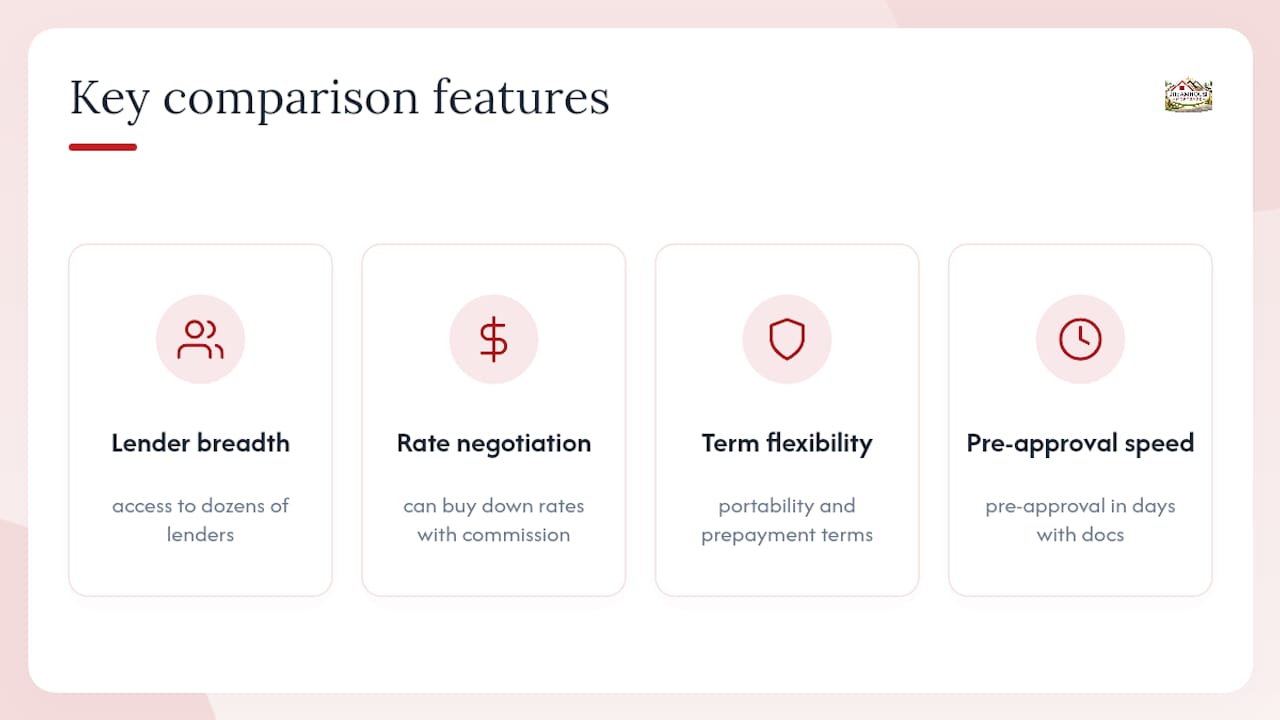
The features that separate a good alternative from a mediocre one rarely show up in marketing copy. Lender breadth matters more than almost anything else. A broker with access to dozens of lenders can shop your file against banks, credit unions, monoline lenders, and private options simultaneously, while a single bank specialist is stuck with one product shelf.
Rate negotiation ability is the second differentiator. Established brokers can sometimes secure exclusive rate deals or buy down a rate using part of their commission, a practice Ratehub has documented as a real lever high-volume brokers use for clients. Term flexibility, including portability and prepayment terms, matters just as much as the number on the rate sheet, since a locked-in penalty can cost thousands if your plans change.
Speed of pre-approval also varies widely. A broker with strong lender relationships can often turn around pre-approval in days once you supply income documents, ID, and property details, while some marketplaces are fast at quoting but slow at actually funding. Look for a provider that combines lender breadth, rate negotiation leverage, and realistic turnaround times, not just one of the three.
How Do Eligibility Requirements Differ Between Alternatives?
Eligibility is where alternatives diverge the most, and it is the single biggest reason first-time buyers get rejected by the wrong provider before trying the right one.
Banks generally require clean, easily verifiable income, a strong credit score, and a standard down payment structure. Credit unions often mirror that standard but add flexibility for members with local ties or community banking history. Independent brokers can place files that fall outside those boxes, including self-employed borrowers whose taxable income doesn’t reflect their real earnings, and newcomers to Canada who lack a Canadian credit file but can show alternative proof of income or savings.

Alternative and private lenders exist specifically for borrowers who don’t qualify anywhere else, whether due to credit history, unverifiable income, or a tight closing timeline. The trade-off is cost. Expect a higher rate and, frequently, a borrower-paid fee on top of it. Online marketplaces sit in an odd middle ground: their eligibility filters are often automated and blunt, so a file with any complexity tends to get flagged for manual review anyway, erasing the speed advantage they advertise.
How Does Customer Service Compare Across Providers?
Support quality is hard to judge from a website, but the pattern holds across most Alberta borrowers’ experiences. A dedicated broker who works your file personally, answers calls directly, and coordinates with lenders on your behalf tends to catch problems before they delay your closing date.
Bank specialists often serve you well if your file is simple, but they can disappear behind call centers or branch turnover once anything gets complicated. Credit unions tend to offer a more personal touch locally, though their support hours and staff availability can be limited outside larger branches. Online marketplaces are built for volume, which means support is frequently a shared queue or a chatbot rather than a named person who knows your file.
The practical test: ask who exactly will be your point of contact from application to funding, and whether that person is reachable by phone. A broker who gives you a direct line, rather than a general inbox, is generally the stronger support option for a first-time buyer navigating stress test qualification and document collection for the first time.
How Does the Application Experience Compare?
Usability differences show up fastest in how much friction there is between you and an actual answer. Independent brokers who run a structured intake process, collecting income documents, ID, and property details upfront, tend to move faster because there’s no back-and-forth guessing about what a lender needs.
Bank apps and portals are often polished for simple purchase files but clunky the moment your situation includes self-employment income, a co-signer, or a property outside standard zoning. Credit union platforms vary widely; some have modernized well, others still rely heavily on in-branch appointments. Online marketplaces tend to have the smoothest initial quote experience, since that’s their entire product, but the experience often stalls once you move from a quote to actual underwriting.
For a first-time buyer in Red Deer or Chestermere managing a purchase timeline alongside a full-time job, the deciding factor usually isn’t how attractive an app looks. It’s how many times you have to re-explain your situation to a new person.
What Do Real Borrower Situations Look Like?
Concrete scenarios make the category differences easier to picture than abstract comparisons.
Their decision usually comes down to rate and portability terms, not access.
A self-employed tradesperson in Rocky View County with strong cash flow but modest reported taxable income is a different story. Banks often decline this file outright, since reported income doesn’t match what the business actually generates. A broker who can present the same file to a lender that accepts stated-income documentation, or an alternative lender that weighs cash flow differently, is often the only realistic path to approval.
A newcomer to Canada working in Edmonton with a strong job offer but no Canadian credit history faces a third scenario entirely. Standard banks frequently require Canadian credit history that doesn’t exist yet. Brokers who specialize in New to Canada programs know which lenders accept foreign credit reports or larger down payments as substitutes, turning an otherwise stalled application into a funded mortgage.
What Actually Matters When You Compare These Alternatives?
Most articles ranking mortgage alternatives treat every provider category as roughly interchangeable, differing only in interest rate. That framing misses the point for a large share of Alberta buyers. Rate matters, but eligibility and lender access decide whether you get approved at all, and no rate matters if you can’t qualify.
The conventional advice to “shop around for the best rate” also undersells how much broker relationships affect outcomes. A broker who regularly sends volume to a lender can sometimes negotiate a rate discount an individual borrower calling that same lender directly would never see. That’s not a marketing claim, it’s how volume-based commission structures work.
If you’re a first-time buyer with a straightforward file, prioritize term flexibility and written fee clarity over chasing the lowest advertised rate. If your file is complex, self-employed income, newcomer status, or credit challenges, prioritize lender access above everything else. A provider with 40 lender relationships and a slightly higher rate will get you approved. A provider with one lender and the lowest rate might not.
Ready to Talk to a Calgary Mortgage Broker?
Comparing marketplaces and bank specialists is useful, but most of those routes still leave you doing the lender legwork yourself. DreamHouse Mortgage does that legwork for you, comparing banks, credit unions, monoline lenders, and private options in parallel, then bringing back the options that actually fit your income, credit, and timeline.

Before your first call, have three things ready: photo ID, proof of income (pay stubs, an employment letter, or two years of financials if you’re self-employed), and either a signed purchase agreement or the address of the property you’re considering. If you’re refinancing or renewing instead of buying, have your current mortgage statement handy too.
On that first consultation, Guriqbal Chahal will check your pre-approval eligibility, walk through realistic lender options for your specific file, and give you an honest estimate of timeline and any fees involved, including rate negotiation strategy where it applies. Call 403-966-6072 directly, or find DreamHouse Mortgage on Google Business Profile to see local reviews before you book. For first-time buyers in Calgary, Airdrie, Cochrane, or Chestermere, this is usually the fastest way to know exactly where you stand.
Sources
- How Mortgage Brokers Get Paid in Canada (2026 Guide)
- Mortgage Broker Commission Calculator 2026 | Lender Fees & Bonuses
- What Is a Mortgage Broker? – NerdWallet Canada
This article is general information, not a substitute for advice from a qualified financial advisor. Consult a qualified financial professional about your own circumstances before acting on anything here.
FAQ
How much does a mortgage broker in Canada make off a $1,000,000 mortgage?
Broker compensation typically comes from a lender-paid commission, ranging roughly from 0.30% to 1.20% of the mortgage amount, plus a possible trailer commission of 0.15% to 0.35% annually. On a $1,000,000 mortgage, that puts the upfront commission somewhere in the $3,000 to $12,000 range, paid by the lender, not the borrower, in most standard deals.
Which alternative lenders are the best in Canada?
There’s no single best alternative lender since fit depends on your credit profile and income type. A broker with access to multiple alternative and private lenders can match your specific file, which generally works better than picking one alternative lender in isolation.
What should you avoid telling a lender?
Avoid guessing at figures. Never state an estimated income or asset value when you can provide documented numbers, since discrepancies between your application and your paperwork can delay or derail approval. Be direct about any recent credit issues rather than hoping they won’t come up in underwriting.
What is the best CRM software for mortgages?
This depends on whether you’re a borrower or a broker; for borrowers, the more relevant question is whether your broker uses organized systems to track your file and deadlines. Ask any broker how they track your application status and follow-up timeline before you commit to working with them.
Do I need a down payment saved before calling a broker?
No. DreamHouse Mortgage can review your pre-approval eligibility and outline down payment options, including minimum requirements for first-time buyers in Alberta, before you have funds fully saved.