If you qualify as a first-time buyer in Canada, you can recover the federal GST, up to $50,000, on many new homes purchased below $1 million, with a phase-out ending at $1.5 million. Ontario buyers may stack a provincial top-up worth up to $130,000 combined under the 2026 enhanced program, although that provincial piece does not extend to Alberta. Confirm at signing whether your builder will assign the rebate directly at closing. That single question can save you tens of thousands of dollars in cash you’d otherwise need on closing day.
TL;DR:
- The federal rebate offers up to $50,000 on homes priced at $1 million or less, phasing out entirely at $1.5 million, with partial rebates available in between.
- Ontario buyers can combine federal and provincial rebates for up to $130,000 in specific price ranges, but Alberta buyers do not have access to this provincial top-up.
- Rebate eligibility depends on prior homeownership within a set look-back period and excludes corporate or partnership owners, including homes owned by a numbered company.
- Most buyers should confirm whether their builder will credit the rebate at closing, as this affects the amount of cash needed and loan calculations, avoiding costly delays.
- Proper documentation, timely filing within two years for owner-built homes, and accurate invoice records are essential to prevent delays in rebate processing.
Table of Contents
- What the GST New Home Rebate Actually Covers
- How Much Money Are We Talking About?
- Do You Qualify? The First-Time Buyer Test Explained
- How to Claim: Builder Credit vs. Filing Directly With the CRA
- The Ontario Enhanced Rebate: Why Alberta Buyers Should Still Understand It
- Documents, Deadlines, and How Long Payment Takes
- Does the Rebate Affect Selling Your Home Later?
- Buying a New Condo or Multi-Unit Building? Here’s the Nuance
- When You Might Have to Repay the Rebate
- Sample Rebate Calculations for Different Purchase Prices
- A Calgary Broker’s Take on Rebate Timing and Your Mortgage
- How DreamHouse Mortgage Helps You Time Financing and Rebates Right
- Official CRA and Provincial Pages Worth Bookmarking
- Sources
- FAQ
What the GST New Home Rebate Actually Covers
The GST/HST new housing rebate lets an individual recover part of the GST, or the federal portion of the HST, paid on a new or substantially renovated home. Layered on top of it is the first-time home buyers’ rebate, which is where most Calgary buyers will see the biggest benefit.
Both programs apply to a specific set of purchase types:
- New homes bought directly from a builder
- Owner-built homes, including major additions
- Substantially renovated houses
- Mobile and modular homes
- Shares in a housing co-operative
One rule trips people up more than any other: these rebates go to individuals, not corporations or partnerships. If your closing documents list a numbered company as the buyer, the rebate generally will not apply, even if you personally live in the home.
How Much Money Are We Talking About?
The federal first-time buyer rebate is worth up to $50,000, and it applies in full to homes priced at $1,000,000 or less. Above that, the rebate shrinks on a sliding scale until it disappears entirely at $1.5 million.
Statistic snapshot: A home purchased at exactly $1,000,000 or below can qualify for the full federal rebate. Between $1,000,000 and $1,500,000, the FTHB rebate phases out proportionally, and at $1,500,000 or above, no federal rebate is available.
Ontario stacks its own provincial rebate on top of the federal one under the enhanced program, reaching a combined maximum of $130,000 for qualifying buyers in specific price bands. That provincial layer is unique to Ontario and does not apply to purchases in Alberta.
Here’s a simplified example: a first-time buyer purchases a new home in Calgary for $1,250,000. That price sits inside the federal phase-out zone, so instead of the full $50,000, the buyer receives a partial rebate calculated on a sliding scale between the $1 million and $1.5 million thresholds. The exact dollar figure depends on where in that band your purchase price lands, which is exactly the kind of calculation worth running past a mortgage professional before you sign anything.
Do You Qualify? The First-Time Buyer Test Explained
Eligibility hinges on a specific look-back period, not just your current homeownership status. The CRA generally requires that neither you nor your spouse or common-law partner owned and occupied another home as a principal residence anywhere in the world during a defined period before the critical date, which is either the date ownership transfers or the date you take possession, whichever your agreement specifies.
A few situations deserve extra attention:
- Owner-built homes: You can claim the rebate, but you’ll need Form GST191 and the GST191-WS worksheet, plus complete invoices for materials and labor.
- Co-op shares: Buying shares in a housing co-operative can qualify, provided the unit is your principal residence.
- Substantial renovations: A renovation only counts as a “new” home for rebate purposes if it meets the 90% interior rule, meaning at least 90% of the interior of the existing house was removed or replaced.
- Age and residency: You generally need to be at least 18 and either a Canadian citizen or permanent resident to claim.
- Corporations and partnerships: These entities are not eligible, regardless of how the property is used.
Married and common-law couples should note that both partners’ prior homeownership history counts, even if only one spouse is named on title.
How to Claim: Builder Credit vs. Filing Directly With the CRA
Most Calgary buyers have two paths to the rebate, and one is considerably less stressful than the other.
- Builder credit at closing. Your builder applies the rebate directly against the purchase price, so you never pay the full HST out of pocket. This requires the Agreement of Purchase and Sale to clearly assign the rebate to the builder, and your lawyer should confirm this language before you sign.
- Filing directly with the CRA. If the builder does not credit the rebate, you file it yourself using Form GST190 for builder purchases, or Form GST191 and the GST191-WS construction summary worksheet for owner-built homes. You can file through CRA My Account or by mail.
- Owner-built cost tracking. If you built your own home, the GST191-WS worksheet needs itemized, dated invoices. Estimated or missing receipts are one of the most common reasons claims get delayed.
- Deadline discipline. Owner-built claims generally must be filed within two years of the date you occupied the home or ownership transferred, so mark that date the moment you move in.
- Record retention. Keep every form, invoice, and worksheet for six years, since the CRA can request supporting documents well after your rebate is paid.
Pro Tip: Ask your builder’s sales representative, in writing, whether the purchase price already reflects the rebate credit. Some contracts quietly build the rebate into the “net price,” which can confuse your mortgage lender when calculating your loan-to-value ratio at closing.
The Ontario Enhanced Rebate: Why Alberta Buyers Should Still Understand It
Ontario’s 2026 enhanced new housing rebate, known as ENHR, raises the combined provincial and federal relief available to qualifying buyers to as much as $130,000 within specified price bands. Alberta buyers won’t access the provincial layer since Alberta has no equivalent provincial sales tax rebate program, but the mechanics are worth understanding if you’re comparing markets or advising family members purchasing in Ontario.
Under ENHR:
- Builders typically apply both the federal and provincial rebate portions directly at closing, so the buyer doesn’t front the tax.
- The CRA and the Province of Ontario share eligibility data, which requires buyer consent as part of the paperwork.
- Ontario has committed to reimbursing builders electronically within 30 days of a valid claim, keeping the administrative burden off the buyer’s shoulders.
If you’re an Ontario transplant now settling in Calgary, this context helps explain why a friend’s closing statement back home might look different from yours.
Documents, Deadlines, and How Long Payment Takes
Keep a dedicated folder, physical or digital, with these items ready before closing:
- Your signed Agreement of Purchase and Sale showing the rebate assignment
- Invoices that clearly display the tax charged
- Builder assignment or credit forms
- Completed GST191-WS worksheet, if you built the home yourself
Owner-built claims face a firm two-year filing window measured from your possession or ownership date. Builder-purchase claims follow the timelines set out in your GST190 filing instructions.
Statistic snapshot: CRA guidance repeatedly flags incomplete owner-built worksheets and missing invoices as the leading cause of processing delays. Filing a clean, complete package the first time is the single biggest lever you control over how quickly your rebate arrives.
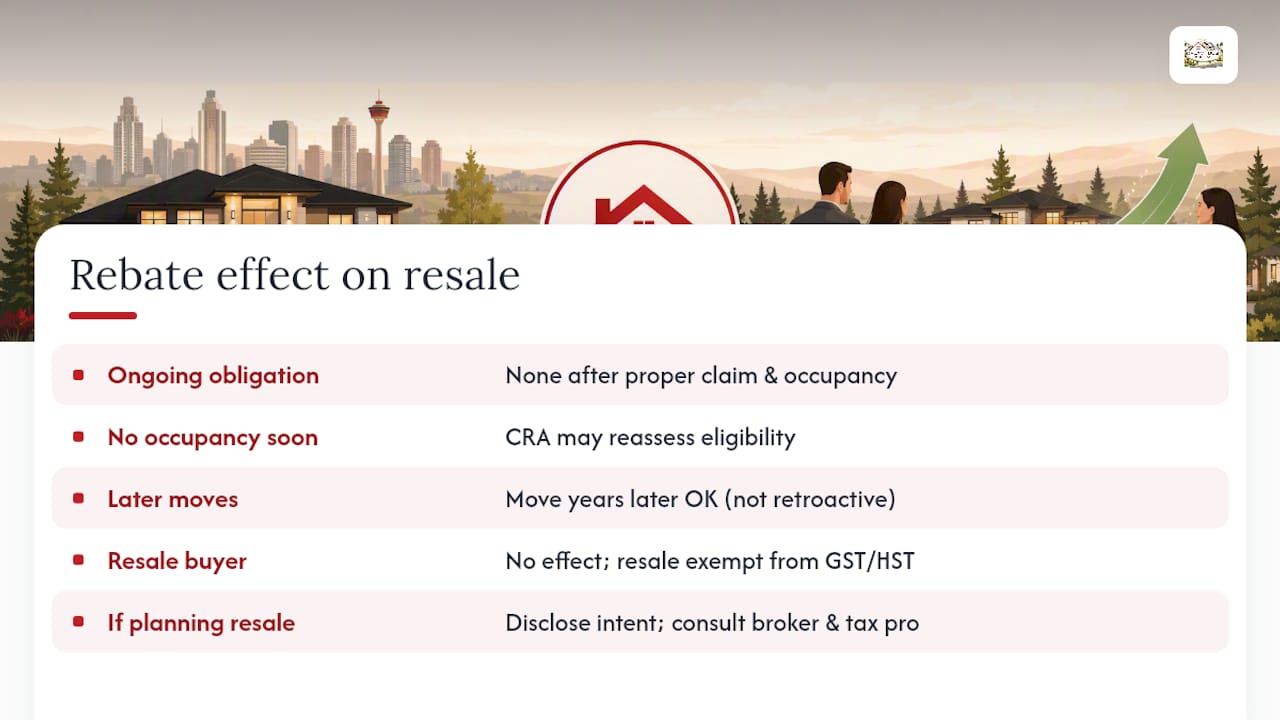
Does the Rebate Affect Selling Your Home Later?
Once your rebate is properly claimed and you’ve met the occupancy requirements, it generally does not create an ongoing obligation tied to a future sale. The rebate is designed as relief on the original purchase transaction, not a loan or a lien against the property.
That said, timing matters. If you claimed the rebate on the basis that the home would be your primary residence, and you sell or convert it to a rental shortly after closing without ever actually occupying it as intended, the CRA can scrutinize whether you met the eligibility conditions in the first place. This isn’t about penalizing normal life changes. Moving for a job or family reasons a year or two later is common and doesn’t retroactively disqualify you. The risk arises when the original intent to occupy the home never existed, which is a very different situation from genuinely living there and later deciding to sell.
For resale buyers purchasing your home afterward, the rebate has no bearing on their transaction at all. GST/HST generally does not apply to the resale of a previously occupied residential home, so a subsequent buyer isn’t stepping into any rebate arrangement you made. Your original claim stays entirely between you and the CRA.
If you’re planning a purchase with resale or rental conversion already in mind within a short window, it’s worth having a frank conversation with your mortgage broker and a tax professional before you finalize the Agreement of Purchase and Sale, since your stated intent at the time of purchase is part of what the CRA considers.
Buying a New Condo or Multi-Unit Building? Here’s the Nuance
Condos follow the same core framework as detached homes, but a few wrinkles show up often enough in Calgary’s growing condo market to flag directly.
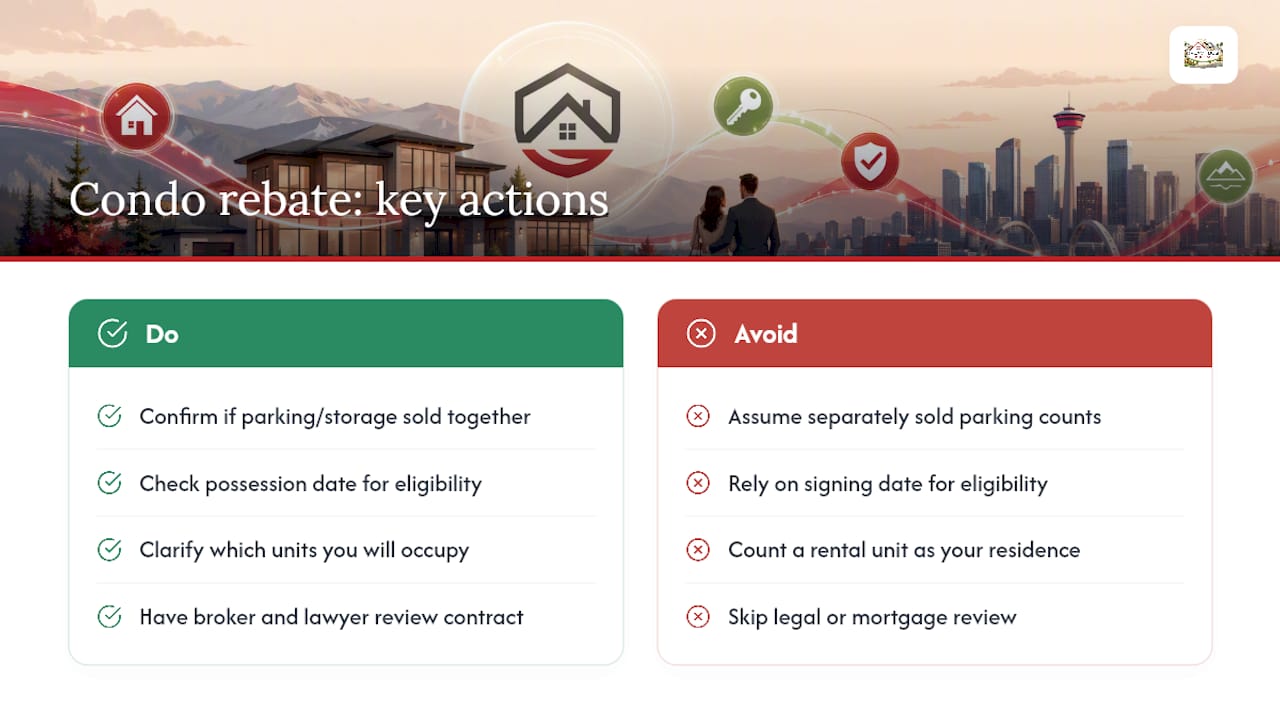
First, the purchase price used to calculate your rebate typically includes the condo unit itself plus any parking or storage locker sold together under one agreement. If the parking spot is a separate contract with a separate closing, it may be treated differently, so ask your lawyer to confirm how your specific paperwork is structured.
Second, pre-construction condo purchases often involve a longer gap between signing and possession, sometimes years. The critical date for your first-time buyer eligibility test is tied to when you take possession or ownership transfers, not when you originally signed the purchase agreement. That gap matters if your personal circumstances, like a change in marital status or a prior home purchase, shift between signing and closing.
Third, for multi-unit buildings where you’re buying more than one unit, such as a duplex or a legal secondary suite setup, the rebate calculation applies to the portion of the property you’ll personally occupy as your principal residence. A unit you intend to rent out from day one generally does not qualify for the first-time buyer rebate on that portion, even if the overall building qualifies partially.
Given how often pre-construction Calgary developments bundle these details into dense contracts, it’s worth having your mortgage broker review the purchase agreement’s rebate language alongside your lawyer before you finalize financing.
When You Might Have to Repay the Rebate
The CRA can require repayment, sometimes called a clawback, when the conditions you claimed under weren’t actually met. The most common triggers include:
Failing to occupy the home as your primary residence when that was the basis of your claim, selling or transferring the property before meeting occupancy requirements, or discovering after the fact that you or your spouse owned another qualifying home during the disqualifying look-back period. Filing a claim based on incorrect purchase price information, or a builder incorrectly assigning a rebate that later turns out to exceed what you qualified for, can also trigger a reassessment.
If the CRA determines a rebate was paid in error, it will typically issue a notice requiring repayment, often with interest calculated from the original payment date. This is one more reason document accuracy matters so much: a clean paper trail is your best defense if the CRA ever asks questions years down the road.
Sample Rebate Calculations for Different Purchase Prices
Seeing the numbers side by side often makes the phase-out easier to grasp than reading the threshold rules alone.
A first-time buyer purchasing a new home for $800,000 sits comfortably under the $1 million threshold and qualifies for the full federal rebate, up to $50,000, depending on the exact GST calculation on that purchase price.
A buyer at exactly $1,000,000 still captures the full federal rebate, since that price sits right at the upper edge of the full-rebate band rather than inside the phase-out zone.
A buyer at $1,300,000 lands inside the $1,000,000 to $1,500,000 phase-out corridor. Instead of the full $50,000, the rebate shrinks proportionally based on how far the price sits into that band, similar in principle to the $1,250,000 example covered earlier in this article.
A buyer with a home priced above the maximum threshold is not eligible for the federal rebate.
These scenarios all assume the buyer meets the underlying eligibility tests, ownership history, occupancy intent, and individual (not corporate) purchase status. A Calgary mortgage broker who understands both the rebate mechanics and your specific lender’s requirements can help you model these numbers against your actual pre-approval before you commit to a purchase price.
A Calgary Broker’s Take on Rebate Timing and Your Mortgage
Coordinating the rebate with your mortgage is where I see the most confusion among first-time buyers here in Calgary, Cochrane, and Airdrie. Ask your builder point-blank: “Will the rebate be assigned and credited at closing, or am I filing this myself afterward?” That single answer changes how much cash you need on closing day and how your lender calculates your final loan-to-value ratio.
If the rebate is credited at closing, your effective purchase price drops, which can shift your mortgage insurance premium and your minimum down payment calculation. If you’re filing separately after closing, you need enough cash reserved to cover the full HST upfront. DreamHouse Mortgage regularly coordinates with lenders and real estate lawyers to make sure financing timelines and rebate assignments line up correctly for Calgary-area buyers.
— Guriqbal Chahal, MBA, PMP
How DreamHouse Mortgage Helps You Time Financing and Rebates Right
Working with a local mortgage broker can help avoid last-minute lender conditions or issues with builder contracts not crediting rebates by coordinating mortgage pre-approval, cash-to-close plans, and rebate assignments together.

When purchasing your first home in Calgary, Cochrane, or Airdrie, a mortgage broker can assist with lining up pre-approval, planning your exact cash-to-close amount, and coordinating directly with your builder and lawyer to ensure the rebate is properly handled at closing. If you’re weighing a pre-construction purchase and want someone reviewing your numbers before you sign, that’s exactly where a mortgage broker’s rate negotiation expertise earns its keep. Guriqbal Chahal, MBA, PMP, Mortgage Broker, has spent years helping first-time buyers across Calgary and the surrounding communities navigate exactly this kind of closing coordination.
Call Guriqbal Chahal, MBA, PMP, Mortgage Broker, at 403-966-6072, or visit the DreamHouse Mortgage Google Business Profile to book a consultation before you sign your next purchase agreement.
Official CRA and Provincial Pages Worth Bookmarking
- GST/HST new housing rebate: eligibility and rebate types
- FTHB GST/HST rebate: amounts and phase-out bands
- Guide RC4028: full rebate rules and forms
- Ontario ENHR notice: provincial top-up details
This article is general information, not a substitute for advice from a qualified financial advisor. Consult a qualified financial professional about your own circumstances before acting on anything here.
Sources
- GST/HST new housing rebate
- First-time home buyers’ (FTHB) GST/HST rebate
- How to apply – First-time home buyers’ (FTHB) GST/HST rebate
- Ontario Expanding HST Rebate to Lower the Cost of New Homes in Partnership with the Federal Government
FAQ
Did Canada’s $50,000 GST rebate on new homes clear the Senate?
Yes, the federal first-time home buyers’ GST/HST rebate, offering up to $50,000 on qualifying new homes, is in effect and administered by the CRA under current federal rules.
How long does it take to receive the FTHB GST rebate?
Processing time varies based on whether your claim is complete, but missing invoices or incomplete owner-built worksheets are the most common cause of delays beyond the CRA’s standard review period.
What rebates are coming in 2026?
Ontario’s enhanced new housing rebate takes effect in 2026, raising combined provincial and federal relief to as much as $130,000 for eligible buyers in specified price bands; this provincial top-up applies in Ontario, not Alberta.
Who is eligible for the GST/HST new housing rebate in Ontario?
Eligibility follows the same federal first-time buyer test, plus Ontario’s provincial criteria for the enhanced rebate, and builders typically apply both rebate portions directly at closing once eligibility is confirmed.
Can I claim the rebate if I’m buying with my spouse?
Yes, but both spouses’ prior homeownership history counts toward the first-time buyer test, so if either partner owned and occupied a home during the look-back period, it can affect the claim.
Recommended
- First Time Home Buyer Incentives: Calgary and Edmonton Guide
- FIRST‑TIME HOME BUYER CANADA BENEFITS: The ULTIMATE 2026 Guide to FHSA, GST Rebate & Home Buyers’ Plan (HBP)
- New Build vs Resale Calgary Mortgage: The Smart Winner for Buyers in 2026
- closing costs Calgary home purchase: The Complete 2026 Breakdown