
Amortization controls how long you take to pay off your loan and how much interest you pay overall. The mortgage term controls how long your rate and contract conditions last before you must renew or renegotiate. For most Calgary buyers, that means picking a longer amortization to keep payments affordable while choosing a term length that manages your rate risk. Watch for Canada-specific rules too: 30-year amortization is available only for eligible first-time buyers and new builds, and every uninsured mortgage must clear the federal stress test.
TL;DR:
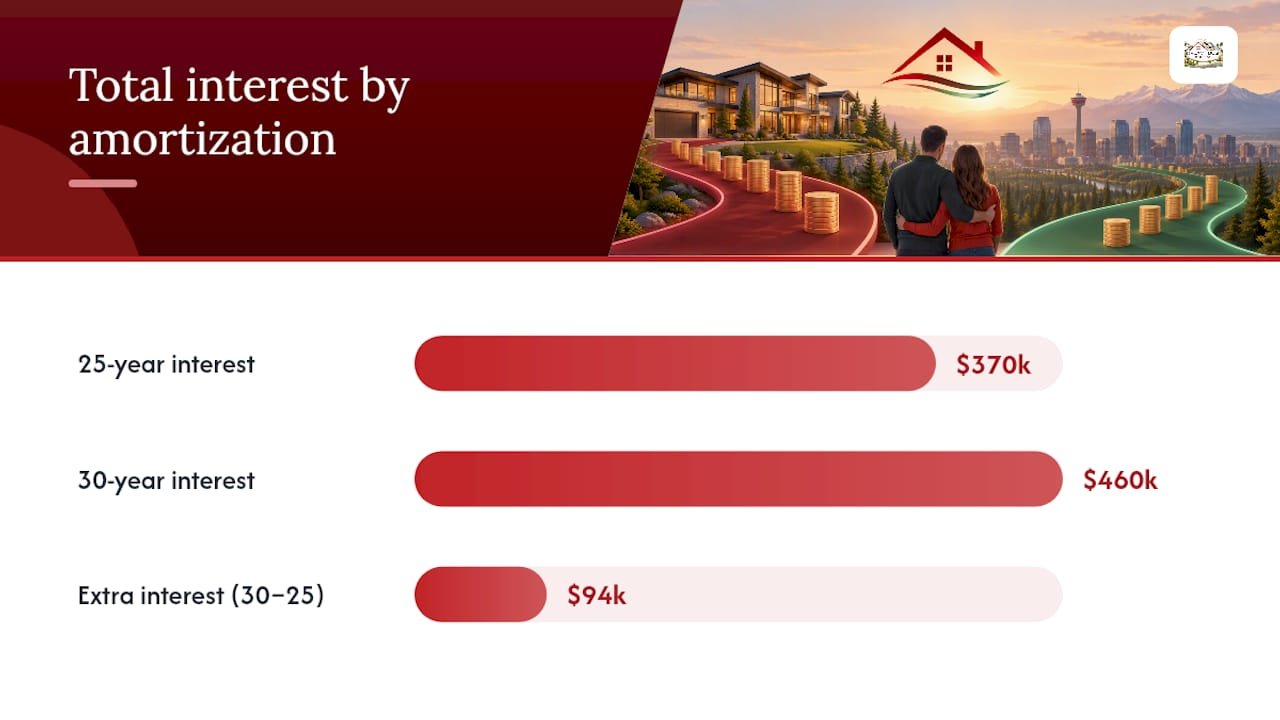
- Extending amortization from 25 to 30 years can save monthly payments but increases total interest paid by nearly $94,000 on a $500,000 mortgage at 5%.
- Eligible first-time buyers and new-build purchases can access 30-year insured mortgages, but with a 20 basis-point premium surcharge on mortgage insurance.
- Choosing a shorter mortgage term, such as one or two years, exposes you to more frequent rate re-evaluations but offers more renewal flexibility.
- Renewal negotiations are critical because lenders often do not compare current market rates, potentially costing homeowners thousands over time.
- Regularly modeling both amortization and term options at each renewal can save Calgary borrowers tens of thousands of dollars in interest.
Table of Contents
- Amortization vs Term: The Core Definitions Every Calgary Buyer Needs
- What Longer Amortization Really Costs You Over Time
- How Your Mortgage Term Shapes Rate Risk and Renewal Options
- Canada’s Amortization Rules: 30-Year Eligibility and the Stress Test
- How to Choose Your Amortization and Term: A Practical Checklist
- A Broker’s View From Calgary on Amortization Planning
- Where Calgary Borrowers Usually Go Wrong
- Get Amortization and Term Advice From a Calgary Mortgage Broker
- Sources
- FAQ
Amortization vs Term: The Core Definitions Every Calgary Buyer Needs
Your amortization period is the total time it takes to pay off your mortgage completely, and in Canada that typically runs 25 years, with 30 years permitted in specific insured cases. Your mortgage term, by contrast, is the length of the current contract you have signed with your lender, usually somewhere between one and five years. Every mortgage has both numbers working at once, and confusing them is the single most common mistake we hear from first-time buyers in Airdrie, Cochrane, and across Calgary.
Here’s how the two typically break down in a standard Canadian mortgage:
- Common term lengths: 1, 2, 3, 4, or 5 years, with the 5-year fixed remaining the most popular choice among Alberta homeowners.
- Standard amortization: 25 years for most buyers.
- Extended amortization: 30 years, available for eligible first-time buyers or newly built homes.
- Lender discretion: if your down payment exceeds 20%, your lender has more flexibility on amortization length since mortgage insurance isn’t required.
The Financial Consumer Agency of Canada treats these as two separate decisions you make with your lender, and each carries its own trade-offs. Your term decision gets revisited every few years. Your amortization decision shapes the entire cost of homeownership.
What Longer Amortization Really Costs You Over Time
Stretching your amortization from 25 to 30 years lowers your monthly payment, but the FCAC’s own examples show that difference gets paid back many times over in extra interest across the life of the loan. This is the trade-off every Calgary buyer needs to see in real numbers before signing anything.
Consider a $500,000 mortgage at a 5% contract rate, comparing two amortization scenarios:
| Scenario | Amortization | Approx. Monthly Payment | Approx. Total Interest Paid |
|---|---|---|---|
| Example Scenario A | 25 years | $2,900 | $370,000 |
| Example Scenario B | 30 years | $2,700 | $460,000 |
Those figures are illustrative estimates based on standard amortization math at a 5% rate, not a quote, and your actual numbers will shift with your real rate and lender. Still, the pattern holds: the 30-year option saves roughly $224 a month but adds close to $94,000 in interest over the full life of the loan. That is the price of flexibility, and it’s a fair trade for some buyers and a costly mistake for others.
Extra or accelerated payments work in the opposite direction. Even modest lump-sum prepayments each year can shave years off your amortization and cut tens of thousands in interest, because every dollar applied to principal early stops accruing interest for the rest of the loan.
For eligible first-time buyers and new-build purchasers, CMHC allows 30-year amortization on insured mortgages, but it comes with a 20 basis-point premium surcharge on your mortgage insurance. On a typical insured mortgage, that surcharge adds a modest amount to your upfront premium, small compared to the payment relief it buys, but it’s a real cost you should factor into your affordability math.
Pro Tip: Run both amortization scenarios through the CMHC mortgage calculator before you commit. Seeing the 25-year and 30-year total interest side by side makes the decision far less abstract.
How Your Mortgage Term Shapes Rate Risk and Renewal Options
Your term length determines how often you face rate risk, and that timing matters more than most buyers realize. A shorter term, say one or two years, exposes you to more frequent renewals and rate uncertainty, but it also gives you more chances to renegotiate if rates drop. A five-year fixed term locks in payment certainty but means you’re committed to that rate regardless of where the market moves in the meantime.
Fixed and variable rates behave differently within a term too. A fixed rate holds steady until renewal, while a variable rate moves with the lender’s prime rate throughout the term, which can change your payment or your amortization pace depending on how your lender structures it. Prepayment penalties also scale with term length. Breaking a five-year fixed mortgage early typically costs more than breaking a one-year term, and portability rules (moving your existing mortgage to a new property) vary by lender and by how much time is left on your term.
Renewal is the moment that matters most, and it’s also the moment too many homeowners let slide by accepting whatever their lender mails them. Before you sign a renewal offer, compare:
- Your remaining balance and current amortization schedule
- The new rate being offered versus current market rates
- Payment frequency options (monthly, biweekly, accelerated biweekly)
- Whether a shorter or longer new term fits your next few years
If you’re planning to sell within a year or two, a shorter term with lower penalty exposure often makes more sense. Investors and self-employed borrowers anticipating income changes should weigh the same question before locking into five years.
Canada’s Amortization Rules: 30-Year Eligibility and the Stress Test
Canada’s mortgage rules set clear limits on amortization length, and understanding them upfront saves you from a disappointing surprise at the lender’s desk. Here’s what governs your options:
- 30-year amortization is permitted for insured mortgages only when you’re an eligible first-time homebuyer or purchasing a newly built home.
- 25 years remains the maximum for most other insured mortgage scenarios.
- The 20 basis-point premium surcharge applies specifically to those 30-year insured mortgages, raising your insurance premium slightly in exchange for the longer payoff window.
- The Minimum Qualifying Rate, or stress test, applies to uninsured mortgages (typically those with 20% or more down). You must qualify at the greater of your contract rate plus 2%, or a regulatory floor, which OSFI currently sets at 5.25%.
That stress test exists to confirm you can still afford your payments if rates climb after you buy, and it directly shapes how much home you qualify for regardless of which amortization or term you eventually choose. For the full eligibility criteria on either rule, the FCAC’s guidance on mortgage terms and amortization and our own breakdown of 30-year amortization eligibility in Alberta both lay out the details in plain language.
How to Choose Your Amortization and Term: A Practical Checklist
Deciding between amortization lengths and term structures comes down to four questions: What can you actually afford monthly? How stable is your income over the next five years? Do you expect to sell, refinance, or renew mid-term? And does a CMHC-insured product with 30-year amortization apply to your purchase?
Once you’ve thought through those, here’s how to move from decision to action:
- Simulate both scenarios. Run your numbers through a mortgage calculator using your real rate, not a rough estimate.
- Get pre-approved. A pre-approval locks in a rate hold and tells you exactly what you qualify for before you shop.
- Ask your broker about restoring amortization at renewal. If you started with 30 years, a broker can help you plan a path back to 25 or fewer once your income or equity improves.
- Compare renewal offers before signing anything. Never assume your current lender’s renewal letter is the best rate available to you.
When you’re speaking with a broker or lender, ask directly: how does this amortization affect my total interest paid? What are my prepayment options without penalty? Does 30-year amortization change my insurance premium here? And what leverage do I have to negotiate at renewal?
Watch for two red flags in particular: a lender who auto-renews you without comparing current market rates, and a variable-rate mortgage with a fixed payment that isn’t covering the interest owed each month, a sign of negative amortization risk that the FCAC expects lenders to monitor and correct.
Pro Tip: If your lender offers an amortization extension as a hardship measure, ask for a written restoration plan showing how you’ll shorten it back down once your situation stabilizes. Extensions should be temporary, not permanent.
A Broker’s View From Calgary on Amortization Planning
A common strategy we use with Calgary clients is treating a longer amortization as a temporary cash-flow tool, not a permanent plan. Get into the home comfortably now, then revisit the schedule at your first renewal once income or equity has grown. A broker can model both paths and shop the market for you at renewal, rather than letting your current lender set the terms unchallenged.
Mortgage brokers work with Calgary, Airdrie, and Cochrane buyers on exactly this kind of amortization planning, alongside first-time buyer support and renewal negotiation. You can also run your own numbers through our mortgage amortization calculator before your first conversation with a lender. This guidance reflects the practical experience of Guriqbal Chahal, MBA, PMP, Broker of Record at DreamHouse Mortgage.
Where Calgary Borrowers Usually Go Wrong
The mistake I see most often isn’t choosing the wrong amortization. It’s not revisiting the choice at all. Buyers lock into a 30-year amortization to make the numbers work at purchase, then never model what shortening it back to 25 would look like once their first raise or renewal comes around. Renewal is a negotiation moment, not a formality, and treating it that way is the single biggest lever homeowners leave on the table.
The corrective action is simple: model your amortization trade-offs with a broker every time your term comes up for renewal, not just at purchase. For readers in Calgary, Airdrie, or Cochrane, that conversation costs you nothing and can reshape years of interest costs.
— Guriqbal Chahal, MBA, PMP
Get Amortization and Term Advice From a Calgary Mortgage Broker
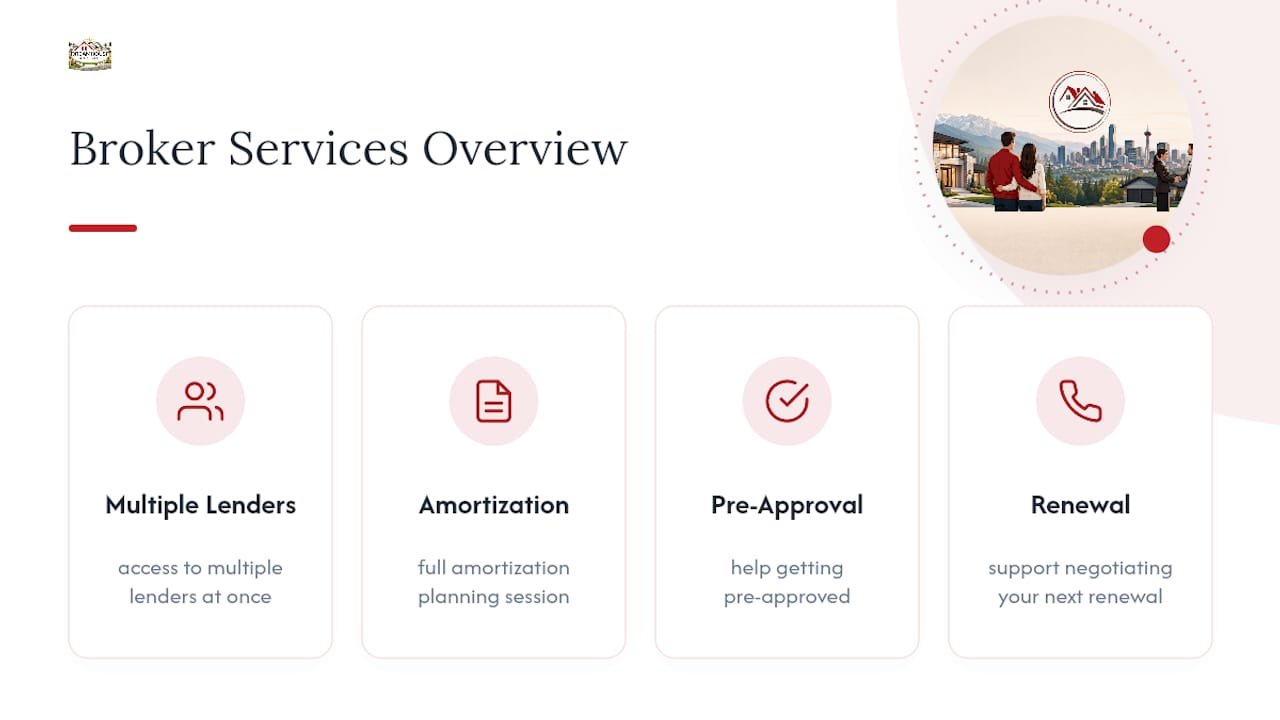
DreamHouse Mortgage gives Calgary-area buyers something a bank branch can’t: access to multiple lenders at once, so your amortization and term decisions get built around your actual numbers instead of one institution’s product lineup.

Whether you need first-time buyer mortgage guidance, help getting pre-approved, a full amortization planning session, or support negotiating your next renewal, DreamHouse Mortgage handles the comparison work so you don’t have to shop lender by lender on your own. Before your consultation, bring your latest mortgage statement, recent income documents, and a rough idea of your down payment plan; that’s enough for a broker to start modeling your options on the spot.
Call Guriqbal Chahal, MBA, PMP, Mortgage Broker at DreamHouse Mortgage, at 403-966-6072, or find us on our Google Business Profile to book a consultation. If you’d rather start online, visit DreamHouse Mortgage to explore your amortization and renewal options today.
This article is general information, not a substitute for advice from a qualified financial advisor. Consult a qualified financial professional about your own circumstances before acting on anything here.
Sources
- Mortgage terms and amortization — Financial Consumer Agency of Canada (FCAC)
- CMHC revises homeowner mortgage loan insurance premiums
- Minimum qualifying rate for uninsured mortgages — OSFI
FAQ
What Is the Difference Between Term and Amortization?
Your term is the length of your current mortgage contract, usually one to five years, covering your rate and conditions until renewal. Your amortization is the total time it takes to pay off the entire mortgage, typically 25 years in Canada, sometimes 30 for eligible buyers.
Can You Get 30-Year Amortization in Canada?
Yes, but only for eligible first-time homebuyers or newly built homes on insured mortgages. CMHC applies a 20 basis-point premium surcharge to these 30-year insured mortgages, and most other insured mortgages remain capped at 25 years.
How Can I Pay Off a $500,000 Mortgage Faster?
Making extra lump-sum payments toward principal, increasing your payment frequency to accelerated biweekly, and shortening your amortization at renewal all cut years off a $500,000 mortgage. Our guide on paying down your mortgage faster walks through specific Alberta strategies for doing this without straining your monthly budget.
Is a 25-Year or 30-Year Amortization Better?
A 25-year amortization saves significantly on total interest but comes with a higher monthly payment. A 30-year amortization lowers your monthly cost but adds tens of thousands of dollars in interest over the life of the loan, so the better choice depends on your cash flow needs today versus your tolerance for long-term cost. A mortgage broker can model both scenarios against your actual income and down payment before you decide.